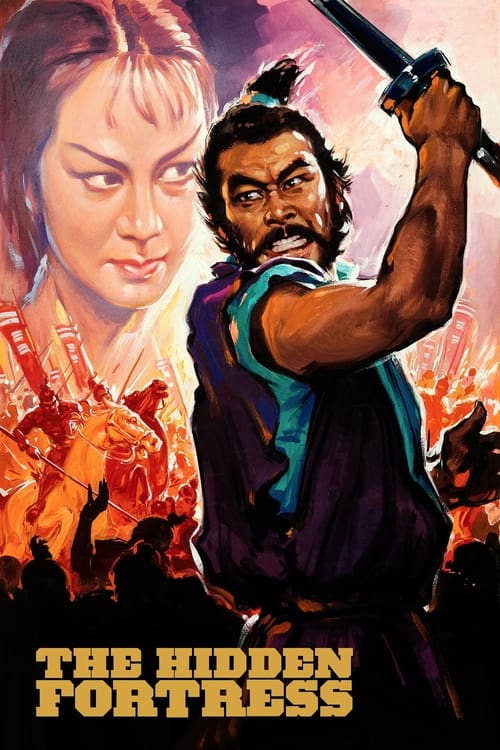
The Hidden Fortress
1958 · Akira Kurosawa
For when you want classic adventure done at the highest level — a crowd-pleaser that works for a first-timer or a family night, no prior samurai-movie experience required. Pure pleasure with impeccable craft.
What it's about
In war-torn feudal Japan, two bickering, greedy peasants fleeing a lost battle stumble into the scheme of a legendary general: smuggling a defeated clan's headstrong princess and her hidden gold across enemy territory. The whole adventure — checkpoints, chases, disguises, a fortress in the mountains — is seen largely from the bottom, through the two schemers who can't stop trying to make off with the treasure.
The experience
Rousing, funny and briskly told, it's an adventure that keeps a grin on your face — swashbuckling one minute, sly comedy the next. Of the director's samurai films, it's the one built purely to entertain, and it does.
Performances
Toshiro Mifune, at the height of his physical charisma, plays the general with effortless command — glaring, galloping, and dominating every frame — while the two peasant players make cowardice and greed genuinely hilarious.
The craft
Akira Kurosawa's first film in widescreen, and he uses the full frame gloriously: mountain vistas, massed crowds, a horseback chase and a spear duel staged with total clarity. The crisp black-and-white compositions make it one of the great big-screen adventures of the 1950s.
Why it matters
George Lucas has openly cited it as a template for Star Wars — from its bickering lowly duo to its princess-and-general rescue — making it one of the most quietly influential adventure films ever made.
Snapshot
A feudal adventure filmed in crisp TohoScope widescreen, The Hidden Fortress follows two quarrelsome, cowardly peasants — Tahei and Matashichi — who stumble into a clandestine military mission: escorting the last survivor of a defeated clan, Princess Yuki-hime, and her gold reserves through enemy-controlled territory to safety. The mission is orchestrated by the steely General Rokurota Makabe, played by Toshiro Mifune at the height of his physical authority. Often described as Kurosawa's most overtly entertaining film, The Hidden Fortress is at once a genre exercise — jidaigeki as picaresque road movie — and a structurally sophisticated piece of filmmaking that turns the camera's gaze upward from the bottom of the social hierarchy. It is the film George Lucas has most openly cited as a template for Star Wars (1977), a fact that has retroactively inflected how Western audiences read it, sometimes at the expense of appreciating it on its own terms.
Industry & production
The Hidden Fortress was produced by Toho Co., Ltd., the studio with which Kurosawa maintained his most productive relationship throughout the 1950s. By 1958, Kurosawa was Toho's prestige director, having delivered the international successes of Rashomon (1950), Ikiru (1952), and Seven Samurai (1954), each of which had expanded the foreign-market appetite for Japanese cinema. Toho accordingly sanctioned a large-scale production, supporting extensive location shooting across mountainous terrain and a substantial cast of extras for battle and crowd sequences.
The film was written by Kurosawa's most trusted scriptwriting team — Shinobu Hashimoto, Hideo Oguni, and Ryuzo Kikushima, working alongside Kurosawa himself — the same four-person unit responsible for Seven Samurai and Throne of Blood (1957). The collaborative script process was characteristically rigorous: the writers worked in close proximity, often in seclusion, arguing over narrative logic before a single scene was shot. This method is well-documented in Kurosawa's memoir Something Like an Autobiography (1982) and in Hashimoto's own retrospective accounts.
The production occupied Kurosawa for much of 1957–58 and marked a deliberate pivot toward more popular, crowd-pleasing material after the bleak theatrical adaptation The Lower Depths (1957). Toho's commercial priorities and Kurosawa's own appetite for formal experiment converged productively: the studio wanted a hit; Kurosawa wanted to master the new widescreen technology it had just adopted.
Technology
The Hidden Fortress was Kurosawa's first film in TohoScope, Toho's proprietary anamorphic widescreen process delivering a 2.35:1 aspect ratio comparable to CinemaScope. This represented a genuine technological and aesthetic threshold for the director. He had resisted widescreen in earlier years, reportedly concerned that the elongated horizontal frame would undermine the compositional precision he had developed for the Academy ratio. The Hidden Fortress was in large part an extended test of whether he could master — or subvert — the format's demands.
The widescreen negative was shot on 35mm Eastmancolor stock using TohoScope lenses, with prints initially released in black-and-white for standard venues and available in color for premium engagements — though it is the monochrome version that most audiences know and that was submitted for international distribution. The use of multiple cameras for large action sequences, a technique Kurosawa had pioneered on Seven Samurai, was again deployed here, allowing the director to capture simultaneous angles on cavalry charges and crowd movement without interrupting performance or blocking continuity.
Technique
Cinematography
The principal camera work was handled by Kazuo Yamazaki, and the TohoScope frame becomes almost a character in itself. Kurosawa approached the wide horizontal canvas with a landscape painter's instinct, organizing compositions around diagonal movement and strong horizontal strata: foreground peasants against mid-ground troops against distant mountain ridgelines. The frame is rarely filled symmetrically; Kurosawa and Yamazaki habitually push figures to the periphery, leaving negative space that creates unease or visual irony — the gold-laden peasants dwarfed by the mountain they are climbing, the princess rendered small and anonymous in disguise.
Kurosawa's signature use of telephoto compression is fully present. Long lenses flatten depth and produce the layered, bas-relief quality that would later become instantly recognizable in his work: crowds advancing as a dense, undifferentiated mass; the General moving against a background that seems to press forward onto him. The fire festival sequence — a riot of torchlight, drums, and frenzied dancing — is shot with a kinetic restlessness that contrasts sharply with the stillness Kurosawa elsewhere imposes, underscoring the ceremonial release of social control.
Editing
Kurosawa edited the film himself, as was his practice throughout this period. His editing grammar here is built around rhythmic contrast: long, slow establishing shots of terrain are punctuated by rapid cutting during combat or chase. The opening sequence — cross-cutting between the two peasants arguing separately, then together, establishing their relationship through fragmented action before we even understand the narrative context — demonstrates his willingness to withhold orienting information in favor of character texture. The film's pacing is deliberately uneven by conventional Hollywood standards, allowing comedy to breathe and landscapes to register as genuinely traversable distances.
Mise-en-scène / staging
Kurosawa's staging throughout exploits the TohoScope frame for ensemble dynamics. Scenes frequently arrange four or five characters in the wide shot simultaneously, with eyeline vectors and body language doing the work that dialogue would handle in a narrower frame. The peasants are almost always positioned low in the frame, crouching or stumbling; Mifune's General is upright, centered, his physical authority conveyed through placement before a word is spoken. Princess Yuki-hime's disguise — she poses as a mute peasant girl — is staged with careful attention to the moments when her bearing involuntarily betrays her aristocratic reflex, an upright spine, a command in the eyes that her silence cannot suppress.
The fortress of the title functions primarily as an abstract idea and goal rather than a detailed architectural space. Kurosawa's interest is in the journey and its terrain, not the destination. Rocks, rivers, mountain passes, enemy checkpoints, and an open road become the mise-en-scène's dominant elements.
Sound
Masaru Sato composed the score, as he did for several Kurosawa films of this period. The music oscillates between martial vigor and comic deflation, matching the film's tonal ambivalence — genuinely exciting chase sequences are undercut, then reinforced, by shifts in orchestration that signal whether Kurosawa wants laughter or adrenaline in any given moment. The fire festival scene is anchored by percussive, almost hypnotic musical figures that feel distinct from the Western-inflected scoring elsewhere in the film. Ambient sound — wind, hoofbeats, crowd noise — is used with the selective emphasis characteristic of Kurosawa's approach: silence is deployed as punctuation, not dead air.
Performance
Toshiro Mifune brings a controlled, authoritative physical presence to General Makabe that differs markedly from his more explosive performances in Seven Samurai or Yojimbo (1961). Makabe is a man of compressed violence and dry wit; Mifune communicates competence and moral seriousness without theatrical excess. His scenes opposite Susumu Fujita as the rival general Tadokoro have a subdued, almost elegiac quality — two professionals who respect each other across a war neither wholly chose.
Misa Uehara's Princess Yuki-hime is one of the more interesting female performances in Kurosawa's filmography: haughty, willful, occasionally petty, and gradually humanized. The scene in which she intervenes to purchase a slave girl out of bondage — at genuine cost and risk to the mission — marks the pivot in her characterization from obligation to agency. Uehara was a relative newcomer, and the performance is occasionally uneven, but her work in the film's best scenes is convincing.
Minoru Chiaki (Tahei) and Kamatari Fujiwara (Matashichi) carry the film's comic register with practiced precision. Both were veteran Toho ensemble players, and their squabbling chemistry — petty, cowardly, endearingly incompetent — is the emotional engine that stops the adventure from becoming merely stately. Their characters are the structural POV vehicle: we understand the world of the film at their level of ignorance, learning as they learn.
Narrative & dramatic mode
The narrative architecture is deliberately inverted. By anchoring the story to the two most marginal observers — peasants who are, frankly, bad people: venal, cowardly, and self-serving — Kurosawa both democratizes the epic and complicates its heroic conventions. The nobility of the mission (saving a princess, preserving a clan's lineage and treasury) is refracted through the lens of men who primarily want the gold. This produces tonal irony throughout: the viewer can sense the gravity of the historical stakes while simultaneously watching characters who experience those stakes only as personal inconvenience or opportunity.
The road-movie structure — a journey through hostile territory toward a destination — keeps the narrative engine running through episodic encounters: checkpoints, betrayal, capture, escape, ceremony. The episodic form allows Kurosawa to modulate tone radically between sequences without loss of momentum. The film is simultaneously a thriller, a comedy, and an occasional meditation on loyalty and class, and the genre machinery is fluid enough to accommodate all three modes.
Genre & cycle
The Hidden Fortress sits squarely in the jidaigeki tradition — the Japanese period drama set in the pre-Meiji era, with particular roots in the Sengoku (warring states) period. Within jidaigeki, it operates closer to the chanbara (sword-fight drama) subgenre than to the austere, Buddhist-tinged period films of directors like Kenji Mizoguchi. It also draws extensively on the Western's structural vocabulary — the frontier journey, the outnumbered protector, the dangerous crossing — which Kurosawa had absorbed deeply through his well-documented admiration for John Ford.
The film participates in a cycle of large-scale Toho adventure productions that flourished in the mid-to-late 1950s, as the studio sought to compete both domestically and internationally with Hollywood spectacle pictures. Within Kurosawa's own filmography, it forms something of a trilogy with Yojimbo (1961) and Sanjuro (1962) — lighter, more genre-savvy works that frame the samurai tradition with ironic distance.
Authorship & method
Kurosawa's authorial presence is visible in every compositional and structural choice. His method was intensely collaborative but hierarchically organized: the script team debated and revised at the writing stage; on set, Kurosawa's authority was absolute. He was known to rehearse extensively and to insist on retakes until he achieved a specific physical quality of performance, not merely correct line delivery.
The collaboration with Masaru Sato produced some of the most propulsive scoring in Kurosawa's filmography. Sato, younger and more jazz-influenced than the composer Fumio Hayasaka (who had died in 1955 and whose work on Seven Samurai and Ikiru had been foundational), brought a different rhythmic sensibility to the material — more overtly kinetic, occasionally brash.
Kurosawa's role as his own editor — a rarity among directors of equivalent stature in any national cinema — means that rhythm in the finished film is not a post-production decision but a fully integrated authorial one. The editing and the shooting were conceived together; the coverage was designed to be cut as it was shot.
Movement / national cinema
The Hidden Fortress occupies a complex position in the postwar Japanese cinema. Toho's output in the 1950s represented the commercial mainstream of Japanese film — genre entertainment in color and widescreen, with stars, spectacle, and narrative clarity — in productive tension with the art-cinema prestige represented by the same studio's support of Kurosawa's more formally ambitious projects. The Hidden Fortress sits at the commercial end of Kurosawa's output, but it does not represent a capitulation to formula: the structural inversions and tonal complexity mark it as distinctively his work.
The film was made at a moment when Japanese cinema was attracting sustained international critical attention in the wake of Rashomon's twin prizes at Venice and the Academy Awards. Toho's international distribution ambitions — and Kurosawa's own desire for a global audience — shaped the film's broadly legible genre framework. The story's feudal setting, however specifically Japanese in its historical reference, was packaged for a spectator who might have no knowledge of the Sengoku period.
Era / period
The late 1950s in Japanese cinema were characterized by extraordinary formal vitality and commercial productivity. Toho, Shochiku, Daiei, and Nikkatsu were all producing ambitious genre pictures alongside art-cinema prestige works; the studio system was healthy in ways that the American studios, disrupted by television and antitrust rulings, no longer were. Kurosawa made The Hidden Fortress in a single concentrated burst of energy between the austere Throne of Blood (1957) and the equally austere The Bad Sleep Well (1960), which suggests that the film served him as a deliberate tonal holiday — a chance to work at pace, with pleasure, within genre conventions he had thoroughly internalized.
Themes
Class and social legibility is the film's governing preoccupation. The narrative depends entirely on the invisibility of the nobly born as commoners — Princess Yuki-hime's disguise only works because the social hierarchy makes actual peasants beneath systematic attention. The peasants, by contrast, are visible everywhere and trusted nowhere; their marginality is both their danger and their cover. The film treats this with comedy but does not sanitize it: the class system is brutal, and the film knows it.
Loyalty across status lines is embodied in Makabe's relationship to the princess. His devotion is absolute and professionally disinterested — there is no romantic subplot — and the film frames this as a genuine ethical achievement in a world organized by clan interest and personal survival. The contrast with the peasants, who are loyal only to the gold, gives the film its moral texture without preachiness.
Female agency and constraint runs under the surface. Yuki-hime is, on the surface, a figure to be transported and protected. But Kurosawa systematically gives her moments of unilateral decision — purchasing the slave girl, choosing the route, overriding Makabe's tactical judgment — that resist the passivity her structural role implies. That she must enact this agency while disguised as a mute is a pointed irony the film does not fully unpack but clearly intends.
Greed as comedy and driver uses avarice as the engine of the plot. The peasants follow the gold; the gold needs moving; therefore the plot moves. This is a classical picaresque structure that Kurosawa deploys with full awareness of its generic ancestry.
Reception, canon & influence
Critical reception at the time of release was warm but not reverential. Japanese critics recognized the film as a calculated entertainment rather than a Kurosawa statement piece, and international reviews — facilitated by Toho's export operation — tended to frame it against the grander ambitions of Seven Samurai. The film won the Silver Bear for Best Direction at the 9th Berlin International Film Festival (1959), giving it significant institutional validation in Europe. Western retrospective critics have generally been generous, particularly in the years following Star Wars, when the film's structural logic became newly legible to audiences who had absorbed its descendant first.
Influences on the film are eclectic and well-attested. Kurosawa's admiration for John Ford — particularly the cavalry Westerns and the road journey structure of films like The Searchers (1956) — is visible in the epic spatial scale and the morally ambiguous rescue narrative. The picaresque tradition in Japanese popular literature (and its theatrical counterpart in kabuki and rakugo) provides the comic template for the two peasants. The Sengoku period setting draws on a well-established jidaigeki iconography, and Kurosawa's own earlier work — particularly the ensemble management and terrain-as-character approach of Seven Samurai — is clearly the film's most immediate precursor.
Legacy and forward influence centers overwhelmingly on Star Wars (1977), which George Lucas has acknowledged in interviews and public statements with unusual directness for a Hollywood filmmaker. The structural parallel is precise: Lucas took the device of the story told from the perspective of the lowest participants (the peasants → the droids C-3PO and R2-D2), the princess being smuggled through enemy lines, the hidden base, and the masked authority of the enemy, transposing the feudal Japan setting into a science-fiction galaxy. This influence is so thoroughly documented in film scholarship and in Lucas's own words that it requires no inflation; it is among the most clearly attested director-to-director debts in the history of popular cinema.
Beyond Star Wars, The Hidden Fortress contributed to Western understanding of the range within Kurosawa's filmography — demonstrating that the director who had made Rashomon and Ikiru was equally capable of sustained genre pleasure. The film's deployment of widescreen landscape as moral and psychological space anticipates the visual grammar Kurosawa would refine in Ran (1985) decades later. Its structural device of routing high-stakes narrative through low-status observers has had a diffuse but real influence on how filmmakers think about point-of-view in epic genre cinema, though tracing these threads beyond the Star Wars connection requires caution against over-attribution.
A Deleuzian reading
Two filthy men stagger up a mountain, bickering, and the mountain does not care about either of them.
The full Deleuzian reading of The Hidden Fortress →
Reception
A huge commercial hit in Japan on release — Kurosawa's biggest box-office success to that point — it later got filed as 'minor Kurosawa' next to Seven Samurai and Rashomon, before being reclaimed as one of cinema's great pure adventure entertainments.
How The Hidden Fortress was received, from release to now →
Influences: the films it descends from and the films it influenced
- The Men Who Tread on the Tiger's Tail (1945) — The porter Kikutachi—a cowardly, vulgar low-status figure inserted into a high-stakes samurai disguise-and-escape mission—is the direct structural prototype for Tahei and Matashichi, establishing Kurosawa's technique of grounding feudal action through a comic pov character who lacks the dignity to understand what he is witnessing.
- Seven Samurai (1954) — Kurosawa first systematized the use of multiple simultaneously-running cameras to capture cavalry and crowd movement without interrupting blocking continuity; Hidden Fortress directly extended this multi-camera action grammar, the same four-person script collective, and Mifune's compressed physical authority as a commanding figure amid chaotic ensemble action.
- Stagecoach (1939) — Ford's picaresque structure—a socially stratified group traversing hostile open terrain in a single sustained journey, with landscape framing encoding class position—provided the narrative architecture Kurosawa adapted, including the convention of organizing characters horizontally against vast exterior space to signal vulnerability and distance.
- The Searchers (1956) — Ford's VistaVision compositions habitually isolate a dominant figure in mid-frame surrounded by open negative space against a wide horizon; Kurosawa studied this widescreen negative-space grammar and transposed it to the TohoScope mountain sequences of Hidden Fortress the following year, using emptiness to dwarf and define characters rather than fill the frame.
- It Happened One Night (1934) — Capra's structural conceit—a high-status woman traveling incognito through hostile territory accompanied by socially inferior companions, with comedy generated by class-role inversion—is the Hollywood template for the Princess-disguised-as-commoner dynamic; the tension between Yuki-hime's concealed authority and her enforced submission to peasant conditions directly echoes Capra's gender-and-class engine.
- Yojimbo (1961) — Kurosawa's immediate TohoScope follow-up refines the same widescreen ensemble blocking vocabulary—multiple figures distributed across the 2.35:1 frame with body language and eyeline vectors encoding power differentials—while Mifune's compressed authority becomes even more physically economical, reducing the Makabe template to pure stillness and explosive micro-gesture.
- Sanjuro (1962) — The superior military strategist navigating bumbling low-status allies extends Hidden Fortress's Makabe-and-peasants dynamic into an explicitly comedic register; Kurosawa deploys the same TohoScope telephoto compression for action sequences and the same rhythmic-contrast editing—long passages of comic inaction erupting into sudden, devastating violence.
- Once Upon a Time in the West (1968) — Leone pushes Kurosawa's long-lens bas-relief technique to abstraction: extreme telephoto compression stacks figures into a nearly flat plane against a distant background, flattening space into graphic strata; simultaneously, Leone's systematic use of prolonged silence punctuated by sudden sonic event directly extends Hidden Fortress's silence-as-punctuation grammar into operatic Western form.
- Star Wars (1977) — Lucas transplants the film's structural armature intact: two bickering low-status companions (R2-D2 and C-3PO derived directly from Tahei and Matashichi) provide the point-of-view through which a princess-in-disguise escaping enemy occupation with a military escort is dramatized, including the plans-as-MacGuffin, the fire-ceremony sequence, and the vertical hierarchy between peasant, general, and royalty recast as droid, soldier, and princess.
- Kagemusha (1980) — Kurosawa scales the vertical hierarchy framing and telephoto army compositions of Hidden Fortress to full epic dimensions; scenes of the double observed from distance against ranked cavalry directly develop the negative-space-and-scale visual logic established in the mountain sequences, while the comic-pov structure reappears inverted—the low-status impersonator now occupying the high-status frame position.
- Ran (1985) — The multi-camera battle sequences—simultaneously-running cameras capturing cavalry and infantry from multiple angles through telephoto lenses—represent the fullest development of the technique Hidden Fortress pioneered, while the negative-space compositions of solitary figures surrounded by burned landscape extend the widescreen grammar established in the mountain approach sequences to their most austere and geometrically precise extreme.
- Willow (1988) — Produced by George Lucas and explicitly built on his Hidden Fortress-derived template: two low-status comic companions (Willow and Meegosh) escort a magically significant infant through enemy-controlled territory, with the picaresque episodic road structure, disguise-and-escape scenarios, and comic-duo point-of-view mechanism all lifted from the lineage Lucas had already encoded in Star Wars.
- 13 Assassins (2010) — Miike's jidaigeki revival deploys multi-camera filming of the sustained village battle—simultaneous angles on melee and crowd movement without cutting away from blocking continuity—and telephoto compression of armed groups advancing through confined space in direct homage to Kurosawa's multi-camera action grammar, while the widescreen ensemble staging in planning sequences descends from Hidden Fortress's approach to distributing a large cast across the 2.35:1 frame.
- The Empire Strikes Back (1980) — Kurosawa's three-strand intercutting between a princess's covert escape and a parallel peasant subplot provided Lucas with the multi-protagonist narrative structure that Empire deploys across three simultaneously advancing storylines — Luke on Dagobah, Han and Leia through space, Lando at Cloud City — each advancing independently toward a single convergence.
- Return of the Jedi (1983) — Lucas lifts the bickering-low-characters POV and the hard horizontal wipe transitions, both reprised in Jedi's scene-to-scene cutting and its peasant-Ewok ground war told from below.
- Star Wars: The Force Awakens (2015) — The low-status-companion POV (peasants/droids) and graphic screen-wipe transitions Lucas borrowed are re-inherited by Abrams at second hand, structuring exposition through BB-8 and the wipe cuts.
- Star Wars: Episode III - Revenge of the Sith (2005) — Lucas lifts Kurosawa's graphic screen-wipes and axial, low-angle 'peasant's-eye' staging of grand events, the transition grammar that structures the prequel's scene changes and battlefield geometry.
- Harakiri (1962) — Kobayashi's Grandscope jidaigeki independently develops vertical hierarchy framing—the clan's rigid feudal power structure rendered geometrically through figure placement across the wide frame, with supplicants and authority figures assigned positions that make hierarchy legible without dialogue—arriving at formal solutions parallel to Kurosawa's without direct derivation.
- The Good, the Bad and the Ugly (1966) — Leone's picaresque trio traversing a war-torn landscape transposes Hidden Fortress's three-protagonist road structure and uneasy alliance into the Western; his rhythmic contrast editing—extreme stillness before explosive violence, with Morricone's silence-and-sound dynamic mirroring Kurosawa's silence-as-punctuation—constitutes an Italian translation of the same editing grammar.
- Star Wars: The Last Jedi (2017) — Source of the jidaigeki lowly-bystander POV and the flat, frieze-like theatrical staging of figures against landscape that Johnson revives in the Canto Bight and throne-room blocking.
Similar films
- Seven Samurai (1954) — influence & lineage
- Kagemusha (1980) — influence & lineage
- Yojimbo (1961) — influence & lineage
- Ran (1985) — influence & lineage
- Star Wars (1977) — influence & lineage
- Sanjuro (1962) — influence & lineage
- Throne of Blood (1957) — shared sensibility
- Rashomon (1950) — shared sensibility
All the films related to The Hidden Fortress →