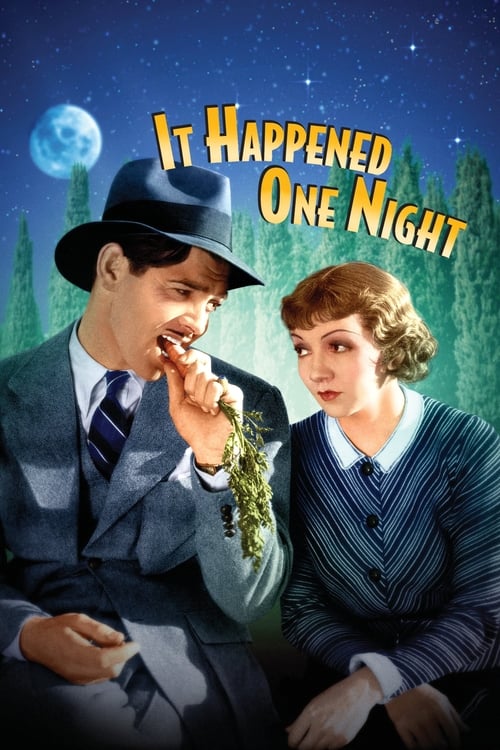
It Happened One Night
1934 · Frank Capra
For a cozy night in when you want to fall in love — or when you need proof that they really did make them like this. Pure comfort viewing, and a perfect first classic for someone who thinks old movies are stuffy.
What it's about
A spoiled heiress jumps ship — literally — to escape her father and reach the husband he disapproves of, and ends up on a night bus to New York with no money and no street smarts. The reporter who recognizes her offers a deal: he'll help her get there in exchange for the exclusive story. Then the bus leaves without them, and the two are stuck hitchhiking, bickering, and sharing motor-court rooms across Depression-era America.
The experience
Fast, flirty, and effortlessly funny — the pleasure is watching two people who can't stand each other trade insults until the insults start sounding like something else. Nearly a century on, the banter still crackles.
Performances
Clark Gable and Claudette Colbert are one of the great screen pairings — his cocky charm keeps meeting her imperious wit and losing. Both won Oscars for it, and you can see why in every scene they share.
The craft
Frank Capra shoots the road — buses, motels, hitchhiking on the highway shoulder — with an easy naturalism that grounds the fizz, and the script builds two of the most famous comic set pieces in Hollywood history around a blanket and a raised skirt hem. The rhythm of the dialogue became the template everyone copied.
Why it matters
It swept all five major Academy Awards — the first film ever to do so — and effectively invented the screwball comedy, setting the pattern for decades of romantic comedies about mismatched couples on the road.
Snapshot
It Happened One Night is the film that, more than any other single title, codified the American romantic comedy and lit the fuse on the screwball cycle that would dominate Hollywood for the rest of the 1930s. A modestly budgeted release from Columbia — then a scrappy operation on Hollywood's "Poverty Row" under Harry Cohn — it paired a runaway heiress (Claudette Colbert) fleeing a society marriage with a recently fired newspaperman (Clark Gable) who smells a scoop, and sent them down the highways and bus depots of a Depression-era America improvised out of necessity and observation. The picture became a slow-building sleeper sensation and then a phenomenon: at the 7th Academy Awards it swept all five of the major categories — Picture, Director, Actor, Actress, and Adaptation — the first film ever to do so, a feat matched only twice since (One Flew Over the Cuckoo's Nest, The Silence of the Lambs). Its blend of class friction, erotic sparring conducted under the cover of banter, and a populist faith in the decency of ordinary travelers became the template that Capra, screenwriter Robert Riskin, and a generation of imitators would work for years. What looks effortless on screen — two stars, a blanket, a bus — is in fact a near-perfect calibration of star chemistry, economical staging, and tonal control.
Industry & production
The film's production history is one of Hollywood's favorite underdog stories, and most of its broad strokes are well documented. Columbia in 1933–34 was a second-tier studio without a stable of major stars, and the project came together through a series of reluctances. Robert Riskin adapted Samuel Hopkins Adams's magazine story "Night Bus," published in Cosmopolitan — a "bus picture" being, at the time, considered commercially toxic after a run of failures in the cycle. Casting was famously difficult: a number of actresses passed before Claudette Colbert agreed, and the durable account holds that she accepted only on the condition of a substantially increased salary and a short shooting schedule, remaining skeptical of the material throughout. Clark Gable came to Columbia on loan from MGM; the long-repeated version of events frames the loan-out as a kind of disciplinary exile for a contract player, though film historians have cautioned that this "punishment" narrative is at least partly studio-era myth-making and should be treated as received tradition rather than established fact.
What is not in dispute is the outcome. The picture opened in February 1934 to respectable but unspectacular business and built into a major hit through word of mouth, demonstrating the long-tail power of audience enthusiasm in the pre-television era. Its Oscar sweep the following year transformed both Columbia's prestige and the careers of everyone involved, and it remains the foundational success on which Capra's subsequent run of socially minded comedies at the studio was built.
Technology
Technologically the film is a product of mature early-sound practice rather than innovation. By 1934 the disruptions of the transition to sound had largely been absorbed: cameras were blimped and mobile again, microphone placement had grown more flexible, and panchromatic film stock under incandescent lighting gave cinematographers a soft, gradated monochrome palette. The film uses these tools unobtrusively. Its "technology," in a sense, is logistical: the bus, the auto camp, the open road, and the night exterior are the apparatus of the story. Process and rear-projection work of the period allowed dialogue scenes nominally set in moving vehicles to be staged under controlled studio conditions, and the film's blend of studio interiors with location-flavored exteriors is characteristic of the resourceful, budget-conscious filmmaking Columbia practiced.
Technique
Cinematography
Joseph Walker, Capra's longtime director of photography, shot the film, and his work here is a model of self-effacing classical technique. Walker favored a soft, luminous treatment of his stars — Colbert in particular is lit with a glamour that never tips into artifice — while keeping the overall look grounded and naturalistic, suited to bus stations, rain-soaked roadsides, and a curtained-off room in an auto camp. The camera serves the performers: compositions are built around the two leads and the shifting distance between them, and the lighting does dramatic work, using the literal and figurative dark of night-bus travel and shared rooms to charge the space between the characters. Walker's restraint is the point; the cinematography earns its effects by refusing to announce them.
Editing
Gene Havlick's cutting exemplifies the "invisible" continuity style at its most assured. The film's comedy depends on timing, and the editing lets gags and exchanges breathe to their natural rhythm rather than chopping them for emphasis. The celebrated set pieces — the hitchhiking contest, the auto-camp negotiations — are constructed so that the audience reads the geography and the escalating stakes clearly, with cutting motivated by reaction and by the give-and-take of dialogue. The episodic, journey-structured narrative is held together by a confident sense of pace that never lets the road-movie format feel slack.
Mise-en-scène / staging
Staging is where the film's artistry is most legible. The single most famous device is the "Walls of Jericho" — a blanket strung on a clothesline between the two beds in the shared auto-camp room. It is a brilliant piece of dramaturgy: a physical object that materializes the sexual tension, the class barrier, and the proprieties of the not-yet-couple all at once, and whose eventual fall becomes the film's emotional and erotic punctuation. The hitchhiking sequence, in which Colbert stops a car by raising her skirt after Gable's confident thumb-technique lecture has failed, stages a battle of the sexes in pure visual terms. Throughout, Capra and Riskin use the cramped, public, in-transit spaces of Depression travel — buses, depots, motor courts — to keep the antagonists forced into intimacy, turning logistical confinement into romantic mechanism.
Sound
The sound design is functional and dialogue-forward, as the screwball form requires: the words are the action, and the recording prioritizes the clarity and overlap of verbal sparring. The film's best-remembered musical moment is diegetic — the bus passengers' communal singalong to "The Man on the Flying Trapeze," a sequence that both characterizes the democratic camaraderie of the road and gives the picture one of its warmest set pieces. Louis Silvers served as musical director; the score is used sparingly, in keeping with early-1930s practice that had not yet embraced wall-to-wall orchestral underscoring.
Performance
The film lives or dies on its two leads, and both deliver career-defining work. Gable shed the heavy-romantic register MGM had been cultivating and discovered a relaxed, wisecracking, faintly self-mocking masculinity — the reporter as charming rogue — that would reshape his persona. Colbert matches him with sharp intelligence and a willingness to play imperious, petulant, and finally vulnerable in quick succession, refusing to let the heiress become merely a foil. The chemistry is built on antagonism: their best scenes are arguments, and the performances make the audience feel the attraction precisely through the friction. Walter Connolly as Colbert's exasperated father and Roscoe Karns as the blowhard fellow passenger anchor a sturdy supporting ensemble.
Narrative & dramatic mode
Structurally the film is a road movie and a journey narrative: a linear, episodic progress from Florida toward New York, with each leg — bus, hitchhiking, auto camp — functioning as a self-contained comic and romantic unit while advancing the central courtship. The dramatic mode is romantic comedy built on the venerable engine of two mismatched antagonists thrown together, sparring their way from contempt to love, with a third-act complication of misunderstanding before the reconciliation. Riskin's screenplay is a marvel of economy and motivation: the reporter's professional ambition and the heiress's flight from a loveless society marriage give the romance both an obstacle and a stake, and the running gag of the "Walls of Jericho" provides a structural through-line that pays off in the final image. The mode is comic but never purely farcical; Capra grounds the laughter in plausible human behavior and genuine emotional risk.
Genre & cycle
It Happened One Night is conventionally regarded as the wellspring of the screwball comedy — the cycle of fast, verbally combative, class-crossing romantic comedies that flourished from the mid-1930s into the early 1940s. While elements of the form predate it, the film crystallized the essential ingredients: the battle of the sexes conducted as banter, the collision of social classes, the heiress and the working man, and a tone that married sophistication with slapstick. It also sits at a precise historical hinge. Released in February 1934, it preceded the strict enforcement of the Production Code that began that July; its frankness about sex — the shared room, the undressing, the charged proximity — belongs to the freer pre-enforcement moment, even as its ultimate chastity (the blanket stays up until marriage legitimizes its fall) points toward the displacement strategies that screwball would use to smuggle sexuality past the censors for the rest of the decade.
Authorship & method
The film is the signal early product of the Capra–Riskin partnership, one of the most fruitful director-writer collaborations of the studio era. Capra's method prized warmth, pace, and a populist faith in ordinary Americans — the bus passengers, the auto-camp proprietors, the common folk of the road are treated with affection rather than condescension — and his direction of actors coaxed the loose, lived-in playing that makes the romance credible. Riskin supplied the structural rigor and the crackling, idiomatic dialogue; the recurring critical view that Riskin's writing supplied the backbone and social intelligence to Capra's sentiment is well established, even if the exact division of creative labor is impossible to adjudicate from the outside. Joseph Walker (cinematography) and Gene Havlick (editing) were core members of Capra's Columbia unit, and the consistency of their work across his films is part of what gives the director's output its coherent house style. Louis Silvers handled the music. The "Capra touch" that emerges here — sentiment disciplined by speed and skepticism — would define his major work to follow.
Movement / national cinema
The film is a quintessential product of classical Hollywood and of the American studio system, with no direct affiliation to a formal avant-garde or national-cinema movement. Its significance is internal to American cinema: it helped define a homegrown comic idiom — the screwball romance — that is distinctly of the United States in its democratic ethos, its regional texture, and its fantasy of class reconciliation. If it belongs to any "movement," it is the broad current of 1930s Hollywood populism that Capra came to personify, an essentially American mythology of the decent common citizen.
Era / period
It Happened One Night is inseparable from its Depression context. Made in the trough of the 1930s, it speaks directly to an audience for whom economic hardship and downward mobility were daily realities, and it offers a reassuring fantasy in response: the spoiled heiress is humanized by exposure to the hardships and pleasures of ordinary travel, the rich are gently satirized, and dignity is located among the bus-riding multitude. The film's faith that the classes can meet and merge on the open road is a Depression-era wish as much as a romantic convention. Industrially, the period placement is equally crucial — on the cusp of Production Code enforcement, at the moment when a minor studio could still vault to the top of the industry on the strength of a single sleeper hit.
Themes
The film's central theme is the romantic reconciliation of class difference: a marriage of the moneyed and the working worlds, brokered by the leveling experience of shared hardship and shared laughter. Closely bound to this is the battle of the sexes — pride, autonomy, and desire negotiated through verbal combat, with the "Walls of Jericho" standing as the literalized boundary between independence and union. Running beneath both is Capra's populism: a celebration of ordinary Americans and a mild skepticism toward inherited wealth and its hollow ceremonies (embodied in the absurd society wedding Colbert flees and ultimately abandons). The film also dramatizes self-reinvention — the heiress learning to dunk a donut and ride a bus, the cynical reporter rediscovering his capacity for sincerity — as a path to authentic selfhood.
Reception, canon & influence
Critically and commercially the film's triumph was decisive, sealed by its historic Academy Awards sweep, and its standing in the canon has never seriously wavered; it is routinely ranked among the foundational American comedies and was among the early inductees recognized for preservation as a culturally significant work. Looking backward, the film draws on a deep well of comic and theatrical tradition — the antagonists-to-lovers structure of stage romance, the picaresque journey narrative, and the topical "bus picture" trend it inherited from Adams's magazine fiction — and on the loosening sexual frankness of the pre-Code early thirties.
Looking forward, its influence is enormous and many-channeled. It is the acknowledged progenitor of the screwball cycle that produced My Man Godfrey, The Awful Truth, Bringing Up Baby, and His Girl Friday, and the philosopher-critic Stanley Cavell would later locate it at the head of the "comedy of remarriage" tradition he traced through Hollywood's golden age. It durably shaped the road-movie romance and the broader DNA of the romantic comedy, whose mismatched-couple structure and antagonism-into-love arc remain industry standard nearly a century on. Its individual images entered the wider culture: the hitchhiking-skirt gag and the blanket-divided room are among the most quoted set pieces in American film, and a familiar piece of animation lore holds that Bugs Bunny's nonchalant carrot-chewing was modeled on Gable's manner in the film — a charming attribution that circulates widely but is best treated as popular legend rather than documented fact. The same caution applies to the oft-repeated claim that Gable's bare chest in the undressing scene devastated the American undershirt industry: it is a beloved anecdote whose factual basis is thin and disputed, and it should be cited as myth, not market history. What is certain is the film's structural legacy — it taught Hollywood how to make audiences fall in love by watching two people argue, and the lesson has never been unlearned.
A Deleuzian reading
The blanket goes up first in memory.
The full Deleuzian reading of It Happened One Night →
Reception
Nobody wanted to make it — Gable was loaned to lowly Columbia as a punishment, Colbert called it 'the worst picture in the world' — and then it swept all five major Oscars, the first film ever to do so. Ninety years on it's the acknowledged blueprint for every romantic comedy since.
How It Happened One Night was received, from release to now →
Influences: the films it descends from and the films it influenced
- Trouble in Paradise (1932) — The elliptical 'Lubitsch touch' — desire dramatized through withheld thresholds and offscreen suggestion rather than shown — is the technique the walls-of-Jericho blanket gag runs on.
- Platinum Blonde (1931) — The first full Capra–Riskin pass at the wisecracking-reporter-versus-pampered-heiress class comedy, supplying the idiomatic vernacular dialogue and rich-poor friction reused here.
- Lady for a Day (1933) — Established Capra's affectionate populist handling of common-folk characters (street people, con men) immediately before he turned it on the bus passengers and auto-camp proprietors.
- The Front Page (1931) — Set the template of fast, overlapping, vernacular newspaper-room patter that Riskin sharpened into the film's crackling idiomatic dialogue.
- City Lights (1931) — Model of sentiment disciplined by precise comic timing and tenderness toward the common man — the emotional grammar the 'Capra touch' inherits.
- My Man Godfrey (1936) — Reruns the class-reconciliation arc — heiress humbled, 'forgotten man' elevated — that this film first played as screwball comedy.
- The Awful Truth (1937) — Coaxes romance out of antagonism through loose, improvised, lived-in ensemble playing — the same directorial trust in actors over rigid blocking that Capra used.
- Bringing Up Baby (1938) — Extends the relentless comic pace and the madcap-woman-drags-stiff-man-through-a-chaotic-journey-into-love structure to its frantic extreme.
- His Girl Friday (1940) — Carries the antagonists-to-lovers arc almost entirely on weaponized, overlapping machine-gun idiomatic dialogue — the Riskin lesson pushed to its limit.
- The Lady Eve (1941) — Builds the battle-of-the-sexes on a cross-class con and seduction, deploying dialogue as romantic combat in the mismatched-couple mold.
- Mr. Deeds Goes to Town (1936) — Direct Capra–Riskin continuation pitting a populist common-man hero against moneyed society, paired with a wisecracking journalist love interest.
- Sullivan's Travels (1941) — A populist road picaresque among bus riders, hoboes, and the poor that treats common Americans with affection rather than condescension, as Capra did.
- The Palm Beach Story (1942) — A runaway-spouse road romance whose cross-country rail transit and remarriage resolution extend the road-movie-romance formula.
- The Philadelphia Story (1940) — Keystone of Cavell's comedy-of-remarriage line, resolving reporter-versus-heiress class friction into reconciliation built on argument.
- Roman Holiday (1953) — Transplants the structural template wholesale — a runaway heiress and a working newspaperman falling in love over an unsanctioned road escapade — to Rome.
- The African Queen (1952) — Capra established the bickering-couple conversion narrative: a prim, self-possessed woman and a rough, competent man forced into a shared physical journey, their antagonism converting to love through proximity and mutual testing — the exact generic template Huston transplants to the African river.
- The Hidden Fortress (1958) — Capra's structural conceit—a high-status woman traveling incognito through hostile territory accompanied by socially inferior companions, with comedy generated by class-role inversion—is the Hollywood template for the Princess-disguised-as-commoner dynamic; the tension between Yuki-hime's concealed authority and her enforced submission to peasant conditions directly echoes Capra's gender-and-class engine.
- Twentieth Century (1934) — Same-year battle-of-the-sexes staged in a confined transit setting (a train), driving two combative leads whose antagonism is itself the engine of attraction.
- Raising Arizona (1987) — The runaway-couple-on-the-road armature and the Depression-era populist warmth beneath the comic friction give Arizona its screwball spine of two mismatched lovers improvising a life on the lam.
- The Thin Man (1934) — Codified screwball's bickering-equals dynamic and class-crossing banter months earlier, the comic engine The Thin Man welded onto a murder plot.
Similar films
- The Palm Beach Story (1942) — influence & lineage
- My Man Godfrey (1936) — influence & lineage
- Bringing Up Baby (1938) — influence & lineage
- Roman Holiday (1953) — influence & lineage
- The Philadelphia Story (1940) — influence & lineage
- City Lights (1931) — influence & lineage
- The Awful Truth (1937) — influence & lineage
- Sullivan's Travels (1941) — influence & lineage
All the films related to It Happened One Night →