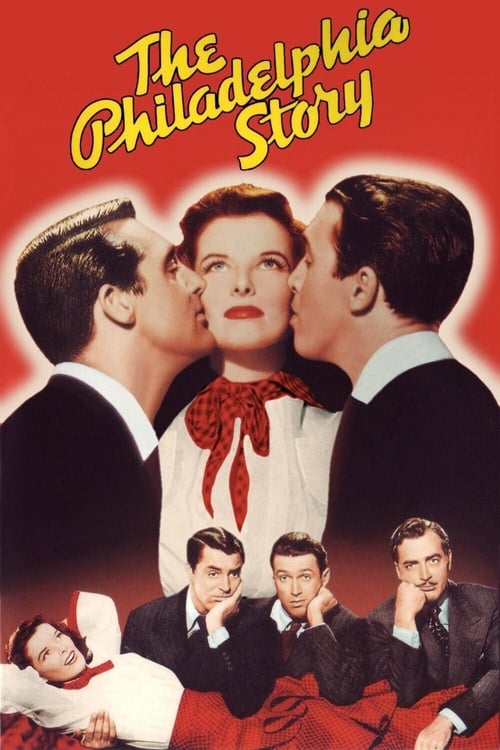
The Philadelphia Story
1940 · George Cukor
For a cozy night in when you want wit, romance, and zero stress — pure comfort viewing that still respects your intelligence, perfect with a drink in hand.
What it's about
On the eve of her second wedding at her family's Philadelphia estate, a haughty heiress gets two unwelcome guests: her sardonic ex-husband and a tabloid reporter sent to cover the society event of the year. Over one champagne-soaked twenty-four hours of needling, flirtation, and a moonlit swim, she's forced to see herself — and the men around her — a good deal more clearly.
The experience
Effervescent and fast on its feet — the dialogue crackles, the barbs land, and underneath the sparkle there's real feeling about pride, forgiveness, and being human rather than perfect. It's the kind of comedy that makes you grin for two hours straight.
Performances
Katharine Hepburn, Cary Grant, and James Stewart at the top of their games, in the only film where all three share the screen — Hepburn turning a role written for her into a career resurrection, Grant doing more with a raised eyebrow than most actors do with a page, and Stewart winning an Oscar as the reporter who falls where he shouldn't.
The craft
George Cukor directs with invisible elegance, keeping the camera out of the way of Philip Barry's diamond-cut dialogue and letting three stars volley it at full speed. The pacing is a lesson in how to make talk feel like action — every scene lands its laugh and moves.
Why it matters
It rescued Hepburn from being labeled box-office poison and re-launched her as one of Hollywood's great stars, while cementing the sophisticated romantic comedy as a form other films have been chasing ever since.
Snapshot
The Philadelphia Story is the cinema's most polished comedy of remarriage, a sparkling adaptation of Philip Barry's 1939 Broadway hit that turned a personal crisis in Katharine Hepburn's career into one of the great Hollywood triumphs. Set over twenty-four hours at a Main Line Philadelphia estate, it follows Tracy Lord, a haughty heiress on the eve of her second wedding, as her sardonic ex-husband C. K. Dexter Haven and a slumming tabloid reporter, Macaulay "Mike" Connor, arrive to puncture her self-righteous perfection. By the time the night is over, she has been humbled, intoxicated, and re-educated about her own humanity, and she remarries Dexter rather than the priggish self-made man she had chosen. Directed with unobtrusive elegance by George Cukor and acted by Hepburn, Cary Grant, and James Stewart at the peak of their respective gifts, the film is at once a witty class comedy, a vehicle of star rehabilitation, and a near-perfect demonstration of studio-era craftsmanship subordinated entirely to performance and language.
Industry & production
The film's origins are inseparable from Hepburn's professional predicament. After a run of underperforming pictures in the late 1930s, she had been notoriously branded "box-office poison" by an exhibitors' association and had effectively exiled herself from Hollywood. Playwright Philip Barry wrote The Philadelphia Story for her, tailoring the role of Tracy Lord to her persona — patrician, brittle, and in need of thawing. Hepburn starred in the Broadway production, which opened in 1939 and became a major success on a national tour as well.
Crucially, Hepburn controlled the screen rights — by widely reported accounts, the rights were secured for her with the backing of Howard Hughes — which gave her unusual leverage in negotiating her own return to film. She brought the property to MGM and to producer Joseph L. Mankiewicz, with Louis B. Mayer's studio mounting the production. Hepburn reportedly wanted Clark Gable and Spencer Tracy as her co-stars; instead the picture was cast with Cary Grant and James Stewart, both on loan or under arrangements typical of the period's star economy. Grant, by accounts of the production, negotiated top billing and a substantial fee that he donated to British war relief — a gesture consistent with the wartime moment, though specific figures should be treated cautiously.
George Cukor, long associated with literate, performance-driven pictures and with Hepburn personally (he had directed her screen debut), was the natural choice to direct. The result was both a critical and commercial success, restoring Hepburn's standing and confirming MGM's instinct that prestige theatrical adaptation, handled with restraint, could be highly profitable. The film became a centerpiece of the studio's 1940–41 awards campaign.
Technology
Technologically, The Philadelphia Story is a conservative, fully mature example of late-1930s/early-1940s studio sound filmmaking rather than an innovator. It was photographed in black-and-white on 35mm using the standard Academy ratio and the panchromatic stock and incandescent lighting that had become the MGM norm. The production relied on the era's optical sound recording, sound-stage construction of the Lord estate interiors, and the studio's deep resources in set dressing and costuming. There is no evidence that the film pursued the technical experimentation associated with contemporaneous pictures such as Citizen Kane; its ambitions lay entirely in the smooth, transparent service of a verbal comedy. The technological story here is one of refinement — a studio system whose tools had become so reliable that they could disappear behind the actors.
Technique
Cinematography
Joseph Ruttenberg, one of MGM's premier cinematographers, shot the film in a glossy but unshowy black-and-white idiom. The photography exemplifies the high-key "MGM gloss": clean, even illumination, luminous treatment of Hepburn in close-up, and a controlled greyscale that flatters skin and fabric without calling attention to itself. Ruttenberg's camera is largely at the service of the ensemble, framing the players in balanced two- and three-shots that let dialogue carry the scene. Where the staging allows, compositions exploit the depth and scale of the estate sets, but the overriding principle is legibility — the audience must always be able to read faces and follow the verbal volleys. The result is elegant and discreet, the visual equivalent of good manners.
Editing
Frank Sullivan's editing is similarly self-effacing, built around the rhythm of performance rather than montage effect. Cutting follows the cadence of Barry's dialogue and Donald Ogden Stewart's adaptation, favoring sustained takes that allow comic exchanges to build and reaction shots that register the characters' shifting power. The film's celebrated set pieces — the drunken late-night encounter between Stewart and Grant, the poolside intimacy between Stewart and Hepburn — depend on patient timing, holding on the actors so that the humor accrues through gesture and pause as much as through line. The editing's discipline lies in knowing when not to cut.
Mise-en-scène / staging
Cukor's mise-en-scène is rooted in the theatrical bones of the material but never feels stage-bound. The action unfolds largely within the Lord mansion and its grounds — drawing rooms, libraries, terraces, the swimming pool — spaces dressed to evoke inherited wealth and Main Line propriety. Cukor, famous as a "woman's director" and as a master of actors, blocks his ensemble to dramatize relationships spatially: who approaches whom, who retreats, who commands a room. Props and décor carry thematic weight — the model boat "True Love," recalling Tracy and Dexter's marriage, is the most pointed example. The staging continually choreographs the triangulation among Tracy, Dexter, Mike, and the colorless fiancé George Kittredge, using the architecture of privilege as both setting and subject.
Sound
As a dialogue comedy, the film lives in its soundtrack of speech. Recording is crisp and centered on intelligibility, capturing the overlapping wit and rapid exchanges that define the genre. Franz Waxman contributed the score, which functions in the customary studio manner — underlining transitions and romantic beats without intruding on the talk. The film's most memorable "sound" effects are performative rather than designed: Stewart's hiccuping drunkenness, the musical cadence of Hepburn's diction, the deflating pomposity in the supporting voices. Sound here is an instrument of comedy and class characterization.
Performance
Performance is the film's true medium. Hepburn gives one of her defining performances as Tracy Lord, modulating from imperious froideur to vulnerability and finally to chastened warmth; the role was built to weaponize and then redeem her established persona, and she plays that arc with precision. Cary Grant's Dexter Haven is a study in elegant restraint — wry, wounded, and quietly authoritative, his comedy located in timing and underplaying. James Stewart, as the resentful, idealistic reporter Mike Connor, supplies the film's emotional unpredictability, especially in the drunk scene and the moonlit seduction; his performance won the Academy Award for Best Actor. Ruth Hussey, as the photographer Liz Imbrie who loves Mike, grounds the picture with dry intelligence and earned an Oscar nomination. The supporting players — Roland Young's tipsy Uncle Willie, John Howard's stiff Kittredge, and Virginia Weidler's irrepressible younger sister Dinah — complete an ensemble in which every register of comic acting is calibrated to the whole.
Narrative & dramatic mode
The dramatic mode is high comedy of manners crossed with romantic reconciliation. Structurally, the film observes a near-classical unity of time and place: the action compresses into roughly a day and night before a wedding, in a single estate. Its engine is the comedy-of-remarriage premise — a divorced couple drawn back together — complicated by a love triangle (or quadrangle) and by the intrusion of outsiders who function as both threat and catalyst. The reporter and photographer, planted by a scandal magazine, introduce the class-comedy mechanism: the patrician world is observed, judged, and ultimately reaffirmed through the eyes of those who do not belong to it. The narrative's moral arc belongs to Tracy, who must learn to forgive human frailty — her father's, Dexter's, and her own — and to abandon the "goddess" pedestal others (and she herself) have built. The resolution restores the original marriage, the comedy's traditional sign that disorder has been set right.
Genre & cycle
The Philadelphia Story belongs to the screwball/sophisticated-comedy cycle of the 1930s and early 1940s, and more specifically to what the philosopher Stanley Cavell later canonized as the "comedy of remarriage" — films in which the central couple's reunion, rather than a young couple's courtship, drives the plot. It shares with The Awful Truth, Bringing Up Baby, and His Girl Friday the figure of the verbally dexterous, combative couple, and it reunites Grant and Hepburn from the earlier Cukor and Hawks pictures. Compared with the more anarchic screwball entries, however, it is talkier and more decorous, leaning toward drawing-room comedy and away from physical farce. It also belongs to a Hollywood lineage of prestige stage adaptations, in which Broadway successes were transferred to the screen as star vehicles with their literary cachet intact.
Authorship & method
The film is a convergence of several authorships. George Cukor, the director, exemplifies a method built on serving writers and actors: he was prized for eliciting nuanced performances and for handling literate material with taste and discretion, and The Philadelphia Story is a textbook case of his self-effacing craft. Donald Ogden Stewart, who adapted Barry's play, won the Academy Award for Best Adapted Screenplay; his contribution was to open out and sharpen the stage dialogue for the screen while preserving its wit (Barry's underlying play, written for Hepburn, is the foundational text). Joseph Ruttenberg, the cinematographer, brought MGM's luminous house style. Franz Waxman supplied the score, and Frank Sullivan edited. Above and around them stands Katharine Hepburn as a kind of producing intelligence — the figure who commissioned the vehicle, controlled the rights, and shaped the project as an instrument of her own return; and Joseph L. Mankiewicz as producer. The film is thus best understood not as a single auteur's statement but as a studio collaboration orchestrated to showcase its stars.
Movement / national cinema
The picture is a quintessential product of the classical Hollywood studio system at MGM, the most prestige-conscious of the major studios. It does not belong to any avant-garde or national-cinema movement; rather, it represents American commercial filmmaking's mainstream at its most assured. Its lineage runs through Broadway and the American comedy of manners, and its sensibility is distinctly American in its preoccupation with class, self-made men, and the tension between inherited privilege and democratic scrutiny — even as it ultimately reaffirms the charm of the patrician world it gently satirizes.
Era / period
Released in 1940, the film sits at the tail end of the Depression-era screwball cycle and on the threshold of America's entry into the Second World War. Its world of effortless wealth and romantic intrigue offered escapist pleasure, yet its concern with the aristocracy being held up to public examination — by a scandal magazine, no less — resonates with Depression-era anxieties about class and privilege. The wartime context is visible at the margins of the production history (Grant's reported donation of his salary to British war relief) rather than in the film's content. It is a late, refined flowering of a comic mode that the war years would soon transform.
Themes
The film's central theme is the redemption of a too-perfect woman through the acceptance of human imperfection. Tracy Lord's journey is from judgmental rigidity — toward her father, her ex-husband, and herself — to tolerance and self-knowledge; the recurring charge that she is a "goddess" or "married to herself" frames her flaw as a failure of empathy. Closely related is the theme of class and authenticity: the collision between old money and the self-made man (Kittredge), and between the privileged and the working journalists who scrutinize them, interrogates who is "real" and who deserves love. The film also meditates on marriage as mutual forgiveness rather than idealization, and on the gap between public image and private truth — Tracy must be seen, flaws and all, before she can be loved. Beneath the wit runs a current of romantic idealism, crystallized in the recurring motif of "True Love."
Reception, canon & influence
The Philadelphia Story was both a popular and critical success on release, widely credited with restoring Katharine Hepburn's box-office viability and confirming her as one of Hollywood's foremost stars. At the Academy Awards it won Best Actor for James Stewart and Best Adapted Screenplay for Donald Ogden Stewart, and it received multiple further nominations including Best Picture, Best Director, Best Actress for Hepburn, and Best Supporting Actress for Ruth Hussey. (The precise tally of nominations and the competition that year are matters of public record; the headline wins were Stewart and the screenplay.)
Looking backward, the film drew on Philip Barry's stage play and on the screwball and comedy-of-manners traditions of the preceding decade, including the earlier Grant–Hepburn pairings under Cukor and Howard Hawks. Looking forward, its influence is substantial. It became the prime exhibit in Stanley Cavell's influential study of the "comedy of remarriage," securing its place in academic film canon. It was directly remade as the MGM musical High Society (1956), with Bing Crosby, Grace Kelly, and Frank Sinatra in the roles originated by Grant, Hepburn, and Stewart, and a Cole Porter score. More broadly, it stands as a model of the literate romantic comedy — the talk-driven, ensemble-balanced, emotionally intelligent comedy of reconciliation — that later filmmakers have repeatedly invoked. It has been preserved in the United States National Film Registry as a culturally significant work, and it remains a staple of repertory programming and a touchstone for discussions of star persona, of Cukor's directorial method, and of the screwball tradition's most refined endpoint.
A Deleuzian reading
The little boat is called *True Love*.
The full Deleuzian reading of The Philadelphia Story →
Reception
A smash on release — it was one of 1940's biggest hits and won two Oscars — so its arc isn't rediscovery but durability: it's the comeback story, the film that took Katharine Hepburn from 'box office poison' to untouchable, and it's never really left the canon since.
How The Philadelphia Story was received, from release to now →
Influences: the films it descends from and the films it influenced
- Holiday (1938) — The direct template: Cukor directing a Philip Barry stage play adapted by Donald Ogden Stewart, with Hepburn and Grant — the same writer-director-star machinery for opening out drawing-room theatrical material into screen comedy.
- The Awful Truth (1937) — Established the comedy-of-remarriage architecture — a divorcing couple relitigating love through jealousy of a stuffy interloper — and McCarey's loose, improvised timing that gave Grant the unflappable comic persona Cukor inherits.
- Bringing Up Baby (1938) — Forged the Grant–Hepburn comic chemistry and the screwball tactic of puncturing Hepburn's patrician hauteur through escalating humiliation, which Philadelphia Story reworks as moral chastening rather than slapstick.
- It Happened One Night (1934) — The genre's foundational text — a runaway heiress humbled into authenticity by a déclassé newspaperman — supplying the class-descent-toward-true-love structure Stewart's reporter reenacts at the party.
- Twentieth Century (1934) — Pioneered the rapid, overlapping, weaponized-wit verbal duel between equals that defines screwball dialogue and underwrites the talk-driven sparring of the Tracy–Lord scenes.
- Dinner at Eight (1933) — Cukor's prototype for orchestrating a balanced theatrical ensemble in a single milieu with self-effacing camera, prioritizing actor blocking and overlapping social registers over directorial flourish.
- My Man Godfrey (1936) — Sharpened the comedy-of-manners critique of wealthy frivolity judged by an outsider's authenticity, the class-and-pretension theme Philadelphia Story routes through the magazine-reporter intrusion.
- A Bill of Divorcement (1932) — Cukor's first collaboration with Hepburn, where he established his method of building a film as an instrument to frame and protect her specific star intensity — the producing-intelligence relationship she later commanded outright.
- Adam's Rib (1949) — Cukor reapplies his actor-serving, sustained-take method to a married couple sparring as equals, refining the literate ensemble comedy into the Tracy–Hepburn battle-of-wits formula seeded here.
- Pat and Mike (1952) — Continues Cukor's project of constructing vehicles around Hepburn's specific persona — competence, hauteur, vulnerability — with self-effacing direction that lets the star carry the comic and emotional load.
- High Society (1956) — The literal MGM remake, transposing the exact plot and roles into a Cole Porter musical and proving the property's scaffolding portable to song while retaining the talk-driven reconciliation beats.
- The Apartment (1960) — Inherits the emotionally intelligent talk-comedy that earns its romantic reconciliation through moral growth rather than farce, balancing wit against genuine feeling in the Cukor-Stewart manner.
- When Harry Met Sally... (1989) — The modern flowering of the literate, ensemble-balanced comedy of reconciliation between sparring equals, where dialogue and the slow correction of self-deception, not plot mechanics, drive the couple back together.
- Annie Hall (1977) — Extends the talk-driven, emotionally intelligent romantic comedy of a relationship relitigated in retrospect, descended from Cavell's comedy-of-remarriage canon for which Philadelphia Story is the prime exhibit.
- The African Queen (1952) — Hepburn's against-type performance model: the rigid, controlled woman whose self-possession is exposed as a defensive posture by external pressure, then rebuilt on more generous terms — the arc Huston explicitly recruited by casting her as Rose Sayer.
- Moonstruck (1987) — Cukor's transposition of a well-made stage play to film by trusting the proscenium two-shot and letting actors deliver aphoristic, declarative dialogue in sustained wides — the same anti-coverage discipline Watkin and Jewison apply to the Loretta/Ronny kitchen and the final breakfast-table assembly.
- Crossing Delancey (1988) — The classical two-suitor architecture in which the glamorous, socially upward option is systematically exposed as an act of self-flattery and the unglamorous option as the one who actually sees her — the exact chassis under Anton Maes vs. Sam Posner.
- Metropolitan (1990) — The drawing-room verbal rhythm Stillman writes to — epigram, riposte, and self-indicting aside traded between a class insider and a watchful outsider — plus the staging convention of arranging six people around furniture so that the seating chart itself carries the social hierarchy.
- His Girl Friday (1940) — The same-year remarriage comedy that takes the talk-driven divorced-couple reunion to its velocity extreme with overlapping dialogue, the inverse pole to Cukor's measured, sustained-take staging of the same plot DNA.
- The Lady Eve (1941) — Extends the screwball comedy of moral re-education — a man humbled into recognizing the woman he wronged — with Sturges's literate, epigrammatic dialogue carrying the same wit-as-character-revelation function.
- The Palm Beach Story (1942) — Carries the remarriage plot forward into Sturges's register, staging reconciliation through a comedy of moneyed manners and the threat of a comically inadequate alternative suitor.
Similar films
- Holiday (1938) — influence & lineage
- Bringing Up Baby (1938) — influence & lineage
- His Girl Friday (1940) — influence & lineage
- Adam's Rib (1949) — influence & lineage
- The Palm Beach Story (1942) — influence & lineage
- The Awful Truth (1937) — influence & lineage
- It Happened One Night (1934) — influence & lineage
- The Lady Eve (1941) — influence & lineage