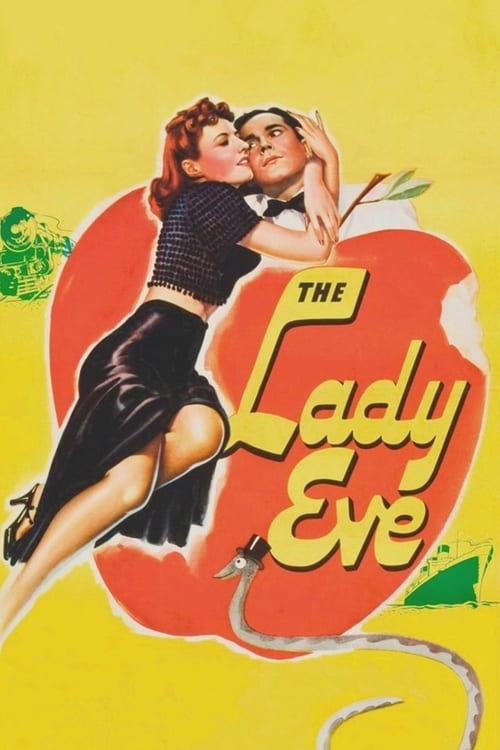
The Lady Eve
1941 · Preston Sturges
For a cozy night in when you want to fall in love and laugh at the same time — especially if you like your romance with the woman firmly in charge. Comfort viewing with a wicked streak.
What it's about
Aboard an ocean liner, card sharp Jean Harrington and her con-man father pick out the perfect mark: Charles Pike, a shy, snake-obsessed heir to a brewing fortune. The fleecing goes fine until Jean falls for him — and when Charles finds out what she is and drops her cold, she plots the sweetest revenge she can think of: walking back into his life as an English aristocrat, betting that no man could be fool enough to fall for the same woman twice.
The experience
Sparkling and slyly sexy, with dialogue that crackles and pratfalls that land like punchlines — but there's a real bruise under the comedy, because both leads get genuinely hurt. It's funny out loud and quietly romantic at once.
Performances
Barbara Stanwyck gives one of the great comic-romantic performances: predatory, tender, and heartbroken by turns, running every scene she's in. Henry Fonda is a revelation as the mark — earnest, dignified, and hilariously helpless every time he falls down.
The craft
Preston Sturges wrote and directed at the peak of his powers, and the script is a machine of perfect lines — the ocean-liner seduction, played almost entirely in close quarters over a deck of cards, is a master class in staging flirtation. Every pratfall is choreographed like a dance step.
Why it matters
A crown jewel of the writer-director's brief, brilliant Hollywood run and a landmark of the screwball era — its con-woman-in-charge romance has been borrowed from ever since.
Snapshot
The Lady Eve is Preston Sturges's romantic comedy of seduction, humiliation, and re-seduction, made at Paramount at the height of his brief, incandescent run as a writer-director. Barbara Stanwyck plays Jean Harrington, a card sharp working ocean liners with her confidence-man father; Henry Fonda is Charles Pike, a bashful, snake-obsessed heir to a brewing fortune who is exactly the kind of rich rube the Harringtons exist to fleece. Jean falls for her mark, is exposed and dumped, and engineers an elaborate revenge by returning to Charles's life as a fabricated English aristocrat, "Lady Eve Sidwich" — a disguise consisting of nothing but a change of accent and the assumption that no man could be fool enough to fall for the same woman twice. He is. The film is at once a screwball farce built on pratfalls and mistaken identity and a startlingly frank study of erotic power, female agency, and the male ego's capacity for self-deception. It is widely regarded as one of the supreme American comedies and one of Sturges's two or three best films.
Industry & production
The film was produced and released by Paramount Pictures in 1941, during the studio era's mature phase, when the major studios controlled production, distribution, and exhibition under a vertically integrated system soon to be challenged by the Paramount antitrust proceedings. Sturges had broken through as a writer-director only the year before: after a decade as one of Hollywood's most successful screenwriters, he had persuaded Paramount to let him direct his own script The Great McGinty (1940), reportedly for a nominal fee in exchange for the director's chair — a now-famous arrangement that helped open the door for the writer-director as a studio role. The Lady Eve came in the productive burst that followed, alongside Christmas in July (1940) and Sullivan's Travels (1941).
The screenplay was adapted by Sturges from a story by Monckton Hoffe (often cited under the title "Two Bad Hats"); Hoffe's original story received an Academy Award nomination. Stanwyck was by 1941 an established, highly versatile star, equally credible in melodrama and comedy; she had recently demonstrated comic range, and Sturges is generally said to have written the part with her in mind. Fonda, more associated with earnest dramatic roles (The Grapes of Wrath had appeared in 1940), was cast against type as the tongue-tied, perpetually toppling Charles — the physical comedy of the role depending precisely on the audience's sense of Fonda as a dignified leading man. The supporting cast drew on Sturges's celebrated informal stock company of character actors: Charles Coburn as the silken cardsharp "Colonel" Harrington, Eugene Pallette as Charles's bellowing brewer father, William Demarest as the suspicious bodyguard Muggsy, and Eric Blore as the fraudulent "Sir Alfred."
Technology
The Lady Eve was made with the standard professional apparatus of a major studio at the start of the 1940s: black-and-white 35mm photography, the Academy ratio (1.37:1), and post-synchronized optical sound recording. There is no novel technology at issue — the film is conventional in its tools and innovative in their deployment. Its most technologically inflected sequence is the long stretch in which Jean watches Charles across the ship's dining room through the small mirror of her compact, narrating to herself (and us) the parade of women trying to catch his eye; the effect depends on entirely ordinary resources — a framing device, an internal monologue carried on the soundtrack — rather than any special process. The ocean-liner and shipboard settings, like the later country-estate scenes, were realized on Paramount soundstages with studio sets, process photography, and the rear-projection conventions of the period.
Technique
Cinematography
The cinematography is credited to Victor Milner, a senior Paramount cameraman with a long association with the studio's most polished directors. The visual style serves performance and dialogue rather than calling attention to itself: clean, glossy studio lighting, fluid but unobtrusive camera movement, and compositions that keep two and three actors in frame so that reaction and timing can play out within the shot. The celebrated mirror sequence is the film's signal piece of camera storytelling — Jean's commentary motivates a long held passage in which the camera effectively adopts her point of view, turning surveillance into seduction. Elsewhere the photography favors elegant medium shots that frame Stanwyck as the controlling intelligence of any scene she enters.
Editing
The editing is credited to Stuart Gilmore. The film's comic rhythm — its alternation of rapid verbal volleys with sudden physical catastrophe — depends heavily on cutting that respects the integrity of a performance while landing each beat. Sturges's method generally favored sustained takes that let dialogue and physical business unfurl, with cuts placed to punctuate rather than to fragment; the running gag of Fonda's pratfalls (the tripping, the spilled food, the ruined dinner jacket) is built so that the camera often catches the fall whole, the cut arriving on the aftermath and the reaction.
Mise-en-scène / staging
Staging is where Sturges's authorship is most visible. He blocks scenes to dramatize power: Jean repeatedly maneuvers Charles physically as well as emotionally — most famously in the shipboard cabin scene where she draws him down beside her, runs her hand through his hair, and talks almost without interruption while he is reduced to stammering paralysis. The choreography of bodies (Jean in command, Charles overbalanced and literally falling) externalizes the film's argument about who holds erotic power. The two halves of the film mirror each other in setting — the enclosed, intimate ocean liner versus the expansive Pike country estate — and the production design tracks Charles's class world (brewery wealth, snakes, dinner parties) against the Harringtons' rootless elegance.
Sound
The sound design is dialogue-forward, as one expects of a Sturges picture: the screenplay's torrential, overlapping talk is the film's primary musical instrument. The musical score functions in a supporting, conventional studio mode, underscoring transitions and romance rather than asserting itself; precise attribution of the musical direction is one of the areas where the popular record is thin, and I will not assign a composer credit I cannot verify. What is unambiguous is the film's reliance on the human voice — accents, cadences, the contrast between Jean's American directness and "Lady Eve's" mannered English — as both comic engine and the literal mechanism of the central deception.
Performance
The performances are the film's glory. Stanwyck gives one of the great comic-romantic performances of the studio era, modulating between predatory wit, genuine wounded feeling, and the broad theatrical artifice of the "Lady Eve" masquerade — and making the joke that Charles cannot recognize her play as both absurd and psychologically true. Fonda commits fully to humiliation, deploying his natural gravity as the setup for slapstick; his pratfalls are funny precisely because he plays the surrounding scenes straight. Coburn's purring crook, Pallette's apoplectic patriarch, Demarest's growling skepticism ("positively the same dame"), and Blore's preening impostor supply a dense ensemble texture that keeps every scene populated and quick.
Narrative & dramatic mode
The narrative is built on a near-perfect symmetry and a single audacious comic premise: that a man will fail to recognize the woman he loved when she returns under a thin disguise, and that his very refusal to believe she could be the same person becomes the proof of his foolishness. The first movement is seduction (Jean wins Charles), the hinge is exposure and rupture (Charles learns she is a cardsharp and rejects her), and the second movement is revenge folded into reconciliation (Jean returns as Eve to punish and reclaim him). The dramatic mode is comedy of remarriage in spirit — though the couple is never married in the first half, the structure of estrangement and reunion belongs to that tradition — laced with a sexual candor unusual for its moment. Sturges manages tonal shifts that should be impossible: the cabin seduction is genuinely erotic, the pratfalls are pure farce, and the wedding-night confession sequence (Eve inventing a long parade of former lovers to torment Charles) is cruel, funny, and emotionally serious at once.
Genre & cycle
The Lady Eve belongs to the screwball comedy cycle that ran roughly from It Happened One Night (1934) through the early 1940s — a cycle defined by battling couples, class friction, rapid overlapping dialogue, and the comic inversion of gender power. By 1941 the cycle was mature, even late, and Sturges's film both epitomizes and complicates it. Where many screwballs pit a madcap heiress against a stiff man, here the aggressor is a working con artist and the "innocent" is the wealthy man; the film keeps the genre's verbal velocity and physical comedy while pushing its sexual subtext closer to the surface than most of its contemporaries dared. It also belongs to the broader Sturges comic mode — satirical about American wealth, business, and self-importance — that links it to The Great McGinty, Christmas in July, and the later The Palm Beach Story.
Authorship & method
The film is among the purest expressions of Sturges as auteur, since he both wrote and directed it and his sensibility saturates every level. His method was fundamentally that of a writer: the script is the architecture, and the dialogue's speed, density, and wit are the film's defining features. Sturges's directing served that writing — staging and pacing engineered so that lines land and physical gags detonate on cue — and his use of a recurring repertory company (Demarest, Pallette, Blore, and others who reappear across his films) gave the comedy a stock-character richness reminiscent of theatrical and commedia traditions. Among collaborators, cinematographer Victor Milner supplied the studio's polished visual surface and editor Stuart Gilmore cut for comic timing; the casting of Stanwyck and Fonda was itself an authorial decision, exploiting their established personae. As noted above, the score's authorship is the one element where I cannot responsibly name a credit from the established record without risk of error.
Movement / national cinema
This is mainstream classical Hollywood cinema at its most accomplished — not part of any avant-garde or national-cinema "movement" in the European sense, but a high product of the American studio system's golden age. If it belongs to a movement, it is the loose cohort of Hollywood writer-directors who in the late 1930s and early 1940s won unusual creative control — Sturges foremost among them, with figures like John Huston and Billy Wilder following the same path from screenwriting into direction. The film exemplifies the classical Hollywood style: invisible technique, story and star in service of entertainment, genre convention deployed with great craft.
Era / period
The Lady Eve arrived in 1941, on the eve of American entry into the Second World War, near the close of the screwball era and at the apex of Sturges's career. It was made under the Production Code, and part of its art is the way it smuggles frank sexual content past the censors through innuendo, performance, and the Edenic joke embedded in the very name "Eve" (with Charles, the snake expert, as a comic Adam undone by a woman and serpents alike). The period's studio economics — stable contracts, a reliable star system, in-house craft departments — are everywhere visible in the film's finish. Within months the industry and the country would be reoriented by the war, and Sturges's own remarkable run at Paramount would last only a few more years before his career declined.
Themes
The film's central theme is sexual and emotional power, and specifically the agency of a woman who is smarter, more experienced, and more in command than the man she desires. Jean/Eve drives every turn of the plot; Charles is acted upon. Closely related is the theme of self-deception and male vanity: Charles's inability to admit that Eve could be Jean is rooted in pride, and the film argues that his idealization of women ("the type" he thinks he wants) is precisely what blinds him. Identity and performance run throughout — Jean is always playing a role, and the "real" self the film finally affirms is the one that loves rather than the social mask. The Edenic framing (Eve, the apple of temptation, the snakes) gives the comedy a sly mythic underlayer about temptation, knowledge, and the fall. Class and money supply the satirical bass note: the Pike brewing fortune, the rituals of wealth, and the con artist's clear-eyed view of the rich as marks.
Reception, canon & influence
The Lady Eve was received as a major comic success on release and has only grown in critical stature; it is now routinely placed among the finest American comedies and among Sturges's best work. Contemporary critics praised its wit and Stanwyck's performance, and it has frequently appeared on retrospective best-of lists in the decades since; I would flag that specific year-end rankings and box-office figures sometimes attributed to it are not something I can state precisely from memory without risk of inventing numbers, so I leave them unquantified. Its lasting canonical status was formalized when it was selected for the United States National Film Registry by the Library of Congress in 1994 as a work of cultural, historical, or aesthetic significance.
Looking backward, the film draws on the screwball tradition established by It Happened One Night and refined across the late 1930s (the battling-couple structure, the class comedy, the rapid dialogue), on the long tradition of stage farce and disguise plots, and on Sturges's own decade of screenwriting craft. Looking forward, its influence runs through the rest of Sturges's Paramount comedies and into the broader lineage of American romantic comedy built on verbal sparring and reversible gender power. It was directly remade as The Birds and the Bees (1956) with George Gobel and Mitzi Gaynor — a version generally judged far inferior, which mostly serves to demonstrate how much of the original's brilliance lay in Sturges's writing and Stanwyck's performance rather than the plot mechanics. More diffusely, the film's model of a wised-up, sexually frank heroine outmaneuvering a naïve man has echoed through later romantic comedy, and it remains a touchstone cited by filmmakers and critics whenever the screwball tradition is invoked.
A Deleuzian reading
Before she ever speaks to him, Jean Harrington watches Charles Pike in a mirror.
The full Deleuzian reading of The Lady Eve →
Reception
No rediscovery needed — it was a hit and a critical darling in 1941 and has only climbed since, now routinely name-checked as the screwball comedy, with a Criterion edition and a spot in the National Film Registry sealing the deal.
How The Lady Eve was received, from release to now →
Influences: the films it descends from and the films it influenced
- It Happened One Night (1934) — Established the battling-couple road structure and class-friction banter that Sturges inherits — antagonistic equals forced together, romance generated by verbal combat rather than courtship.
- Twentieth Century (1934) — Pioneered the overlapping, machine-gun dialogue tempo and the performer-as-manipulator dynamic (Lombard/Barrymore) that Sturges times his lines and Stanwyck's con against.
- Bringing Up Baby (1938) — Codified the screwball reversal of gender power — the assured, scheming woman driving the plot while the bookish man (Fonda's snake-scholar echoes Grant's paleontologist) is reduced to flustered prey.
- The Awful Truth (1937) — Set the comedy-of-remarriage template Stanley Cavell traces to Eve: the same couple must be re-won after rupture, here via Eve's split identity standing in for divorce-and-remarriage.
- Trouble in Paradise (1932) — Supplies the elegant-con-artist comedy and the 'Lubitsch touch' of sexual sophistication played through indirection — the grifter-as-romantic-lead that Stanwyck's Jean inherits.
- The Front Page (1931) — Brought the Hecht-MacArthur stage-farce density of cynical, fast wisecrack dialogue into sound cinema, the verbal-architecture model Sturges built his screenwriting decade on.
- Easy Living (1937) — A Sturges-scripted film whose frustration with Leisen's handling of his words drove Sturges to direct — its class-collision farce and Jean Arthur's wised-up heroine prefigure Eve directly.
- Remember the Night (1940) — Sturges directs Stanwyck as a con artist whose redemption trades on the identical genial-warmth register, proving what his script for Leisen could only supply from behind the words.
- The Palm Beach Story (1942) — Extends Eve's reversible-marriage machine and Sturges's blocking-as-power staging, with Colbert running the same wised-up-woman-outmaneuvering-husband con against McCrea's straight man.
- The Miracle of Morgan's Creek (1944) — Pushes the Production-Code-evading frankness about female sexuality further than Eve's seduction scenes, sustained by the same stock-company farce engine and breakneck dialogue.
- Adam's Rib (1949) — Carries forward the comedy-of-remarriage built on combative intellectual equals, the reversible gender-power sparring Eve modeled, scripted as verbal duel between matched leads.
- The Heartbreak Kid (1972) — Inherits Sturges's cringe-comedy of a naïve man undone by a wised-up woman and the precise comic timing of social humiliation, extending screwball's verbal cruelty into the New Hollywood.
- Heaven's Gate to The Lady Eve lineage — Out of Sight (1998) — Revives the sexually-frank con-artist romance of equals (Lopez/Clooney as cop and thief), Eve's model of seduction-as-mutual-manipulation between criminally smart partners.
- Gentlemen Prefer Blondes (1953) — Extends the cast-against-type, sexually-knowing heroine working a wealthy naïf, foregrounding the gold-digger-as-strategist that Stanwyck's Jean made sympathetic and self-aware.
- Women on the Verge of a Nervous Breakdown (1988) — The feminist screwball comedy in which prop objects (the snake, the card tricks) function simultaneously as comic instruments and symbolic agents, and delayed revelation through strategic intercutting controls audience knowledge against the characters' — both central to Almodóvar's method with the gazpacho and the answering-machine tape.
- The Sting (1973) — Sturges established the confidence trick as sustained comedic engine in which the audience watches the mark being manipulated while the grifter improvises within the scheme; The Sting's audience-as-mark structure and its protagonist maintaining a false persona across the film's full length both derive from this model.
- Some Like It Hot (1959) — Comedy of seduction built on sustained dramatic irony — the audience knows the imposture the dupe doesn't — the exact irony structure governing Curtis's fake-millionaire courtship of Monroe.
- House of Games (1987) — Establishes the card-sharp/female grifter working a mark, with the technical mechanics of the con played as a seduction the victim never sees coming.
- The Grifters (1990) — Codifies the con-as-seduction and the professional grifter team working a mark, the cardsharp-romance mechanics that The Grifters strips of comedy and renders fatal.
- The Hudsucker Proxy (1994) — Sturges's satiric screwball method — the fast-talking con artist working an innocent mark, delivered in machine-gun verbal velocity and ironic narratorial framing that Hudsucker's Amy Archer plotline reproduces.
- The Great McGinty (1940) — Sturges's directorial debut establishing his repertory method — Demarest, Pallette, the stock company — and the writer-director control over staging-for-the-line that Eve perfects a year later.
- Sullivan's Travels (1941) — Same year, same repertory company and verbal-density method, with Stanwyck's persona refracted through Veronica Lake's tough heroine — Sturges authorship saturating every staging and cut for timing.
- To Be or Not to Be (1942) — Builds comedy from impersonation and double-identity performance — the disguise-plot mechanics of Eve/Lady Eve Sidwich treated as both farce engine and character revelation.
- His Girl Friday (1940) — Contemporary apex of overlapping-dialogue tempo and the dominant woman / outmatched man dynamic, the same dialogue-forward, comic-timing-edited craft Sturges and Stanwyck deploy.
- The Philadelphia Story (1940) — Extends the screwball comedy of moral re-education — a man humbled into recognizing the woman he wronged — with Sturges's literate, epigrammatic dialogue carrying the same wit-as-character-revelation function.
- Ball of Fire (1941) — A same-year twin casting Stanwyck as the streetwise operator who schools a naive, bookish specialist (the snake scholar), matching Ball of Fire's dynamic of erotic worldliness dismantling cloistered expertise.
- Hail the Conquering Hero (1944) — Uses the same repertory ensemble and a confidence-trick imposture structure resolved by confession, scored in the mock-heroic/sentimental balance Werner Heymann brings to Hail.
Similar films
- The Palm Beach Story (1942) — influence & lineage
- Bringing Up Baby (1938) — influence & lineage
- Trouble in Paradise (1932) — influence & lineage
- Sullivan's Travels (1941) — influence & lineage
- It Happened One Night (1934) — influence & lineage
- Charade (1963) — shared sensibility
- Remember the Night (1940) — shared sensibility
- All About Eve (1950) — shared sensibility