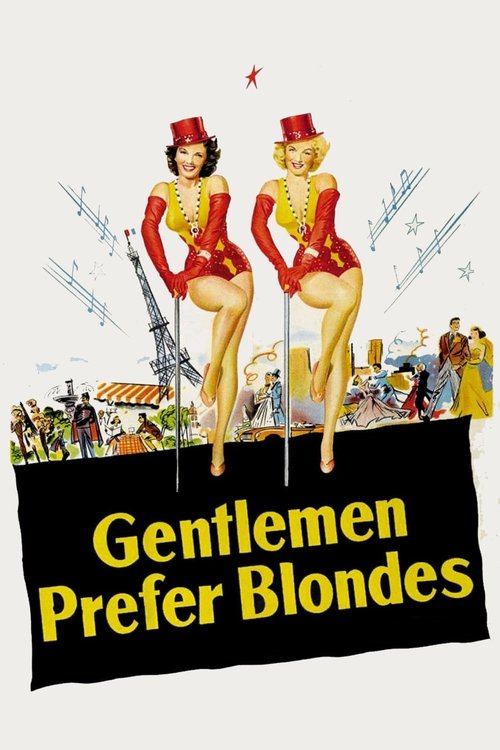
Gentlemen Prefer Blondes
1953 · Howard Hawks
For a glamorous, feel-good night when you want wit, spectacle, and zero stress — perfect with friends or as a first date with classic Hollywood. All comfort, no homework.
What it's about
Showgirls and best friends Lorelei Lee — who loves diamonds and the millionaires who buy them — and Dorothy Shaw — who just loves men — sail for Paris, with a private detective aboard hired by Lorelei's disapproving future father-in-law to catch her in a scandal. Shipboard schemes, a borrowed tiara, and an Olympic team's worth of distractions ensue. Beneath the farce, it's really about two women who always take each other's side.
The experience
Bright, fast, and effortlessly funny — a Technicolor confection where the wisecracks are as polished as the musical numbers. It's pure pleasure, but there's a sly intelligence underneath: the supposed gold digger is usually the smartest person in the room.
Performances
Marilyn Monroe, in the role that fixed her screen persona, plays Lorelei's wide-eyed materialism with immaculate comic precision — the joke is always hers, never on her. Jane Russell matches her beat for beat with dry, knowing warmth, and their double act is the film's engine.
The craft
Howard Hawks runs the comedy at his signature crackling pace, and the production numbers — above all the shocking-pink 'Diamonds Are a Girl's Best Friend' — are staged with jewel-box Technicolor opulence that begs for the biggest screen you have. Anita Loos's satirical DNA keeps the script sharper than its candy surface suggests.
Why it matters
A pinnacle of the studio-era musical and the moment Monroe became a star, its central number is one of the most imitated and referenced performances in pop culture, echoed by generations of music videos and stage acts.
Snapshot
A Technicolor musical comedy from 20th Century-Fox, Gentlemen Prefer Blondes pairs Marilyn Monroe and Jane Russell as a nightclub duo — the gold-minded Lorelei Lee and the wisecracking, man-loving Dorothy Shaw — who sail to Paris trailed by a private detective hired to catch Lorelei in some disqualifying indiscretion. Adapted from a Broadway hit that was itself adapted from Anita Loos's 1925 satirical novel, the film is remembered less for its slender plot than for two things: its numbers, above all Monroe's shocking-pink rendition of "Diamonds Are a Girl's Best Friend," and its unusually frank, affectionate portrait of female friendship. It arrived in 1953, the year Monroe crossed from starlet to star, and it remains a touchstone both of the studio-era musical and of her screen persona.
Industry & production
The film was produced by Sol C. Siegel for 20th Century-Fox and released in the summer of 1953. Its source was the 1949 Broadway musical Gentlemen Prefer Blondes, with a book that descended from Anita Loos's novel — first serialized in Harper's Bazaar in the 1920s — and its sequel. The stage show had made a star of Carol Channing as Lorelei; for the screen, Fox cast Monroe, then a rising contract player, in the role.
The production sits inside a specific moment of studio anxiety. Television was eroding attendance, and Hollywood was reaching for spectacle — color, scale, and soon the anamorphic widescreen of CinemaScope. Notably, Gentlemen Prefer Blondes predates Fox's own CinemaScope launch (The Robe, later in 1953); it was shot in standard Academy ratio, so it belongs to the last cohort of Fox's "flat" Technicolor musicals rather than the widescreen era the studio was about to inaugurate. Its expensive glamour — Travilla's gowns, the ocean-liner sets, the elaborate production numbers — reads as part of that broader push to give audiences what the small screen could not.
The casting economics are part of the film's lore. Jane Russell, under contract to Howard Hughes and a bigger name at the time, was reportedly the higher-paid of the two leads, while Monroe was still bound by a comparatively modest Fox contract — a disparity that later fed accounts of Monroe's grievances with the studio. The two stars, by most contemporary and later testimony, got on well, and Russell's protectiveness toward the more insecure Monroe on set has been widely recounted, though the finer details of such anecdotes rest on memoir and interview rather than documentary record.
Technology
The film was made in Technicolor, and color is not incidental to it — the palette is a working part of the design, from the red opening gowns to the saturated pink of the "Diamonds" number. By 1953 the industry was in transition from three-strip Technicolor capture toward color negative stock printed by Technicolor's dye-transfer process; the precise capture particulars are a technical detail I won't overstate, but the finished film carries the dense, high-chroma look associated with the studio's Technicolor releases of the period.
Framing is the other technological marker. As noted, the picture was composed for the roughly 1.37:1 Academy frame, before Fox reoriented its production around the wide CinemaScope frame. The staging — the centered, proscenium-like presentation of the musical numbers especially — reflects that squarer canvas rather than the horizontal sprawl the studio would soon favor.
Technique
Cinematography
Harry J. Wild photographed the film. The visual approach is bright, frontal, and glamour-forward: figures lit to flatter, color blocks used to organize the frame, and the musical numbers staged for clarity of line rather than for camera acrobatics. The "Diamonds Are a Girl's Best Friend" sequence is the signature achievement — Monroe isolated against a hot-pink field, the surrounding chorus and décor arranged to keep the eye on her — and it demonstrates the film's preference for legible, poster-like compositions over restless movement.
Editing
The film was cut by Hugh S. Fowler. Editing serves two distinct registers: the comedy scenes are paced to the actors' timing and the verbal sparring, while the numbers are cut to preserve the integrity of choreography and performance, holding shots long enough to let a gesture or a full musical phrase land. The result is a rhythm that alternates brisk farce with the more measured, display-oriented cutting of the set-pieces.
Mise-en-scène / staging
Staging is where the film's craft is most concentrated, largely through the choreography of Jack Cole, one of the most influential figures in mid-century American dance and a key architect of Monroe's and Russell's screen movement. Cole's numbers are built on strong silhouettes, angular arms, and precise group geometry. The opening "Two Little Girls from Little Rock," with the two stars in matching red, establishes the pair visually as a mirrored unit; "Diamonds" turns Lorelei into an object of, and commentator on, spectacle; and Russell's "Ain't There Anyone Here for Love?", set amid a troupe of flesh-and-muscle athletes, inverts the usual gender direction of the ogling gaze. Travilla's costumes and the liner-and-Paris settings complete a design world of controlled artifice.
Sound
The score draws on the Broadway songs by composer Jule Styne and lyricist Leo Robin — including "Diamonds Are a Girl's Best Friend," "Bye Bye Baby," and the "Little Rock" number — supplemented for the film by songs from Hoagy Carmichael and Harold Adamson, among them "When Love Goes Wrong" and "Ain't There Anyone Here for Love?" Lionel Newman handled the musical direction at Fox. The soundtrack, in the studio manner, is built on pre-recorded playback to which the numbers were staged and lip-synced; the dialogue scenes lean on the performers' vocal comedy, particularly Monroe's breathy, deliberately naïve delivery and Russell's dry contralto.
Performance
The film is a two-hander, and its pleasure is in the contrast. Monroe plays Lorelei as a comic construction — a woman whose apparent dimness is a screen for shrewd, unembarrassed self-interest, delivered with impeccable timing so that lines about diamonds and rich fathers register as both innocent and calculating. Russell's Dorothy is her grounded counterweight: sardonic, appetitive, loyal, and openly desiring, a figure who reads as a version of the self-possessed "Hawksian woman." The supporting cast — Charles Coburn as the diamond-owning "Piggy" Beekman, Elliott Reid as the detective Ernie Malone, Tommy Noonan as the hapless fiancé Gus Esmond, and George "Foghorn" Winslow as a preternaturally deep-voiced child — plays comic types against the two leads' central duet.
Narrative & dramatic mode
The narrative mode is farce organized as travelogue: a voyage structure that strings episodes — the ship, the passengers, Paris — along a loose line of romantic complication and mistaken purpose. The engine is Esmond Sr.'s suspicion of Lorelei and the surveillance he commissions, which converts courtship into a comedy of watching and being watched. Songs interrupt and comment on the action in the integrated-musical manner, though the plot remains frankly a scaffold for star performance. Beneath the froth runs a satirical thesis inherited from Loos: that marriage, money, and sexual attraction are entangled transactions, and that Lorelei's candor about this is more honest than the hypocrisy of the men who judge her.
Genre & cycle
The film belongs to the Hollywood musical comedy in its golden-age studio form, and specifically to the early-1950s cycle of glossy, color, star-driven musicals that Fox and MGM were mounting against television. It is also part of the 1953 run of pictures that built Monroe's stardom — appearing the same year as Niagara and How to Marry a Millionaire — and thus a document of the "blonde bombshell" persona being manufactured in real time. Within the musical genre it leans toward the show-number model, where the songs are performances given by performers, rather than the fully diegetic-fantasy mode of the era's most celebrated dance films.
Authorship & method
Howard Hawks directed, which makes the film an outlier in one of American cinema's most eclectic careers. Hawks moved freely across genres — screwball comedy, gangster film, Western, war picture, adventure — but the musical was not his usual terrain, and Gentlemen Prefer Blondes is often discussed as an anomaly in his output that nonetheless carries his fingerprints. Chief among them is the female pairing: the bond between Lorelei and Dorothy has the mutual regard and self-sufficiency Hawks prized in his characters, and critics have long read the two women as the film's true "couple," with the men reduced to obstacles, prizes, or fools.
Authorship here is genuinely shared, and the collaborators are as consequential as the director. The screenplay is credited to Charles Lederer, adapting the stage book and Loos's material. The songs come from Styne and Robin (with Carmichael and Adamson additions), the choreography and much of the stars' physical performance from Jack Cole, the photography from Harry J. Wild, the editing from Hugh S. Fowler, and the costumes from Travilla, with Lionel Newman directing the music. In a studio musical of this kind, the "method" is a division of specialized labor coordinated toward star display, and the finished film is best understood as the product of that system rather than of a single controlling vision — even a director as strong as Hawks.
Movement / national cinema
This is a mainstream Hollywood studio production, not a film of any avant-garde or national movement; its "movement" is the classical American studio system at a late, defensive, spectacle-heavy phase. Its national-cinema significance is as an artifact of that system — the vertically organized, genre-fluent, star-driven Hollywood of the early 1950s — and of the specifically American satirical tradition, via Loos, that treats money and marriage as a single subject.
Era / period
The film is stamped by 1953. Economically, it answers the postwar box-office decline and the rise of television with color and glamour. Culturally, it sits in a period of conservative gender expectations and a booming consumer economy, which gives its jokes about diamonds, provision, and the price of a woman their satirical edge. And it belongs to the pre-CinemaScope instant at Fox — made just before the studio reorganized around widescreen — so it captures the classical framing conventions on the eve of their transformation.
Themes
The governing theme is the economics of desire: Lorelei's forthright understanding that beauty is capital and marriage a contract, articulated most memorably in "Diamonds Are a Girl's Best Friend." The film's satire cuts in more than one direction — at Lorelei's mercenary streak, but harder at the men who moralize about it while pursuing their own transactions. A second theme is the primacy of female friendship: the Lorelei–Dorothy bond is the relationship the film most values, more stable and more genuinely reciprocal than any of the heterosexual pairings. Bound up with this is the theme of the gaze and its reversal — Dorothy's "Ain't There Anyone Here for Love?" turning the machinery of erotic display back on male bodies, and Lorelei's performances making spectacle self-aware. These readings have made the film a durable object of feminist criticism, which has argued both that it objectifies its stars and that it slyly critiques the objectifying culture around them.
Reception, canon & influence
Contemporary reception was broadly favorable, and the film performed strongly as a piece of popular entertainment; I'll avoid citing specific grosses, as I can't verify exact figures, but it is consistently described as a commercial success that helped cement Monroe's stardom. Over subsequent decades its critical standing rose considerably, and it is now firmly canonical — regularly cited among the great Hollywood musicals, among the essential Monroe films, and, more surprisingly, as a Hawks film worth serious attention despite its distance from his usual genres.
Looking backward, the film's influences are legible: Anita Loos's Jazz Age satire supplies the sensibility and the character of Lorelei; the Broadway score supplies its spine; Jack Cole's dance vocabulary — itself drawn from a synthesis of jazz, modern, and ethnic dance traditions — shapes the numbers and, through them, the physical persona of both stars. Cole's influence radiated widely through American musical staging, and this film is one of its most visible showcases.
Looking forward, the film's most conspicuous legacy is the afterlife of the "Diamonds" number, whose staging and iconography were directly restaged in Madonna's 1985 "Material Girl" music video, itself an enduring pop-culture citation — a lineage that has turned Monroe's pink-gowned image into one of the most reproduced tableaux of the twentieth century. More broadly, the film contributed decisively to the codification of Monroe's screen image, which became a reference point for later performers and a subject of ongoing scholarship on stardom, gender, and spectacle. The record on some production specifics is thinner than the film's fame suggests, and where accounts rest on memoir I've flagged them as such; but the film's place in the canon, and the reach of its central number, are not in doubt.
A Deleuzian reading
Pink, edge to edge.
The full Deleuzian reading of Gentlemen Prefer Blondes →
Reception
A box-office hit in 1953 but written off by most critics as glossy fluff, it was later reclaimed by feminist film scholars and Hawks devotees alike — the 'dumb blonde' picture turned out to be one of the sharpest studio comedies about money, men, and female solidarity.
How Gentlemen Prefer Blondes was received, from release to now →
How to watch Gentlemen Prefer Blondes: what to notice on a first viewing
- Watch Monroe stand inside a field of solid pink. The Diamonds number places her against a hot-pink background with little sense of a real location, the color itself carrying the scene's mood. The pink stops describing a place and simply becomes the feeling of the scene.
- Notice the two stars dressed in matching red at the start. Lorelei and Dorothy open the film as a mirrored pair in identical red gowns, visually established as a unit before either man appears. The film sets up its two women as the real couple before any romance begins.
- Watch Lorelei survey the dining room through her compact mirror. She tilts the small mirror to scan the room behind her, narrating and appraising rivals under her breath. You watch her watching, and the scheming is happening entirely through her own eyes.
- Watch the athletes ignore Dorothy while she looks them over. In Ain't There Anyone Here for Love, a troupe of men decline to look at her while she openly looks her fill. The number simply reverses who usually gets to do the looking in a musical scene.
- Watch how still Cole keeps Lorelei's body during the numbers. Strong silhouettes and angular arms hold her relatively fixed while the chorus and camera do the moving around her. She stops driving the scene and becomes the point all its motion passes through.
The whole guide to watching Gentlemen Prefer Blondes, with the keys for a rewatch →
Influences: the films it descends from and the films it influenced
- Red-Headed Woman (1932) — Anita Loos's screenplay sets the template Lorelei descends from — an amoral social-climbing gold-digger written as sympathetic and never morally punished for weaponizing desire.
- Gold Diggers of 1933 (1933) — Establishes the showgirl-economics musical whose 'We're in the Money' opening turns the pursuit of a man's wealth into a full production number — the economics-of-desire spine Lorelei's numbers inherit.
- His Girl Friday (1940) — Hawks's own template for the self-sufficient professional woman and rapid dialogue exchange — the mutual-regard female competence that becomes the Dorothy/Lorelei 'true couple.'
- Ball of Fire (1941) — Hawks directing Barbara Stanwyck's nightclub 'Sugarpuss' — a dry run for the wise showgirl heroine who runs verbal and physical rings around the men around her.
- Cover Girl (1944) — Jack Cole staged the ensemble dance at Columbia here, importing his jazz-modern isolation vocabulary into Technicolor star display — the same choreographic method he brings to Monroe and Russell.
- Gilda (1946) — Cole's staging of Hayworth's 'Put the Blame on Mame' as a single-woman-and-chorus number, using glove-peel gesture and glamour-frontal framing, is the direct precedent for the 'Diamonds' number's construction.
- The Lady Eve (1941) — Extends the cast-against-type, sexually-knowing heroine working a wealthy naïf, foregrounding the gold-digger-as-strategist that Stanwyck's Jean made sympathetic and self-aware.
- There's No Business Like Show Business (1954) — Directly continues the Cole–Monroe partnership: Cole choreographs Monroe's 'Heat Wave' with the same isolationist hip-and-shoulder vocabulary he built on her body in the 'Diamonds' and 'Little Rock' numbers.
- The Girl Can't Help It (1956) — Tashlin frames Jayne Mansfield in poster-like frontal compositions as a living pin-up — a cartoon-satiric exaggeration of exactly the codified bombshell image and glamour-frontal grammar Blondes crystallized.
- Some Like It Hot (1959) — Deploys and gently sends up the luminous dim-blonde persona Blondes fixed, building Sugar Kane's musical-number glamour framing on Monroe's now-codified screen image.
- Sweet Charity (1969) — Fosse, who called Cole 'the teacher of us all,' extends Cole's angular, isolation-based jazz staging into the signature Fosse vocabulary of turned-in knees and articulated hands.
- Chicago (2002) — Inherits the Cole-via-Fosse jazz idiom and the dual-register cutting between diegetic scene and fantasy performance number that Blondes uses in its intercut musical set-pieces.
- Material Girl (1985) — Madonna's video restages the 'Diamonds Are a Girl's Best Friend' number near shot-for-shot — pink strapless gown, tuxedoed male chorus, staircase and fan tableau — the most literal citation of the film's iconography.
- Moulin Rouge! (2001) — Nicole Kidman's 'Sparkling Diamonds' directly interpolates 'Diamonds Are a Girl's Best Friend' and restages its jewel-and-chorus staging, extending the number's afterlife into maximalist digital-era editing.
- How to Marry a Millionaire (1953) — Fox's immediate companion piece — Monroe in a gold-digging female trio, Travilla gowns, and the same travelogue-farce economics of desire, produced back-to-back.
- Kismet (1955) — Jack Cole's continuing studio career — his ethnic-jazz fusion staging ('Not Since Nineveh') showing the same synthesized dance idiom radiating across the mid-'50s musical.
- Les Girls (1957) — Cole choreographs a Technicolor CinemaScope showgirl piece, extending his method of building numbers around individual star personae rather than symmetrical Berkeley-style geometry.
Similar films
- Some Like It Hot (1959) — influence & lineage
- Gilda (1946) — influence & lineage
- Breakfast at Tiffany's (1961) — shared sensibility
- To Have and Have Not (1945) — shared sensibility
- The Earrings of Madame de... (1953) — shared sensibility
- Midnight (1939) — shared sensibility
- The Rules of the Game (1939) — shared sensibility
- Jules and Jim (1962) — shared sensibility