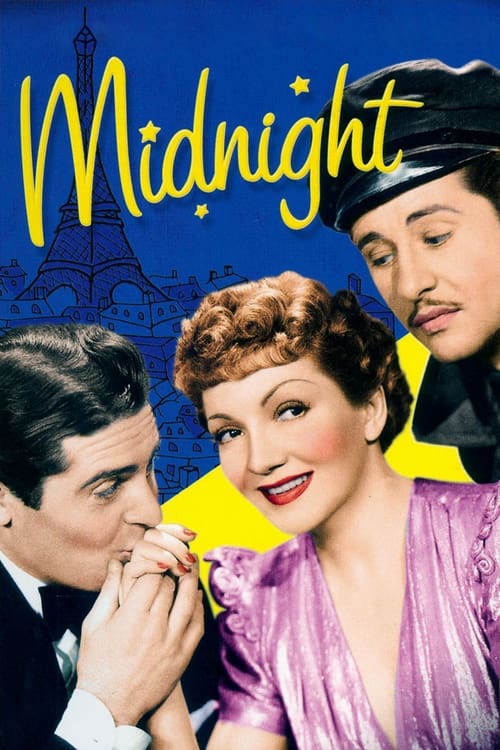
Midnight
1939 · Mitchell Leisen
For a sparkling night in when you want to be charmed — witty, romantic, zero heaviness, the cinematic equivalent of getting dressed up. Pure comfort, delivered with brains.
What it's about
A broke American showgirl steps off a train into rainy Paris with nothing but an evening gown, and by nightfall has talked her way into high society as a fictitious Hungarian baroness. A wealthy husband hires her to lure a gigolo away from his straying wife, so the masquerade escalates — while the lovestruck taxi driver who first befriended her hunts for her across the city, threatening to blow the whole invention apart.
The experience
Champagne-fizz screwball at its most elegant: fast, glamorous, and constructed like a Swiss watch, with each lie requiring a bigger, funnier lie to prop it up. You spend half the film delighted and the other half braced for the whole house of cards to come down at a dinner party.
Performances
Claudette Colbert is the gold standard of screwball heroines here — quick, dry, and improvising under pressure with visible pleasure — and John Barrymore, as her mischievous secret benefactor, matches her scheme for scheme.
The craft
The screenplay, by Charles Brackett and Billy Wilder before Wilder started directing, is one of the most admired of the era — a fairy-tale premise engineered so every improvised fib pays off later. Mitchell Leisen directs it with silky Paramount polish, all gowns, ballrooms, and perfectly timed reveals.
Why it matters
Made in Hollywood's storied year of 1939, it's held up ever since as a crown jewel of screwball comedy and prime evidence of what Brackett and Wilder could do on the page.
Snapshot
Midnight is one of the crown jewels of the American screwball comedy, arriving in Paramount's most celebrated year and standing among the finest scripts Charles Brackett and Billy Wilder produced before Wilder took up directing. Its premise is pure fairy-tale mechanics dressed in Continental sophistication: Eve Peabody (Claudette Colbert), a stranded American chorus girl, steps off a rain-soaked train into Paris with an evening gown and no money, and by a chain of improvisations reinvents herself as the "Baroness Czerny," a fictitious aristocrat, in order to survive. Recruited by the wealthy Georges Flammarion (John Barrymore) to lure a gigolo away from his straying wife, Eve stages an elaborate masquerade while a lovestruck Hungarian taxi driver, Tibor Czerny (Don Ameche), pursues her across the city. The film's engine is the Cinderella myth pushed to the edge of exposure, and its pleasure lies in watching a resourceful heroine improvise a self grand enough to fool a society that is itself a masquerade. Fleet, verbal, and structurally elegant, Midnight is often cited as a model of the "champagne comedy" register—light on its feet, ruthless underneath.
Industry & production
Midnight was a Paramount Pictures production, made within the studio's specialty for glossy, Continental-flavored comedies of manners. It was produced by Arthur Hornblow Jr., a Paramount producer closely associated with the Brackett-Wilder unit and with several of Leisen's most polished films. The picture belongs to the studio's high era of sophisticated comedy, when Paramount's house style—elegant interiors, cosmopolitan settings, worldly wit—distinguished it from the more populist comedy of Columbia or the prestige literary output of MGM.
The film's release in 1939 places it squarely in what is routinely described as Hollywood's annus mirabilis, competing for attention with Gone with the Wind, The Wizard of Oz, Stagecoach, and Ninotchka, among others. Within that crowded field, Midnight was received as an accomplished studio entertainment rather than a prestige event, and it has grown in critical estimation over the decades as the Brackett-Wilder partnership came to be studied in depth.
Production was governed by the Production Code, and the film's negotiation of adultery, kept women, and a sham marriage is instructive: the screenplay converts potentially transgressive material—a wife's near-affair, a heroine trading on a false identity—into the safely resolved architecture of romantic comedy, so that every apparent impropriety is defused by the closing reconciliations. This is characteristic of the period's screwball strategy of smuggling adult subject matter past the Code through speed, wit, and structural containment.
Technology
Midnight was made with the mature tools of late-1930s black-and-white studio filmmaking: panchromatic film stock, incandescent lighting, and the fully evolved sound-on-film recording that had become standard by the middle of the decade. There was nothing technologically experimental about the production; its sophistication is one of craft rather than apparatus. The film exploits the maturity of the studio soundstage—controlled interiors, back-projection for the taxi and travel sequences, and the deep resources of Paramount's art and lighting departments—to manufacture a wholly artificial Paris that never pretends to location authenticity. In this sense the "technology" of Midnight is the studio system itself operating at peak efficiency: a self-contained world assembled entirely indoors, lit and dressed to evoke a Continental fantasy.
Technique
Cinematography
The cinematography is credited to Charles Lang, one of Paramount's most distinguished directors of photography and a specialist in the soft, luminous lighting that flattered stars and dignified elegant interiors. The visual signature of Midnight is glossy and restrained: even, high-key lighting for the comic society scenes, with the rain-swept opening and the nocturnal Parisian streets providing the film's principal moments of atmospheric contrast. Lang's work here serves the performers and the dialogue rather than calling attention to itself; the camera is fluid but unshowy, framing the ensemble to keep the verbal sparring legible and the reversals of the plot clear. The polish of the image is integral to the film's fantasy of aristocratic Paris—every surface gleams, every gown catches the light—so that the visual luxury underscores the gap between Eve's true circumstances and the world she is impersonating her way into.
Editing
The cutting is classical and invisible in the best sense: it subordinates itself to performance and comic timing, holding on the actors long enough to let the dialogue land while keeping the farcical machinery moving. Midnight is a talk-driven comedy, and its editorial logic is built around the rhythm of the exchanges—cutting to reactions at the moment a lie is tested, sustaining two-shots during the verbal duels. The film has long been associated with Doane Harrison, the Paramount editor who became Billy Wilder's indispensable editorial collaborator; his involvement with the Brackett-Wilder pictures of this period is well documented, though anyone citing his specific contribution to Midnight should confirm the credit against the film's titles, as editorial attributions of the era are sometimes recorded loosely.
Mise-en-scène / staging
The staging is where Midnight's theatrical intelligence shows most clearly. The film is organized around a handful of extended set-piece situations—the taxi courtship, the society party, the invented "sick child" ruse, the climactic mock-legal confrontation—each staged like a one-act play with entrances, exits, and reversals. Hans Dreier headed Paramount's art department in this era and supervised the studio's distinctive Continental interiors, and Midnight's salons, hotel suites, and country château are exactly the kind of tasteful, deep-perspective settings that defined the studio's look. The décor is not merely decorative: the grandeur of the rooms is the stage on which Eve must sustain her performance, and the mise-en-scène keeps reminding us that she is an interloper in a space designed to expose imposture. Costume plays a related structural role—Eve's borrowed elegance is her passport—and the film was mounted with the couture polish for which Paramount was known, though the specific costume credit is best verified against the titles rather than assumed.
Sound
As a dialogue comedy, Midnight lives on its soundtrack. The recording is clean and forward, prioritizing the intelligibility of overlapping, rapid-fire speech that is the genre's hallmark. Musical scoring is used sparingly and functionally—to bridge transitions and lightly point the romance—rather than as a dominant expressive element; the film's real music is its language. A musical score is credited to the picture, frequently associated with the Paramount composer Frederick Hollander, but because contemporary scoring credits were often shared or supervised, that attribution is worth confirming before it is stated as fact.
Performance
The performances are the film's chief glory. Claudette Colbert, already a defining screwball star from It Happened One Night (1934), gives Eve a brittle intelligence and self-possession that keep the character sympathetic even as she lies her way upward; her comic timing and her ability to signal the calculation behind a poised façade anchor the whole design. Don Ameche's Tibor supplies earnest romantic ardor as a counterweight to the surrounding cynicism. Mary Astor and Francis Lederer handle the adulterous subplot with worldly lightness. But the performance most often singled out is John Barrymore's Georges Flammarion—a late-career turn from an actor by then in visible decline, who nonetheless delivers a witty, self-aware comic characterization; accounts of Barrymore relying on cue cards during this period of his career are well established in the biographical record. The ensemble balance—romantic sincerity against society-comedy artifice—is a large part of why the film sustains its farcical premise without curdling.
Narrative & dramatic mode
Midnight operates in the mode of romantic farce built on mistaken and manufactured identity. Its dramatic engine is the sustained lie: Eve constructs a false self and must continually improvise to keep it from collapsing, so that suspense is generated not by external danger but by the ever-present threat of exposure. The screenplay is tightly plotted around escalating complications—each solution to a problem breeds a new one—culminating in a virtuoso final movement in which Tibor gate-crashes the masquerade and, rather than unmasking Eve, plays along by inventing an even more elaborate fiction, forcing a resolution through a mock legal proceeding. This structure of lie-piled-upon-lie, resolved by turning the machinery of deception toward reconciliation, is the classic screwball architecture, and Midnight executes it with unusual precision. Beneath the farce runs the durable Cinderella pattern—the poor girl transformed by a night of borrowed splendor, the recurring motif of midnight as the hour of reckoning when the illusion must end.
Genre & cycle
The film sits at the center of the screwball comedy cycle that ran roughly from the mid-1930s into the early 1940s. It shares that cycle's defining traits: verbal velocity, class-crossing romance, a resourceful and unsentimental heroine, and a plot that treats social identity as performance. Within the cycle, Midnight belongs to the "Continental" or "champagne comedy" wing—stories of Americans among European aristocrats, trading on the glamour of Paris and the comedy of manners—as distinct from the rural or domestic strain of screwball. Its imposture premise links it to a long comic lineage of masquerade and mistaken rank, and its 1939 release places it among the cycle's most refined late examples, when the genre's conventions were fully mature and could be handled with the confidence Midnight displays.
Authorship & method
The authorship of Midnight is genuinely contested in a way that makes it a landmark case in Hollywood auteur debates. The screenplay is by Charles Brackett and Billy Wilder, adapted from a story by Edwin Justus Mayer and Franz Schulz, and it is widely regarded as one of the finest scripts the Brackett-Wilder team wrote in their pre-directing years. Yet the film was directed by Mitchell Leisen, a former costume and set designer whose gifts lay in visual elegance, performance, and the management of tone. The Brackett-Wilder–Leisen relationship is famous for its friction: Wilder's resentment of Leisen's alterations to his scripts—and his conviction that directors were mishandling his writing—is frequently cited among the motives that drove Wilder to become a director himself in 1942. This tension makes Midnight a productive test case: admirers of Leisen argue that his taste, his handling of the actors, and his instinct for pace are precisely what let the script sparkle, while the Wilder-centered view treats the film as evidence of the screenwriter's genius surviving despite the intermediary. The truth the film itself suggests is collaborative: a superb script realized by a director whose particular strengths in design and performance were exactly suited to its polished, actor-driven farce. Key craft collaborators—cinematographer Charles Lang, producer Arthur Hornblow Jr., and Paramount's art department under Hans Dreier—supplied the studio gloss that the material required.
Movement / national cinema
Midnight is a product of the classical Hollywood studio system rather than of any avant-garde movement, but it belongs to a distinctly transatlantic strain within American cinema. Its Parisian fantasy, its Continental characters, and its comedy-of-manners sensibility reflect the strong European presence in Hollywood in the 1930s—Wilder himself was a Central European émigré, and the film's worldly, faintly Lubitsch-flavored tone connects it to the tradition of sophisticated comedy that European-trained filmmakers brought to the American studios. The "Paris" of Midnight is an entirely Hollywood construction, an imaginary Europe assembled on soundstages, which is itself characteristic of the period's national cinema: American films projecting a glamorous, deracinated Continent as a backdrop for native comic energy.
Era / period
The film is deeply of 1939, and of the late-Depression, pre-war moment more broadly. Its Cinderella fantasy of a penniless American transformed by a night among the rich carries the wish-fulfillment charge that Depression-era audiences prized, while its cosmopolitan setting reflects a Hollywood still comfortably trading in European glamour on the eve of the war that would soon foreclose such fantasies. It arrives at the high-water mark of the studio system and of the screwball cycle, both of which would be reshaped within a few years by the war and by shifts in popular taste. Read historically, Midnight is a late, confident flowering of a particular kind of studio comedy just before the world it depicts and the mode it exemplifies began to pass.
Themes
The film's governing theme is identity as performance—the idea that social station, respectability, and even love are roles that can be assumed, improvised, and sustained by sheer nerve. Eve's masquerade dramatizes the permeability of class in a comic register: the "baroness" is only a chorus girl with good diction and a borrowed gown, and the aristocratic society she penetrates is shown to be scarcely less fraudulent than she is. Related themes cluster around money and survival (the film is candid that Eve's deceptions are driven by poverty), and around the tension between authenticity and artifice in romance—Tibor's plain sincerity set against the glittering falseness of high society. The recurring Cinderella motif, with midnight as the appointed hour of exposure, gives these ideas a mythic frame: the film is about the anxiety and exhilaration of pretending to be more than one is, and the fantasy that the pretense might, against all the rules, be allowed to come true.
Reception, canon & influence
Midnight was received on release as a smart, superior Paramount comedy, and its critical reputation has risen steadily as scholarship on the Brackett-Wilder partnership and on screwball comedy has matured. It is now routinely included in surveys of the genre's best work and cited as one of the strongest scripts Wilder and Brackett wrote before Wilder's directing career, as well as one of Mitchell Leisen's finest films—often invoked in the reassessment of Leisen as a director unjustly overshadowed by the writers he worked with. Specific contemporary box-office figures and individual reviews should be checked against period sources rather than asserted here; the durable claim is one of growing esteem rather than of a single defining critical verdict.
Looking backward, the film draws on the deep comic tradition of masquerade and mistaken rank, on the Cinderella tale, and on the Continental sophisticated comedy associated with Ernst Lubitsch, whose influence hangs over Paramount's comedy output of the period and over Wilder's own developing sensibility. Looking forward, its most concrete legacy is Leisen's own remake, Masquerade in Mexico (1945), which transplanted the plot to a new setting. More diffusely, Midnight helped consolidate the template of the imposture romance and the fast-talking, self-inventing screwball heroine, and its enduring reputation contributes to the case—central to Wilder's later self-mythology—that made him one of the defining writer-directors of the following two decades. As a synthesized account, the safest summary is that Midnight's influence has been less a matter of direct imitation than of exemplary status: a near-perfect specimen of a genre, repeatedly returned to as a benchmark of how sharp writing, star performance, and studio craft could combine.
Reception
Well liked in 1939 but drowned out by Hollywood's most stacked year ever, Midnight spent decades as a connoisseur's secret before being reappraised as one of the very best screwball comedies — the film people now cite to prove Mitchell Leisen was underrated all along.
How Midnight was received, from release to now →
Influences: the films it descends from and the films it influenced
- Trouble in Paradise (1932) — Supplies the 'Lubitsch touch' Leisen inherits — seduction and class staged as elliptical performance, con artists who charm by impersonating rank, and risqué meaning displaced onto objects and closed doors rather than stated.
- Bluebeard's Eighth Wife (1938) — The first Brackett-Wilder screenplay, written directly under Lubitsch, establishing the team's Continental sophisticated-comedy voice and epigrammatic dialogue architecture that Midnight refines a year later.
- It Happened One Night (1934) — Fixes Claudette Colbert's runaway-heiress screwball persona and the invented-identity road romance in which a mismatched couple improvise fake names and personas to travel together.
- Twentieth Century (1934) — Perfects John Barrymore's late-career mode of grand theatrical ham as comic engine — the register Leisen leans on for his imperious, self-amused Georges Flammarion.
- My Man Godfrey (1936) — Codifies the Depression class-masquerade plot — an outsider passed off among the rich — and the Cinderella-in-reverse conceit Midnight rewires into a chorus-girl impersonating a baroness.
- Hands Across the Table (1935) — Leisen's own gold-digger romance, showcasing the actor-driven farce and precise tonal management — balancing mercenary scheming against sympathy — that he brings to Midnight.
- Easy Living (1937) — Leisen's earlier Paramount Cinderella comedy (from a Sturges script) about a working girl mistaken for a tycoon's mistress — a direct in-house template for Midnight's misidentified-into-luxury structure and studio gloss.
- The Awful Truth (1937) — Models the improvisatory, rapid-fire comic timing and the sparring-couple rhythm that Midnight's fast, overlapping Brackett-Wilder exchanges depend on.
- Midnight's source-adjacent The Lady Eve (1941) — Extends the Paramount imposture-romance into a con-woman who seduces by inventing an aristocratic alter ego — the self-inventing heroine performing class that Midnight helped consolidate.
- Ball of Fire (1941) — Brackett-Wilder again build the plot around a fast-talking, self-reinventing showgirl heroine whose survival depends on verbal quickness and adopted personas.
- The Palm Beach Story (1942) — Carries forward the champagne-comedy of marital masquerade and mistaken wealth, staged as glittering set-piece theatricality among the idle rich.
- To Be or Not to Be (1942) — Pushes Midnight's identity-as-performance premise to its limit — impersonation and adopted roles as literal survival — sustaining the Lubitschian masquerade lineage.
- The Major and the Minor (1942) — Wilder's directorial debut, built on a sustained imposture premise (an adult passing as a child) — the writer taking control of exactly the masquerade material Leisen had realized for him on Midnight.
- Masquerade in Mexico (1945) — Leisen's own scene-for-scene remake of Midnight, transplanting the imposture-romance plot to a new setting — the most literal extension of the film's craft.
- Remember the Night (1940) — Leisen's immediately prior demonstration of the tonal control that is the film's signature — sliding a scene from wisecrack to genuine feeling without a visible seam, staged inside glossy, decor-driven Paramount interiors.
- Sabrina (1954) — Wilder and Brackett's own Paris masquerade, in which a working girl's imposture is financed by a wealthy man and then turns sincere; Sabrina keeps the machinery and inverts the ownership by having the woman author and pay for her own transformation.
- Bringing Up Baby (1938) — Contemporary benchmark for the breakneck overlapping-dialogue tempo and escalating-lie farce structure that Midnight shares as a peak-screwball specimen.
- Ninotchka (1939) — Same-year Brackett-Wilder screenplay directed by Lubitsch himself — the sibling test case where the team's Continental-comedy writing meets the master's direction rather than Leisen's.
Similar films
- Trouble in Paradise (1932) — influence & lineage · same viewing thread
- It Happened One Night (1934) — influence & lineage
- The Palm Beach Story (1942) — influence & lineage
- To Be or Not to Be (1942) — influence & lineage
- Bringing Up Baby (1938) — influence & lineage · same viewing thread
- Ball of Fire (1941) — influence & lineage · same viewing thread
- Some Like It Hot (1959) — same viewing thread
- Charade (1963) — same viewing thread
All the films related to Midnight →
Watch it with: curated runs of related films
- Fast Talk & Fur Coats — A run of quick-witted charmers who disguise, con, and sweet-talk their way across class lines — watch them near each other and the century between Lubitsch and Sean Baker collapses into one long, glittering grift.