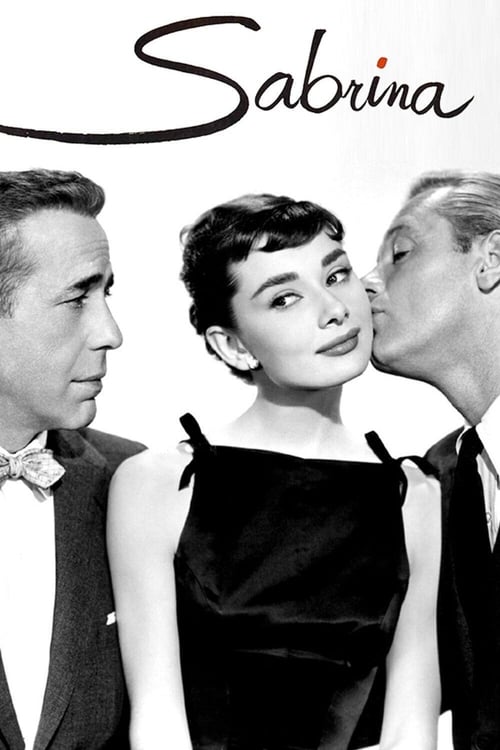
Sabrina
1954 · Billy Wilder
For a cozy night in when you want old-Hollywood glamour and to fall a little in love — champagne-cocktail comfort viewing with a knowing edge. Pure pleasure, no homework.
What it's about
Sabrina, the chauffeur's daughter on a grand Long Island estate, has spent her whole life watching the wealthy Larrabee family's parties from a distance — and adoring David, the family's charming playboy son. When she returns from two years in Paris transformed into an elegant, self-possessed woman, David finally notices her, which is a problem: the family business needs him to marry someone else. Enter Linus, his all-work older brother, who steps in to manage the situation and finds it harder to manage than expected.
The experience
Light on its feet and glowingly romantic, but with a dry, worldly wit running underneath — a fairy tale told by a director who doesn't quite believe in fairy tales, which somehow makes the romance land harder. It's warm, funny, and effortlessly elegant.
Performances
Audrey Hepburn, fresh off her Oscar for Roman Holiday, is luminous — she makes the Cinderella transformation feel like a soul arriving rather than a makeover. Humphrey Bogart, cast far outside his tough-guy lane as the buttoned-up Linus, plays wonderfully against type, and William Holden gives the playboy real sparkle.
The craft
Billy Wilder directs the Cinderella material with his trademark acid intact, so the class fairy tale keeps bumping against real questions of money and what people are worth to each other. The black-and-white photography of estates, boardrooms, and Paris-by-way-of-Hollywood is silvery and luxurious, and Hepburn's wardrobe became instantly iconic.
Why it matters
A defining Audrey Hepburn vehicle that cemented her screen persona and her association with high fashion, and proof that Wilder could bend his cynicism into swooning romance — a template Hollywood has remade and imitated ever since.
Snapshot
Sabrina is Billy Wilder's second film for Paramount after Stalag 17 (1953) and his first outright romantic comedy since The Major and the Minor (1942) — a Cinderella fable assembled by a director whose reputation rested on corrosion. It adapts Samuel A. Taylor's Broadway play Sabrina Fair, which opened in New York in 1953, and it pairs Audrey Hepburn, fresh from her Academy Award for Roman Holiday (1953), with Humphrey Bogart, then near the end of his career, and William Holden, Wilder's Stalag 17 and Sunset Boulevard lead. The premise is a class fairy tale: the chauffeur's daughter watches the Larrabee family's parties from a tree above the tennis court, goes to Paris, returns transformed, and becomes the object of a contest between two brothers.
What distinguishes the film is the friction between that fairy tale and the sensibility administering it. Wilder never quite believed in the wish-fulfillment he was staging, and Sabrina keeps flickering between enchantment and transaction — a merger in sugarcane plastics is as much the film's engine as any romance. It is also, canonically, the film where Hepburn's screen image consolidated into something the culture could copy: the Givenchy wardrobe, the boat-neck gown, the silhouette that outlived the picture by decades.
The production was famously unhappy. Bogart, cast late and out of temperament, was reportedly antagonistic toward Wilder, Hepburn, and Holden alike; Holden and Hepburn were involved off-screen; the shooting script was still being written during production. Some of that discomfort is legible on screen, and not always to the film's detriment — Bogart's stiffness reads as Linus Larrabee's own.
Industry & production
Sabrina belongs to Wilder's Paramount period, the studio where he had worked since arriving as a writer in the late 1930s and where he made Double Indemnity, The Lost Weekend, Sunset Boulevard, Ace in the Hole, and Stalag 17. It was, in fact, near the end of that relationship: Wilder left Paramount after Sabrina and moved into the independent-producer model that would define his later career, most consequentially in his partnership with the Mirisch Company and, from 1957, with co-writer I.A.L. Diamond. So the film sits on a hinge — the last major work of Wilder-as-studio-contract-director before Wilder-as-his-own-producer.
The property was a hot Broadway acquisition. Taylor's Sabrina Fair was a contemporary stage success, and Paramount bought it as a vehicle. Wilder produced as well as directed, and the writing credit went to Wilder, Taylor, and Ernest Lehman — Lehman then early in a screenwriting career that would run through Sweet Smell of Success, North by Northwest, West Side Story, and The Sound of Music. Accounts from Lehman and from Wilder's biographers describe a script that was chronically behind the camera, written in pieces as shooting proceeded, with Lehman under considerable strain. Wilder's usual method was the opposite — long, meticulous pre-production writing with a partner (Charles Brackett through 1950, then a series of collaborators) and comparatively fast, economical shooting. Sabrina inverted that, and the improvisatory pressure shows in a third act that has to work hard to redirect the film's romance from one brother to the other.
Casting drove much of the trouble. Cary Grant is widely reported to have been Wilder's preferred Linus and to have declined; Bogart came in late, on loan and in a register — light comedy, romantic lead opposite a woman thirty years his junior — that suited neither his image nor his mood. The reported friction on set is one of the better-documented Hollywood production feuds of the decade, though as with most such stories the specific insults attributed to Bogart vary by source and should be treated as recollection rather than record. Bogart at this point was in the last phase of a career that would end in 1957; Sabrina falls between The Caine Mutiny and The Barefoot Contessa, both also 1954, a year in which he was working constantly.
Hepburn arrived with enormous momentum. Roman Holiday had made her a star and won her the Oscar; Paramount had her under contract and Sabrina was the follow-up. During pre-production she was sent to Paris for wardrobe and met Hubert de Givenchy, then a young couturier newly established on his own — the beginning of a designer-muse relationship that ran the length of her career. Edith Head received the Academy Award for costume design, and the question of credit for the Paris gowns has been a durable point of contention: Givenchy's contribution was substantial and went unrecognized by the Academy at the time, a fact Head's own later accounts did not fully clarify. The film received several Academy Award nominations, including Best Director for Wilder, Best Actress for Hepburn, and Best Screenplay, and won for costume design.
Technology
Sabrina is a black-and-white, Academy-ratio (1.37:1) studio picture released in the year Hollywood's format panic was at its loudest. This is worth stating plainly, because 1954 is the year of The Robe's aftermath — CinemaScope spreading across the industry, VistaVision debuting at Paramount itself with White Christmas, Technicolor prestige releases everywhere, and the studios throwing width and color at television. Wilder made a small, monochrome, boxed-in comedy in the middle of that. Paramount's own widescreen system, VistaVision, was launched the same year on the same lot; Sabrina did not use it.
The choice reads as deliberate rather than merely economical. Black-and-white in 1954 was already becoming an aesthetic decision rather than a default, and Wilder used it for texture and for the specific gray-scale sheen that Paramount's crews could produce — high-key, glossy, with deep blacks in evening wear. The Academy frame also suits the film's fundamental geometry: doorways, car interiors, an office, a tree branch. Sabrina is a film of thresholds and enclosures, and a wider frame would have diluted them.
Sound is standard optical mono. The production was mostly studio-bound at Paramount, with location work on Long Island's North Shore standing in for the Larrabee estate — the film's establishing exteriors of the great house and grounds do real narrative work in establishing a scale of wealth that the interior sets then confirm.
Technique
Cinematography
Charles Lang shot the film. Lang was one of Hollywood's most decorated cinematographers, with a career reaching back to the silent era and eventually accumulating a very large number of Academy Award nominations — he had won for A Farewell to Arms (1932) and would go on to shoot Some Like It Hot for Wilder in 1959. His work on Sabrina is glossy studio black-and-white of the highest order, and it does two things at once.
First, it manufactures glamour. The Paris transformation has to be visually persuasive or the film collapses, and Lang lights Hepburn to make the change feel like a fact about the world rather than a costume swap — the return-from-Paris sequence at the train station, and the party sequence that follows, are lit to make her legible as a different order of being from the girl in the tree. Second, and less remarked, Lang lights the Larrabee interiors with a coolness that keeps undercutting the fairy tale. The house is beautiful and slightly airless. Linus's office is a place of glass, hard surfaces, and reflected light.
The film's most famous images are compositional rather than lighting effects: Sabrina in the tree, framed above and outside the party; the greenhouse-and-garage world of the servants' quarters set against the mansion; and the Paris cooking-school sequence, which is shot with a genial comic flatness that contrasts deliberately with the polish of everything on the Larrabee estate.
Editing
Arthur P. Schmidt cut the film. Schmidt had edited Sunset Boulevard for Wilder and would work across a long Hollywood career. Wilder's editing philosophy is well attested and consistent: he shot economically, with limited coverage, on the principle that a director who shoots only what he intends to use protects his cut. Sabrina accordingly has a cutting pattern that is unobtrusive to the point of invisibility — long-ish two-shots, cuts motivated by dialogue and movement, very little montage.
The exception is the Paris section, which is compressed and elliptical, carried partly by Sabrina's letters home in voiceover. That compression is structurally necessary: the film cannot dramatize a two-year transformation, so it summarizes one and then presents the result as a shock. The efficiency of that ellipsis is one of the film's best pieces of construction.
Mise-en-scène / staging
The staging is organized around a single spatial idea: above and below, inside and outside. Sabrina begins in a tree, looking down at a party she cannot attend. The Larrabee house has a front and a back, a family and a staff, and the film keeps its characters sorted by which door they use. The garage apartment where Sabrina and her father live is materially comfortable and socially incidental; the mansion is the reverse.
Wilder's blocking is functional and often built around business — objects that give a scene its shape. Two set pieces are famous. The first is the champagne glasses David tucks into his back pockets before sitting down in the indoor tennis court, a gag whose setup, payoff, and consequence (Holden's injury and immobilization) all do plot work. The second is Linus's office and the recurring prop of the hat and the umbrella — the businessman's uniform, which the film eventually has him abandon.
The sugarcane-plastics demonstration is Wilder at his most characteristically double-edged: a scene of corporate showmanship that is also a scene of seduction, in which a man tries to sell a woman a substance made from garbage. The film's cynicism is rarely spoken; it is placed in the room as an object.
Sound
Frederick Hollander (credited variously as Friedrich Hollaender) wrote the score. Hollander was a Weimar-era composer — most famously the songwriter of The Blue Angel — who, like Wilder, emigrated from Germany after 1933 and rebuilt a career in Hollywood; he scored several Wilder films including A Foreign Affair. His work here is light and pliable, with a strong reliance on source-music and standards culture.
The film's decisive musical element is "La Vie en rose," Édith Piaf's signature song, which functions as the sonic marker of Paris and of Sabrina's transformation — a piece of ready-made cultural shorthand rather than a composed theme. "Isn't It Romantic?" (Rodgers and Hart) also recurs; the film uses pre-existing popular song as an emotional index in a way that anticipates a great deal of later romantic-comedy practice.
Sabrina's voiceover letters carry the Paris section. Wilder used first-person narration constantly — Double Indemnity, Sunset Boulevard, and later The Apartment — and here the device is gentler than usual, more epistolary than confessional, but it performs the same function: giving the audience a subjectivity to occupy while the plot restructures itself.
Performance
Three performances pulling in three directions, which is both the film's problem and its interest.
Hepburn plays Sabrina in two distinct registers, and the discontinuity is the point — the pre-Paris girl is gangly, hectic, and adolescent; the post-Paris woman is composed to the point of stillness. Hepburn's technical control of that shift is what makes the film work; she does not merely change clothes, she changes tempo. Her performance is also where the film's fashion legacy lives, since the wardrobe is inseparable from the physical bearing that carries it.
Holden plays David as a lightweight, and does it with real generosity — David is a charming vacancy, and Holden was secure enough as an actor to let the character be one. His broadest sequence, the aftermath of the champagne-glass gag, is played for pure physical comedy.
Bogart is the vexed case. He is manifestly uncomfortable, and the performance is dry, clipped, and withholding where the script increasingly requires warmth. Critics have been divided on this ever since. The defensible reading is that Linus Larrabee is a man who has spent thirty years suppressing himself, and Bogart's rigidity gives that suppression a body; when the character finally softens, the softening is genuinely surprising because the actor has conceded nothing up to that point. The less generous reading — that the miscasting is simply visible — is also available, and Wilder himself in later interviews expressed dissatisfaction with the casting.
Narrative & dramatic mode
The film runs on a bait-and-switch. It establishes a romance (Sabrina and David) and then dismantles it in favor of a different romance (Sabrina and Linus) that emerges from what begins as a manipulation. Linus courts Sabrina not out of desire but to detach her from David so a merger can proceed, and the film's central dramatic question becomes whether the pretense converts into the real thing.
This is Wilder's signature structure. The pattern — a man begins with a scheme and is trapped by feeling — runs through The Major and the Minor, A Foreign Affair, Love in the Afternoon, The Apartment, and Avanti!. It permits Wilder to have the romance and disown it at once: the audience gets the love story, but the love story is built out of deception, so the film never has to be naïve.
The weakness is the ending, and it is a well-known one. The transfer of Sabrina's affection from David to Linus is dramatically underprepared, and the machinery required to get everyone onto the boat is visibly machinery. Taylor's play resolved differently, and the adaptation's compression — plus the fact that the script was being written on the fly — leaves the final movement asserting a change of heart that it has not fully earned. That said, the film is honest about its own contrivance in a way that partially disarms the objection: the last act is openly a fairy tale, complete with a fairy godfather in the person of Linus's father.
The dramatic mode is comedy of remarriage's cousin — not remarriage but reclassification, the comedy of a person changing social category. It shares DNA with the Cinderella plot, with the Lubitsch continental romance, and with the American screwball tradition, but its temperature is cooler than any of them.
Genre & cycle
Sabrina sits in the mid-1950s Hollywood romantic comedy, a cycle in transition. The screwball comedies of the 1930s had been built on velocity, verbal overlap, and class antagonism played as combat. By 1954, the form had slowed, gone glossier, and shifted from combat toward courtship — the sex comedies of the later 1950s (the Doris Day–Rock Hudson cycle, beginning with Pillow Talk in 1959) were coming, and Sabrina is on the road there without arriving.
It belongs equally to a specific mid-century subgenre: the transformation romance, in which a woman is remade by Europe and returns legible to the wealthy world that previously ignored her. Sabrina is arguably the film that codified this for Hollywood, and Hepburn would repeat variants of it — most explicitly in Funny Face (1957), which is a musical restatement of the same idea, and in the Pygmalion structure of My Fair Lady (1964).
The film also belongs to the Wilder cycle of romances between a young woman and a significantly older man, which he returned to repeatedly and which drew criticism even at the time: Sabrina (Hepburn/Bogart), Love in the Afternoon (1957, Hepburn/Gary Cooper), and the reworked material of later films. Wilder was aware of the pattern; it is one of the more discussed aspects of his output.
Authorship & method
Wilder's authorship is a writer's authorship. He came to directing to protect his scripts, and his direction is structurally conservative and verbally aggressive: the camera serves the scene, the scene serves the line, and the line is where the film's intelligence lives. Sabrina is unusual in his filmography for how little of that verbal aggression it deploys — it is his most emotionally open film to that date, and the softness cost him something in control.
The collaborators matter.
Ernest Lehman, co-writer, was brought in with a background in short fiction and magazine work; his contribution to Sabrina — under famously difficult conditions — launched a major screenwriting career. Samuel A. Taylor, the source playwright, shares credit and would later write Vertigo for Hitchcock.
Charles Lang, cinematographer, was a studio master of glamour lighting whose collaboration with Wilder continued through Some Like It Hot.
Frederick Hollander, composer, brought a Weimar-cabaret sensibility that shows up as an ironic lightness under sentimental material — the same quality that made his contributions to A Foreign Affair so effective.
Arthur P. Schmidt, editor, had cut Sunset Boulevard; his work here is deliberately self-effacing.
Edith Head, costume designer, was Paramount's institutional authority on costume and won the Oscar for the film; Hubert de Givenchy designed the Paris clothes that made the film's visual reputation and received no screen credit of comparable weight. The Head/Givenchy dispute is a real and documented point of friction in costume-design history, and it has been revisited repeatedly by scholars of Hepburn's image.
Hal Pereira and Walter Tyler handled art direction; the Larrabee house — a set of tastefully oppressive interiors — is one of the film's quiet achievements.
Wilder's method on Sabrina departed from his norm in one crucial way: he shot without a finished script. He rarely did this, and by his own later account regretted it. The film is thus a partial test case for the value of his usual discipline — the parts written in advance are tighter than the parts written under fire.
Movement / national cinema
Sabrina is American studio filmmaking, but its author is not. Wilder was a Viennese-born, Berlin-trained émigré — a journalist and screenwriter in Weimar Germany who left after 1933 and reached Hollywood by way of Paris. He belongs to the large and consequential cohort of Central European émigrés who reshaped American cinema: Lubitsch, Preminger, Zinnemann, Siodmak, Ophüls, Lang, and many others, with Hollander among the composers.
The specific inheritance here is Lubitsch. Wilder had written for him (Ninotchka, Bluebeard's Eighth Wife) and revered him; the famous sign in his office reading "How would Lubitsch do it?" is one of the most repeated anecdotes in Hollywood history. Sabrina is Wilder's most nakedly Lubitschean film — a continental romance, an ellipsis-driven treatment of desire, a Paris that functions as a transformative idea rather than a place. What Wilder cannot fully reproduce is Lubitsch's lightness. Where Lubitsch would have let the fairy tale float, Wilder keeps grounding it in money.
Paris in the film is a construct — a European elsewhere where an American girl acquires taste. That is a durably American fantasy, and Sabrina is one of its most influential postwar statements, but it is worth noting that a European made it, and made it with a slight ironic distance from the fantasy's sincerity.
Era / period
1954 is a year of institutional strain in Hollywood. Television had taken the audience; the Paramount consent decrees had separated the studios from their theaters; widescreen and color were the industry's technological counter-offensive; and the Production Code was still fully operative but visibly under pressure — Otto Preminger's The Moon Is Blue had been released without a seal in 1953, and Wilder himself would test the Code repeatedly later in the decade.
Sabrina's content is Code-compliant, but its structure quietly registers postwar American preoccupations: corporate consolidation as a social force, plastics as the material of the future (the sugarcane-derived polymer is a joke and a prophecy at once), and a class system the film treats as both permeable and absolutely real. The Larrabees are not aristocracy; they are a business, and the merger is not a subplot but the plot's engine.
The film also sits at the beginning of the Hepburn era — a redefinition of American screen femininity away from the postwar bombshell and toward slenderness, gamine youth, and European polish. That shift is cultural as much as cinematic, and Sabrina is one of its founding documents.
Themes
Class as geography. The film's most consistent idea is spatial. Sabrina's exclusion is expressed as physical position — in a tree, in a garage, behind a door, on the wrong side of a window. Her inclusion is expressed the same way: descending a staircase, entering a room. Wilder never makes a speech about class; he stages it.
Money as the real romance. The merger drives everything. David's marriage to Elizabeth Tyson is a business term; Linus's courtship of Sabrina is a business tactic; the plastic made from sugarcane is the actual object of desire in Linus's life until it isn't. The film's romance is finally a story about a man discovering that his ledger has been wrong.
Transformation and its costs. Sabrina becomes visible by becoming someone else, and the film is more ambivalent about this than its reputation suggests. She is loved for a self acquired abroad. The film's warmest scenes are with her father, who is skeptical of the whole enterprise and who articulates the film's counter-argument — a modest life, honestly assessed — more clearly than anyone else.
Work versus feeling. Linus is a man organized entirely around productive function, and the film treats his emotional atrophy as a genuine injury rather than a comic flaw. Wilder returned to this figure repeatedly, most fully in The Apartment's corporate hierarchy.
Performance and sincerity. Almost every character is playing a part: David plays the charming heir, Linus plays the suitor, Sabrina plays the sophisticate. The film's question is whether a performance sustained long enough becomes true — a question Wilder asked in almost every film he made.
Reception, canon & influence
Critical reception. Sabrina was received as a success on release and was a substantial popular hit; it earned multiple Academy Award nominations, including Best Director, Best Actress, and Best Screenplay, with Edith Head winning for costume design. Contemporary critical response was generally warm, with the recurring reservation — expressed then and ever since — that Bogart was miscast and that the film's second half is less convincing than its first. That double judgment has been remarkably stable across seventy years of criticism.
Wilder's own retrospective view was cool. In interviews and in his conversations with Cameron Crowe (Conversations with Wilder), he spoke about the film's troubled production and the casting problem with characteristic bluntness. Among Wilder scholars, Sabrina is generally ranked below Double Indemnity, Sunset Boulevard, Some Like It Hot, and The Apartment — a very good film in a filmography containing several masterpieces — while being acknowledged as pivotal for Hepburn.
Influences on the film (backward). Three lines feed in. First, Lubitsch — the continental romantic comedy, the elliptical treatment of sex, the Paris of the imagination; Ninotchka, which Wilder co-wrote, is a direct antecedent in its structure of transformation-by-elsewhere. Second, the American screwball and Cinderella comedies of the 1930s, particularly the class-crossing romances of Frank Capra and the transformation plots of the Depression era. Third, the theatrical source: Taylor's Sabrina Fair was a drawing-room comedy, and the film retains a stage architecture of rooms and entrances even as it opens the material out.
Behind all of this stands Pygmalion — Shaw's play and the broader myth — which Sabrina refashions by making the transformation self-directed. Sabrina goes to Paris and remakes herself; there is no Higgins. That is a meaningful revision, and it is the reason the film has aged better than some of its descendants.
Legacy (forward). The film's largest legacy is not cinematic but visual-cultural. The Hepburn-Givenchy collaboration begun here established a template for on-screen fashion that ran through Funny Face, Breakfast at Tiffany's, Charade, and beyond, and made Hepburn the most durably imitated style figure produced by Hollywood. The specific garments — the boat-neck "Sabrina neckline," the black cocktail dress, the cropped trousers and flats — entered the general vocabulary of fashion. Few films have exported a silhouette this successfully.
Structurally, Sabrina helped codify the makeover romance as a Hollywood staple, a form that runs forward through decades of romantic comedy. Its Paris-as-transformation trope became so standard that later films could invoke it in shorthand.
Within Wilder's own work, Sabrina is a rehearsal. The scheme-that-becomes-real structure, the corporate setting, the man hollowed out by work, the woman who forces a reckoning — all return, refined and darkened, in The Apartment (1960), which is the film Sabrina is reaching toward. The Hepburn-and-older-man romance returns directly in Love in the Afternoon (1957), again with Paris as the setting.
The film was remade by Sydney Pollack in 1995 with Julia Ormond, Harrison Ford, and Greg Kinnear — a respectful, softer version that resolved the original's tonal contradictions by removing them, and which is generally regarded as the lesser film precisely for that reason. The remake's existence is itself evidence of the original's status as a durable commercial property.
Sabrina remains in wide circulation, is a fixture of Hepburn retrospectives and Wilder retrospectives alike, and has been released in restored editions by major home-video labels. Its position in the canon is secure but specific: not Wilder's best film, and one of the most consequential star vehicles ever made.
A Deleuzian reading
A girl sits in a tree.
The full Deleuzian reading of Sabrina →
Reception
A hit with seven Oscar nominations in 1954, it's now filed as 'minor Wilder but major Hepburn' — modern viewers adore the fairy-tale charm while side-eyeing the 30-year age gap between Audrey Hepburn and Humphrey Bogart far more than 1954 audiences did.
How Sabrina was received, from release to now →
How to watch Sabrina: what to notice on a first viewing
- Watch which door or level each character uses. Sabrina opens the film in a tree above a party she was not invited to. She lives over the garage. The Larrabee house has a front and a back, and Wilder sorts everyone by the entrance they take. Class here is geography. Nobody makes a speech about it because position in the house already says it.
- Follow the props: two champagne glasses, a hat, an umbrella. Wilder builds scenes around objects. David tucks flutes into his back pockets before he sits down. Linus carries a businessman's hat and umbrella everywhere. Each object gets a setup and a consequence. The gag does in four seconds what a confession scene would need a page to do badly. Objects carry the plot and the joke together.
- Watch how fast Hepburn moves before Paris and after. The pre-Paris Sabrina is gangly and hectic. The returning one is composed nearly to stillness. Hepburn changes her tempo, not only her clothes, and the Givenchy wardrobe works because her bearing carries it. The film never dramatizes the two years abroad. The change has to be legible in a body, and it is.
- Compare the light in Linus's office to the light at the party. Charles Lang gives evening wear deep blacks and a silver glow. Then he lights the Larrabee interiors and the office with glass, hard surfaces and cool reflection. The mansion is beautiful and slightly airless. The same cinematographer manufactures the fairy tale and quietly undercuts it, so glamour and chill sit in the same house.
- Listen for La Vie en rose and note where it arrives. Frederick Hollander's score stays light and leans on standards. Piaf's song works as ready-made shorthand for Paris rather than as a composed cue, and Sabrina's letters home carry the trip in voiceover. Borrowed songs let the film skip two years of story. You hear the transformation instead of watching it happen.
The whole guide to watching Sabrina, with the keys for a rewatch →
Influences: the films it descends from and the films it influenced
- Trouble in Paradise (1932) — Establishes the con-that-becomes-real armature and Lubitsch's habit of routing erotic and financial information through handled objects rather than dialogue — the substitution Wilder repeats with the champagne flutes slipped into Linus's trouser pocket and the sugarcane-plastic demonstration that doubles as a seduction.
- It Happened One Night (1934) — Codifies the class-inversion romance and the prop-as-barrier method (the hung blanket) that stages desire through obstacles rather than contact, which Sabrina converts into threshold props — the tree, the garage doors, the tennis court hammock — that keep the lovers physically bracketed.
- Desire (1936) — Charles Lang's diffused silver-black key on Dietrich, developed under Lubitsch's production supervision, is the exact glamour lighting Lang later brings to Hepburn in Sabrina, where the star's face is treated as the film's principal optical effect.
- My Man Godfrey (1936) — Builds an entire comedy out of servant's-eye staging — the help watching the rich family from below stairs — supplying the vertical blocking grammar Sabrina formalizes as chauffeur's-apartment-over-the-garage and girl-in-the-tree looking down on the terrace party.
- Midnight (1939) — Wilder and Brackett's own Paris masquerade, in which a working girl's imposture is financed by a wealthy man and then turns sincere; Sabrina keeps the machinery and inverts the ownership by having the woman author and pay for her own transformation.
- Ninotchka (1939) — Wilder co-wrote the template of transformation-by-elsewhere, where a single secretly purchased garment (the hat) is the only visible register of interior change — Sabrina externalizes the same device across an offscreen Paris and a Givenchy wardrobe that reports the change the script never states.
- The Shop Around the Corner (1940) — Runs a romance entirely on letters read aloud while the correspondents misread each other face to face; Sabrina lifts the read-aloud-letter device intact for the Paris correspondence to her father, using it to cover a two-year ellipsis without a single expository scene.
- A Foreign Affair (1948) — Wilder and composer Friedrich Hollaender work out the method of letting one diegetic, on-screen-performed song carry the subtext a Production Code scene cannot state — Hollaender scores Sabrina too, and 'La Vie en Rose' does that identical errand at the indoor tennis court.
- Sunset Boulevard (1950) — Opens with narration that has already judged the story before the first scene plays, setting an ironic contract with the audience; Sabrina swaps the dead man for a fairy-tale 'once upon a time on the North Shore of Long Island' but keeps the pre-judged voice structure exactly.
- Roman Holiday (1953) — Wyler establishes how to photograph Hepburn — long takes, minimal makeup, the camera holding on her reaction rather than cutting to it — and the Edith Head aristocrat-in-disguise silhouette; Wilder cast her off this film and reversed the premise, sending the servant up instead of the princess down.
- Love in the Afternoon (1957) — Wilder immediately re-runs the Hepburn-and-older-tycoon pairing with Paris as the actual location, and hardens Sabrina's one-scene diegetic song into a structural device: a gypsy quartet that physically trails the couple, an on-screen orchestra that scores the romance in the frame.
- The Apartment (1960) — Rebuilds Sabrina's corporate vertical as literal architecture (executive floor above, clerical pool below), reuses the scheme-that-becomes-love and the near-suicide rescued by the schemer, and refines prop-driven business — the tennis racket straining spaghetti is the direct heir of the pocketed champagne glasses.
- Breakfast at Tiffany's (1961) — Pairs the Givenchy silhouette Sabrina introduced with a signature song performed diegetically by the star herself as the character's only honest disclosure — the 'Moon River' fire escape scene is the technique Sabrina models with 'La Vie en Rose.'
- Charade (1963) — Charles Lang photographs Hepburn in Paris again with the same soft-key glamour scheme he built for Sabrina, while the plot systematizes the bait-and-switch romance by making the man's identity the film's running variable rather than a single second-act reveal.
- Working Girl (1988) — Transposes Sabrina's above-and-below staging into 1980s Manhattan as literal geography — ferry deck to executive tower — and keeps the makeover as self-authored strategy rather than gift, the revision Sabrina made to the Pygmalion plot.
- Pretty Woman (1990) — Runs the Hollywood makeover-romance beats Sabrina helped standardize — the shopping montage substituting for interior change, the transaction that turns sincere — but restores the Pygmalion patron Sabrina had deliberately removed, which is why it reads as the older form.
- Sabrina (1995) — Remakes the script while abandoning the Academy-ratio drawing-room staging of entrances and thresholds for widescreen shot-reverse coverage, and evens out the brothers' asymmetry — demonstrating by subtraction how much of the original's tension lived in Wilder's blocking rather than his dialogue.
- The Devil Wears Prada (2006) — Codifies the Cinderella makeover reveal — the plain girl restyled abroad into elegance (Hepburn's Paris return) — the exact structural beat Andy's mid-film wardrobe transformation replays.
- What a Way to Go! (1964) — Edith Head's costume-as-narrative-argument — wardrobe marking a heroine's transformation — is the technique WAWTG amplifies into 'costume-as-structure' and escalating sartorial excess.
- How to Steal a Million (1966) — Origin of the Hepburn–Givenchy contract and of couture framing: the camera holds the figure full-length and lets the garment complete a plot beat, a shot-length discipline Lang repeats for the white lace and black eyelet ensembles.
- Funny Face (1957) — Takes Sabrina's elliptical Paris-as-transformation montage — a passage the earlier film handles offscreen in letters — and makes it the movie's literal subject, extending the Hepburn–Givenchy pipeline by moving the couturier from behind the credits into the plot.
Similar films
- Charade (1963) — influence & lineage · same viewing thread
- Breakfast at Tiffany's (1961) — influence & lineage · same viewing thread
- Roman Holiday (1953) — influence & lineage · same viewing thread
- Midnight (1939) — influence & lineage · same viewing thread
- Sunset Boulevard (1950) — influence & lineage
- It Happened One Night (1934) — influence & lineage
- Trouble in Paradise (1932) — influence & lineage · same viewing thread
- Some Like It Hot (1959) — same viewing thread
All the films related to Sabrina →
Watch it with: curated runs of related films
- Fast Talk & Fur Coats — A run of quick-witted charmers who disguise, con, and sweet-talk their way across class lines — watch them near each other and the century between Lubitsch and Sean Baker collapses into one long, glittering grift.