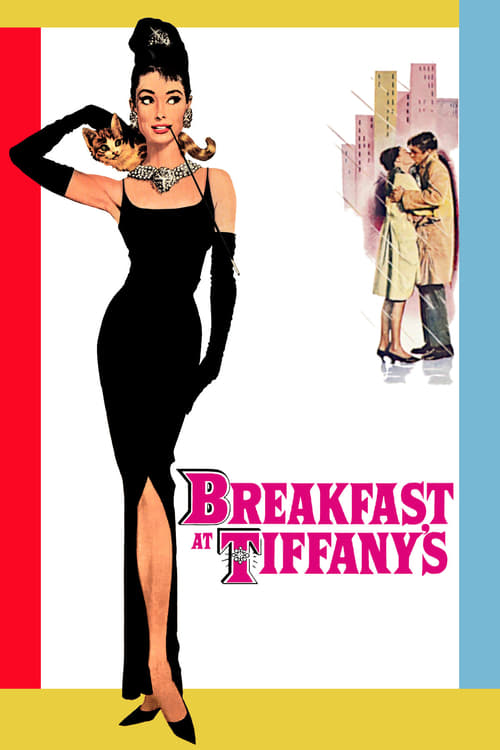
Breakfast at Tiffany's
1961 · Blake Edwards
For a dressed-up, nostalgic night in — when you want old-Hollywood glamour and a love story, but with enough melancholy to feel like more than candy. Pure comfort viewing with a bruise in the middle.
What it's about
Holly Golightly is a self-invented Manhattan party girl who lives on charm, cocktail invitations, and the generosity of rich men, with her sights set on marrying a Brazilian millionaire. When a broke young writer moves into her brownstone, the two drift into each other's lives — and the past Holly has carefully reinvented herself away from starts knocking at the door. It's a romance, but also a portrait of two people financing their glamour in ways neither wants to say out loud.
The experience
Glossy and effervescent on the surface, with a persistent ache underneath — party scenes fizz along, then a quiet moment at a window catches you off guard. It's the rare romantic comedy that leaves you a little wistful even when it's making you smile.
Performances
Audrey Hepburn turns what could have been a brittle socialite into one of cinema's most beloved characters — all sparkle and armor, with loneliness flickering just behind the sunglasses. It's the role that fixed her image in the popular imagination.
The craft
Blake Edwards shoots New York as a dream of itself — the dawn shot of Hepburn at the Tiffany's window, croissant in hand, is one of the most imitated images in movies. Henry Mancini's score, built around the wistful 'Moon River,' does as much emotional work as the script, and the whole thing glows in early-sixties Paramount color.
Why it matters
It made Holly Golightly — the little black dress, the cigarette holder, the up-do — a permanent piece of pop iconography, and defined a fantasy of single life in New York that romantic comedies have been chasing ever since.
Snapshot
Breakfast at Tiffany's is the film that fixed Audrey Hepburn — and a particular dream of New York — in the popular imagination more durably than almost any other single image of the 1960s. Adapted from Truman Capote's 1958 novella by screenwriter George Axelrod and directed by Blake Edwards for Paramount, it transposes the story of Holly Golightly, a self-invented Manhattan party girl living on the generosity of men, into a glossy romantic comedy with a melancholic underside. The film is best understood as a negotiation: between Capote's cooler, sadder, more sexually frank source and the romantic-comedy machinery Hollywood imposed on it; between Hepburn's gamine elegance and the call-girl reality the story only obliquely names; and between a genuinely modern portrait of female autonomy and the conventional coupling that closes it down. Its surfaces — the little black dress, the cigarette holder, the dawn pastry outside the jeweler, Henry Mancini and Johnny Mercer's "Moon River" — have outlived nearly every argument about the picture, which is both the source of its enduring appeal and the reason it now arrives freighted with critical reservation, above all over Mickey Rooney's caricatured yellowface performance.
Industry & production
The film was produced at Paramount by Martin Jurow and Richard Shepherd, who had acquired the rights to Capote's novella. Capote was famously dissatisfied with the result; he had wanted Marilyn Monroe for Holly Golightly, a casting that would have pushed the character toward the overt sexuality of the original, and he regarded Hepburn as miscast. The studio's preference for Hepburn — and for George Axelrod's softening rewrite — reflects the commercial logic of early-1960s Hollywood, then managing the decline of the studio system and the constraints of a still-active Production Code that made the novella's frank treatment of a woman who is, in plain terms, a sex worker impossible to render directly. Axelrod's screenplay accordingly sublimates Holly's profession into euphemism ("fifty dollars for the powder room") and invents a reciprocal romance, recasting Capote's nameless, arguably gay narrator as the heterosexual, kept writer Paul Varjak.
Blake Edwards was at a transitional point, moving from television and lighter comedies toward the broader career that would include Days of Wine and Roses (also 1962) and the Pink Panther series. Breakfast at Tiffany's gave him his first major prestige success. The casting around Hepburn drew on reliable studio talent: George Peppard as Paul, Patricia Neal as the wealthy "2E" who keeps him, Buddy Ebsen in the quietly devastating role of Doc Golightly (the country husband who reveals Holly's invented identity), and Martin Balsam as the agent O.J. Berman. The production filmed on location in New York — most famously the dawn exterior at Tiffany & Co.'s Fifth Avenue store — alongside studio interiors. The single most damaging production decision in retrospect was the casting of Mickey Rooney, in heavy makeup and prosthetic teeth, as the Japanese photographer Mr. Yunioshi; Edwards in later years expressed regret over it.
Technology
The film was shot on 35mm in Technicolor, in the standard widescreen ratio of its era rather than an anamorphic scope format, a choice consistent with a character-driven romantic comedy rather than a spectacle picture. The most consequential technologies at work are less photographic than musical and promotional. Henry Mancini's score, and "Moon River" in particular, arrived at the moment the film soundtrack was becoming a commercial product in its own right; Mancini was among the figures who helped make the LP soundtrack and the spun-off pop single central to a film's afterlife. The song's success across multiple recorded versions illustrates how, by the early 1960s, a movie's music could circulate as an independent commodity that fed back into the film's reputation. Beyond this, the production relied on conventional sound-stage and location filmmaking of the period; it is not a film whose interest lies in technical novelty.
Technique
Cinematography
The cinematography is credited to Franz Planer, the Austrian-born veteran who had also photographed Hepburn in Roman Holiday (1953) and understood how to frame her. Planer's work here is polished and unaggressive, organized around two registers: the bright, postcard New York of the daytime and party scenes, and the softer, more intimate lighting of the apartment interiors and the rain-soaked finale. The celebrated opening — Hepburn alone on a deserted Fifth Avenue at dawn — is the film's most considered image, using the empty, even early light and the long, quiet street to isolate Holly against the shuttered luxury she covets. Elsewhere the camera is largely deferential to performance and décor, holding compositions that let Hepburn, the costumes, and the Givenchy silhouette read clearly.
Editing
The editing, credited to Howard Smith, serves the film's tonal oscillation between comic set-pieces and emotional scenes. The bravura sequence is Holly's cocktail party, an exercise in choreographed crowding and overlapping incident — the woman weeping at the mirror, the spreading chaos — cut for escalating comic density. Against this, the dramatic scenes (Doc's arrival, the climactic taxi argument and reconciliation) are paced more patiently. The film's structure depends on this rhythm of party-comedy giving way to disclosure, and the cutting manages the transitions without calling attention to itself.
Mise-en-scène / staging
Mise-en-scène is arguably the film's true subject. Holly's apartment — sparsely furnished, half-unpacked, a bathtub repurposed as a sofa — is a precise visual statement of a life held provisionally, by someone who refuses to belong anywhere ("I'll never get used to anything. Anybody that does, they might as well be dead"). The contrast between this emptiness and the burnished interior of Tiffany's, where Holly takes Paul to be soothed, externalizes her longing for security and permanence. Costume is inseparable from staging here: the black sleeveless Givenchy gown of the opening, the wardrobe associated with Hubert de Givenchy's collaboration with Hepburn (with Edith Head credited as the film's costume designer), and the cigarette holder all function as character architecture, building Holly as a self-authored image whose poise is also a disguise.
Sound
The sound design is dominated by Mancini's score, but the film's most discussed sonic moment is diegetic: Holly, in jeans and a towel, sitting on the fire escape and singing "Moon River" to her own guitar. The intimacy of that performance — a small, unadorned voice rather than a trained one — is precisely the point, locating the character's wistfulness in a single quiet scene. A frequently repeated production anecdote holds that a studio executive wanted the song cut from the film and that Hepburn objected; whatever its exact details, the episode underscores how nearly the picture lost its signature element.
Performance
The film lives or dies on Hepburn, and she carries it. Her Holly is a performance of performance — a Texas country girl named Lula Mae Barnes who has built "Holly Golightly" as a continuous act of self-fashioning — and Hepburn finds the loneliness beneath the chic. It is a register quite different from the gamine ingénue of her earlier work, asking her to play brittleness, evasion, and sudden grief. Peppard is the weaker presence, handsome but somewhat inert as Paul. The supporting performances supply the film's gravity: Buddy Ebsen's Doc, with his soft-spoken account of the child bride he lost, punctures the comedy and reframes everything we have seen; Patricia Neal brings worldly hardness to 2E. Rooney's Yunioshi stands entirely apart — a broad, demeaning racial caricature that no defense of period context has rehabilitated, and which is now central to any honest account of the film.
Narrative & dramatic mode
The narrative mode is romantic comedy braided with a coming-to-truth drama. On the surface it follows the courtship structure: two beautiful, financially dependent people (she kept by suitors, he kept by 2E) meet, spar, and fall in love. Beneath it runs a darker study of evasion and self-deception, in which Holly's relentless forward motion — toward a Brazilian millionaire, toward an imagined future of belonging — is gradually revealed as flight. The dramatic engine is disclosure: the steady stripping-away of Holly's invented self, through O.J. Berman's account of her reinvention, through Doc's arrival, through her brother Fred's death, culminating in the rain-soaked climax where she must choose between perpetual escape and attachment. Axelrod's screenplay resolves this tension with a conventional romantic affirmation — Holly retrieves the cat she has thrown out, and embraces Paul — that supplies emotional catharsis at the cost of the open, sadder irresolution of Capote's novella, in which Holly slips away for good.
Genre & cycle
The film sits within the early-1960s cycle of sophisticated urban romantic comedies — adjacent to the Doris Day–Rock Hudson pictures and the broader vogue for glamorous, sexually knowing-but-Code-bound stories of single life in the city. It also belongs to the lineage of New York "career girl" films and to Hepburn's own cycle of fashion-forward romances. What distinguishes it is the unstable mixture of that bright comedic mode with genuine pathos and with a heroine whose livelihood the genre cannot quite name. The result is a hybrid that helped define a strain of bittersweet romantic comedy, and it became a touchstone for the "single woman in the city" archetype that later film and television repeatedly revisited.
Authorship & method
The film is a product of several authorships in tension. Blake Edwards directs with an evident gift for the comic set-piece (the party) and a willingness to let the melancholy scenes breathe, though the film is less a personal statement than a skilled act of orchestration. George Axelrod, the screenwriter (himself a Broadway comedy specialist, author of The Seven Year Itch), is the decisive shaping intelligence, responsible for the softening of Capote and the invention of the reciprocal romance. Franz Planer's cinematography supplies the polished surface; Howard Smith's editing the rhythm. But the collaborator whose contribution most defines the film's legacy is Henry Mancini, whose score and song (with lyricist Johnny Mercer) give the picture its emotional through-line. Hepburn, working again with Givenchy on costume, is herself effectively a co-author of the film's iconography. Capote, the originating author, is best understood here as a dissenting voice — the film is in large part a transformation against his intentions.
Movement / national cinema
Breakfast at Tiffany's is mainstream American studio filmmaking, not part of any avant-garde or art-cinema movement. It does, however, register the period's currents indirectly: a tentative loosening of the Production Code's grip on adult subject matter, visible in how much the film implies without stating, and an embrace of a chic, internationalized glamour (the Givenchy connection, the European-trained Hepburn) that aligned American romantic comedy with a transatlantic idea of style. It is a New York film in setting and self-image, contributing to the cinematic mythology of Manhattan as the natural habitat of reinvention.
Era / period
The film is a near-perfect artifact of the threshold between the 1950s and the 1960s. It reflects the lingering Production Code in its euphemisms, the studio system in its production model, and a pre-feminist culture in its ultimate insistence on marriage as resolution — yet it also gestures forward, toward a decade in which female independence, sexual frankness, and single urban life would become explicit screen subjects. Holly Golightly is, in this sense, a transitional figure: a woman whose autonomy the film both celebrates and finally contains. The Rooney caricature, similarly, marks the era's casual racism with painful clarity, which is part of why the film now functions as a historical document as much as an entertainment.
Themes
The governing theme is self-invention and its cost — Holly as a person who has authored herself out of a hardscrabble past and cannot stop performing the result. Around it cluster: belonging versus freedom, dramatized in the recurring motif of the unnamed cat ("a no-name slob" who, like Holly, "belongs to nobody") and resolved only when Holly claims it; the commodification of intimacy, with both leads living off others and Tiffany's standing as the temple of purchasable security; loneliness beneath glamour; and the gap between identity and authenticity. "Moon River," with its "huckleberry friend" and its yearning for an unreachable destination, distills the film's central feeling: a homesickness for a place and a self that may not exist.
Reception, canon & influence
On release the film was a commercial and largely critical success and earned five Academy Award nominations, winning two — Best Original Score for Mancini and Best Original Song for "Moon River" by Mancini and Mercer — with further nominations including Hepburn for Best Actress and Axelrod for his screenplay. (I am avoiding specific box-office figures, which I cannot verify precisely.) Hepburn's Holly became one of the defining star images of the era, and the film entered the canon as much through its iconography as its narrative.
Looking backward, the film draws on Capote's novella as its essential source, on the tradition of the sophisticated stage and screen comedy that was Axelrod's idiom, and on Hepburn's established persona from Roman Holiday and Sabrina, including her prior partnership with Givenchy. Looking forward, its influence is enormous but selective: the opening image, the black dress, and the cigarette holder became among the most reproduced visual references in popular culture, fashion, and advertising; "Moon River" became a standard recorded by countless artists; and the figure of the stylish, independent, romantically searching single woman in New York reverberates through decades of subsequent film and television. That legacy is now held in tension with sustained criticism of the Yunioshi caricature, which has made the film a standard case study in how a beloved classic can carry an indefensible element — so that its modern reception is double, celebrating the iconography while reckoning honestly with the racism, and noting too how thoroughly the movie sweetened the sharper, sadder book it came from.
A Deleuzian reading
A yellow cab stops on an empty Fifth Avenue at first light.
The full Deleuzian reading of Breakfast at Tiffany's →
Reception
A hit in 1961 that won Oscars for 'Moon River,' it's since become a strange double object: the Hepburn iconography only grew more beloved while Mickey Rooney's yellowface Mr. Yunioshi turned into one of classic Hollywood's most cited embarrassments — even Blake Edwards later said he wished he could recast it.
How Breakfast at Tiffany's was received, from release to now →
Influences: the films it descends from and the films it influenced
- Roman Holiday (1953) — Established the Hepburn gamine persona — the runaway playing at another identity, patrician fragility under impish charm — that Axelrod and Edwards retool wholesale into Holly Golightly.
- Sabrina (1954) — First Hepburn–Givenchy collaboration, inventing the costume-as-character method (the silhouette announces the woman's transformation) that Tiffany's perfects in the opening black sheath.
- The Seven Year Itch (1955) — Axelrod's own play and screenplay; its brittle, innuendo-laced sophisticated-comedy idiom about apartment-bound desire is the exact dialogue register he imports into Tiffany's.
- Funny Face (1957) — Staged Hepburn as pure couture spectacle photographed against high-style surfaces, codifying the fashion-icon framing that Planer's Fifth Avenue dawn shot would distill into a single image.
- The Apartment (1960) — Made the provisional Manhattan apartment a moral space and ran comedy over loneliness at the Production Code threshold of kept relationships — the exact tonal and spatial scheme Tiffany's adopts.
- Laura (1944) — Pioneered the single recurring theme-melody (Raksin's) as a film's emotional through-line and obsession-object — the structural template Mancini extends with 'Moon River.'
- Pillow Talk (1959) — Set the glossy Technicolor sophisticated-urban-romcom template — split-life deception, glamorous surfaces, a disclosure engine — that Tiffany's inherits as its genre chassis.
- Peter Gunn (1958) — Birthed the Edwards–Mancini partnership and its jazz-scored, LP-as-commodity sound, the working method and aesthetic Mancini carries directly into the Tiffany's score.
- Days of Wine and Roses (1962) — Edwards–Mancini–Mercer reunite the very next year on the same formula — a hummable Oscar-winning theme floated over melancholy beneath a polished surface.
- Charade (1963) — Reassembles the exact Tiffany's package — Hepburn styled by Givenchy, scored by Mancini, in a glamorous urban romance — confirming the star-couture-score unit as a portable brand.
- The Pink Panther (1963) — Scales Edwards's signature comic set-piece (the cocktail-party logic of bodies colliding in a confined space) into full farce, again anchored by a Mancini theme-as-trademark.
- Klute (1971) — Takes the Manhattan call-girl heroine in the serious, psychologically exposed direction Capote's novella implied — the dark answer to the romance Axelrod sweetened away.
- Annie Hall (1977) — Extends the stylish, independent, romantically searching single woman in New York whose wardrobe is an act of self-authorship — the Holly figure relocated to the neurotic-realist register.
- Pretty Woman (1990) — Reruns the self-invention/makeover arc and the kept-woman-redeemed-by-romance plot, with couture montage as transformation — Holly's structure sanitized for the blockbuster era.
- Sex and the City (1998) — Franchises the iconography directly — the stylish single woman as fashion-plate navigating New York romance — treating clothing and the city as the heroine's defining authorship, Holly multiplied.
- The Devil Wears Prada (2006) — Builds its whole arc on costume-as-character — the provincial reinventing herself in Manhattan through clothes — the Givenchy-sheath logic of Tiffany's made the film's central device.
- The Notebook (2004) — The cathartic rain-drenched reunion kiss as romantic climax — the storm-soaked embrace that the Notebook's rain-reunion kiss directly quotes.
- The Party (1968) — Its extended cocktail-party sequence is the prototype deep-staged ensemble mayhem, and rehearses the Edwards–Mancini blend of chaos laced with romantic lyricism.
Similar films
- Roman Holiday (1953) — influence & lineage · same viewing thread
- Sabrina (1954) — influence & lineage · same viewing thread
- Charade (1963) — influence & lineage · same viewing thread
- Annie Hall (1977) — influence & lineage
- How to Steal a Million (1966) — same viewing thread
- Midnight (1939) — same viewing thread
- Bringing Up Baby (1938) — same viewing thread
- The Apartment (1960) — influence & lineage · often watched together
All the films related to Breakfast at Tiffany's →
Watch it with: curated runs of related films
- Fast Talk & Fur Coats — A run of quick-witted charmers who disguise, con, and sweet-talk their way across class lines — watch them near each other and the century between Lubitsch and Sean Baker collapses into one long, glittering grift.