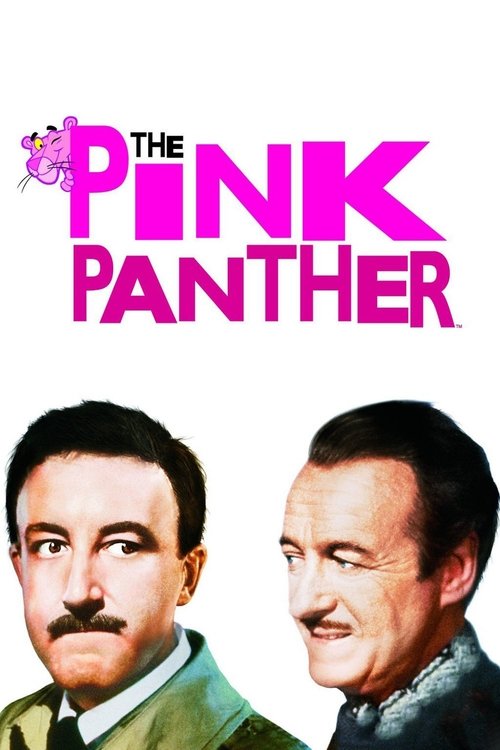
The Pink Panther
1963 · Blake Edwards
For a light, stylish night when you want to laugh without a single heavy moment — perfect with company, a drink, and no cares. All comfort, zero challenge.
What it's about
A world-famous jewel thief known as the Phantom — calling card: a single glove — is circling the fabulous 'Pink Panther' diamond at a glamorous Alpine ski resort. On his trail comes Inspector Clouseau, a French detective whose confidence is total and whose competence is a rolling catastrophe. Around them swirls a plush comedy of seductions, disguises, and mistaken identities among the rich and beautiful.
The experience
Breezy, glamorous, and increasingly hilarious — it starts as a suave caper and keeps erupting into perfectly built slapstick, the kind where you see the disaster coming and laugh anyway. Pure champagne, with pratfalls.
Performances
Peter Sellers walks off with the entire film as Clouseau — a masterclass in physical comedy and wounded dignity that spawned a franchise — while David Niven supplies the silky charm the movie was originally built around.
The craft
Blake Edwards stages slapstick with an elegance few directors ever managed, choreographing chaos across glossy widescreen frames of Alpine resorts and grand hotels. Henry Mancini's slinky jazz theme and the animated pink cat of the title sequence are as famous as anything in the film itself.
Why it matters
It launched one of the most durable comic franchises in movie history and made Clouseau — a supporting character who stole the picture — an icon of screen comedy, with Mancini's theme instantly recognizable ever since.
Snapshot
The Pink Panther is a glossy, internationally minded caper comedy that became famous less for the story it set out to tell than for the supporting character who quietly stole it. Conceived as a sophisticated romantic farce centered on a suave jewel thief, Sir Charles Lytton (David Niven), the film was overtaken in the editing and in the public imagination by Peter Sellers' Inspector Jacques Clouseau, the accident-prone French detective whose physical disasters and wounded dignity would launch one of the most durable comic franchises in cinema. Released by United Artists in 1963 (with a New York premiere in early 1964), the film married Blake Edwards' taste for elegant widescreen slapstick to Henry Mancini's instantly iconic jazz theme and Friz Freleng/David DePatie's lithe animated cat over the titles. The result was a transitional object: part Lubitsch-flavored continental sex comedy, part vaudevillian pratfall machine, and the seed of a series that pivoted decisively toward the second mode. It is best understood as the moment a star, a composer, and a director discovered a comic instrument none of them had fully planned.
Industry & production
The film was an independent production financed and distributed through United Artists, the studio that had built much of its postwar identity on backing producer- and talent-driven packages rather than maintaining a traditional contract roster. It was shot largely in Italy — at Cinecittà and in the Alpine resort settings that stand in for the fictional Tyrolean and Roman locales — reflecting the era's strong economic logic of "runaway" European production, where favorable costs, location glamour, and international co-financing made the Continent attractive for Hollywood-facing pictures. The casting history is the production's defining drama: the project was built around Peter Ustinov as Clouseau and Ava Gardner, with David Niven as the marquee romantic lead. Ustinov departed before shooting, and Sellers was brought in to replace him — a substitution that reoriented the film's center of gravity, because Sellers and Edwards rapidly expanded Clouseau's business through improvisation and elaborated gags on set. The shift is the clearest production fact of the film: a picture sold on Niven's sophisticate became, in practice and then in reception, a Sellers vehicle. United Artists' subsequent decision to fast-track a Clouseau-forward sequel, A Shot in the Dark, the very next year confirms how thoroughly the studio read the audience's response.
Technology
The Pink Panther was made with the standard high-end tools of early-1960s color spectacle: anamorphic widescreen photography and Technicolor processing, deployed for a luxe, postcard-bright look appropriate to a film about wealth, leisure, and resort settings. The most consequential technological contribution is arguably not photographic but graphic and musical. The animated title sequence — produced by Friz Freleng and David DePatie's newly independent animation operation — established a vogue for character-driven, narratively self-contained main-title cartoons, an approach that itself owed a debt to Saul Bass's graphic title revolution but pushed it toward standalone comic performance. The pairing of that animation with Mancini's recorded theme demonstrates the period's increasing sophistication in integrating soundtrack, brand, and marketing: the title cat and the saxophone line functioned as a portable identity that could outlive any single film, and in fact did, spinning off into an entire television and merchandising afterlife.
Technique
Cinematography
The photography favors bright, even, glamour-forward lighting and the controlled deep space of anamorphic widescreen. Edwards consistently used the wide frame as a comic stage: the format's horizontal breadth lets him hold full figures and multiple players in a single shot, which is essential to his style of physical comedy built on geography, timing, and the relationships between bodies and objects within a continuous space rather than on cutting. The Alpine and Roman exteriors are shot for travelogue appeal, reinforcing the film's atmosphere of moneyed international leisure. The look is unfussy and classical; the camera serves the performers and the architecture of the gags.
Editing
The film's editing logic is shaped by Edwards' preference for the sustained comic take. Where much screen comedy is "saved" or sharpened in the cutting room, Edwards' farce depends on letting an action play out so the audience can see cause and effect uninterrupted — the slow-building catastrophe rather than the quick punchline. The larger and better-documented editorial story, however, is structural: the rebalancing of the film around Clouseau. The accumulation of Sellers' physical set-pieces shifted the picture's weight away from the Niven plot, and the comparative energy of those sequences is part of why audiences and the studio came away convinced the detective, not the thief, was the film's true subject.
Mise-en-scène / staging
Staging is where the film is most distinctly Edwards. His comedy is architectural: doors, beds, bathrobes, hotel suites, and the precise positioning of who is hiding where become the engine of farce. The celebrated bedroom sequence — multiple would-be lovers and intruders cycling through a single suite while remaining improbably unaware of one another — is staged as classical bedroom farce, dependent on entrances, exits, and the audience's privileged knowledge of a geography the characters cannot see whole. Clouseau's gags are similarly object-driven: a spinning globe, a recalcitrant suit of armor, a violin case, all turned into instruments of dignified self-destruction. The mise-en-scène treats elegance and pratfall as a single continuous texture, the luxury of the settings making the physical indignities funnier by contrast.
Sound
Sound is dominated, definitively, by Henry Mancini's score and above all "The Pink Panther Theme," with its slinking, chromatic saxophone line (the tenor sax solo famously associated with Plas Johnson). The theme is one of the most recognizable pieces of film music ever written, and it does real narrative work, coding the film's world as cool, sly, and sophisticated — the sound of the thief rather than the bumbling cop. Mancini, already Edwards' regular collaborator, supplies a jazz-inflected idiom that locates the picture firmly in the early-'60s lounge-modern sensibility. The film's verbal comedy, meanwhile, lays early groundwork for the Clouseau character's later signature: the malapropism and the strangled French accent, which Sellers would inflate into the franchise's central running joke in subsequent entries.
Performance
Performance is the film's deepest subject and its lasting legacy. Sellers builds Clouseau out of a contradiction — total physical incompetence married to total, unshakable self-regard — and the comedy lives in that gap, in the detective's serene conviction of his own mastery as the world collapses around him. It is a performance of sustained control disguised as chaos: every fall is precisely timed, every recovery a small act of preserved dignity. David Niven plays Sir Charles as the effortless continental charmer, the role the film was designed around, and he embodies the urbane sophistication the production initially prized. Capucine, Robert Wagner (as Charles's larcenous nephew), and Claudia Cardinale fill out the romantic-caper machinery. But the film is remembered as a duet that became a solo: Niven supplies the intended elegance, Sellers supplies the comedy that turned out to matter, and the imbalance between them is the picture's accidental authorship.
Narrative & dramatic mode
Structurally the film is a romantic caper farce organized around dramatic irony and mistaken or concealed identity. The audience is granted knowledge the characters lack — that Sir Charles is the Phantom, that Clouseau's own wife is entangled with the thief, that the resort is a nest of overlapping romantic and criminal schemes. From that asymmetry the film generates both its suspense and its comedy: we watch Clouseau pursue a quarry standing in plain sight, and we watch elaborate seductions and burglaries proceed past one another in the same rooms. The dramatic mode is essentially theatrical — bedroom farce and drawing-room comedy translated to widescreen color — and it resolves in the broad, knockabout register of the climactic chase. The film's celebrated final irony, in which Clouseau himself is framed and convicted as the Phantom, turns the detective's incompetence into the structure's punchline and seals the inversion by which the fool, not the hero, claims the story.
Genre & cycle
The Pink Panther sits at the intersection of two genre traditions. Looking backward, it belongs to the sophisticated continental comedy of jewel thieves, glamorous resorts, and amorous intrigue — a lineage running through Lubitsch's Trouble in Paradise and Hitchcock's To Catch a Thief, with their suave criminals and Riviera settings. Looking forward, it inaugurates a new cycle of its own: the Clouseau/Pink Panther series, a sustained run of slapstick detective comedies that would become one of the defining comedy franchises of the 1960s and '70s. The film is thus a hinge between the elegant caper and the broad physical-comedy series, and the tension between those two genres — Niven's mode versus Sellers' mode — is legible right in its construction.
Authorship & method
Blake Edwards is the organizing intelligence, and the film exemplifies his career-long synthesis of sophistication and slapstick — the same sensibility visible across Breakfast at Tiffany's, Operation Petticoat, and later The Party and 10. Edwards' method privileged extended physical set-pieces, precise spatial staging, and a willingness to let comic catastrophe build in long takes; crucially, his collaboration with Sellers was generative and improvisational, with gags developed and elaborated in production. Henry Mancini, Edwards' essential musical partner across many films, is the second author of the picture's identity, supplying a theme that became more famous than the movie. The screenplay is credited to Edwards and Maurice Richlin, who had worked with Edwards previously. The animated titles by Friz Freleng and David DePatie constitute a distinct authorial contribution, creating the visual mascot that would brand the entire franchise. The film is therefore best read as a convergence of authors — director, composer, animators, and an improvising star — in which the star's contribution overflowed the script's design.
Movement / national cinema
The film does not belong to a self-conscious film "movement" so much as to a specific industrial moment: American studio comedy produced abroad, drawing on European locations, talent, and finance during the era of runaway production. Its sensibility is transatlantic — an American director and studio, a British star (Sellers) and a British romantic lead (Niven), Italian and French featured players, and shooting at Cinecittà and in Alpine resorts. In that sense it is a characteristic artifact of early-1960s international co-production, the kind of glossy, border-crossing entertainment the period's economics encouraged, rather than a contribution to any national-cinema project.
Era / period
The Pink Panther is thoroughly a film of the early 1960s. Its visual and musical sensibility — jazz-lounge cool, modern resort glamour, anamorphic Technicolor brightness — places it squarely in the era of the sophisticated adult comedy and the international jet-set fantasy. It arrives at a moment when Hollywood was leaning on spectacle, location glamour, and star packages to compete with television, and when screen comedy was moving toward bigger, more physical, more widescreen forms. The film's continental milieu of wealth and leisure reflects a particular early-'60s appetite for aspirational European settings, while its eventual pivot toward broad slapstick anticipates the more anarchic comedy of the decade to come.
Themes
Beneath its light surface the film plays consistently with identity and disguise: nearly everyone is concealing who they really are — the thief posing as a gentleman, the gentleman who is the thief, the detective's wife as the thief's accomplice, the nephew as a rival burglar. The synopsis's own refrain — that Clouseau "does not know who anyone really is" — names the governing theme. From this flow the film's secondary preoccupations: the comedy of dignity and its collapse, embodied in Clouseau's heroic insistence on competence he does not possess; the seductive amorality of the elegant criminal, treated with affection rather than censure; and the satire of wealth and class, in which luxury exists mainly as a beautiful surface for theft, deception, and farce. The recurring counterpoint between sophistication and pratfall is itself thematic — a film about polished appearances forever undone by physical reality.
Reception, canon & influence
The film was a commercial success and is widely credited with launching the Pink Panther franchise, though specific contemporaneous box-office and review figures should be cited from primary sources rather than asserted from memory here. The decisive critical and popular fact is the reception of Sellers' Clouseau: audiences and the studio responded so strongly to the inspector that the character, not the elegant caper around him, became the property's enduring core. United Artists and Edwards moved immediately to A Shot in the Dark (1964), which sharpened Clouseau into a fully comic lead and established the template the series would follow.
The influences on the film run backward to the tradition of sophisticated thief comedies — Lubitsch's and Hitchcock's glamorous criminals — and to the broad heritage of silent and theatrical physical comedy that Sellers and Edwards drew on for the slapstick. Saul Bass's graphic-title revolution stands behind the innovation of the animated main titles.
The legacy running forward is unusually large for a comedy. The film produced a multi-decade franchise of Clouseau pictures; it gave the world the animated Pink Panther, who became an independent star of television cartoons and a lasting commercial mascot; and Mancini's theme entered the permanent repertory of recognizable film music, an asset that has long outlived the movie's plot. The character of Clouseau became a reference point for comic incompetence and a foundational performance in Sellers' canonization as one of cinema's great comic actors. Perhaps the film's most instructive legacy is as a case study in emergent authorship — a picture whose true center was discovered in the making, when a replacement actor and an improvising director found a character bigger than the film built to contain him.
A Deleuzian reading
A white glove, left on purpose where a jewel used to be.
The full Deleuzian reading of The Pink Panther →
Reception
A hit in 1964 as a glossy David Niven jewel-heist caper — but history rewrote it in real time, as Peter Sellers's supporting-role Clouseau ran off with the picture and the whole franchise. Now it's watched almost entirely as 'the first Clouseau film', which is not what audiences thought they were buying tickets for.
How The Pink Panther was received, from release to now →
Influences: the films it descends from and the films it influenced
- Trouble in Paradise (1932) — Establishes the sophisticated jewel-thief comedy where elegant criminals seduce as they steal, with sexual and larcenous intent conveyed by the 'Lubitsch touch' of offscreen suggestion — the romantic-caper register Edwards inherits for the Phantom's seductions.
- To Catch a Thief (1955) — Supplies the glamorous Riviera-resort jewel-thief template and the cat-and-mouse between a debonair gentleman-criminal and a pursuer, including the costume-ball climax that Edwards restages as caper spectacle.
- The Man with the Golden Arm (1955) — Saul Bass's kinetic cut-paper animated title sequence is the direct formal precedent for DePatie-Freleng's animated Pink Panther main titles, which spun a graphic device into an independent mascot.
- Mr. Hulot's Holiday (1953) — Models sustained, near-wordless physical comedy choreographed within precisely observed architectural space, with gags built from offscreen sound and spatial geometry — the staging grammar behind Edwards' long-take slapstick set-pieces.
- The Lavender Hill Mob (1951) — Ealing's caper comedy of mild, fastidious men executing a gold/jewel heist supplies the genre scaffold of meticulous crime played for character comedy rather than suspense.
- Modern Times (1936) — The silent tradition of comic catastrophe escalating in unbroken takes — the body at war with objects and machinery — is the physical-comedy inheritance Sellers and Edwards develop into Clouseau's destructive incompetence.
- Breakfast at Tiffany's (1961) — The same Edwards–Mancini partnership in which a hummable, character-defining theme ('Moon River') becomes a second author of the film's identity, exactly as the Panther theme would outlive its plot.
- How to Steal a Million (1966) — A museum jewel-heist played as romantic caper comedy with glamorous stars and elaborate gallery staging — the continuing 1960s vein of elegant theft-as-flirtation.
- A Shot in the Dark (1964) — The immediate sequel that recenters the franchise on Clouseau as comic lead and codifies the series machinery — Dreyfus's nervous breakdown and Cato's ambushes — building the template directly out of the emergent character.
- The Party (1968) — Extends the Edwards–Sellers method to its purest form: a feature-length architectural-comedy set-piece of escalating disaster in a single modernist house, gags improvised and elaborated on set.
- The Return of the Pink Panther (1975) — Revives the franchise format wholesale — Clouseau's disguises, the destroyed apartment, Cato, the animated titles, and the Mancini theme — confirming the series as a self-replicating authorial brand.
- The Pink Panther Show (1969) — The animated title character spun off into its own wordless cartoon series, fulfilling the mascot's escape from the film and proving the title sequence's authorship overflowed the live-action picture.
- The Naked Gun (1988) — Leslie Nielsen's Frank Drebin is Clouseau's heir — the supremely confident, oblivious detective whose deadpan dignity amid self-caused catastrophe descends straight from Sellers' inspector.
- Austin Powers: International Man of Mystery (1997) — Mike Myers extends the Sellers model of a single comic actor in multiple disguised roles anchoring a spy/caper spoof, with a swinging-'60s lounge-jazz score and graphic title sequence quoting the same idiom.
- Catch Me If You Can (2002) — Establishes the animated-caper title (DePatie-Freleng) over a Mancini lounge-jazz idiom — the template for Catch Me's stylized animated opening and its early-60s lounge sound.
- The Great Muppet Caper (1981) — The diamond-theft caper-comedy template — a bungled investigation around a stolen gem played for farce — is the genre chassis Caper builds its braided plot on.
- Charade (1963) — Same-year glossy European caper-romance scored by Mancini with Maurice Binder graphic titles — the parallel realization of sophisticated-heist-plus-jazz-score chic.
- Topkapi (1964) — Converts the straight heist (Dassin's own Rififi) into caper comedy by foregrounding a bumbling comic accomplice (Ustinov), the same tonal pivot from tension to farce around a sustained robbery set-piece.
- C.I.D. Moosa (2003) — Establishes the incompetent-detective engine C.I.D. Moosa runs on — comedy generated by a sleuth whose costume, gravity and self-image are wildly incongruous with his bungling method, the same costume-incongruity gag Moosa builds his persona from.
Similar films
- The Party (1968) — influence & lineage
- Breakfast at Tiffany's (1961) — influence & lineage
- Charade (1963) — influence & lineage
- How to Steal a Million (1966) — influence & lineage
- Goldfinger (1964) — shared sensibility
- Sherlock Jr. (1924) — shared sensibility
- Le Cercle Rouge (1970) — shared sensibility
- The Italian Job (1969) — shared sensibility