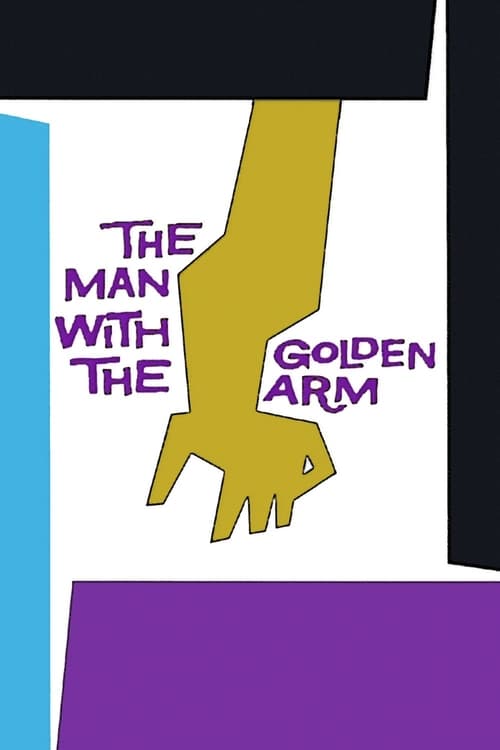
The Man with the Golden Arm
1955 · Otto Preminger
For when you want a gritty, grown-up drama with real stakes — a smoky night-city mood, not comfort viewing. Reach for it when you're curious what old Hollywood looked like the moment it stopped playing nice.
What it's about
Frankie Machine deals cards in Chicago's back rooms — that's the golden arm — but he's fresh out of prison, clean of heroin, and determined to stay that way by making it as a jazz drummer. The neighborhood has other plans: his old boss wants him back at the poker table, his dealer wants him back on the needle, and every debt and guilt he left behind is waiting on his doorstep. It's a story about how hard it is to become a new man in the exact place that made you the old one.
The experience
Tense and claustrophobic, with the coiled energy of a jazz set that keeps threatening to fall apart. You spend the film watching a man white-knuckle his way past temptation after temptation, and when he slips, it's genuinely harrowing for a studio-era picture.
Performances
Frank Sinatra, in his most physically committed dramatic work — jittery, sweaty, and raw, especially in the withdrawal scenes, which he plays with no vanity at all.
The craft
Saul Bass's jagged animated title sequence and Elmer Bernstein's brassy, nervous jazz score are both landmarks in their own right — the film announces its modernity before a single scene plays. Otto Preminger shoots the tenement world in stark black and white, letting long takes trap Frankie in rooms with the people who are bad for him. It sounds fantastic through good speakers; that score does half the storytelling.
Why it matters
Released without the Production Code's seal of approval, it became one of the decisive test cases that broke the censorship system's grip on American movies — Hollywood's first unflinching look at heroin addiction.
Snapshot
The Man with the Golden Arm is the film in which postwar Hollywood looked directly at heroin addiction and dared the Production Code to stop it. Adapted from Nelson Algren's National Book Award–winning 1949 novel, Otto Preminger's independent production gives Frank Sinatra his most physically committed dramatic role as Frankie Machine — a Chicago card dealer and aspiring jazz drummer trying to stay clean after prison, pulled back toward the needle by the gravity of his old life. The picture is remembered less for its narrative, which is melodramatic by design, than for what it did to the industry: released by United Artists in December 1955 without the Production Code Administration's seal of approval, it became one of the decisive test cases that cracked the Code's authority over American screen content. It is also a landmark of mid-century film craft — Saul Bass's jagged animated arm and Elmer Bernstein's hard-driving jazz score together announced a new modern idiom for the title sequence and the dramatic film score. Sinatra earned an Academy Award nomination for Best Actor. The film endures as a hinge object: a transitional work standing between the studio era's enforced euphemism and the more frank, addiction-haunted cinema that followed.
Industry & production
The film was produced by Preminger's own company, Carlyle Productions, and distributed by United Artists — the arrangement that made the picture's defining controversy possible. As an independent releasing through UA (a distributor rather than a Code-bound studio in the classical sense), Preminger had the structural freedom to fight the Production Code Administration directly. The PCA, then under Geoffrey Shurlock, refused the film a seal because the Code explicitly forbade the depiction of narcotics trafficking and addiction. Preminger and United Artists released it anyway, without the seal — a move that, following Preminger's earlier seal-less release of The Moon Is Blue (1953), helped expose the Code's enforcement mechanism as increasingly toothless. The episode prompted a revision of the Code's drug provisions soon after. Algren's novel had circulated as difficult, "unfilmable" material precisely because of its subject; the rights history is tangled, and accounts note that John Garfield had been associated with a screen version before his death. Preminger acquired and steered the property to the screen on his own terms, casting Sinatra — already an Oscar winner for From Here to Eternity (1953) — in a role that traded on the singer's by-then-established capacity for bruised, nervy drama rather than his crooner persona.
Technology
The film was shot in black-and-white, 35mm, in the standard Academy-adjacent flat ratio rather than the era's fashionable widescreen — a choice that keeps the picture intimate and boxed-in, consistent with its largely studio-bound staging. Production took place on constructed sets rather than Chicago locations, and the artificiality is deliberate: the world is a fabricated slum, lit and dressed for expressive effect. The most genuinely novel "technology" of the project is arguably graphic and musical rather than photographic — Saul Bass's title work used animation and abstract design as an industrial-strength branding and mood-setting instrument, and Bernstein's score deployed a jazz big band as the film's nervous system. In an era when prestige drama still leaned on lush symphonic scoring, foregrounding amplified, syncopated jazz across an entire feature was itself a technical and aesthetic gambit.
Technique
Cinematography
Sam Leavitt's black-and-white photography works in a register of urban expressionism softened by the realism of its faces. The film favors enclosed, low-ceilinged spaces — the back-room card games, the cramped tenement flat, the bar — and uses shadow and hard pools of light to externalize Frankie's entrapment. Preminger's preference for the long, fluid take and choreographed camera movement (a signature across his work) gives several sequences an unbroken, watchful quality, letting tension accumulate within the frame rather than through cutting. The visual treatment of the withdrawal sequence — Frankie locked in a room going cold turkey — relies on confinement and the actor's body more than on overt stylization.
Editing
Louis R. Loeffler, Preminger's frequent editor, cut the film in a manner consistent with the director's taste for sustained shots and spatial continuity: the editing tends to serve the performances and the unbroken unfolding of scenes rather than to impose a fragmented rhythm. The notable exception is the integration of Bernstein's score, where music and image are timed to the percussive momentum of the drumming and the drug cravings — the film's most "edited"-feeling energy is musical as much as visual.
Mise-en-scène / staging
The fabricated Chicago of the film is a closed circuit of rooms and doorways through which the same predatory figures keep reappearing — the dealer Louie, the fixer Schwiefka, the manipulative wife Zosh. Preminger stages Frankie as a man perpetually hemmed in by other people's needs, blocked into compositions where exits are visible but unreachable. Zosh's wheelchair — and the staircase that becomes its narrative trap — is the central piece of expressive staging, the apartment built as a cage. The deliberate studio artifice supports a near-allegorical reading of the environment as moral entrapment.
Sound
Sound is inseparable from Bernstein's score here; the jazz idiom is not background but a diegetically-adjacent pressure, linking Frankie's drumming ambitions to the rhythm of his addiction. The film's sonic identity — brassy, driving, anxious — does much of the work of conveying interior compulsion that the Code-era screenplay could only gesture at verbally.
Performance
Sinatra's performance is the film's spine and its most enduring achievement. He plays Frankie as twitchy, charming, and increasingly desperate, and commits fully to the physical degradation of the withdrawal scene — long regarded as among his finest sustained dramatic work. He prepared the drumming convincingly enough to read as a working musician (jazz drummer Shelly Manne is generally credited with coaching/dubbing the playing). Eleanor Parker is theatrically large as Zosh, the wife feigning paralysis to bind Frankie to her through guilt; Kim Novak, early in her stardom, brings a grave stillness to Molly, the downstairs neighbor who represents Frankie's possible redemption. Darren McGavin's dealer Louie is silken and reptilian, and the supporting bench (Arnold Stang as Sparrow, Robert Strauss as Schwiefka) fills out the milieu.
Narrative & dramatic mode
The film operates in a heightened social-melodramatic mode: a fallen-man redemption arc structured around temptation, relapse, and the possibility of grace through a good woman's love. Its dramatic engine is the tension between Frankie's two futures — the legitimate one as a drummer with Molly, and the entrapping one of the card table, the dealer, and Zosh. The screenplay (credited to Walter Newman and Lewis Meltzer, with reported uncredited contribution by Ben Hecht) compresses and sentimentalizes Algren's bleaker, more diffuse novel, notably softening the ending. The result is a hybrid: a film whose subject matter is unprecedentedly frank for 1955 Hollywood, wrapped in a conventional melodramatic architecture. The friction between transgressive content and reassuring form is itself part of the film's historical interest.
Genre & cycle
The picture sits at the intersection of the social-problem film and film noir. Its lineage runs back to the Warner Bros. social-problem tradition and forward into the "adult," taboo-breaking dramas of the later 1950s. As a drug-addiction film it belongs to a small, fraught cycle — arriving roughly contemporaneously with other mid-decade attempts to broach narcotics on screen — but it is the most prominent and consequential of them precisely because of the Code fight. Stylistically its shadowed urban underworld, doomed protagonist, and femme-fatale-adjacent wife figure align it with late noir, even as its redemptive impulse pulls against noir fatalism.
Authorship & method
Preminger is the decisive author here in both the aesthetic and the institutional sense. An Austrian émigré who had become one of Hollywood's most effective independent producer-directors, he made a method of provocation: acquiring controversial properties, releasing without the seal, and forcing the industry's self-censorship apparatus into public crisis. His directorial signature — fluid camera, long takes, an unjudging, almost clinical observation of compromised people — shapes the film's refusal to moralize cheaply even within its melodramatic frame. The key collaborators are unusually consequential. Elmer Bernstein, composer, delivered a jazz score that became a touchstone and earned an Oscar nomination. Saul Bass, designing the titles and the campaign's poster art, produced the iconic stark white arm — a piece of graphic design so identified with the film that it effectively rebranded what a movie title sequence could be, and cemented the Preminger–Bass partnership that continued across later films. Sam Leavitt (cinematography) and Louis R. Loeffler (editing) executed Preminger's controlled visual style; the screenplay credits to Walter Newman and Lewis Meltzer carry the adaptation, with the precise division of labor (and Hecht's reported involvement) somewhat blurred in the record.
Movement / national cinema
This is American studio-era cinema in its late, fracturing phase, made just outside the major-studio production system by an independent working through United Artists. It reflects a distinctly mid-1950s American current: the postwar push toward "mature," realist subject matter and the chafing of filmmakers against an aging censorship regime. Preminger's émigré sensibility — his European theatrical training and taste for moral ambiguity — inflects the material, but the film is firmly a product of, and an intervention in, the American industry rather than any foreign movement.
Era / period
Released at the end of 1955, the film is a near-perfect marker of Hollywood's transitional decade: television was eroding audiences, the studio system was loosening, widescreen and color were being deployed as differentiators, and the Production Code was visibly failing. The Man with the Golden Arm belongs to the moment when "adult themes" became a competitive asset rather than a liability. Its frank treatment of addiction, its jazz modernism, and its independent production all read as symptoms of the same mid-decade loosening that would accelerate through the late 1950s and into the 1960s.
Themes
Addiction is the central theme — not merely as plot but as metaphor for a wider entrapment by environment, dependency, and other people's claims. The "golden arm" is doubly figured: Frankie's gifted dealer's hand and his drummer's arm, both expressions of talent, and the same arm that takes the needle — skill and self-destruction housed in one limb. Surrounding this is a web of dependency: Zosh's feigned disability that imprisons Frankie through guilt, Sparrow's neediness, the dealer's economic hold. Against entrapment the film sets the thin possibility of redemption — work, love, self-respect — embodied by Molly. There is also a sharp class dimension: this is a portrait of the urban poor, of people whose options have already been foreclosed by circumstance, observed with more sympathy than judgment.
Reception, canon & influence
Contemporary reception was substantially shaped by the censorship controversy, which guaranteed the film prominence and debate; critics engaged seriously with its subject matter and with Sinatra's performance, which was widely praised and recognized with an Academy Award nomination for Best Actor (he lost to Ernest Borgnine for Marty). The film also received nominations associated with Bernstein's score and its black-and-white art direction; I'd flag that the exact slate of nominations is best verified against the Academy record rather than asserted from memory in full. Specific box-office figures I will not invent, but the picture's commercial visibility was amplified by the seal controversy and Sinatra's stardom.
The influences on the film run backward to the Warner social-problem tradition, to film noir's urban fatalism, and most directly to Algren's literary naturalism and the postwar appetite for "unfilmable," frank subject matter. Its forward legacy is considerable and operates on several axes. Institutionally, alongside The Moon Is Blue, it is routinely cited as a key precedent in the erosion of the Production Code, helping clear the path for the franker American cinema of the late 1950s and 1960s and contributing to the eventual move toward the ratings system. Musically, Bernstein's jazz score is a foundational text for the jazz-inflected film and television scoring that flourished afterward, from noir-jazz scores to the crime-drama idiom of the following decade. Graphically, Saul Bass's title design helped inaugurate the modern era of the title sequence as an authored, expressive form. And as a screen depiction of addiction, the film stands as an important early entry in a lineage of drug dramas that would deepen in candor over subsequent decades. Its melodramatic packaging has dated more than its provocations have; but as a junction point where craft innovation and institutional rupture coincide, The Man with the Golden Arm remains a film whose importance exceeds its narrative.
A Deleuzian reading
Start with the arm.
The full Deleuzian reading of The Man with the Golden Arm →
Reception
A scandal in 1955 — released without the Production Code seal because drug addiction was a forbidden subject — it's now remembered as one of the films that broke the Hays Code, even if modern viewers often rank its historical importance above the drama itself.
How The Man with the Golden Arm was received, from release to now →
Influences: the films it descends from and the films it influenced
- The Lost Weekend (1945) — Establishes the clinical addiction-descent drama Preminger inherits: withdrawal staged as expressionist horror, with the cold-turkey lockup sequence descending directly from Wilder's DT-hallucination set piece.
- I Am a Fugitive from a Chain Gang (1932) — The Warner social-problem template — naturalist indictment of a doomed man trapped by institutions, refusing tidy moral resolution — supplies the genre frame Golden Arm updates for the addict.
- Laura (1944) — Preminger's own gliding long-take camera and cool, non-judgmental observation of compromised people is first codified here and reapplied to Frankie Machine's milieu.
- The Moon Is Blue (1953) — Preminger's no-seal release-as-provocation method — acquire a forbidden property, defy the Production Code in public — is the institutional playbook Golden Arm runs again at higher stakes.
- The Asphalt Jungle (1950) — Late-noir urban fatalism rendered through a closely observed underworld of small-time hustlers and their fatal weaknesses, the doomed-milieu construction Golden Arm borrows.
- On the Waterfront (1954) — Leonard Bernstein's symphonic-jazz scoring of urban desperation, composed the year before, is the immediate stylistic precedent for Elmer Bernstein's jazz idiom (no relation, but the same emergent scoring vocabulary).
- A Streetcar Named Desire (1951) — Elmer Bernstein's driving jazz score extends Alex North's breakthrough of vernacular blues/jazz as the emotional language of serious dramatic film.
- Anatomy of a Murder (1959) — Extends both signatures at once: the Preminger–Bass cut-out-figure title design and a fully diegetic jazz score (Duke Ellington) that develops Bernstein's jazz-as-mood innovation.
- Vertigo (1958) — Bass's title sequence as an authored, kinetic, expressive overture — the modern title form Golden Arm's animated white arm helped inaugurate.
- Psycho (1960) — Bass's slashing graphic-bar typography continues the Golden Arm precedent of titles as a stark, abstract emotional cue rather than mere credits.
- Elevator to the Gallows (1958) — Miles Davis's improvised jazz score develops Bernstein's innovation of jazz as the primary emotional register for urban-crime drama into pure modal mood-scoring.
- Peter Gunn (1958) — Henry Mancini's noir-jazz theme codified the jazz crime-drama scoring idiom for television that Bernstein's Golden Arm score had made foundational.
- The Connection (1961) — A junkies-waiting-for-the-fix drama scored with live jazz, pushing Golden Arm's pairing of heroin subject and jazz idiom into raw, near-documentary candor.
- The Panic in Needle Park (1971) — Unflinching procedural realism of heroin dependency that deepens the screen-addiction lineage Golden Arm pioneered, stripping away the melodramatic packaging.
- Trainspotting (1996) — Stages withdrawal as stylized expressionist set piece and binds the addiction narrative to a driving music score — the Golden Arm formula of formalized detox sequence plus pop-musical rhythm.
- Drugstore Cowboy (1989) — First American studio film to break the Production Code's drug ban and dramatize addiction as physiological process — the craving-and-fix procedural beat that Van Sant inherits but drains of Sinatra-style melodrama.
- The Pink Panther (1963) — Saul Bass's kinetic cut-paper animated title sequence is the direct formal precedent for DePatie-Freleng's animated Pink Panther main titles, which spun a graphic device into an independent mascot.
- Christiane F. (1981) — Founds the frank addiction film's cold-turkey set-piece and drives it with Elmer Bernstein's jazz score as structural pulse — the pop-score-as-architecture strategy Christiane F. reworks through Bowie.
- Carmen Jones (1954) — The first Preminger–Saul Bass collaboration, where Bass began designing the campaign's bold graphic identity that Golden Arm's stark white-arm logo would crystallize into a brand.
- Sweet Smell of Success (1957) — Elmer Bernstein again scores an expressionist nighttime city with hard-bop jazz, extending the same noir-jazz idiom into a sibling portrait of urban predation.
- A Hatful of Rain (1957) — A contemporaneous frank morphine-addiction social melodrama built on the same withdrawal-and-domestic-collapse structure, riding the candor Golden Arm had just opened up.
Similar films
- The Lost Weekend (1945) — influence & lineage
- The Asphalt Jungle (1950) — influence & lineage
- The Panic in Needle Park (1971) — influence & lineage
- On the Waterfront (1954) — influence & lineage
- Anatomy of a Murder (1959) — influence & lineage
- I Am a Fugitive from a Chain Gang (1932) — influence & lineage
- Where the Sidewalk Ends (1950) — shared sensibility
- The Hustler (1961) — shared sensibility