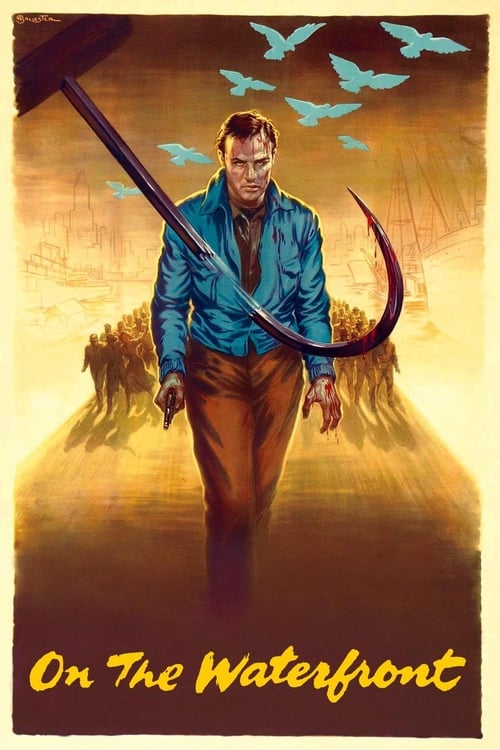
On the Waterfront
1954 · Elia Kazan
For when you want a serious, meat-and-potatoes classic that actually delivers — a film about doing the right thing when it costs everything. Rewarding rather than heavy; you come out moved, not flattened.
What it's about
Terry Malloy is a washed-up boxer running errands for the corrupt union boss who rules the New Jersey docks — deciding who works, who starves, and who disappears. When Terry is unwittingly drawn into a murder, and the dead man's sister and a crusading priest start pressing him about what he knows, he's caught between loyalty to the only world he's ever had and a conscience he can't shake.
The experience
Raw, gripping, and surprisingly tender — a moral pressure-cooker that plays out in cold dockside air and cramped rooms, where every conversation carries weight. It's a drama of conscience that builds to real bruising power, with a love story that aches.
Performances
Marlon Brando's Terry Malloy is still the performance other screen acting gets measured against — mumbling, tender, wounded, and completely alive; the taxi scene with Rod Steiger is a masterclass in itself. Eva Marie Saint, in her film debut, and Karl Malden as the dockside priest are superb around him.
The craft
Shot on the actual Hoboken waterfront in wintry black and white, it fuses documentary grit with intense, psychologically raw performances — plus a driving, brassy score by Leonard Bernstein, his only original film score. The location shooting gives every frame the chill of real weather and real work.
Why it matters
Winner of eight Academy Awards including Best Picture, it changed what screen acting could look like — Brando's naturalism became the template for generations of American actors — and remains the touchstone for socially engaged Hollywood drama.
Snapshot
One of the defining films of postwar American cinema, On the Waterfront is a moral drama set among the longshoremen of the New Jersey docks, following Terry Malloy — a washed-up boxer now running errands for a corrupt union boss — as his conscience drags him toward testimony against the men who control his life. The film synthesizes Italian Neorealist location practice, Stanislavski-descended performance craft, and the social-problem tradition of American cinema into something distinctly new: a work at once politically charged, psychologically raw, and cinematically urgent. It won eight Academy Awards, including Best Picture, and its central performance — Marlon Brando as Terry — remains a reference point for screen acting fifty years after its release.
Industry & production
The film's origins lie in Malcolm Johnson's Pulitzer Prize-winning series of investigative articles, "Crime on the Waterfront," published in the New York Sun in 1949, which documented the systematic corruption, extortion, and murder that characterized the International Longshoremen's Association under mob influence along the New York–New Jersey waterfront. Screenwriter Budd Schulberg undertook years of his own research into the docks, befriending union dissidents and clergy, before arriving at the screenplay.
The path to production was entangled with the era's political convulsions. Before Schulberg and Kazan collaborated, Kazan had been developing a waterfront project with Arthur Miller — a play called The Hook, set on the Brooklyn docks — but the project foundered partly over pressure from Columbia and HUAC-era politics, and Miller's refusal to reshape the material as an anti-Communist parable. After Kazan testified before the House Un-American Activities Committee in April 1952 — naming eight former colleagues as Communist Party members, a decision that permanently split Hollywood — he and Schulberg, who had also cooperated with HUAC, developed On the Waterfront together. The political subtext became inescapable: the film's central act of testimony was read, then as now, as Kazan's self-justification.
Producer Sam Spiegel — who worked under the pseudonym "S.P. Eagle" in the credits — acquired the property and brought it to Columbia Pictures after other studios declined. The film was shot in the winter of 1953 on location in Hoboken, New Jersey, a choice that aligned artistic and practical imperatives: the actual docks, the cold-weather atmosphere, and the working-class architectural texture of Hoboken were inseparable from the film's meaning.
Technology
On the Waterfront was shot in black and white on 35mm, and the tonal range that cinematographer Boris Kaufman extracted from the overcast New Jersey winter — gray skies, steaming breath, dockside haze — was a deliberate technical and aesthetic choice rather than a default. The decision to work almost entirely on location, in genuine winter cold, imposed real constraints: available light was low and variable, interiors were cramped, and the rough geography of actual working docks was unforgiving. Kaufman and Kazan adapted rather than controlled, allowing environmental conditions to shape the image. The rooftop pigeon coops were actual structures; the hold of the cargo ship where Father Barry delivers his sermon was a working vessel. This embedded documentary texture was inseparable from the film's emotional register.
The production also relied on a combination of long lenses for exterior crowd scenes — compressing space and enabling unobtrusive observation of the extras — and intimate close-up work for the film's chamber-like dialogue scenes. The taxi scene between Brando and Rod Steiger was shot in a studio with rear projection, allowing the controlled, claustrophobic conditions the scene required.
Technique
Cinematography
Boris Kaufman was the younger brother of the Soviet documentarians Dziga Vertov and Mikhail Kaufman, and had been trained in European documentary and realist aesthetics before emigrating to the United States. His work on On the Waterfront fused that tradition with classical Hollywood grammar. The film's exterior compositions are often deliberately unglamorous — gray, flat light, industrial clutter — while Kaufman reserved depth and tonal contrast for interiors and close-ups, giving the film a visual hierarchy that tracks its moral stakes. His compositions on the docks frequently isolate figures against the scale of the waterfront machinery, emphasizing the individual's smallness against institutional force. The rooftop sequences, by contrast, are rendered with a softer, more intimate quality — the pigeon coop as a private space above the violence below.
Kaufman received the Academy Award for Best Cinematography (Black-and-White) for this film.
Editing
Gene Milford's editing is notable for its patience with performance. In the Actors Studio tradition that Kazan was helping to institutionalize, the significant beat often arrives after the conventional cutting point — in the half-second of Brando looking away, the moment after the line lands. Milford's cuts are generally classical in structure but permissive toward the duration of close-ups, allowing emotional states to complete themselves on screen. The film also uses montage rhetorically in its crime sequences — the killing of Joey Doyle in the opening, the murder in the hold — intercutting action and reaction to build implication rather than explicit depiction.
Mise-en-scène / staging
Kazan's staging draws on his theatrical background and his deep investment in the Actors Studio philosophy: scenes are composed to enable spontaneous behavioral response rather than to lock performances into fixed choreography. The actors worked extensively with Kazan in rehearsal before filming, building character relationships from the inside out. The result is a mise-en-scène in which blocking often feels motivated by character impulse — characters touch, withdraw, circle — rather than dictated by coverage requirements.
The use of Hoboken's actual geography is integral: the shape of the waterfront, the narrowness of the streets, the scale of the cargo holds, and the elevated vantage of rooftops all become active elements in the staging. Father Barry's sermon in the ship's hold is among the most elaborately staged sequences in the film — the vertical space, the listening faces, the body of the dead man as altar — and represents Kazan at his most controlled and overtly theatrical.
Sound
The sound design uses ambient industrial noise — ship horns, machinery, the echoing hollows of the cargo hold — as consistent environmental texture, anchoring the drama in its physical world. Leonard Bernstein's score is strategically deployed rather than omnipresent, leaving several key scenes to naturalistic sound or near-silence. Bernstein's music, his only major feature film score, integrates jazz idioms — a brass-inflected, urban angularity — with orchestral writing, giving the film a sonic world that feels both of its moment and slightly heightened. The score received an Academy Award nomination but did not win.
Performance
The film is a landmark in the history of screen performance. Marlon Brando, who had studied under Stella Adler (herself trained directly by Stanislavski), brought to Terry Malloy an unprecedented physical and psychological interiority: slurred diction that renders thought half-formed, gestural habits that suggest biography, a constant sense of something withheld. The taxi scene — in which Terry tells his brother Charley that he could have been a contender, that he had a "bum steer" from the men he trusted — is probably the most discussed single scene in the history of American acting. It was largely improvised in its smaller rhythms within Schulberg's written dialogue, and Steiger's responsiveness matches Brando's moment-to-moment.
The ensemble around Brando is equally specific: Eva Marie Saint, in her film debut, won the Academy Award for Best Supporting Actress for Edie Doyle, playing grief and idealism with a directness that never tips into sentiment. Karl Malden's Father Barry is one of cinema's great supporting performances — physically large, morally certain, yet never simplified. Lee J. Cobb's Johnny Friendly radiates a theatrical menace calibrated to the film's scale. Rod Steiger's Charley, the weak man who loves his brother, anchors the film's central moral tragedy.
Narrative & dramatic mode
The film is structured as a classical moral drama with a strong bildungsroman arc: Terry's movement from complicity to conscience to public testimony and physical sacrifice. It operates on a Greek template — the community silenced by a corrupt authority, the individual forced by love and grief into confrontation, the final reckoning played as near-ritual — but its idiom is American and specifically Catholic. Father Barry's presence frames the moral choices in explicitly religious terms: the ship's hold becomes a church, the long walk at the end a stations-of-the-cross procession.
The romantic plot between Terry and Edie is the mechanism of conscience: her demand that someone answer for her brother's death opens Terry to a moral awareness he has suppressed. The film does not sentimentalize this awakening; Terry's testimony is costly and his redemption is physical and painful, not triumphant in any easy sense.
Genre & cycle
On the Waterfront sits at the confluence of several generic streams: the social problem film that flourished in late-1940s Hollywood (exemplified by films like Gentleman's Agreement, 1947, also directed by Kazan); the crime film and its concern with institutional corruption; and what might be called the working-class drama, with roots in 1930s labor-conscious cinema and in the agitprop theatrical tradition from which Kazan himself emerged. It also shares formal and thematic territory with film noir — its gray visual world, its sense of a protagonist caught in structures larger than himself — while ultimately refusing noir's fatalism in favor of a moral resolution.
The film was released at the height of Cold War anxiety, and its labor-corruption subject matter was both politically legible and politically evasive: the mob-controlled union was not Communist, but the act of testifying carried unmistakable resonance with HUAC cooperation. This ambiguity has made the film a persistent object of ideological debate.
Authorship & method
Elia Kazan was among the most technically accomplished and psychologically sophisticated directors in American cinema at mid-century. A co-founder of the Actors Studio in 1947 (with Cheryl Crawford and Robert Lewis), he had built his reputation working with Williams and Miller in the theater before transitioning to film. His method centered on preparation: extended rehearsal, biographical work with actors, creating conditions for behavioral truth on set. On the Waterfront represents the fullest synthesis of his theatrical and cinematic instincts, and the film on which his artistic reputation and his political controversies are most densely superimposed.
Budd Schulberg's screenplay is lean and precisely structured — he drew on years of firsthand documentary research — and gave the film a sociological specificity that elevates it above moral allegory. The "D and D" code (deaf and dumb — the waterfront omertà), the shape-up hiring system, the mechanics of union corruption, all emerged from Schulberg's interviews with real dockworkers and dissidents.
Boris Kaufman's cinematographic approach has been discussed above; his contribution was decisive in translating Kazan's intent into a visual grammar.
Leonard Bernstein's score is distinctive enough to reward separate attention. Bernstein integrated jazz idioms and modernist orchestration in ways that few film composers attempted at the time; the score is both dramatically functional and artistically autonomous.
Gene Milford, the editor, had won an Academy Award for It Happened One Night (1934) two decades earlier; his work here is subtler, built around accommodating rather than shaping the actor-centered material.
Movement / national cinema
On the Waterfront is a signal work of American social realism at mid-century, but its practice was deeply shaped by Italian Neorealism. Rossellini's Rome, Open City (1945) and De Sica's Bicycle Thieves (1948) had demonstrated that location shooting, non-professional texture (even within professional casts), and working-class subject matter could achieve a moral seriousness unavailable to studio-bound production. Kazan and Kaufman absorbed these lessons without transcribing them: the film is more formally composed than Neorealist work, more actor-centered, and ultimately more classically structured in its dramaturgy.
It also bears the marks of the documentary impulse in American cinema — the "city symphony" and social-documentary traditions of the 1930s and 1940s — and of the Group Theatre's leftist theatrical realism, in which Kazan had been formed. The film represents the fullest translation of that theatrical tradition into cinematic language.
Era / period
The film belongs to the early Cold War period in American culture, with all the pressures that implied: HUAC investigations, the blacklist, a narrowing of political discourse, and an artistic response that frequently displaced political content into moral or psychological register. It was made in the wake of Kazan's and Schulberg's HUAC cooperation, and its period-specific meanings are inseparable from that context. The early 1950s also saw the consolidation of television as a mass medium, which was simultaneously eroding Hollywood's audience and driving the industry toward the prestige, location-shot, psychologically ambitious productions that On the Waterfront exemplifies.
Themes
Complicity and conscience: The film's moral architecture rests on the question of what it costs to know, and what it costs to act on what you know. Terry's initial complicity in Joey's death — he unwittingly led him to his killers — establishes the condition from which the film works outward.
The ethics of testimony: The act of "ratting," of informing on one's community, is the film's central moral event. Kazan and Schulberg frame testimony as courage and conscience; critics have always noted that this reading served the filmmakers' own circumstances before HUAC with uncomfortable convenience. The debate is not resolvable — it is baked into the film.
Loyalty and its claims: Terry's love for his brother Charley, and his loyalty to the men who "made" him, war with his awakening conscience. The film takes seriously the moral weight of community solidarity even as it ultimately asks Terry to break it.
Class and institutional power: The shape-up, the "company man" hiring system, the casual expendability of dock labor — these are rendered with documentary specificity, making the film a genuine account of working-class economic vulnerability.
Redemption and sacrifice: The Catholic moral framework — Father Barry as confessor and prophet, the walk at the film's end as via crucis — frames Terry's suffering as redemptive, both for himself and, symbolically, for the community he rejoins.
Reception, canon & influence
On the Waterfront received ecstatic critical notices upon its release in 1954, and its sweep of eight Academy Awards — Best Picture, Best Director, Best Actor (Brando), Best Supporting Actress (Saint), Best Screenplay, Best Cinematography, Best Editing, and Best Art Direction — ratified a consensus that this was a major work. It was immediately received as proof that American cinema could achieve the artistic seriousness and social engagement of European art film while retaining popular and dramatic power.
Influences on the film (backward): The Neorealist tradition (Rossellini, De Sica, Visconti) is the most visible formal antecedent. Behind it: the Group Theatre's social realism of the 1930s, from which Kazan emerged; Stanislavski's actor-training via Stella Adler and the Actors Studio; the investigative journalism tradition represented by Johnson's articles; and the generic conventions of the American crime film, particularly the labor-corruption cycle that included films like The Racket (1951). European location-shot social dramas from Britain — Carol Reed's The Third Man (1949), early Free Cinema work — were also part of the cultural context.
Legacy and forward influence: The film's influence operates on at least three distinct registers. In performance, Brando's Terry Malloy is the template against which a generation of American screen acting calibrated itself: the compressed interiority, the behavioral specificity, the subordination of rhetoric to psychology. James Dean, Paul Newman, Al Pacino, Robert De Niro — all worked in the aesthetic space the film helped define. In direction, Kazan's synthesis of theatrical preparation and location-based filmmaking became a model for directors as varied as Sidney Lumet and Martin Scorsese. In subject matter, the film established the American urban working-class drama as a prestige genre: Rocky (1976) reworks its Hoboken archetypes almost scene for scene; Scorsese's Mean Streets (1973) and much of his subsequent work are unimaginable without it. The taxi scene has been referenced, homaged, and parodied so many times that it has acquired its own life independent of the film.
The HUAC controversy has shadowed the film's canonical status in particular ways. When Kazan received an honorary Academy Award in 1999, a portion of the audience — including figures such as Nick Nolte and Ed Harris — declined to applaud, a gesture that made visible the wound the film had never quite closed. Scholarly literature on On the Waterfront is now as much about the politics of cultural memory as about the film itself; Brian Neve, James Naremore, and Victor Navasky are among the critics who have written most seriously about the entanglement. The film remains in any serious assessment of the greatest American films, not despite its complications but in part because of them: it is a work whose unresolved tensions are historical, artistic, and moral all at once.
A Deleuzian reading
A man stands on a tenement roof in the cold and looks down at something he started and cannot stop.
The full Deleuzian reading of On the Waterfront →
Reception
A sensation on release — it swept the 1955 Oscars with eight wins including Best Picture — but its afterlife is tangled: ever since Kazan named names to HUAC, viewers have re-read the film as his defense of informing, and the 1999 honorary-Oscar protest reignited the whole argument.
How On the Waterfront was received, from release to now →
Influences: the films it descends from and the films it influenced
- Rome, Open City (1945) — Rossellini's practice of filming in actual bombed-out Roman streets with available light and non-professional extras established the neorealist location doctrine — embedding narrative fiction in uncontrolled real environments to produce documentary texture from production circumstance — that Kazan adopted wholesale for the Hoboken docks.
- Body and Soul (1947) — Rossen and cinematographer James Wong Howe mounted cameras on roller skates to follow fighters inside the ring, pioneering kinetic proximity to working-class physical labor and establishing the morally compromised athlete as the social-problem film's central figure — both techniques Waterfront inherits directly.
- Bicycle Thieves (1948) — De Sica's use of telephoto lenses to compress urban crowd space while filming non-professional extras in genuine working-class environments — workers as scenic mass observed from a distance without disrupting them — directly informs Kaufman's long-lens crowd work on the Hoboken docks.
- All the King's Men (1949) — Rossen's social-problem exposé established the American grammar for institutional-corruption drama — documentary-inflected location photography, a working-class protagonist's moral compromise under organized power — that Waterfront directly inherits and layers with Actors Studio performance depth.
- The Men (1950) — Zinnemann embedded Brando — in his film debut — among actual paraplegic veterans in a real VA hospital, establishing the performer-in-authentic-environment method that Waterfront extends: Brando working in the Hoboken cold alongside real longshoremen rather than costumed extras.
- Panic in the Streets (1950) — Kazan's own noir thriller, shot entirely on location in New Orleans with the city's actual working waterfront, developed his personal production methodology of substituting real urban geography for studio sets — the systematic rehearsal he gave himself before Hoboken.
- A Streetcar Named Desire (1951) — Kazan's prior Actors Studio film institutionalized the staging principle Waterfront inherits: permissive blocking that enables spontaneous behavioral response to complete itself on screen before the cut, prioritizing psychological duration over narrative economy — codified here with Brando before being transplanted to the docks.
- From Here to Eternity (1953) — Kazan extended Eternity's Method ensemble strategy into the same documentary-naturalist cinematography — Kaufman's New Jersey docks extending Guffey's Hawaii location grammar — with the identical institutional-betrayal dramatic structure, consolidating in one film the template Zinnemann had established one year earlier.
- L'Atalante (1934) — Boris Kaufman's Oscar-winning photography carried Vigo's poetic realism of working docks, fog and river-edge labor directly into American cinema.
- A Tree Grows in Brooklyn (1945) — Extends the debut's working-class milieu and father-figure/child dynamics into location-shot social realism, still built on the primacy of behavioral, interior-driven Actors Studio performance.
- East of Eden (1955) — Kazan's immediate follow-up extended the Actors Studio behavioral method into CinemaScope — Dean inheriting Brando's improvisatory register — adapting performance-patience editing to the widescreen frame; the bildungsroman structure of a son seeking paternal validation under moral pressure mirrors Waterfront's arc beat for beat.
- Marty (1955) — Adapted from Chayefsky's television play and shot on location in the Bronx, Marty is Waterfront's closest craft sibling: the same New York social-realist milieu, the same patience with behavioral understatement in the editing room, and Ernest Borgnine's anti-heroic specificity as the period's alternative paradigm to Brando's method intensity.
- 12 Angry Men (1957) — Lumet — trained in the same New York television-and-stage realist milieu — concentrates the Actors Studio ensemble method into a single room, calibrating editing durations to let emotional states complete themselves in close-up, directly inheriting Milford's performance-patience doctrine and applying it to twelve performers simultaneously.
- Midnight Cowboy (1969) — Schlesinger extends Waterfront's location doctrine into the New Hollywood era: long telephoto lenses filming actual Manhattan crowds without staging them, ambient sound foregrounded against the Nilsson score, and a working-class bildungsroman enacted entirely in authentic urban geography — the Kaufman cinematographic method transplanted to color and new subject matter.
- The Godfather (1972) — Brando's Don Corleone consciously inherits the behavioral register of his Terry Malloy — the mumbled speech, the physical weight, the withholding of emotion — while Gordon Willis's low-key high-contrast cinematography extends Kaufman's tonal discipline into color; the ensemble's Actors Studio-descended specificity (Pacino, Duvall, Caan) pervades every scene.
- Mean Streets (1973) — Scorsese fuses Waterfront's Catholic moral frame — Charlie's guilt and his obligation to Johnny Boy paralleling Terry's responsibility to Joey Doyle — with location shooting in actual Little Italy streets and a sound design that foregrounds diegetic ambient noise against scored music, inheriting Waterfront's sonic hierarchy.
- Dog Day Afternoon (1975) — Lumet's documentary-location aesthetic — long telephoto crowd shots of actual Brooklyn streets capturing real bystanders, ensemble Method performance under institutional pressure, ambient sound texture — directly extends the Kaufman cinematographic doctrine of capturing behavioral truth in real urban geography.
- Raging Bull (1980) — Scorsese and cinematographer Michael Chapman return to black-and-white as a deliberate formal citation; De Niro's preparation for La Motta — physical transformation, behavioral granularity — consciously inherits the Brando/Actors Studio method; Schoonmaker's editing patience with De Niro's behavioral states in the domestic scenes echoes Milford's work with Brando in the taxi.
- Cool Hand Luke (1967) — Kazan's ensemble blocking of working-class men in rough democratic proximity — the dock community as collective background pressure on the individual conscience — and his use of Method performance to layer interiority beneath genre surfaces are the structural and staging precedents for Rosenberg's road-gang scenes, where the gang's faces register Luke's every act as communal event.
- The French Connection (1971) — Boris Kaufman's available-light cinematography on Hoboken docks — underexposed, desaturated, grain-heavy, dependent on the industrial environment for its visual texture — established the American urban-realist palette that Roizman extended into French Connection's gray New York winter.
- Serpico (1973) — Kazan's staging of Actors Studio emotional-recall performance within working-class New York location exteriors—physical labor as moral weight, the corrupt collective refusing one man's conscience—establishes the precise template Lumet uses: Pacino's physical specificity across the film's timeline, the unglamorous urban setting as testimonial evidence, and the narrative logic of an individual's ethical refusal producing institutional retaliation rather than institutional reform.
- Warrior (2011) — The Cain-and-Abel brother dynamic organized around one wound — one brother's forfeiture of the other's potential — is Warrior's structural precedent, while Brando's technique of embodying interiority through physical restraint and minimal gesture is the direct performance ancestry of Hardy's approach to Tommy's suppressed violence.
- The Pawnbroker (1965) — Shot by Boris Kaufman, it set the template — high-contrast black-and-white location monochrome of working New York plus Method performance as the engine of meaning — that Kaufman carried straight into The Pawnbroker.
- Absence of Malice (1981) — The foundational Actors Studio text for performance as banked, behaviorally-channeled emotion, the lineage of Method direction Pollack inherited and deploys with Newman and Brimley.
- Husbands (1970) — Carries the Actors Studio Method into film — the psychologically interiorized, mumble-and-grope performance grammar that Cassavetes, himself Method-trained, builds his entire directorial system around.
- The Harder They Fall (1956) — Schulberg's other screenplay of the same period, built on the identical preoccupation with syndicate corruption, informing, and the moral cost of finally telling the truth — plus the Method-versus-studio performance friction.
Similar films
- Raging Bull (1980) — influence & lineage · often watched together
- A Streetcar Named Desire (1951) — influence & lineage
- The Godfather (1972) — influence & lineage
- Dog Day Afternoon (1975) — influence & lineage
- East of Eden (1955) — influence & lineage
- Mean Streets (1973) — influence & lineage
- The Departed (2006) — same viewing thread · often watched together
- Serpico (1973) — same viewing thread
All the films related to On the Waterfront →
Watch it with: curated runs of related films
- Undercover and Underworld — A run of cops, criminals, and the moles planted between them — watch these back-to-back for how loyalty curdles into betrayal across one corrupt city after another, from the Boston docks to Hong Kong to Marseille-by-way-of-New-York.