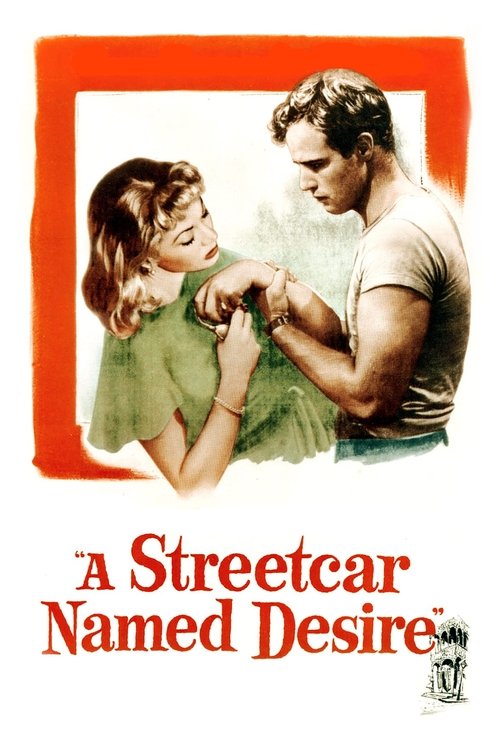
A Streetcar Named Desire
1951 · Elia Kazan
For when you want to be wrecked by great acting — a heavyweight drama night, not a comfort watch. Reach for it when you're ready to feel something raw and can handle a story that doesn't flinch.
What it's about
Blanche DuBois, a fading Southern belle trailing a genteel past that no longer exists, arrives in New Orleans to stay with her sister Stella in a cramped French Quarter apartment. Stella's husband Stanley — blunt, physical, and suspicious of Blanche's airs — sees through her stories and starts pulling at the threads. In two sweltering rooms, refinement and brute force circle each other until something has to give.
The experience
Hot, close, and emotionally bruising — a pressure-cooker chamber drama where you can practically feel the humidity and hear the neighbors through the walls. It's electric to watch and hard to shake; the cruelty lands because the tenderness is real too.
Performances
Marlon Brando's Stanley changed screen acting — volatile, sensual, terrifyingly alive, the performance a whole generation of actors built themselves on. Vivien Leigh's Blanche is its shattering counterweight, a woman performing gentility while it crumbles in her hands; she won the Oscar, and three of the four leads did.
The craft
Elia Kazan, who directed the play on Broadway, brought Tennessee Williams's Pulitzer-winning drama to the screen with most of its original cast, keeping the stage's intensity while tightening the walls around it — shadowy black-and-white, a steamy jazz-inflected score, an apartment that seems to shrink as the story darkens.
Why it matters
This is the film that carried Method acting into Hollywood and made Brando a legend, while its battles with the censors helped crack open what American movies were allowed to say about desire and violence.
Snapshot
A Streetcar Named Desire is the film that carried the Actors Studio revolution from the Broadway stage into the American cinema, and it remains the most consequential record of that transmission. Adapted from Tennessee Williams's 1947 Pulitzer Prize–winning play, directed by Elia Kazan — who had staged the original Broadway production — and featuring most of its principal cast, the film is at once a faithful theatrical preservation and a calculated cinematic intensification of a chamber drama about desire, delusion, and brutality colliding in a cramped New Orleans apartment. Marlon Brando's Stanley Kowalski became the touchstone performance of a new acting style, while Vivien Leigh's Blanche DuBois supplied its tragic counterweight. The picture is also a landmark in the long war between Hollywood's Production Code and adult dramatic content: it reached screens only after cuts imposed both by the Code's Joseph Breen and, more notoriously, by the Catholic Legion of Decency, edits made without Kazan's consent. The result is a work of compressed, sweating, claustrophobic power that pushed the postwar American film toward psychological realism and frank sexuality.
Industry & production
The film was produced by Charles K. Feldman and released through Warner Bros. Feldman, a powerful agent-turned-producer, secured the property and assembled the package around Kazan and Williams. The decision to retain Kazan — fresh from directing the play to acclaim on Broadway — and to import three of the four leads from that production (Brando, Kim Hunter as Stella, and Karl Malden as Mitch) gave the film an unusual continuity of conception between stage and screen. The significant substitution was Vivien Leigh as Blanche, replacing Jessica Tandy, the Broadway Blanche; Leigh had played the role on the London stage in a production directed by her husband, Laurence Olivier, and her established screen stardom — anchored by Gone with the Wind (1939) — gave the film its marquee name and a different, more outwardly fragile reading of Blanche.
The production's defining industrial drama was its negotiation with censorship. Williams's play turned on subjects the Production Code explicitly forbade: a climactic rape, the suicide of Blanche's young husband driven by his homosexuality, and a generally unsanitized sexuality. To obtain a seal, Williams and Kazan accepted revisions — most importantly, the husband's homosexuality was made oblique rather than explicit, and Stanley was made to face a kind of punishment, with Stella's final-scene resolve to leave him strengthened to satisfy the Code's demand that wrongdoing not go unpunished. After the film had already passed the Breen Office, the Legion of Decency threatened a "C" (Condemned) rating, and Warner Bros., fearing the box-office consequences, cut roughly four minutes more without consulting Kazan — trims that softened the eroticism of Stella's descent of the staircase to Stanley and other moments. Kazan protested publicly, and the episode became a celebrated case study in studio capitulation to outside moral pressure. Much of this material was restored in a 1993 "Director's Version," and the restoration is now the standard way the film is seen.
Technology
Streetcar was made with the conventional black-and-white, Academy-ratio (1.37:1) technology of the early-1950s studio system, and it deploys that apparatus deliberately toward confinement rather than spectacle. This was a sound-era studio production shot largely on soundstages with optical, not anamorphic, lenses; the film predates the widescreen and color stampede that CinemaScope would trigger in 1953, and its monochrome, boxy frame is integral to its airless effect. There is no notable technical novelty in the equipment itself — the film's innovations are aesthetic and performative rather than mechanical. What it does demonstrate is the expressive maturity of late classical Hollywood's tools: high-contrast lighting, sensitive panchromatic stock, and post-synchronized music and effects marshaled toward a heightened psychological realism rather than the gloss the same tools typically delivered.
Technique
Cinematography
Harry Stradling Sr., who had photographed Leigh and worked across a range of studio styles, shot the film in a register closer to the shadowed expressionism of film noir than to the polished glamour photography of mainstream melodrama. The visual strategy is one of progressive constriction: as Blanche's grip on reality loosens, the framing tightens, the sets seem to close in, and the lighting grows more fractured. Blanche's terror of harsh light — dramatized in her insistence on covering the bare bulb with a paper lantern — is realized photographically, with the character associated with soft, diffused, protective shadow and Stanley with exposing, unsentimental illumination. The much-discussed claim that the apartment set was literally rebuilt smaller as the story progressed to heighten the sense of entrapment is part of the film's lore; it is widely repeated, and whether through set design, blocking, or lens choice, the felt experience of shrinking space is unmistakable on screen. The camera favors close and medium framings that trap the actors together in the same oppressive air.
Editing
David Weisbart's cutting serves the performances and the play's rhythms rather than imposing an aggressively cinematic tempo. The film's editorial logic is largely subordinated to acting beats — holding on faces, letting Brando's and Leigh's pauses and physical business play out — so that the cutting reinforces the sense of a theatrical event observed with unusual intimacy. Where the editing becomes most expressive is in moments of psychological rupture, where the breakdown of Blanche's composure is matched by a corresponding loosening of the film's controlled construction. The overall design keeps continuity discreet, allowing the spectator to forget the apparatus and attend to the human pressure inside the room.
Mise-en-scène / staging
This is the dimension in which Kazan's stage authorship most directly shapes the film. Having directed the Broadway production, Kazan understood the play as a spatial machine, and he stages the apartment as a pressure vessel: the thin curtain dividing the rooms, the recurring traffic of bodies through narrow doorways, the stairwell to Eunice's flat above. The famous wet-T-shirt physicality of Brando, the sweat and heat made nearly tactile, the bottles and poker table and radio — these props and textures build a dense, lived-in environment that grounds the play's heightened language in working-class material reality. Kazan's blocking keeps characters in forced proximity, and the choreography of advance and retreat between Blanche and Stanley maps the drama's predatory dynamic onto physical space.
Sound
Alex North's score is among the film's most historically important elements (discussed below under authorship), but the sound design more broadly is integral to the storytelling. The recurrent "Varsouviana" polka — the tune that was playing when Blanche's young husband shot himself — functions as a subjective auditory motif, swelling on the soundtrack to mark the moments when her mind slips toward the past, so that the audience hears her madness from inside. New Orleans atmospherics, street cries, the rumble of the titular streetcar, and the intrusions of music from outside the apartment all thicken the environment. The interplay of diegetic source music and North's nondiegetic scoring blurs the boundary between the observed world and Blanche's disintegrating interior.
Performance
Streetcar is, above all, a monument of screen acting and the most influential single demonstration of the Method as adapted by the Actors Studio (which Kazan had co-founded in 1947). Brando's Stanley — physically magnetic, inarticulate yet eruptive, by turns charming and menacing — broke with the elocutionary tradition of prewar Hollywood and modeled a new naturalism of mumble, gesture, and raw emotional immediacy that reshaped American acting for generations. Crucially, the film is not a one-performance affair: Leigh's Blanche supplies a contrasting technique, more classically constructed and theatrical, and that very stylistic friction between her mannered fragility and Brando's animal spontaneity dramatizes the collision of the genteel old South and the brute new order that the play is about. Kim Hunter's Stella, caught sensually and helplessly between them, and Karl Malden's decent, deluded Mitch complete an ensemble of remarkable cohesion, the product of shared rehearsal history. Three of the four leads won Academy Awards — Leigh, Hunter, and Malden — while Brando, nominated, did not; the configuration is often cited as emblematic of how radical Brando's work then seemed.
Narrative & dramatic mode
The film preserves the play's tight Aristotelian compression: a single principal location, a short span of narrative time, and a relentless tragic trajectory built on the arrival, exposure, and destruction of an interloper. Its dramatic mode is domestic tragedy crossed with the revelation-structure of melodrama — secrets from Blanche's past (the lost plantation Belle Reve, her dismissal from teaching, her history of promiscuity, the suicide of her husband) are progressively unearthed by Stanley, whose investigation functions almost as a brutal prosecutorial engine. The point of view is subtly bent toward Blanche's subjectivity, especially through the Varsouviana motif and the increasingly distorted treatment of her breakdown, so that the audience experiences her unreliability from within even as the camera also grants Stanley's appalling vitality. The narrative withholds and discloses with theatrical deliberateness, culminating in the offscreen rape and Blanche's removal to an institution — a resolution that the Code-mandated revisions reframed as a form of moral accounting.
Genre & cycle
Streetcar sits at the intersection of several currents. It is a prestige literary adaptation, part of Hollywood's postwar appetite for serious Broadway and Pulitzer material as a route to adult subject matter and awards. It belongs to the cycle of "social/psychological" dramas that Kazan himself was central to, films probing repression, class, and damaged interiority. And it is shot through with the visual grammar and fatalism of film noir, transposing noir's shadowed entrapment from the crime thriller into domestic tragedy. It also stands at the head of a specifically Tennessee Williams screen cycle — followed across the 1950s and into the 1960s by The Rose Tattoo, Baby Doll (again Kazan), Cat on a Hot Roof, Suddenly, Last Summer, and others — that made Williams's steamy, repression-haunted Southern milieu a recognizable Hollywood genre of its own.
Authorship & method
The film is a study in shared authorship between a playwright, a director, and a cohort of collaborators.
Elia Kazan (director) is the decisive creative intelligence. Having directed the play on Broadway, he approached the film not as a neutral transcription but as a re-staging for the camera, intensifying its physical and psychological pressure. Kazan's signature — an actor-centered realism rooted in his Group Theatre and Actors Studio formation — defines the picture. The film also sits at a fraught biographical moment: Kazan would testify as a friendly witness before the House Un-American Activities Committee in 1952, the year after the film's release, an act that shadows his subsequent reputation and is frequently read into the themes of betrayal and survival across his work.
Tennessee Williams (writer) adapted his own play for the screen (with Oscar Saul credited on the screenplay), and his lyrical, symbol-laden language — Blanche's "kindness of strangers," the paper lantern, the streetcar named Desire itself — survives the adaptation largely intact, giving the film a verbal richness rare in Hollywood. Williams's reluctant accommodation of the censors marks the limits the studio system then imposed on his vision.
Alex North (composer) wrote what is generally regarded as one of the first major jazz-inflected dramatic scores in Hollywood, importing blues and jazz idioms to evoke New Orleans and to charge the drama with a sultry, neurotic eroticism. North's score is a genuine landmark, widely credited with helping open American film music to vernacular jazz and earning him an Academy Award nomination; its influence on subsequent dramatic scoring is substantial.
Harry Stradling Sr. (cinematographer) supplied the shadowed, constricting monochrome look, and David Weisbart (editor) shaped the performance-first cutting, both discussed above. The art direction's claustrophobic apartment completes the collaborative achievement.
Movement / national cinema
The film is a central document of postwar American screen realism and of the Actors Studio's transformation of national acting practice. It is not part of a formally declared movement, but it crystallizes the convergence of the American "Method," the social-problem and psychological drama of the late 1940s and early 1950s, and the prestige theatrical adaptation. Its lineage runs back to the Group Theatre of the 1930s — the New York leftist theatrical milieu from which Kazan, Lee Strasberg, and the Stanislavski-derived training emerged — and forward into the actor-driven American cinema of the 1950s. As national cinema, it is emphatically American in its regional specificity (the working-class, polyglot New Orleans of the French Quarter) and in its preoccupation with the decay of the genteel Old South before the energies of a brawnier, immigrant-inflected modern order.
Era / period
Streetcar is a quintessential early-Cold-War American film, made in 1950–51 at the apex of the studio system's authority and on the eve of its disruption by television, the Paramount divestiture, and the widescreen revolution. Its production coincides with the height of HUAC's pressure on Hollywood and the Red Scare that would soon claim Kazan's testimony; the period's anxieties about loyalty, exposure, and the policing of private life resonate with the film's drama of secrets violently brought to light. It also belongs to the moment when the Production Code's grip began visibly to loosen under the strain of adult material — Streetcar's censorship battle is a key episode in the slow erosion that would culminate in the Code's collapse and replacement by the ratings system in 1968.
Themes
The film's governing oppositions are desire and death, illusion and reality, refinement and brutality. Blanche embodies a fading aristocratic gentility that masks sexual desperation and trauma; Stanley embodies an unillusioned, physical, ascendant working-class virility. Their conflict stages the destruction of a fragile, mendacious beauty by an unsentimental force that claims the name of truth but acts with cruelty. Sexuality runs through everything — repressed, sublimated, weaponized — as does the theme of performance and self-fashioning: Blanche is perpetually staging a version of herself, dressing the world in soft light and euphemism to survive an unbearable reality. The "kindness of strangers" names her terrible dependence on others' charity and desire. Madness, shame, the violence of exposure, and the impossibility of return to a vanished past complete the thematic web, with the streetcar itself standing as the blunt mechanism that carries desire toward its terminus.
Reception, canon & influence
On release, the film was a critical success and a major awards contender, earning twelve Academy Award nominations and winning four — Best Actress (Leigh), Best Supporting Actress (Hunter), Best Supporting Actor (Malden), and Best Art Direction — a near-sweep of the acting categories that confirmed both the film's stature and the arrival of its new performance style. The censorship controversy was itself a significant part of the reception, generating debate about studio cowardice and the moral policing of serious art.
The influences on the film are clear and acknowledged: Williams's play and the Broadway production above all; the Stanislavski-derived acting tradition mediated through the Group Theatre and the Actors Studio; and the visual and fatalistic vocabulary of film noir. Williams's poetic realism and Southern Gothic sensibility supplied the literary DNA.
Its legacy is immense. Brando's Stanley became the foundational image of Method acting on screen and a direct model for the generation of American actors — James Dean, Paul Newman, and beyond — who followed; the performance is routinely cited as one of the most influential in film history. The film helped legitimize frank adult sexuality and psychological complexity in mainstream American cinema, and its censorship saga is a standard reference in histories of the Production Code's decline. Alex North's score opened the door to jazz in serious film music. The Williams–Kazan collaboration it inaugurated shaped the prestige adaptation through the 1950s. Streetcar has been preserved in the National Film Registry and sits securely in the American canon, endlessly revived, quoted, and parodied — "Stella!" bellowed up a stairwell is among the most recognizable images the American sound film has produced. It endures both as a near-definitive record of a great American play and as the hinge on which mid-century screen acting turned.
A Deleuzian reading
The first thing Blanche does in her sister's apartment is dim it.
The full Deleuzian reading of A Streetcar Named Desire →
Reception
A sensation from day one — it won three acting Oscars (a first for any film) — but the version audiences saw was trimmed to appease the censors; the 1993 restoration put back the cut material, and today it's remembered less as a controversy than as the moment screen acting changed.
How A Streetcar Named Desire was received, from release to now →
Influences: the films it descends from and the films it influenced
- The Little Foxes (1941) — Demonstrated how to film a Southern stage play in deep-focus, confined interiors without 'opening it up,' the chamber-adaptation grammar Kazan inherits for Williams.
- Citizen Kane (1941) — Gregg Toland's low-key chiaroscuro and low-ceilinged, pressurized interiors supplied the constricting monochrome vocabulary Harry Stradling adapts for the Kowalski apartment.
- Double Indemnity (1944) — Codified the venetian-blind noir lighting and fatalistic entrapment look that Streetcar imports from crime film into a domestic psychological melodrama.
- Body and Soul (1947) — John Garfield's Group Theatre naturalism is the direct on-screen precursor to Brando's Method — a Stanislavski-trained actor bringing inner-life realism to a Hollywood lead.
- A Tree Grows in Brooklyn (1945) — Kazan's debut established his actor-first tenement realism and ensemble-of-behavior direction that Streetcar concentrates and intensifies.
- The Heiress (1949) — Single-house psychological-cruelty drama adapted from the stage, a model of claustrophobic chamber construction and slow emotional strangulation.
- Rome, Open City (1945) — Italian neorealism's raw behavioral acting legitimized the unpolished naturalism Kazan and Strasberg were championing at the Actors Studio.
- On the Waterfront (1954) — Direct continuation of the Brando–Kazan–Actors Studio method, with improvisatory, gesture-led performance ('I coulda been a contender') extending Stanley's naturalism.
- East of Eden (1955) — Kazan casts James Dean as Brando's heir, building the film around raw, improvised Actors Studio emotionalism descended straight from Streetcar.
- Viva Zapata! (1952) — Kazan and Brando re-teamed immediately after, transposing the same Method physical transformation and naturalist intensity onto historical biography.
- Baby Doll (1956) — Continues the Williams–Kazan screen collaboration and its deliberate provocation of the Production Code over frank Southern sexuality.
- Cat on a Hot Tin Roof (1958) — Tennessee Williams adaptation built on a single sweltering house set, extending the claustrophobic staging and censored sexual frankness Streetcar pioneered.
- Rebel Without a Cause (1955) — James Dean's bruised, inward Method emotionalism descends directly from Brando/Stanley as the template for the sensitive postwar male star.
- The Man with the Golden Arm (1955) — Elmer Bernstein's driving jazz score extends Alex North's breakthrough of vernacular blues/jazz as the emotional language of serious dramatic film.
- Splendor in the Grass (1961) — Late Kazan sexual-repression drama drawing raw Actors Studio performances from Beatty and Wood, sustaining his naturalist actor-direction.
- Who's Afraid of Virginia Woolf? (1966) — The later apotheosis of the Streetcar mode: a claustrophobic single-set theatrical adaptation with lacerating Method performance and Code-defying frankness.
- Anatomy of a Murder (1959) — Kazan's film gave Actors Studio method performance — the coiled physical stillness and sublimated aggression of Brando — its definitive screen vocabulary, the idiom Ben Gazzara and George C. Scott deploy in Anatomy's charged cross-examination sequences.
- 12 Angry Men (1957) — Kazan staged a Method ensemble in a claustrophobic single-set apartment where spatial position — the bedroom door, the poker table — encodes who holds power, the direct template for 12 Angry Men's geographic status coding.
- To Kill a Mockingbird (1962) — Harry Stradling's monochrome cinematography and Kazan's protocol for transposing Williams's stage text into behavioral film acting—naturalism in enclosed domestic spaces replacing theatrical projection—provides the Southern Gothic theatrical-adaptation method that Horton Foote's Mockingbird screenplay directly inherits.
- A Place in the Sun (1951) — Montgomery Clift's interiorized, mumbling Method performance represents the parallel strand of the new naturalism arriving the same year.
- Glengarry Glen Ross (1992) — Set the template for the 'faithful' stage-to-screen transfer that refuses to open the play up, trusting a Method ensemble to carry the chamber confinement and the text's verbal rhythms intact.
Similar films
- Cat on a Hot Tin Roof (1958) — influence & lineage · same viewing thread
- On the Waterfront (1954) — influence & lineage
- A Place in the Sun (1951) — influence & lineage
- East of Eden (1955) — influence & lineage
- A Tree Grows in Brooklyn (1945) — influence & lineage
- Double Indemnity (1944) — influence & lineage
- Gone with the Wind (1939) — same viewing thread
- Suddenly, Last Summer (1959) — same viewing thread
All the films related to A Streetcar Named Desire →
Watch it with: curated runs of related films
- Heat and Reckoning in the American South — A run of Southern dramas where family, race, and old money simmer under the same unbearable heat — watch them together to trace the region from the plantation myth through the civil-rights march.