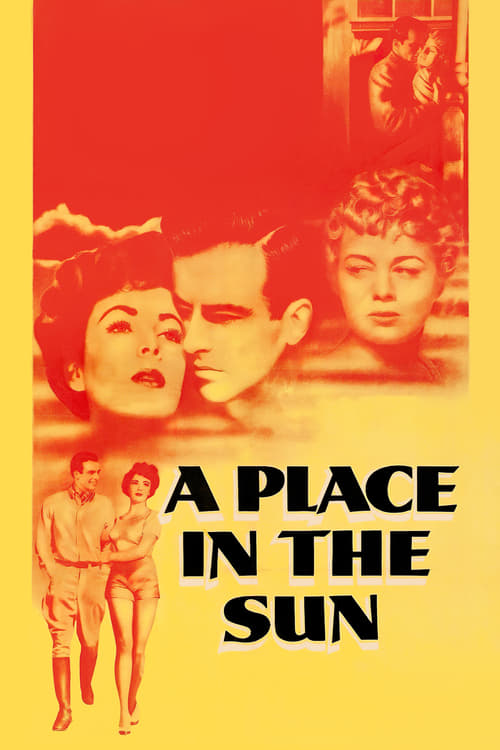
A Place in the Sun
1951 · George Stevens
When you want an old-Hollywood romance with real darkness under the gloss — something lush to surrender to that will also leave you arguing about guilt, class, and desire afterward.
What it's about
A poor young man comes to work in his rich uncle's factory and drifts into a quiet romance with a fellow worker — then falls headlong for a dazzling society heiress who embodies everything he has ever wanted. As his old attachment becomes a pregnancy he can't wish away, his climb toward the American dream tightens into a trap.
The experience
It plays as a swooning romance with dread pooling underneath — dreamy and intimate in its love scenes, then increasingly suffocating as the walls close in. It leaves you unsettled about how much you were rooting for him.
Performances
Montgomery Clift is extraordinary — anguished, inward, modern in a way 1951 screens rarely allowed — opposite a young Elizabeth Taylor at her most luminous, while Shelley Winters is quietly heartbreaking as the woman being left behind.
The craft
George Stevens shoots the romance in enormous, dissolving close-ups that feel almost private — some of the most rapturous black-and-white photography of its era, paced with deliberate, mounting control. It won six Academy Awards, including Best Director.
Why it matters
One of the defining dramas of Hollywood's postwar peak, and its intimate, close-up-driven style pointed toward the more psychological American cinema of the decade that followed.
Snapshot
George Stevens's adaptation of Theodore Dreiser's An American Tragedy is one of the defining films of the American studio system's twilight era — a social melodrama of rare psychological density, shot with an intimate visual grammar that anticipates the close-up-saturated cinema of the following decade. The film follows George Eastman (Montgomery Clift), a factory worker and poor relation of a wealthy industrialist family, whose romance with socialite Angela Vickers (Elizabeth Taylor) is imperiled by his prior entanglement with Alice Tripp (Shelley Winters), a working-class woman he has made pregnant. When Alice drowns during a boat trip on an Adirondack lake, George faces trial for murder — a murder he may or may not have intended. The film won six Academy Awards, including Best Director, and remained among the most discussed American films of the early Cold War period.
Industry & production
Paramount Pictures produced the film under Stevens's own unit, with Stevens serving as producer as well as director — an arrangement that reflected his standing as one of Hollywood's most commercially and critically trusted filmmakers in the late 1940s. The material had history at the studio: Paramount had previously released Josef von Sternberg's An American Tragedy in 1931, based on the same Dreiser novel, and Dreiser himself had been publicly dissatisfied with that adaptation, initiating and then settling a lawsuit. Stevens acquired rights for a second adaptation, and the studio agreed to rename the property, evidently concerned that "tragedy" in a title carried commercial risk. Michael Wilson and Harry Brown's screenplay was credited for the adaptation, though Wilson would later face blacklisting during the HUAC investigations, a circumstance that for years complicated proper attribution of his contribution.
Casting was central to the project's ambitions. Montgomery Clift had already established himself as a new kind of American screen actor through The Search (1948) and The Heiress (1949). Elizabeth Taylor, though primarily known for family pictures and the MGM system's promotional machinery, was eighteen during production; Stevens saw in her a mature screen gravity that her previous roles had not fully exploited. Shelley Winters, cast against her established blonde-comedienne persona, took the role of Alice seriously enough to research the social world of factory women. Stevens filmed extensively on location in Northern California, using Lake Tahoe and surrounding areas to stand in for the Adirondack setting of the novel, which gave the film's outdoor sequences a grandiose, slightly operatic natural scale.
Technology
William C. Mellor, working with Stevens, made a particular technical investment in the telephoto lens for close-up and medium-close work. Long focal-length lenses, used at distance on subjects, compress spatial depth and flatten the plane between two faces pressed close together — and the famous romantic close-ups of Clift and Taylor exploited this compression to create an effect of almost painful intimacy. The technique was not unknown in 1951, but its sustained application throughout a studio prestige picture of this size was relatively uncommon and would prove influential. The choice required precise coordination between Stevens, Mellor, and the camera operators, since shooting with long lenses at such proximity introduced technical challenges in focus and spatial continuity.
Paramount provided the full resources of a major studio: the film was shot in black and white, which Stevens preferred over color for its tonal range and its compatibility with the social-realist undertow of the material. The laboratory work on Mellor's negative produced deep, lustrous contrast — shadows in the Eastman factory have weight; the outdoor lake sequences are luminous and slightly overexposed, as if bleached by aspiration.
Technique
Cinematography
Mellor's work operates in two distinct registers that mirror the film's social logic. Interiors associated with the Eastman factory and George's rooms are low-key, with claustrophobic framings that evoke an earlier documentary-influenced style of American cinematography. The Vickers world — parties, estates, the lakeside — is shot in softer, more diffused light, with wider aperture producing shallow focus that makes Taylor and the social world she inhabits appear dreamlike and slightly unreal. The pivot between these two visual worlds is not accidental; it reproduces George's experience of class as a shift in atmosphere, not merely in circumstance. The lake sequence itself, where Alice drowns, is shot with deliberate restraint — low angles on water, the boat rocking in near-darkness — eschewing any conventional sensationalism and leaving the act's moral status unresolved at the level of image.
Editing
William Hornbeck's editing (which won the Academy Award) is notable for the romantic montage sequences between Clift and Taylor — series of close-ups assembled in rhythmic patterns, faces dissolving into each other, that borrow the lyrical montage grammar of silent cinema and apply it to a sound film's psychological interiority. These sequences create the impression of time compressed by desire. In contrast, the trial sequence is assembled in longer takes with careful spatial geography, producing the grinding procedural momentum of public judgment. The difference in cutting tempo between these sections functions as a formal argument about the relationship between private feeling and public accountability.
Mise-en-scène / staging
Stevens's staging throughout is attentive to the social geometries of class. George's body language in the Vickers world — Clift's particular gift for registering suppressed longing and social discomfort through physical microadjustment — is visually contrasted with the ease of the wealthy characters around him. The society party sequences are staged to emphasize George's literal and figurative peripherality before his gradual entry into the center. Stevens did not favor theatrical or ostentatiously stylized staging; his mise-en-scène is composed to appear natural while being carefully organized around psychological vectors between characters.
Sound
Franz Waxman's score received the Academy Award — his second consecutive win, following Sunset Boulevard (1950). Waxman composed two primary thematic worlds: a lyrical, ascending motif associated with Angela and the romance, which is fully romantic in the European tradition he brought from his Berlin training; and darker, more dissonant material that surfaces during the trial and the scenes of George's entrapment. The score does not comment ironically on the material but takes its emotional stakes at face value, which is part of what gives the film its melodramatic earnestness. Ambient sound — the factory floor, the lake water — is handled with relative restraint; this is not a film interested in industrial naturalism on the soundtrack.
Performance
The film's performance register is essentially Method-adjacent, particularly in Clift's work, which draws on his training with the Actors Studio milieu and produces an interiority — small hesitations, redirected glances, the catching of breath — that was still somewhat unusual in American studio acting. Taylor, responding to Clift's naturalistic approach, shed the declarative quality of her earlier performances and found something more genuinely felt. The chemistry between them became one of the film's most discussed features and appears to have been a genuine phenomenon of their collaboration rather than manufactured effect. Shelley Winters does something considerably harder: she plays a woman whose social vulnerability and romantic desperation are fully legible to the audience, making Alice's death painful rather than convenient. The film's moral complexity depends on Winters succeeding in this, and she does. Raymond Burr appears as the prosecuting attorney and gives a concentrated, almost satirically aggressive performance that Stevens uses to externalize the social machinery of retribution.
Narrative & dramatic mode
The film works in the mode of the fallen-man tragedy: George Eastman's arc is visible in outline from early in the narrative, and the dramatic engine is not suspense about outcome but attention to the psychological process by which an ordinary man becomes capable of the thought, if not the act, of murder. The Dreiser source material had been explicitly sociological — Dreiser was interested in the determinism of class and environment — and Stevens's adaptation preserves this structural argument even while shifting its emotional center toward individual psychology and romantic longing. The ambiguity of the drowning, in which George rows Alice onto the lake with murderous intent but does not, in the end, strike the blow (Alice drowns when the boat capsizes accidentally, or nearly accidentally), is the film's central dramatic and moral event, and Stevens stages it to resist resolution. The trial sequence reinstates a social order that demands a clean account — intentional murder — and the film's tragedy is partly the tragedy of that demand's inflexibility.
Genre & cycle
A Place in the Sun sits at the intersection of several overlapping genre currents. It is a social melodrama in the tradition of American prestige adaptations of literary naturalism (John Ford's The Grapes of Wrath, 1940, is an obvious predecessor). It draws on the conventions of the courtroom drama and the film noir's interest in a protagonist's criminal entanglement. And it is, in its romantic sequences, a love story of an unusually intense kind. The film belongs to the immediate postwar cycle of Hollywood dramas concerned with the costs and contradictions of the American Dream — a cycle that included All About Eve (1950), Sunset Boulevard (1950), and, in the following years, would extend toward From Here to Eternity (1953) and the social dramas of Douglas Sirk. Stevens's film is more romantic and less satirical than the Wilder or Mankiewicz films, and its social critique is primarily emotional rather than rhetorical.
Authorship & method
Stevens was, by 1951, a filmmaker with an unusually broad range — he had made comedies with Katharine Hepburn and Fred Astaire, Gunga Din (1939), and I Remember Mama (1948). His military service during World War II, during which he served with the U.S. Army Pictorial Service and filmed the liberation of Dachau, is frequently cited by commentators as formative for the moral seriousness of his postwar work. Stevens was meticulous and slow by industry standards, shooting extensive coverage and taking time to discover scenes during editing. He regarded A Place in the Sun as among his most personal films, though he was reticent about detailed statements of intent, and the scholarly record on his working methods is thinner than for some contemporaries.
Mellor would continue collaborating with Stevens on Shane (1953) and would win a second Oscar for The Diary of Anne Frank (1959), also directed by Stevens. Hornbeck was one of the most distinguished editors of the classical Hollywood period, with credits extending back to Frank Capra's productions. Wilson's contribution to the screenplay — the adaptation's structural decisions, the compression of the novel's social machinery into a manageable three-act form — should be noted: the blacklist's disruption of attribution has long complicated clear accounting of his role, though rehabilitation of his credit has since been largely accomplished.
Movement / national cinema
The film belongs to American studio cinema at the height of its classical phase and at the edge of its institutional transformation. It does not align with any modernist or international movement, though its telephoto-inflected close-up grammar would become a technical influence that crossed national borders. In the context of American cinema specifically, it participates in the liberal melodrama tradition that characterized the prestige output of the major studios in the postwar decade — politically cautious in explicit terms, but registering social anxiety through generic and psychological pressure.
Era / period
The film is produced at the moment of Hollywood's response to television competition and the consent decrees that had broken studio ownership of theater chains, forcing reorganization. Stevens's semi-independent production arrangement was representative of the new deals directors and stars were negotiating. The film's content — its preoccupation with upward mobility, the violence latent in aspiration, the exposure of class difference beneath the surface of democratic mythology — resonates with the social anxieties of early Cold War America, though Stevens did not pursue this as explicit political commentary.
Themes
The film's central preoccupation is the destructive pressure of the American Dream on individuals who believe in it absolutely. George Eastman is not a cynic; he is a believer, which is what makes him dangerous to himself and others. The romantic fantasy that Angela represents — the fantasy of transcendence through the right love, the right social connection — is presented with genuine sympathy and genuine critique simultaneously, which gives the film its emotional doubleness. Class is treated not as a backdrop but as a force that shapes desire, perception, and moral capacity. The film is also concerned with guilt — specifically with the question of whether intending an action and failing to perform it carries equivalent moral weight to performing it, a question the legal system in the film answers yes and the film itself treats with more uncertainty.
Reception, canon & influence
A Place in the Sun was a major critical and commercial success on release. It received six Academy Awards from nine nominations, including Best Picture (for which it lost, to An American Place — actually it lost Best Picture to An American in Paris). Critical response was largely enthusiastic, with the film's romantic sequences and performances receiving particular praise. Charlie Chaplin was reported to have expressed strong admiration for the film, though the precise terms and context of that statement are not consistently documented in the scholarly literature, and it should be treated cautiously.
Pauline Kael's later, more skeptical account — she found the film overwrought and its romanticism a betrayal of Dreiser's social determinism — became one of the defining dissents in postwar American film criticism, and the argument about whether Stevens's lyricism illuminates or sentimentalizes the material has not been definitively resolved. The 1931 von Sternberg version is generally considered more faithful to Dreiser's bleak naturalism; the 1951 version is considered more cinematically achieved. Dreiser himself died in 1945 and did not see the Stevens adaptation.
Influences on the film: Dreiser's naturalist tradition; the European romantic melodrama as filtered through studio-era conventions; the Method acting movement already reshaping American performance; the Italian neorealist influence visible at the margins of Stevens's location work; von Sternberg's 1931 version, which Stevens and his writers had studied and consciously departed from.
The film's legacy: The extreme close-up grammar developed by Mellor and Stevens — the telephoto compression of two faces — became a touchstone for directors interested in rendering interiority through the face. The film's treatment of ambiguous moral culpability, refusing to resolve the drowning into clear innocence or guilt, was cited by later filmmakers working in the psychological crime tradition. The casting of Taylor against type inaugurated a second phase of her career and established the template for her subsequent dramatic work. For the study of American social melodrama, A Place in the Sun remains a canonical text — neither fully naturalist nor fully romantic, it inhabits the productive unease between those modes and uses it as a form of critique.
A Deleuzian reading
There's a close-up in this film that feels like being held too close to someone.
The full Deleuzian reading of A Place in the Sun →
Reception
A colossus in 1951 — six Oscars including Best Director, and Chaplin reportedly calling it 'the greatest movie ever made about America' — it lost Best Picture to An American in Paris in one of the Academy's most second-guessed calls. Today its stock has slipped from untouchable-masterpiece to admired-but-argued-over, its melodrama dated for some, its imagery undimmed for all.
How A Place in the Sun was received, from release to now →
Influences: the films it descends from and the films it influenced
- An American Tragedy (1931) — Stevens and co-writer Michael Wilson studied von Sternberg's expressionist staging of the murder-drowning and deliberately replaced its externally coded guilt with psychologically interior telephoto close-up, making the drowning's intentionality permanently ambiguous rather than visually declared.
- Greed (1924) — Von Stroheim's use of environmental and social density to render class aspiration as a mechanistic, destroying force established the American literary naturalist grammar Stevens adapts — replacing von Stroheim's material determinism with psychological interiority but keeping the same structural logic of class as doom.
- Double Indemnity (1944) — John Seitz's dual-register black-and-white lighting — high-key domesticity against low-key moral darkness — established the grammar William Mellor extends to split A Place in the Sun's visual register between the soft-focus romanticism of the Taylor sequences and the harder social realism of the Winters scenes.
- Letter from an Unknown Woman (1948) — Ophüls's dissolve-montage sequences — compressing subjective romantic time into a rhythm of close-ups that idealize experience against the social reality surrounding it — directly inform Stevens's romantic interludes between Clift and Taylor, which use the same optical technique and the same tactic of rendering desire as an edited rhythm rather than a represented event.
- Sunset Boulevard (1950) — Franz Waxman developed his dual-leitmotif scoring architecture — a romantic theme and a fate theme in sustained, unresolved counterpoint — in Sunset Boulevard and carried it structurally intact to A Place in the Sun, scored the following year by the same composer for the same studio.
- All That Heaven Allows (1955) — Sirk extends Stevens's class-geometry staging — the practice of placing characters at different planes and heights within the frame to externalize social hierarchy as spatial arrangement — and inherits the tactic of deploying romantic visual excess as social critique rather than endorsement.
- Vertigo (1958) — Robert Burks's telephoto close-up renders Scottie's obsessive male gaze through the same optical compression Mellor used for Clift, while Bernard Herrmann's dual thematic scoring — Scottie's and Madeleine's leitmotifs in unresolvable counterpoint — replicates Waxman's architecture; the morally complicit male who witnesses a woman fall from a height holds Eastman's exact structural position.
- Lolita (1962) — Kubrick uses telephoto close-up to render Humbert's self-justifying romantic gaze — the desired face in shallow focus, abstracted from social context — extending Stevens's technique for the morally compromised male protagonist whose romantic self-narration the camera endorses visually while condemning structurally.
- The Graduate (1967) — DP Robert Surtees extended Mellor's telephoto grammar — compressing two faces into a single shallow-focus frame to render romantic obsession as an almost abstract proximity — and the lyrical montage sequences with Simon and Garfunkel holding the same structural counterpoint role as Waxman's score are a direct formal inheritance Surtees discussed in interviews about the film's visual approach.
- Badlands (1973) — Malick deploys lyrical dissolve-montage as moral counterpoint — the romantic visual beauty of Kit and Holly's idyll set against the horror of the killings — extending Stevens's tactic of using romantic lyricism as critique rather than endorsement, and treating American landscape as a social force that determines rather than merely frames its characters.
- In the Mood for Love (2000) — Christopher Doyle's telephoto compression of two faces into a single frame for the corridor and staircase sequences, combined with slow-motion optical printing as lyrical montage, extends Stevens's and Mellor's telephoto grammar; the film's dual musical leitmotif structure — Nat King Cole against Shigeru Umebayashi's recurring theme — replicates Waxman's counterpoint architecture for rendering impossible romantic interiority.
- Far from Heaven (2002) — Haynes deploys class-geometry staging as a scholarly citation of the Stevens/Sirk social melodrama tradition, using the widescreen frame as a diagram of the social forces constraining individual desire — with the protagonist's physical placement within domestic and public spaces functioning as a precise formal inheritance of the mise-en-scène logic Stevens's film anchors.
- From Here to Eternity (1953) — Montgomery Clift's established Method screen persona — moral conflict internalized through facial micro-expression and physical restraint rather than dialogue — was directly transplanted into Prewitt; Stevens also chose Academy ratio over emerging widescreen for the identical reason of holding a tragic hero's psychology in tight frame.
- East of Eden (1955) — Its tight, shallow-focus close-ups and overlapping dissolves modeled the intimate psychological melodrama — emotion read off the face — that Eden scaled up to the wide frame.
- A Streetcar Named Desire (1951) — Kazan and DP Harry Stradling simultaneously deployed the Method close-up grammar — the face photographed in extreme proximity as the site of psychological truth rather than conventional three-quarter coverage — that Stevens uses with Clift; Brando and Clift together define the same shift from theatrical to psychological camera coverage in postwar American cinema.
- Shane (1953) — Stevens and Mellor transferred the telephoto compression grammar from face-to-face psychological close-up to landscape, compressing Wyoming mountain ranges against human figures to render scale as social force — extending the same optical logic across a different register with the same director-cinematographer team.
- Rebel Without a Cause (1955) — Ray and DP Ernest Haller use Method close-up — James Dean carrying the Clift grammar directly into CinemaScope — alongside class-geometry blocking that positions the protagonist as spatially isolated from both his social superiors and the suburban milieu, operating in the same American Dream critique Stevens anchors.
Similar films
- A Streetcar Named Desire (1951) — influence & lineage
- The Graduate (1967) — influence & lineage
- All That Heaven Allows (1955) — influence & lineage
- Sunset Boulevard (1950) — influence & lineage
- Memoirs of a Geisha (2005) — often watched together
- Tess (1979) — often watched together
- La La Land (2016) — shared sensibility
- Breakfast at Tiffany's (1961) — shared sensibility