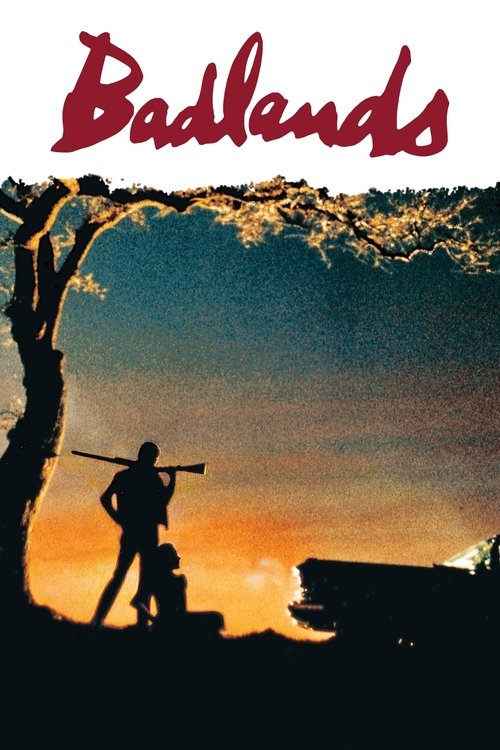
Badlands
1974 · Terrence Malick
For when you want something haunting rather than comforting — a slow-burning American nightmare dressed in golden light. Good for a contemplative night when you're up for beauty with a body count.
What it's about
In a dead-end 1950s South Dakota town, a fifteen-year-old girl falls for a swaggering older garbage collector who styles himself like a movie rebel. When her father objects, the boy answers with violence, and the two take off across the plains — building a hideout in the trees, drifting through the badlands, leaving bodies behind them. She narrates it all in the dreamy, romance-magazine language of a girl who doesn't quite grasp what she's part of.
The experience
Eerie and beautiful in equal measure — the violence comes flat and sudden while the voiceover stays moony and calm, and that gap is what gets under your skin. It's unhurried, strange, often darkly funny, and it leaves a chill that lingers.
Performances
Martin Sheen is magnetic as a killer who acts like he's posing for photographs, all borrowed cool over a hollow center, and Sissy Spacek's affectless, wide-eyed narration is the film's secret weapon — innocence that never quite curdles into understanding.
The craft
Malick's first feature announces his eye immediately: magic-hour light on empty plains, houses burning like altars, nature watching indifferently from the edges of the frame. The chiming, toy-like score gives the killings a fairy-tale wrongness, and the ironic distance between what you see and what Holly says is handled with total control.
Why it matters
An astonishing debut that launched one of American cinema's most distinctive careers and set the template for the dreamy, voiceover-driven lovers-on-the-run film — its tone has been borrowed by decades of crime movies since.
Snapshot
Badlands is Terrence Malick's first feature, a laconic and disquieting account of two young lovers who drift into murder across the empty middle of America. Kit Carruthers (Martin Sheen), a garbage collector who styles himself after James Dean, takes up with fifteen-year-old Holly Sargis (Sissy Spacek); when her father objects, Kit shoots him, and the pair flee into the plains, leaving more bodies behind them. The film is loosely founded on the 1958 Charles Starkweather–Caril Ann Fugate killing spree, which left eleven dead across Nebraska and Wyoming, but Malick is uninterested in the journalism of the case. What distinguishes the film, and what made it instantly influential, is the gap it opens between atrocity and tone: violence arrives flatly, almost as housekeeping, narrated over by Holly in the becalmed, cliché-saturated voice of someone reciting a movie-magazine romance. The result is one of the founding works of the American 1970s art cinema and a permanent reference point for the "lovers on the run" film.
Industry & production
Badlands was made outside the studio system as a genuinely independent production, financed largely through money Malick raised himself from private investors, with Edward R. Pressman serving as producer under the Pressman-Williams banner and Malick taking producer and writer-director credit. It was made cheaply — accounts place the budget in the low hundreds of thousands of dollars, a figure that strained against the ambitions of the shoot — and the production was reportedly difficult, marked by crew turnover that is visible in the unusual fact of multiple credited cinematographers. Malick, a former Rhodes Scholar and philosophy student who had passed through the inaugural class of the American Film Institute's Center for Advanced Film Studies and worked as a screenwriter (including uncredited rewrite work in Hollywood), was a first-time feature director, and the film bears the marks of a debut made on conviction and limited means.
Principal photography took place largely in Colorado — the area around La Junta and the southeastern plains — standing in for the South Dakota and Montana of the story. The film premiered at the New York Film Festival in 1973, where it made an immediate impression on critics, and Warner Bros. acquired it for distribution, giving it its wider release in 1974. The picture launched several careers at once: it was Malick's announcement as a major filmmaker, an early lead for Martin Sheen, and the breakthrough for Sissy Spacek, who would go on to Carrie and Coal Miner's Daughter. Production designer Jack Fisk, who married Spacek, began here a long working relationship with Malick that has continued across his career.
Technology
Badlands was shot on 35mm color film in an era before the digital tools that now smooth low-budget production, and its technology is essentially that of the lightweight, naturalistic American cinema of the early 1970s: portable cameras, fast color stock pushed toward available-light naturalism, and an emphasis on real locations over built sets. The film is notable for its commitment to natural light and to the particular qualities of late-afternoon and "magic hour" sun on the plains — an aesthetic that depended on shooting practices and film-stock sensitivity as much as on any single device. Malick's later, much-discussed obsession with available light and the golden hour is already legible here in embryonic form, achieved with the relatively modest means of a debut feature rather than the elaborate apparatus of his later work.
Technique
Cinematography
The cinematography is credited to three names — Brian Probyn, Tak Fujimoto, and Stevan Larner — a division of labor that reflects the troubled production but yields a remarkably unified look. The film's signature is the tension between the human ugliness of the story and the lyric beauty of the landscape: wide, becalmed compositions of grassland and sky, trees photographed against luminous light, the lovers' hideout in the cottonwoods rendered as a kind of arcadia. Malick repeatedly cuts away from his characters to the natural world — insects, fields, the prairie under enormous sky — establishing the contemplative, nature-attentive visual grammar that would become his trademark. Tak Fujimoto, in particular, went on to a major career (including long collaboration with Jonathan Demme). The beauty is never decorative; it is the film's central irony, a serene world indifferent to the murders committed inside it.
Editing
Edited by Robert Estrin, Badlands moves with an elliptical calm that is essential to its effect. Violence is frequently elided or thrown away in the cutting — deaths occur abruptly, off-handedly, without the build-and-release rhythm of conventional crime cinema — so that the audience is denied the catharsis the genre usually supplies. The editing also sets image against voice: Holly's narration runs over montage sequences that often contradict or float free of what she describes, and the film's pacing privileges digression, observation, and dead time over forward momentum. This refusal of dramatic emphasis, the flattening of climaxes into incidents, is one of the film's most imitated formal strategies.
Mise-en-scène / staging
Jack Fisk's production design grounds the film in a precisely observed lower-middle and working-class American landscape of the period setting — the dead-end town, the billboard, the modest house, the tree-house hideout the couple builds and furnishes like playing house. Malick stages much of the action with an anthropological detachment, letting behavior unfold in long, unhurried takes. Kit's self-conscious performance of cool — his Dean-like posture, his habit of recording sententious thoughts on a dictaphone, the gestures he leaves as souvenirs — is built into the staging, so that the film is partly about people arranging themselves into images of themselves. The hideout sequence, an idyll of domestic make-believe in the wilderness, is the staging's quiet center.
Sound
Sound is among the film's most influential elements, on two fronts. The first is the score and song selection: Malick makes extraordinary use of Carl Orff's "Gassenhauer" (from the Schulwerk / Musica Poetica pedagogy with Gunild Keetman), a simple, circling xylophone theme whose childlike innocence rubs unbearably against the violence; he also draws on Erik Satie and on period pop, including Nat King Cole's "A Blossom Fell" and Mickey & Sylvia's "Love Is Strange." Original music is credited to George Tipton. The second is Holly's voiceover — flat, naive, borrowed wholesale from the vocabulary of teen romance magazines and pulp fiction. This narration is the film's master stroke: it tells us how Holly understands her life even as the images tell us what that life actually is, and the chasm between the two is where the film's meaning lives.
Performance
Martin Sheen's Kit is a study in vacancy dressed as charisma — a young man who has modeled himself so thoroughly on James Dean that he seems to be acting in a film only he can see, polite and matter-of-fact even in murder. The performance withholds the psychological "explanation" the material seems to invite; Kit's emptiness is the point. Sissy Spacek's Holly is its perfect complement: watchful, passive, drifting through events with a child's incuriosity, her affectlessness amplified by the disjunction between her serene narration and her circumstances. Warren Oates, as Holly's stern sign-painter father, brings a grave, grounded weight to his brief role. The two leads' refusal to editorialize — to signal guilt, terror, or remorse — is what makes the film so coldly unsettling.
Narrative & dramatic mode
The film's dramatic mode is anti-melodramatic and ironic. It takes the structure of a crime spree and a road movie but drains both of suspense and moral instruction. Events are filtered through Holly's retrospective narration, an unreliable but not deceitful voice — unreliable because it is so inadequate to what it describes, framing horror in the language of romance and adventure. Malick withholds motive: there is no trauma, no grievance, no coherent psychology offered to account for Kit's killings, and the film's power comes precisely from that withholding. The narrative proceeds by episodes and digressions rather than by escalating stakes, and its emotional register is one of estrangement — the viewer is kept at a contemplative distance, observing rather than identifying. This combination of voiceover lyricism, philosophical detachment, and narrative ellipsis became the template for Malick's subsequent cinema.
Genre & cycle
Badlands belongs to the "young lovers on the run" / outlaw-couple tradition, and it is in conscious dialogue with that lineage. Its ancestors include Fritz Lang's You Only Live Once (1937), Nicholas Ray's They Live by Night (1948), Joseph H. Lewis's Gun Crazy (1950), and, most immediately, Arthur Penn's Bonnie and Clyde (1967), which had reinvented the form for the New Hollywood five years earlier. But Malick refuses the romantic glamour and tragic grandeur those films, especially Bonnie and Clyde, conferred on their outlaws. Where Penn made his couple beautiful losers, Malick makes his banal — cool but hollow, their spree neither heroic nor especially tragic. It also sits within the early-1970s cycle of films revisiting American violence and disaffection. In doing so it effectively redefined the lovers-on-the-run film for everything that followed.
Authorship & method
Badlands is the foundational text of Malick's authorship, introducing nearly every element of the style he would develop across Days of Heaven, The Thin Red Line, The Tree of Life, and after: the lyrical voiceover that runs counter to the images; the contemplative attention to nature; the elliptical, digressive editing; the philosophical preoccupation with innocence, violence, and humanity's place in an indifferent natural world (reflecting Malick's training in philosophy and his engagement with Heidegger, whose The Essence of Reasons he translated). His method here favored observation, natural light, and emotional detachment over conventional dramatic construction. Among his collaborators, the contributions of cinematographers Brian Probyn, Tak Fujimoto, and Stevan Larner, editor Robert Estrin, and especially production designer Jack Fisk — the start of a career-long partnership — are central. The casting of Sheen and Spacek, and Malick's direction of them toward affectlessness, is itself an authorial choice as decisive as any visual one.
Movement / national cinema
The film is a key work of the "New Hollywood" of the late 1960s and 1970s, the period in which a generation of American directors — many, like Malick, schooled in film and steeped in European art cinema — were given unusual creative latitude. It belongs to that movement's most personal, least commercial wing, closer in sensibility to the contemplative European modernism of Antonioni or Bresson than to the genre revisionism of its American peers. As American national cinema, it is also deeply concerned with American myth and landscape — the plains, the open road, the iconography of the outlaw and the teen idol — which it examines with a cool, almost ethnographic eye, treating the American heartland as both an arcadia and a void.
Era / period
Made and released in the early 1970s, Badlands is a period film, set in the late 1950s world of its source events — a moment of postwar prosperity, teen culture, James Dean and rock-and-roll, drive-ins and movie magazines. Malick uses that setting to examine how popular culture shapes and impoverishes the inner lives of his characters: Kit and Holly understand themselves through borrowed images, and their period is rendered as a landscape of consumer surfaces and media-supplied fantasies. At the same time, the film is unmistakably a product of its own moment of production, sharing the New Hollywood's disenchantment, its skepticism toward American myths, and its appetite for moral ambiguity.
Themes
The film's central themes are the banality of violence and the poverty of the mediated self. Kit kills without passion or apparent motive, and the film refuses to supply the psychology that would make his acts comprehensible; evil here is not monstrous but vacant. Running alongside this is the theme of innocence — Holly's, and the natural world's — set against human cruelty: the prairie's serene beauty registers no judgment of the murders committed within it, dramatizing nature's indifference, a preoccupation that would recur throughout Malick's work. The film also probes the way popular culture furnishes its characters with the only language they have for their experience, so that real events are continually translated into the borrowed clichés of romance and stardom. Finally, it meditates on the gulf between image and reality, between how the characters narrate their lives and what those lives actually are.
Reception, canon & influence
Badlands was received at its 1973 New York Film Festival premiere as a striking debut, and critics quickly recognized Malick as a major new American voice; the film's reputation has only grown, and it is now firmly established in the canon as one of the essential American films of the 1970s and a landmark directorial debut. Its influences run backward to the outlaw-couple tradition — Gun Crazy, They Live by Night, and especially Bonnie and Clyde — and to the contemplative European art cinema Malick admired.
Its forward influence is enormous and easy to trace. Bruce Springsteen has cited the film as an inspiration for his stark 1982 album Nebraska, whose title track is sung in the voice of Starkweather. In cinema, the cool, ironic, music-and-voiceover treatment of young lovers and casual violence became a template echoed in Tony Scott and Quentin Tarantino's True Romance (1993), Dominic Sena's Kalifornia (1993), Oliver Stone's Natural Born Killers (1994), and David Lynch's Wild at Heart (1990), among many others; the flat, naive female voiceover narrating violent or melancholy events became a widely borrowed device. More broadly, Badlands established the visual and tonal grammar — natural light, nature inserts, counterpointed voiceover, philosophical detachment — that Malick himself would extend and that a generation of subsequent filmmakers absorbed. It endures both as a singular work and as one of the most generative reference points in modern American cinema.
A Deleuzian reading
The xylophone goes first.
The full Deleuzian reading of Badlands →
Reception
It stunned the 1973 New York Film Festival as an out-of-nowhere debut, but its legend really grew during Malick's twenty-year disappearing act after Days of Heaven — by the time he returned, Badlands had hardened into 'one of the greatest first films ever made.'
How Badlands was received, from release to now →
Influences: the films it descends from and the films it influenced
- They Live by Night (1948) — Establishes the doomed-young-fugitive-couple template Malick inherits — naive lovers fleeing across an indifferent landscape, their tenderness framed as innocence rather than criminality.
- Gun Crazy (1950) — Pioneers the folie-à-deux outlaw couple bound by a fetishized fixation on guns, the eroticized weapon-as-bond that Kit's casual, ritualized shootings echo.
- Rebel Without a Cause (1955) — Supplies the James Dean physical idiom — slouch, jeans, combed hair, mumbled cool — that Sheen consciously imitates as Kit, with characters explicitly noting his resemblance to Dean.
- Pickpocket (1959) — Models the affectless, drained performance ('models' not actors) paired with a flat diaristic voiceover that runs at an emotional remove from the images — the image-against-voice grammar Malick adopts.
- Bonnie and Clyde (1967) — Introduces the New Hollywood tonal whiplash between bucolic lyricism and abrupt, banal violence, deglamorizing the period-outlaw couple Malick then cools further into detachment.
- Breathless (1960) — Malick reworks the B-picture fugitive-couple crime form — the structural armature Godard lifted from American genre — through a lyrical observational camera that lingers in landscape rather than following action, redirecting Breathless's crime-couple picaresque toward ecological meditation while retaining the episodic drift and voice-over detachment.
- Butch Cassidy and the Sundance Kid (1969) — Malick extends Goldman's anachronistic-score approach — period pop songs (Carl Orff's Musica Poetica, Mickey & Sylvia's 'Love Is Strange') played with elegiac distance over outlaw-on-the-run imagery — and uses durational episodic editing to generate the same sense of doomed characters already mythologized in the moment they appear.
- Jules and Jim (1962) — Holly's retrospective voice-over — emotionally detached from events being depicted, creating ironic distance between the narrator's affect and the violence she is describing — is a direct formal inheritance from Jules and Jim's narratorial mode, where the off-screen voice knows more than the characters and maintains a melancholy remove from the present tense of each scene.
- Pierrot le Fou (1965) — Lays detached, lyrical voiceover over a young couple's killing-spree road movie, inheriting Pierrot's split between sensuous landscape image and essayistic narration.
- Band of Outsiders (1964) — Sissy Spacek's third-person literary voiceover narrates characters who mythologize themselves through movie-star outlaw imagery, directly descending from Godard's Band of Outsiders narrator who frames Franz and Arthur through the same borrowed Série noire fantasy.
- A Place in the Sun (1951) — Malick deploys lyrical dissolve-montage as moral counterpoint — the romantic visual beauty of Kit and Holly's idyll set against the horror of the killings — extending Stevens's tactic of using romantic lyricism as critique rather than endorsement, and treating American landscape as a social force that determines rather than merely frames its characters.
- Easy Rider (1969) — Extends the Kovács magic-hour, long-lens landscape lyricism over a picaresque fugitive drive, pairing it with detached voiceover.
- Days of Heaven (1978) — Malick himself extends Badlands' grammar — a naive young girl's offhand voiceover (Linda Manz) counterpointed against magic-hour natural-light landscapes and nature inserts, the lyrical-against-violent template made systematic.
- Wild at Heart (1990) — Inherits the ironic lovers-on-the-run road structure laced with sudden, matter-of-fact violence and a stylized 1950s-rock-and-Americana surface treated as dreamlike pop iconography.
- True Romance (1993) — Lifts Badlands' exact device — a flat, fairy-tale female voiceover narrating a young couple's blood-soaked flight — and even reuses Carl Orff's 'Gassenhauer' on its score as a direct homage.
- Kalifornia (1993) — Builds on the affectless-killer-and-companion-on-the-road structure with a detached narrating voiceover, foregrounding the banality and unreadable motive of casual violence.
- Natural Born Killers (1994) — Pushes the mediated-self strand to its extreme — the celebrity-killer couple who narrate and perform their spree for cameras, exploding Kit's self-mythologizing into media spectacle.
- River of Grass (1994) — A deadpan anti-lovers-on-the-run riff carried by a bored, flat female voiceover over Florida flatlands, draining the genre of momentum while keeping Badlands' affectless narration and indifferent landscape.
- George Washington (2000) — Direct Malick discipleship — a child's hushed, philosophical voiceover laid over natural-light, sun-flared images of decaying landscape, observation and reverie privileged over plot.
- The Assassination of Jesse James by the Coward Robert Ford (2007) — Adopts the Malickian package wholesale — Deakins' natural-light, magic-hour prairie cinematography and landscape lyricism under an elegiac literary voiceover, with violence rendered quiet and inevitable.
- Spring Breakers (2012) — Extends the image-against-voice technique into incantatory, looping female voiceover floated over neon violence and youth ritual, the naive narration severed from and ironizing the brutality onscreen.
- No Country for Old Men (2007) — Holly's peripheral voiceover frames Kit's affectless killing with aesthetic detachment that directly establishes the frame-narration grammar NCFOM inherits—a witness who poeticizes violence they cannot morally process, aestheticizing evil rather than condemning it.
- The Vanishing (1988) — Malick's non-editorializing camera observing a killer in mundane, sun-bleached American landscapes — no shadow expressionism, no moral framing through visual style — modeled the documentary remove and daylight-evil aesthetic Sluizer applies to Raymond traversing French motorway infrastructure.
- The Thin Red Line (1998) — Sissy Spacek's voiceover narrates feelings and observations uncoupled from onscreen events, establishing the contrapuntal image/voiceover device — detached lyrical commentary rather than explanatory narration — that Malick systematized across multiple soldiers' consciousnesses in Thin Red Line.
- The Sugarland Express (1974) — A contemporaneous lovers-on-the-run road picture across flat American plains, treating fugitive devotion against a procession of police and spectacle — the same year's parallel reworking of the form.
- Thieves Like Us (1974) — Adapts the same Edward Anderson novel as They Live by Night with deglamorized location naturalism and overlapping ambient period sound, a sibling deflation of the outlaw-couple myth released the same year.
- Aguirre, the Wrath of God (1972) — Malick's use of Holly's diary-register voiceover — maintaining the formal distance of a teenager's written account while the images systematically undercut its emotional register — is a structural sibling to Aguirre's ship's log device; both films use a written, documentary voice that the camera contradicts without editorial comment.
- Two-Lane Blacktop (1971) — Pursues the same flat-affect drift across American landscape, using deadpan distance and detached widescreen composition to render emotion unreadable rather than underlining it.
- Capote (2005) — Establishes the affectless Midwestern true-crime landscape — flat horizon, naturalistic light, violence drained of melodrama — that Capote inherits for its Holcomb scenes.
- Lolita (1962) — Deploys a naive, affectless voice-over that ironically counterpoints a transgressive older-man/young-girl flight, the same gap between innocent narration and predatory act Lolita engineers.
- The Onion Field (1979) — An affectless, anti-heroic portrait of real killers stripped of glamour, the New Hollywood true-crime mode of refusing to let the criminal become a romantic figure.
- Raising Arizona (1987) — The naïve outlaw-lovers-on-the-run framed by an ironically literate, self-mythologizing voiceover narration establishes the fable-told-by-a-simple-man register that Hi's mock-biblical narration extends into comedy.
- Sling Blade (1996) — Flat-affect regional narration and observational, unhurried landscape framing that lets behavior unfold without editorial over-cutting.
- Paper Moon (1973) — Deploys an affectless, deadpan child-narrator voice across an episodic road picaresque, paralleling the precocious flat-affect performance Bogdanovich draws from Tatum O'Neal.
- The Man Who Wasn't There (2001) — Deploys flat, affectless voiceover as ironic counterpoint to violence and consequence, decoupling narration from emotion — the same disjunction between calm voice and lethal events that governs Crane's commentary.
- Dinner in America (2020) — Establishes the doomed-young-couple-on-the-run template that Dinner in America inherits — affectless outsiders drifting through flat American nowhere, their violence narrated with a naive, deadpan calm that refuses moral framing.
Similar films
- Days of Heaven (1978) — influence & lineage
- Bonnie and Clyde (1967) — influence & lineage
- True Romance (1993) — influence & lineage · often watched together
- Unforgiven (1992) — often watched together
- The Searchers (1956) — often watched together
- The Night of the Hunter (1955) — often watched together
- Memories of Murder (2003) — often watched together
- The Texas Chain Saw Massacre (1974) — shared sensibility
All the films related to Badlands →