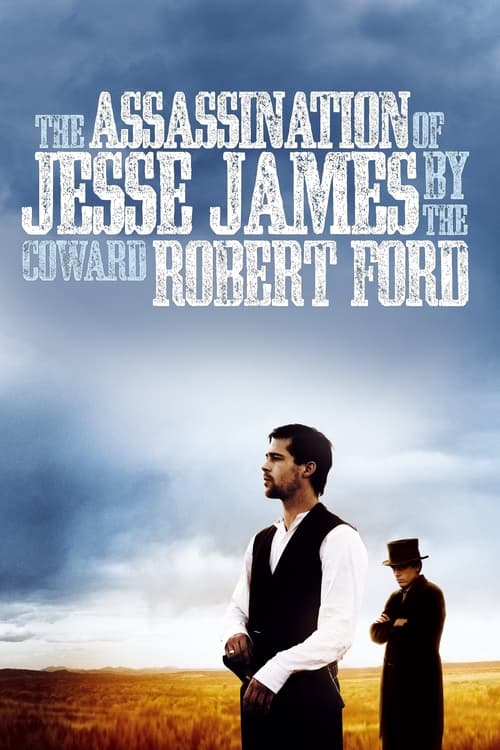
The Assassination of Jesse James by the Coward Robert Ford
2007 · Andrew Dominik
For a patient, contemplative evening when you want to sink into atmosphere and mood — something gorgeous and melancholy to chew on for days, not a Friday-night action fix.
What it's about
The last months of Jesse James, the most famous outlaw in America, and the young man who worshipped him: Robert Ford talks his way into James's gang carrying a lifetime of hero-worship, then discovers what it's like to actually stand next to your idol. The title tells you where it ends; the film is about everything that curdles along the way — admiration turning to envy, celebrity turning to paranoia, and what fame does to both the legend and the nobody standing in his shadow.
The experience
Slow, hushed, and hypnotic — closer to an elegy than a shoot-'em-up, with long silences, wintry landscapes, and a mounting sense of doom that's strangely beautiful to sit inside. It rewards surrender; fight the pace and you'll lose.
Performances
Brad Pitt plays James as a charismatic, unreadable menace — a star playing the burden of being a star — while Casey Affleck's needy, wounded Robert Ford is the real engine of the film, an Oscar-nominated study in humiliated devotion.
The craft
Roger Deakins's cinematography is some of the most beautiful ever put in a Western — dreamlike blurred edges, night trains in lamplight, prairies at dusk — set to a mournful Nick Cave and Warren Ellis score, with a storybook narration threading it together. This is a big-screen, lights-off film if there ever was one.
Why it matters
A commercial flop on release that has steadily grown into a modern classic, now cited as one of the great films about fame and fandom — themes that only got more relevant after 2007.
Snapshot
Andrew Dominik's second feature is a revisionist Western that treats the most mythologized killing in American outlaw history as an intimate, almost chamber-scaled study of celebrity, envy, and the manufacture of legend. Adapted from Ron Hansen's 1983 novel of the same title, the film covers the final months of Jesse James's life in 1881–82 and the long, ruinous afterlife of Robert Ford, the young gang member who shot him. Working with cinematographer Roger Deakins and an ensemble led by Brad Pitt as James and Casey Affleck as Ford, Dominik produced a slow, elegiac picture more interested in atmosphere, interiority, and the corrosive psychology of fandom than in the genre's conventional action. Released by Warner Bros. in the autumn of 2007 after a protracted and reportedly contentious post-production, it underperformed commercially but earned strong reviews, an Academy Award nomination for Affleck, and a cinematography nomination for Deakins, and it has since become one of the most admired and influential American films of its decade — a touchstone for a contemplative, painterly mode of prestige filmmaking.
Industry & production
The film originated as a Brad Pitt project: Pitt, a longtime admirer of Hansen's novel, attached himself as star and producer through his Plan B Entertainment banner, with Ridley and Tony Scott's Scott Free Productions also producing and Warner Bros. financing and distributing. Dominik, a New Zealand–born, Australia-based director whose only prior feature was the acclaimed 2000 crime film Chopper, was hired on the strength of that debut and his own adaptation of Hansen's book. The casting of Pitt as Jesse James lent the production its commercial rationale — and, thematically, its central irony, since the film is partly about the burden of being a famous face.
The production is most often discussed in terms of its difficult, drawn-out post-production. Principal photography took place largely in Alberta, Canada, in 2005, with additional work in Manitoba and Missouri. What followed was an extended editing period during which, by widely reported accounts, Dominik and the studio diverged over length and shape; cuts running well over the eventual theatrical version reportedly circulated, and the release was pushed back more than once. The picture that emerged runs roughly 160 minutes. Precise figures on budget and the full scope of the studio dispute should be treated cautiously, as much of the reporting is secondhand; what is clear is that Warner Bros. ultimately released a long, deliberately paced, uncommercial film, gave it a limited platform rollout in September 2007, and saw it gross modestly. The commercial disappointment was real, even if exact numbers are best not asserted with false precision.
Technology
Shot on 35mm film, the production's most discussed technical dimension is its use of vintage and specialized optics to evoke a period, photographic sensibility. Deakins and Dominik employed antique lenses and, in several sequences, distorting filters that blur and vignette the edges of the frame while keeping the center sharp — an effect evoking 19th-century photography and the warped vision of old plate cameras. These "tintype" or smeared-edge images recur throughout, particularly in landscape interludes, and constitute one of the film's signature looks. The choices belong to a transitional moment in cinematography, just before digital-intermediate color grading and digital capture became ubiquitous; here the analog, optical, in-camera derivation of the imagery is essential to its texture and to the film's argument that we are watching a memory or a myth rather than transparent reality.
Technique
Cinematography
Deakins's work here is among the most celebrated of his career and earned him an Academy Award nomination. The photography is defined by a muted, wintry palette — slate skies, bare prairie, lamplit interiors — and by an extraordinary command of natural and motivated light. Wide compositions place small human figures against vast, indifferent landscapes; the recurring distorted-lens shots of fields, trains, and skies function as lyrical punctuation. Interiors are frequently lit by single sources, with deep pools of shadow that lend the domestic scenes a hushed, conspiratorial intimacy. The much-cited night train-robbery sequence early in the film — figures emerging from darkness lit by the locomotive's headlamp through trees and smoke — is a set piece of pure atmosphere rather than action. Throughout, the camera favors stillness and slow, stately movement, reinforcing the film's contemplative register.
Editing
Cut by Dylan Tichenor and Curtiss Clayton, the film's editing is unhurried and rhythmically distinctive, holding shots well past conventional duration to let mood and unease accumulate. The structure is episodic, organized around the dissolution of the James gang and the lengthening shadow of Ford's resentment. A key formal device is the recurrent voiceover narration — drawn closely from Hansen's prose and delivered in a measured, literary third person — which periodically lifts the film out of scene-level drama into a retrospective, almost historiographic distance, narrating characters' interior states and foretelling their fates. The editing's patience is inseparable from the film's thematic project: it refuses the genre's customary acceleration toward violence.
Mise-en-scène / staging
The production design renders the period with a worn, lived-in naturalism rather than picturesque nostalgia — modest frame houses, frozen ground, cramped rooms thick with the texture of daily life. Staging tends toward the static tableau, with characters arranged in charged, watchful configurations. The film repeatedly stages looking itself: Ford watching James, James sensing the watcher, the audience watching both. The famous assassination is composed around a domestic interior and a framed needlepoint on the wall, James turning his back to dust the picture — a moment of deliberate, mythologized stillness rather than a gunfight.
Sound
The score is by Nick Cave and Warren Ellis, whose spare, mournful arrangements of piano, strings, and drones became closely identified with the film and helped define a strain of melancholic, minimalist film scoring in the years that followed. The music underlines the elegiac tone without sentimentalizing it. Sound design is similarly restrained and atmospheric — wind across the plains, the creak of houses, the report of gunfire arriving with sudden weight against the prevailing quiet. (Cave also appears briefly in the film as a saloon balladeer, a nod to the ballad tradition that mythologized James in his own time.)
Performance
Performances are pitched low and inward. Brad Pitt plays James as a charismatic, unpredictable, increasingly paranoid man, his star wattage deliberately shadowed by menace and fatigue — a portrait of fame as exhaustion and threat. Casey Affleck's Robert Ford is the film's center of gravity: a nervous, ingratiating, hero-worshipping youth whose admiration curdles into resentment and whose post-assassination notoriety becomes its own slow torment; the performance earned Affleck Oscar, Golden Globe, and BAFTA supporting-actor nominations. The supporting ensemble — Sam Rockwell as Charley Ford, Paul Schneider, Jeremy Renner, Sam Shepard as Frank James, and others — fills out a milieu of frightened, diminished men in the gang's twilight.
Narrative & dramatic mode
The film's dramatic mode is anti-suspenseful by design: the title announces the ending, and the narration repeatedly forecloses surprise. What remains is not what will happen but the texture of how and why — a psychological and atmospheric study rather than a plot. The narrative is bifurcated. The long first movement traces the disintegration of the James gang and the courtship-like dynamic between James and the awestruck Ford, building dread through stillness. The shorter but crucial final movement follows Ford after the killing — his brief celebrity re-enacting the murder on stage, his vilification as a coward, his unraveling, and his own eventual death — extending the story past its ostensible climax to examine the consequences of fame and infamy. This coda is central to the film's meaning: the assassination is not the end but the beginning of a different, sadder story.
Genre & cycle
The Assassination of Jesse James belongs squarely to the revisionist Western, the post-classical mode that demythologizes the genre's heroes and interrogates the violence and legend-making at the genre's core. It arrived within a small mid-2000s revival of serious, auteur-driven Westerns — appearing the same year as James Mangold's 3:10 to Yuma and the Coen brothers' No Country for Old Men, and a few years before the Coens' True Grit (2010), photographed by Deakins as well. Within that cycle, Dominik's film is the most contemplative and the least concerned with action, closer in spirit to the elegiac, anti-heroic tradition of films like McCabe & Mrs. Miller and The Long Riders (itself a James-gang film) than to the genre's adventure register. Its specific subject — the outlaw-as-celebrity and the killer-as-fan — pushes it toward something more like a tragedy of media and reputation than a conventional Western.
Authorship & method
The film is most legible as a convergence of strong authorial voices. Andrew Dominik, as writer-director, adapted Hansen's novel with notable fidelity, preserving its literary narration and its psychological emphasis; his method here — patient, image-driven, resistant to genre mechanics — confirmed the sensibility of Chopper on a far larger canvas and anticipated the formal daring of his later Killing Them Softly (2012, again with Pitt) and Blonde (2022). Roger Deakins, the cinematographer, is arguably a co-author of the film's identity, his imagery carrying much of its meaning. Nick Cave and Warren Ellis, the composers, established with this score a collaborative film-scoring partnership that would extend across many subsequent films. Editors Dylan Tichenor and Curtiss Clayton shaped its distinctive tempo. And Brad Pitt, as star-producer, was both the engine that got the uncommercial project financed and, in his casting, part of its thematic argument. The source author, Ron Hansen, deserves emphasis: much of what is most admired in the film — its narration, its interiority, its tragic structure — originates in his novel.
Movement / national cinema
The film resists tidy placement in a national-cinema category. It is an American studio production, financed and distributed by Warner Bros., set in the American heartland and steeped in American myth — yet it was directed by a New Zealand–born filmmaker formed in Australian cinema, photographed by a British cinematographer, scored by Australian musicians, and shot largely in Canada. This transnational authorship is characteristic of 2000s prestige filmmaking, in which a recognizably American genre subject is realized by an international roster of artists. If it belongs to a "movement" at all, it is the loose, festival-adjacent tradition of director-driven American art cinema operating inside the studio system — the same space occupied by Paul Thomas Anderson, Terrence Malick (whose landscape lyricism is an evident touchstone), and the Coens.
Era / period
Two periods bear on the film. Its setting is the closing of the American frontier in 1881–82, a moment when the railroad, the telegraph, the dime novel, and the illustrated press were already converting living outlaws into commercial legends; the film is acutely aware that James was a media phenomenon in his own time, and that Ford's act was shaped by, and fed back into, that machinery of fame. Its moment of production, the mid-2000s, is equally legible in the film: made on the cusp of the digital transition in cinematography, within a brief studio appetite for adult, serious genre filmmaking, and at a cultural juncture preoccupied with celebrity, the parasocial bond between the famous and their admirers, and the violence latent in that relationship. The film reads its 19th-century subject through an unmistakably contemporary lens on fame.
Themes
The film's governing theme is the manufacture of myth — how legend is made, who makes it, and what it costs. Its deeper subject is celebrity and the psychology of the fan: Ford is, in effect, a stalker and worshipper whose intimacy with his idol breeds the resentment that leads him to kill, and whose own brush with fame afterward is hollow and destroying. From this flow its other concerns: envy and the wish to be seen; the gap between the imagined hero and the ordinary, frightened men who surround him; cowardice and courage as labels imposed by public narrative rather than fixed moral facts; the loneliness and paranoia of being watched; and the long, ironic afterlife of violence, in which the act of killing James only magnifies him while diminishing his killer. The title's editorializing word — Coward — is itself a thesis about how reputation, not deed, determines a man's place in legend.
Reception, canon & influence
On release, the film drew strong critical praise for its photography, score, performances, and ambition, even as some reviewers found its length and slowness trying; its commercial reception was muted, a casualty of its uncompromising pace and limited rollout. Awards recognition centered on Casey Affleck's supporting performance and Roger Deakins's cinematography, both Oscar-nominated, with further nominations and critics'-group honors across the season. (Specific tallies are best verified against the record rather than asserted from memory.)
Its influences run backward to the revisionist and elegiac Western tradition — the demythologizing impulse of post-1960s Westerns, the landscape lyricism associated with Terrence Malick, and, most directly, Ron Hansen's novel, whose literary voice the film preserves. It also draws on the long folk and popular tradition of the James legend itself, including the ballad of "Jesse James" that frames the story's concern with how songs and stories make heroes.
Forward, the film's legacy has grown steadily, and its critical reputation now stands considerably higher than its initial box office would suggest; it is frequently cited among the finest American films of its decade and as a high point in the careers of nearly everyone involved. Its specific influence is visible in several directions: in the continued ascent of Deakins's painterly naturalism as a prestige-cinematography ideal; in the Cave–Ellis scoring partnership, whose spare, mournful idiom shaped a generation of melancholic film and television music; in Casey Affleck's subsequent career as a leading dramatic actor; and in a broader vogue for slow, atmospheric, interiority-driven prestige filmmaking that prizes mood and image over plot. As a study of celebrity and the murderous logic of fandom, it has also proven unexpectedly prescient, its 19th-century parable speaking with increasing force to a culture ever more defined by fame, parasocial attachment, and the violence that can attend them.
A Deleuzian reading
There's a framed needlepoint on the parlor wall, and Jesse James decides it needs dusting.
The full Deleuzian reading of The Assassination of Jesse James by the Coward Robert Ford →
Reception
Dumped by Warner Bros after years of post-production battles over the cut, it flopped hard in 2007 despite Brad Pitt winning Best Actor at Venice — and has since climbed to near-universal 'masterpiece' status, routinely called one of the great westerns of the century.
How The Assassination of Jesse James by the Coward Robert Ford was received, from release to now →
Influences: the films it descends from and the films it influenced
- Days of Heaven (1978) — Establishes the magic-hour, golden-light landscape lyricism plus child's-eye reflective voiceover narration that Dominik and Deakins directly emulate.
- McCabe & Mrs. Miller (1971) — Pioneers the anti-suspense, demythologizing revisionist Western built on diffused natural-light photography (Zsigmond flashing the negative) and a melancholic folk-ballad score scoring fate over action.
- The Long Riders (1980) — Earlier James-gang treatment whose ballad framing and elegiac outlaw-myth approach Dominik inherits and inverts toward interiority.
- Pat Garrett & Billy the Kid (1973) — The killer-haunted-by-his-victim's-legend structure and mournful Dylan score model the betrayer's elegy and the song-makes-the-hero theme.
- Heaven's Gate (1980) — Supplies the closing-frontier widescreen tableau aesthetic — vast painterly landscapes, smoke-and-dust natural light, novelistic patience over plot mechanics.
- Unforgiven (1992) — Roger Deakins' cinematography — silhouette framing against candlelit interiors, low-key chiaroscuro faces, anamorphic widescreen used as elegiac register — is the most technically rigorous extension of Unforgiven's visual grammar; Dominik also embeds a mythographer figure (Robert Ford, then the epilogue narrator) who mirrors Beauchamp's function as simultaneous recorder and destroyer of outlaw legend.
- Once Upon a Time in the West (1968) — Roger Deakins used extreme telephoto focal lengths and selective focus to compress mythological landscape into intimate portraiture, building scenes through elongated ritualized anticipation toward sudden violent resolution — Leone's two-register optical grammar re-encoded in a post-classical register.
- Once Upon a Time in America (1984) — Anamorphic elegiac Americana built on a foregrounded prescored ambient leitmotif (Cave/Ellis) and Leone-style temporal dilation that mythologizes its outlaw through stillness and threshold framing.
- Barry Lyndon (1975) — Roger Deakins pairs a literary omniscient narrator and elegiac slow pace with painterly natural light and edge-distorting anamorphic vignetting that echoes Kubrick's withdrawing zoom.
- Badlands (1974) — Adopts the Malickian package wholesale — Deakins' natural-light, magic-hour prairie cinematography and landscape lyricism under an elegiac literary voiceover, with violence rendered quiet and inevitable.
- Road to Perdition (2002) — Extends the painterly, voiceover-driven, restrained period crime-as-tragedy mode — Deakins's diffused Hopperesque light and patient tempo are a direct heir to Hall's valediction.
- The New World (2005) — Roger Deakins explicitly adopts the magic-hour landscape photography and elegiac drifting voiceover to render an American frontier myth in the same lyric register.
- Meek's Cutoff (2010) — Extends the slow, atmospheric anti-Western — static tableau, wide quiet landscapes, withheld suspense and ambient sound over genre incident.
- The Road (2009) — Carries the Cave–Ellis spare-mournful scoring idiom into another desolate-landscape interiority piece, cementing the partnership's prestige-melancholy sound.
- Killing Them Softly (2012) — Dominik's own follow-up (again with Pitt) extending the patient, image-driven, genre-resistant method and elegiac criminal-Americana voice.
- Blonde (2022) — Pushes the celebrity-as-tragedy thesis and distorting-lens/vintage-optics formalism to its extreme, the direct heir to the manufacture-of-myth theme.
- Slow West (2015) — Inherits the lyrical, painterly revisionist-Western frame where folkloric myth and a delicate score eclipse gunfight mechanics.
- The Power of the Dog (2021) — Continues the slow, interiority-driven prestige Western of widescreen landscape tableaux and a spare avant-string score, prizing psychological dread over plot.
- The Sisters Brothers (2018) — Revisionist outlaw-Western of melancholic, novelistic tone that foregrounds fraternal interiority and natural-light frontier vistas over action.
- Hell or High Water (2016) — Carries the Nick Cave–Warren Ellis scoring idiom into a modern-Western elegy of wide, sun-bleached landscape compositions and fatalistic mood.
- News of the World (2020) — Late-career Deakins-adjacent prestige Western applying painterly natural-light landscape compositions to a quiet, anti-action frontier elegy.
- Train Dreams (2025) — Anti-mythic western fusing Deakins' elemental landscape photography with a third-person literary narrator's elegiac prose, the closest formal cousin to Train Dreams' narrated tone-poem.
- True Grit (2010) — Deakins shot both films, carrying his anamorphic ultra-long-focal technique—severe background compression, optical vignetting, and period-correct desaturation—directly from Jesse James into True Grit; the visual grammar of both is functionally identical, including the retrospective-voiceover temporal structure.
- Sicario (2015) — Deakins's aerial and landscape cinematography here — vast Western terrain framed as moral geography, figures staged as silhouettes against sky and burned earth, negative space as psychological register — directly anticipates the visual grammar he transposed to the Sonoran Desert for Sicario.
- The Assassination of Richard Nixon (2004) — Same character study of a parasocial nobody whose fame-hunger curdles into murderous logic, structured as a slow psychological descent rather than a thriller.
- There Will Be Blood (2007) — Contemporary American-frontier epic sharing the patient image-over-plot prestige aesthetic and a spare, mournful avant-string score idiom (Greenwood paralleling Cave–Ellis).
- The Proposition (2005) — Cave–Ellis scoring partnership in its formative outlaw-Western mode — the same sparse, drone-and-violin elegy applied to frontier violence.
- No Country for Old Men (2007) — Deakins's painterly naturalism on the same late-frontier landscape, sharing anti-suspense pacing where dread replaces conventional action beats.
- The Shawshank Redemption (1994) — Deakins extending his source-motivated photochemical naturalism and observer-narrator-framed legend, the human figure perpetually dwarfed by architecture and landscape.
- Miller's Crossing (1990) — Nick Cave's folk ballads — particularly the recurring 'Jesse James' leitmotif — are integrated as structural and emotional keys to a morally ambiguous protagonist, mirroring exactly how 'Danny Boy' functions in Miller's Crossing: a folk song's melodic identity becomes the register through which the film measures its characters' bad faith.
- 3:10 to Yuma (2007) — Roger Deakins's anamorphic widescreen uses period-naturalistic light sources, lens-edge vignetting, and slow temporal compression to construct a pressure-chamber psychological study of two men locked in a fatal dynamic of recognition and destruction—a parallel-development sibling released in the same year as Mangold's film.
- Mesrine: Killer Instinct (2008) — Dominik foregrounds the criminal's conscious construction of his own folk legend — the ironic gap between Jesse's performed identity and his private erosion — paralleling Mesrine's theatrical self-presentation for press cameras during actual bank robberies.
- Mesrine: Public Enemy #1 (2008) — Dominik's outlaw-as-celebrity structure — Jesse James's obsessive awareness of being mythologized, his manipulation of the gap between reputation and action — mirrors Mesrine's press management; both films use period photographic texture as a formal analog for legend-formation, with lens anomalies substituting for Richet's 35mm desaturation.
- The Order (2024) — Shares the elliptical pacing, against-type performance restraint, and Deakins' desaturated frontier light, observing a mythologized outlaw with the same anthropological cool.
- Capote (2005) — Roger Deakins's desaturated, available-light landscapes and contemplative long-take rhythm share Capote's austerity, both anatomizing the myth-maker who exploits his subject.
- Hostiles (2017) — Shares the withheld processional editing rhythm, figures-dwarfed-by-landscape compositions, and a minimalist elegiac score deployed as the film's moral conscience.
Similar films
- There Will Be Blood (2007) — influence & lineage · same viewing thread
- Hell or High Water (2016) — influence & lineage · same viewing thread
- No Country for Old Men (2007) — influence & lineage
- Killing Them Softly (2012) — influence & lineage
- Pat Garrett & Billy the Kid (1973) — influence & lineage
- The Power of the Dog (2021) — influence & lineage
- Days of Heaven (1978) — influence & lineage · same viewing thread
- 3:10 to Yuma (2007) — same viewing thread
All the films related to The Assassination of Jesse James by the Coward Robert Ford →
Watch it with: curated runs of related films
- The Frontier's Long Shadow — A run of American myths going to seed — outlaws, oilmen, and foreclosed ranchers set against big country that outlasts them all; watch them close together and the classic Western slowly dissolves into its elegiac modern kin.