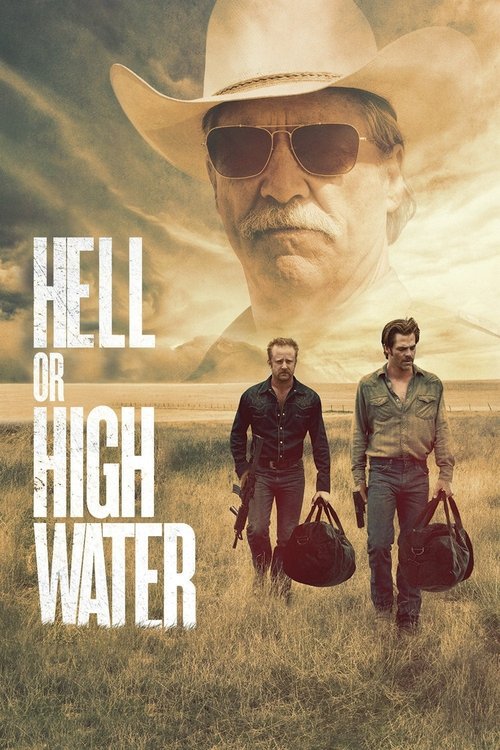
Hell or High Water
2016 · David Mackenzie
For when you want a modern Western that's gripping and about something — satisfying on a Friday night but substantial enough to argue about after. Accessible, with a bittersweet aftertaste.
What it's about
Two West Texas brothers — one careful and quietly desperate, one an ex-con who enjoys the danger — start robbing branches of the very bank that's about to foreclose on their family ranch. On their trail is a Texas Ranger weeks from retirement, needling his half-Comanche partner as he pieces the pattern together. It's a heist story set against boarded-up towns, debt billboards, and a rural economy running on fumes.
The experience
Lean and sun-scorched, with a slow-burn tension that erupts in sudden bursts and a rich vein of dry, cranky humor. It leaves you moved and a little angry — a thriller with a genuine ache in it.
Performances
Jeff Bridges is magnificent as the drawling, needling Ranger — an Oscar-nominated turn — while Ben Foster brings a dangerous, live-wire charm and Chris Pine does career-best work as the quiet brother carrying all the weight. Gil Birmingham's long-suffering partner gives the film its slyest double act.
The craft
Taylor Sheridan's screenplay is a model of economy — every diner scene and roadside conversation doing double duty as character and social portrait — and David Mackenzie shoots the flat, exhausted landscape so it becomes the film's argument. The Nick Cave and Warren Ellis score hums underneath like heat off asphalt.
Why it matters
A sleeper hit that rode word of mouth to four Academy Award nominations including Best Picture, it proved the mid-budget adult drama could still thrive and helped establish the modern-day Western revival of the 2010s.
Snapshot
A lean, sun-scorched crime drama in which two West Texas brothers — methodical Toby (Chris Pine) and volatile Tanner (Ben Foster) — rob branches of a single bank chain to reclaim the family ranch from foreclosure, while an aging Texas Ranger (Jeff Bridges) and his half-Comanche partner (Gil Birmingham) close in. Released under the title Comancheria in the United Kingdom, the film arrived in August 2016 and found an audience far beyond its modest arthouse origins, earning four Academy Award nominations including Best Picture and Best Original Screenplay. It is at once a taut heist procedural, an elegy for a dispossessed rural America, and a moral argument conducted through landscape: the predatory bank is not so different, the film insists, from the outlaws draining it dry.
Industry & production
The script, written by Taylor Sheridan under the working title Comancheria, was developed independently before Sheridan had established himself as a screenwriter of note. Sheridan — then primarily known as an actor (Sons of Anarchy, Veronica Mars) — had only recently completed Sicario (dir. Denis Villeneuve, 2015) for his feature debut as a writer, and Hell or High Water was drafted in parallel with that project, reflecting an intensive period of creative output. The film was produced by Sidney Kimmel Entertainment and OddLot Entertainment, with CBS Films and Lionsgate acquiring distribution rights. The production budget was modest — widely reported in the low-to-mid teens of millions of dollars, though precise figures have not been officially confirmed by the studio — and the shoot was correspondingly tight.
Principal photography took place primarily in New Mexico, with locations around Albuquerque, Tucumcari, and the high desert plains serving as stand-ins for West Texas. The choice was pragmatic (New Mexico's film-incentive infrastructure) but also aesthetically consistent: the scrubby, treeless expanse of the eastern New Mexico basin reads visually and geologically as continuous with the Texas Panhandle. Some sequences were shot across the state line, and the unit was careful to preserve the Permian Basin visual grammar — pump jacks, feedlots, dying main streets — that gives the film its documentary grain.
Technology
Hell or High Water was photographed digitally rather than on film, a practical decision consistent with the production's budget and schedule. Cinematographer Giles Nuttgens shot in an anamorphic format, producing the characteristic widescreen ratio and elliptical lens bokeh that the film uses to hold the landscape in almost oppressive peripheral presence behind its characters. The choice of anamorphic glass for a digital shoot was deliberate: it evokes the Panavision grammar of the 1970s American cinema the film consciously cites while remaining legible and cost-effective in post-production. The resulting image is wide and somewhat harsh in its highlights — overexposed in the noon glare, cooler and more luminous at dusk — without resorting to the desaturated, heavy-grade palette that became a cliché of prestige crime cinema in the period. Color remained relatively naturalistic, letting the raw West Texas palette do its own work.
Technique
Cinematography
Nuttgens and Mackenzie made the landscape do moral work. The camera does not aestheticize desolation for its own sake — it is not the Badlands lyric mode — but neither does it adopt a purely observational flatness. Wide establishing shots hold the brothers' truck as a small, deliberate object moving through indifferent terrain; close-ups in the bank robberies are jittery and close-quartered, generating claustrophobia that contrasts with the vistas outside. The film employs a recurring visual grammar of frames-within-frames: windows of diners, the windshields of patrol cars, the latticed shadows of a ranch-house porch. Characters are seen partially, enclosed, defined by the boundaries of structures that are themselves crumbling. Nuttgens's light is practical and unforgiving — the sun is too bright, the interior diner scenes underlit — producing a textural realism that resists glamorization.
Editing
Jake Roberts edited the film with a pace that respects the laconic rhythms of the script without becoming sluggish. The cutting between the brothers' arc and the lawmen's arc creates a procedural tension without resorting to parallel editing as a pure suspense mechanism; the film is interested in the conversation between these lines of action, not in cliff-hanging intercutting. Roberts's choices in the robbery sequences are restrained — functional coverage, no kinetic flash — which makes the sudden outbursts of violence (particularly in the film's third act) register as genuine shocks rather than choreography. The editing also carries the film's comedy: the long-running joke between Hamilton and Parker, with Hamilton's relentlessly provocative ethnic teasing, is cut with a deadpan timing that preserves the banter's uncomfortable affection.
Mise-en-scène / staging
Mackenzie's staging consistently externalizes the film's economic argument. The main streets of the Texas towns through which the brothers pass are galleries of institutional failure: storefronts advertising payday loans, billboards offering debt relief, empty lots that once held the local businesses of a functioning community. The camera lingers on these signs without underlining them through score or close-up — they accumulate, quietly, as context. The bank interiors are identical no matter the town, the franchise indistinguishable from its branch: this visual fungibility is the point. The family ranch, by contrast, is particular, worn, located — a place with a history, however painful. Mackenzie stages the film's few scenes of domestic tenderness (Toby with his sons) in warm, confined interiors that register as worth protecting precisely because they are so provisional.
Sound
Nick Cave and Warren Ellis composed the score, their fifth major collaboration by this point, following The Proposition (2005), The Assassination of Jesse James by the Coward Robert Ford (2007), The Road (2009), and Lawless (2012). Their characteristic approach — sparse, modal, built from pedal steel, bowed strings, and ambient drone — was already associated with a certain strain of revisionist Western melancholy, and the Hell or High Water score deepens that association. The music seldom announces itself; it operates more as an atmospheric pressure than a cue. Two songs bookend the film: Gillian Welch and David Rawlings's "Didn't Leave Nobody But the Baby" (from the O Brother, Where Art Thou? soundtrack, a choice that carries its own intertextual weight in the context of Southern Gothic crime) is notably absent; the film uses original material and period-appropriate country and Americana without reaching for the Coen Brothers' aesthetic. The ambient sound design — wind, dry grass, the distant percussion of pump jacks — is mixed with care, and silence is used economically but tellingly.
Performance
Jeff Bridges's Marcus Hamilton is the film's warmest performance and arguably its most complex. Bridges plays retirement-averse weariness with a light hand — the character's bigotry toward Parker is established as a form of affection, a lifelong habit of provocation between two men who have ridden together for decades, though the film does not entirely excuse it. His final scene, alone with the knowledge of what he has lost and what he knows, is among the quietest and most affecting moments in his long career. Ben Foster's Tanner is detonation in human form, but Foster resists making him simply dangerous; there is a kind of luminous fatalism in Tanner that reads as a man who has always known how his story ends and has decided, therefore, to be magnificent in it. Chris Pine's casting was widely noted as counter-intuitive — he had been primarily an action and franchise lead — and the film uses his natural ease to shade Toby's calculation. Toby is the planner, the one who loves his sons, the one who has done the math on what this will cost; Pine communicates all of that in the way he listens, the way he holds still. Gil Birmingham's Alberto Parker, easily the film's most underwritten role, nevertheless carries enormous dignity and gets the film's most piercing monologue: the history of dispossession from Comanche to rancher to bank, delivered across a diner table with quiet fury.
Narrative & dramatic mode
The film operates in a modified heist-procedural mode in which the usual suspense mechanics (will they get away with it?) are subordinated to an ethical inquiry (are they wrong?). Sheridan's script is structured so that the audience understands Toby's plan before the lawmen do, but more importantly understands his motivation: the bank foreclosing on the family ranch has discovered, after a mineral survey, that the land sits atop an oil reserve that Toby's mother never knew about; the foreclosure is not merely financial pressure but a specific corporate predation. This revelation, held until fairly late in the film, retroactively reframes every robbery as a form of redistribution. The narrative is also organized around a studied parallel — the brothers occupy the same moral and economic position as the bank, taking money that is not theirs from people who cannot afford to lose it — but Sheridan's script earns the parallel by making Toby's plan precise: they steal only from Texas Midlands branches, launder the cash through a casino, and use the proceeds to pay off the bank with its own money. The neatness of this is morally instructive rather than heroic.
Genre & cycle
Hell or High Water belongs to the post-2008 neo-Western, a cycle of American crime films that filtered the landscape and conventions of the Western through the material conditions of the Great Recession and its aftermath. Films in this loose grouping — Winter's Bone (2010), Mud (2012), Lean on Pete (2017), Leave No Trace (2018) — share a concern with dispossession, rural precarity, and the failure of American economic mythology in specific, provincial places. Within this cycle, Hell or High Water is unusual in its explicitness: the enemy is not abstract hardship but a named, franchised bank, and the film's politics of resentment are never ambiguous about their target. Its other generic coordinates include the outlaw-couple (or sibling-pair) road film (Badlands, Bonnie and Clyde), the elegiac lawman Western (No Country for Old Men, Three Burials of Melquiades Estrada), and the procedural crime film in the American tradition of Michael Mann. The film is also, unusually for its period, a comedy in its procedural half — the Hamilton-Parker scenes are consistently, drily funny — which leavens the political anger without deflating it.
Authorship & method
David Mackenzie (b. 1966, Scotland) came to the project as a genuinely foreign eye on American mythology. His prior work — Young Adam (2002), Hallam Foe (2006), Starred Up (2013) — was primarily British, and rooted in the psychological claustrophobia of enclosed masculine spaces. Starred Up, a prison film, demonstrated his ability to sustain tension through behavioral observation and performance rather than plot mechanism. The American Western presented him with an inverse spatial problem: almost infinite exterior space containing the same interior compression. His direction of Hell or High Water is notable for what it does not do — it does not mythologize, does not slow-motion, does not reach for the operatic register that the genre convention would permit. The result is a film that treats the Western landscape as ordinary rather than sublime: these are people who live here, not visitors to an icon.
Giles Nuttgens, also Scottish, had been collaborating with Mackenzie since Young Adam, and the shared sensibility — realism first, beauty where it arrives naturally — is evident. Nuttgens has spoken in interviews about resisting the temptation to over-compose the landscapes, preferring to let the locations dictate the frame rather than imposing a painterly signature.
Taylor Sheridan brought the screenplay's specific moral architecture and its precise regional knowledge. Raised in Texas and working cattle as a young man, Sheridan wrote from a place of firsthand familiarity with the economic geography the film depicts. His screenwriting in this period — Sicario, Hell or High Water, then Wind River (which he also directed) — constitutes a sustained examination of American institutional failure at the territorial margins: the border, the Plains, the reservation. The Hell or High Water script is the most formally elegant of the three, its doubled structure (brothers and lawmen) rhyming structurally with its thematic argument about who the real thieves are.
Nick Cave and Warren Ellis were by this point so associated with the revisionist Western score that their involvement functioned partly as a generic signal, cueing the audience's expectations of moral ambiguity and landscape tragedy. Whether this constitutes a limitation or a refinement is a matter of critical perspective; the score is effective on its own terms.
Movement / national cinema
The film occupies an interesting position in American cinema precisely because it was made largely by non-Americans. Mackenzie and Nuttgens are Scottish; Cave and Ellis, Australian and Australian-British respectively. The "outsider Western" is a legitimate tradition — Leone's Spaghetti Westerns, Wim Wenders's Paris, Texas — and Hell or High Water benefits from the same defamiliarizing distance, the same ability to see the iconography of the American West as a set of codes to be read rather than a patrimony to be reverenced. Sheridan's American authorship of the script anchors the film in genuine particularity; the international crew supplies the critical angle. The result is less nostalgia than autopsy.
Era / period
The film was shot in 2015 and released in August 2016, in the final months of the Obama presidency. It arrived, however, as a document that many critics immediately recognized as prophetically legible to the Trump election that November: an anatomy of the white rural economic resentment that would become the dominant interpretive frame for that political moment. This retrospective legibility was not the film's design — Sheridan has been explicit that the script predated the political moment — but it sharpened the film's reception and extended its cultural shelf life. Hell or High Water became, for a period, one of the primary artistic exhibits cited in discussions of what might be called "flyover cinema": work that took seriously the material and psychological conditions of non-coastal, non-metropolitan America.
Themes
The film's organizing theme is the inheritance of theft. Alberto Parker's diner monologue encapsulates it: Comanche stole this land from others; white settlers stole it from Comanche; the banks stole it from the settlers; now the brothers are stealing it back from the banks. Every act of possession in the film is also an act of dispossession, and what looks like criminal deviance (the robberies) is revealed as the smallest and most targeted instance in a centuries-long cycle. The film is also, beneath the socioeconomic argument, a study in fraternal love: Tanner and Toby are bound by obligation that exceeds reason, and the film does not flinch from the cost that this bond exacts. Toby's sons appear briefly but centrally — the reason for everything, the future Toby is purchasing. Against the masculine elegies of the lawmen (Hamilton's imminent retirement, Parker's quiet gravity), the film poses a question about whether anything in this landscape is worth transmitting to the next generation, and whether the act of transmission is itself a form of violence.
Reception, canon & influence
Hell or High Water received near-unanimous critical acclaim on release, with particular praise directed at Sheridan's screenplay, Bridges's performance, and the film's political coherence. Its four Academy Award nominations — Best Picture, Best Supporting Actor (Bridges), Best Film Editing (Jake Roberts), Best Original Screenplay (Sheridan) — confirmed its standing as a prestige film that had significantly outperformed its origins. It won none, losing Best Picture to Moonlight in a ceremony remembered for other reasons.
Influences on the film (backward): The debts are worn openly. The doubled lawman-criminal structure, the elegiac Texas landscape, and the late-Cormac McCarthy moral universe all invoke No Country for Old Men (Coen Brothers, 2007) as the film's most proximate predecessor; Mackenzie's film might be understood as a corrective, restoring the political-economic ground that the Coens' more metaphysical film brackets. Sam Peckinpah's late Westerns (The Wild Bunch, 1969; Pat Garrett and Billy the Kid, 1973) contribute the mythology of the outlaw as a figure of displaced social energy. Peter Bogdanovich's The Last Picture Show (1971) supplies the grammar of West Texas institutional decay. The lawman's point of view — weary, funny, too late — recalls Tommy Lee Jones's work in both No Country and Three Burials of Melquiades Estrada (2005). Michael Mann's attention to the professionalism of criminals (Heat, 1995) is visible in the brothers' disciplined method.
Legacy (forward): The film's most substantial legacy is Taylor Sheridan's subsequent career. Wind River (2017), which he directed from his own script, extended the Frontier Trilogy's project, and his creation of Yellowstone (2018–) transformed its sensibility into a mass-audience television franchise of remarkable commercial scale. Whether Yellowstone represents a fulfillment or a dilution of the Hell or High Water political project is a question the critical record has not definitively settled. More narrowly, the film contributed to a renewed critical legitimacy for the neo-Western crime drama as an awards-viable form, helping to establish the conditions in which films like First Cow (2019) and The Power of the Dog (2021) could be seriously considered as prestige objects. Its influence on the representation of post-recession rural America in prestige cinema is diffuse but real, and its use of landscape as economic argument rather than aesthetic decoration has been widely cited as a model.
A Deleuzian reading
A billboard slides past the window of the brothers' truck: DEBT RELIEF.
The full Deleuzian reading of Hell or High Water →
Reception
The sleeper of August 2016 — a quiet, mid-budget neo-Western dropped into a dead blockbuster summer that critics immediately crowned the movie of the season, then rode all the way to four Oscar nominations including Best Picture. Now it's remembered as the moment Taylor Sheridan's screenwriting empire truly ignited, the beloved middle child of his Sicario/Wind River frontier run.
How Hell or High Water was received, from release to now →
Influences: the films it descends from and the films it influenced
- No Country for Old Men (2007) — The doubled lawman/criminal structure — equal-time parallel tracking toward an oblique, non-cathartic reckoning — and dialogue scenes deployed as ethical interrogation rather than plot mechanism is the direct formal template Sheridan's screenplay inherits and corrects toward economic explicitness.
- The Wild Bunch (1969) — Peckinpah's invention of the outlaw elegy — criminality inseparable from displacement by a modernizing financial system — is the political logic underneath the brothers' bank-robbery-to-escape-bank-debt scheme, which literalizes what Peckinpah left mythological.
- Pat Garrett and Billy the Kid (1973) — Bob Dylan's score — folk songs and ambient country textures deployed as threnody for a dying social world rather than conventional underscoring — is the direct sonic model for Nick Cave and Warren Ellis's approach, which performs the same function for post-recession Texas.
- The Last Picture Show (1971) — Bogdanovich's use of anamorphic framing on empty West Texas main streets to make institutional decay spatial and legible — storefronts, vacant lots, shuttered businesses as evidence of a dying economy — is the grammar Nuttgens's color location photography directly inherits.
- Heat (1995) — Mann's procedural symmetry between criminal and lawman — mirrored screen time, mirrored professionalism, a pursuit structured as a partnership of equals — is the formal logic behind the brothers/Rangers doubling, where each pair's competence is the measure of the other's.
- Three Burials of Melquiades Estrada (2005) — Jones established the laconic, deadpan, weary Texas lawman as a specific performance register here — the slow ironic commentary on events arrived at too late — that Bridges's Marcus Hamilton inhabits directly, including the mode of using humor to mark moral defeat.
- Badlands (1973) — Malick conceived the outlaw road film as social document — landscape as the only space the economically displaced can escape into, never through — establishing the political grammar the genre needs for Sheridan's script to function as economic allegory rather than adventure.
- Sicario (2015) — Scripted by Sheridan in the same Frontier Trilogy period, Sicario shares the ethical procedural architecture — institutional violence exposed through a witness-figure caught between competing systems of order, moral weight distributed across structural doubling rather than resolved in a single protagonist.
- Unforgiven (1992) — Mackenzie transposes Unforgiven's formal grammar into the neo-Western: Cave and Ellis's minimal score treats silence as compositional material, Giles Nuttgens' widescreen photography consistently diminishes human figures against the Texas panhandle, and the observational staging refuses the dramatic close-coverage that would sentimentalize violence.
- Inside Man (2006) — Applies Inside Man's heist-as-archive-retrieval architecture to West Texas: the bank robberies are cover for reclaiming ancestral land documentation from the foreclosing institution itself — the theft as archival justice — and the moral equivalence between criminal and law enforcement that Inside Man sustains through its dual-track procedural is here formalized as the film's explicit thesis.
- 3:10 to Yuma (2007) — Mackenzie's parallel-cut structure intercutting pursuer and pursued builds the same pressure-chamber compression, the two-hander ending resolves in the same ambiguous moral standoff, and near-total reliance on diegetic sonic geography with minimal score directly extends Mangold's approach to post-classical Western sound design.
- The Proposition (2005) — Cave and Ellis's score — carrying the acoustic-analogue vocabulary developed on The Proposition — is applied to a contemporary Texas revisionist frontier film, the same tonal vocabulary of sparse regional elegy and sudden harmonic density intact.
- Wind River (2017) — Sheridan's directorial debut extends the Frontier Trilogy's project using identical structural logic — economic landscape as political argument, ethical procedural doubling, counter-intuitive casting — transplanting West Texas summer heat to Wyoming winter reservation land as the same index of federal abandonment.
- Lean on Pete (2017) — Haigh extends the outsider-on-American-landscape template — a British director's eye on Western mythology — using laconic rhythm, practical location photography of a declining Pacific Northwest racing circuit, and a luminous-fatalism performance mode to stage economic precarity as the condition the frontier now contains rather than promises escape from.
- First Cow (2019) — Reichardt's film of small-scale frontier criminality deploys laconic rhythm, practical location photography, and economic desperation as the ground of moral action — small men inside an extractive economy — extending the landscape-as-economic-argument mode into the formal austerity of the 4:3 frame.
- The Power of the Dog (2021) — Campion occupies the prestige neo-Western space Hell or High Water helped legitimate, pushing landscape-as-psychological-argument further with Ari Wegner's anamorphic New Zealand exteriors doubling Montana, and extending the Cave-Ellis sonic template through Jonny Greenwood's score of ambient tension and folk melancholy.
- Relay (2025) — Mackenzie's own lean, character-driven genre discipline — strong performers given room to internalize tension within a tight moral structure — which Relay deliberately returns to after Outlaw King.
- Winter's Bone (2010) — Granik independently established the post-recession American crime drama with practical location photography of economically devastated rural communities, counter-intuitive casting of local non-professional faces, and economic desperation as moral ground rather than backdrop — the template Sheridan's script assumes without having to build.
- Mud (2012) — Nichols deploys the outlaw-on-the-run structure as a doubled narrative — a boy's coming-of-age mirroring the fugitive's impossible situation — with the same laconic dialogue register, practical Southern location photography, and sense of a social world defined by what capital has withdrawn from it.
- Slow West (2015) — Maclean, a Scottish director like Mackenzie, approaches the Western as genre critique from an outside perspective — deploying deadpan comic timing, refusing to mythologize violence or landscape, and using laconic rhythm to expose the genre's conventions by performing them at an ironic distance.
- Three Billboards Outside Ebbing, Missouri (2017) — Taylor Sheridan's screenplay and Giles Nuttgens' wide spherical-lens cinematography of American Southern heartland crime — warm palette, frontal staging of institutional confrontations, a prestige crime drama where the criminals are rendered more sympathetically than the institutions opposing them — establish a parallel formal grammar operating in the same prestige-crime-drama mode.
- Sicario: Day of the Soldado (2018) — Sheridan screenplay sibling: same thesis of institutional rot at the edges of the American project and men who have surrendered their consciences, in a Texas borderland register.
- Rebel Ridge (2024) — A socially-engaged crime procedural that critiques an extractive institutional system, privileging restraint, negotiation, and a folksy lawman over action — the institutional-critique-as-thriller model Rebel Ridge shares.
- The Order (2024) — A bank-robbers-versus-lawmen procedural set in economically hollowed rural America, using parallel-converging editing to draw pursuer and pursued toward collision.
- Logan (2017) — Contemporary sun-bleached Texas Western with a Western-inflected score and elegiac economy, framing violence as a worn-out way of life.
- Twisters (2024) — Sibling in landscape-as-character regionalism: the sun-bleached Texas/Oklahoma plains and economically-hollowed small towns are framed as an active moral environment, the same disaster-capitalism-adjacent terrain Twisters occupies.
- The Outlaw Josey Wales (1976) — Modern-dress revisionist western of outlaw brothers whose subverted-revenge morality and understated behavioral performance descend from Josey's tonal balance of hard action and tenderness.
- The Rip (2026) — Money is photographed as dirty, counted, physically burdensome paper whose handling is staged in real time, and the moral reckoning is deferred to a final quiet two-hander instead of a shootout — the same tonal architecture as The Rip's pared-down beach coda.
Similar films
- Wind River (2017) — influence & lineage · same viewing thread
- No Country for Old Men (2007) — influence & lineage
- The Power of the Dog (2021) — influence & lineage
- The Last Picture Show (1971) — influence & lineage · same viewing thread
- True Grit (2010) — same viewing thread
- 3:10 to Yuma (2007) — same viewing thread
- The Assassination of Jesse James by the Coward Robert Ford (2007) — same viewing thread
- Days of Heaven (1978) — same viewing thread
All the films related to Hell or High Water →
Watch it with: curated runs of related films
- The Frontier's Long Shadow — A run of American myths going to seed — outlaws, oilmen, and foreclosed ranchers set against big country that outlasts them all; watch them close together and the classic Western slowly dissolves into its elegiac modern kin.