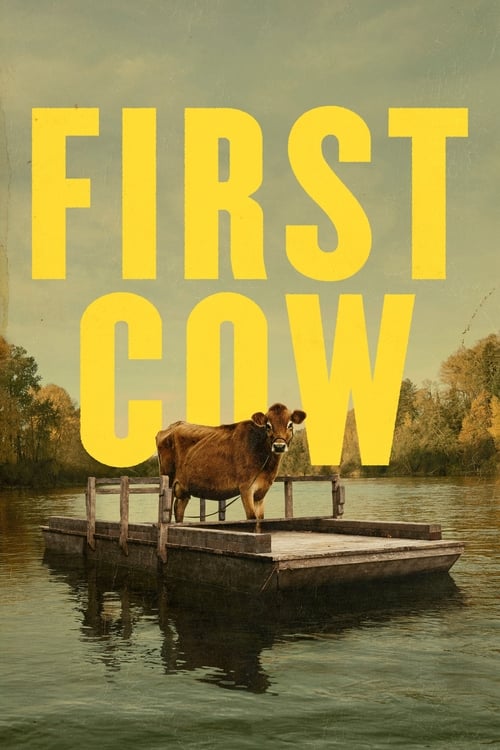
First Cow
2020 · Kelly Reichardt
For a slow, contemplative evening when you want gentleness instead of noise — a film to sink into rather than be jolted by. It's comfort viewing with an ache in it; give it your patience and it stays with you for days.
What it's about
In 1820s Oregon Territory, a gentle cook attached to a rough party of fur trappers crosses paths with a Chinese immigrant on the run, and the two outsiders throw in together. Their big idea is small: fried honey cakes, made with milk secretly drawn at night from the region's only cow — the prized property of the wealthiest man in the territory. What follows is a frontier story built on friendship, biscuits, and a modest crime that can't stay modest forever.
The experience
Quiet, unhurried, and unexpectedly warm — it moves at the pace of dough rising, then tightens a slow knot of dread in your stomach as the scheme gets riskier. The tenderness between the two men sneaks up on you, and so does the sadness.
Performances
John Magaro plays Cookie with a softness that feels almost radical in a Western — watchful, kind, never showy — and Orion Lee gives King-Lu a dreamer's charm and quick-talking ambition; together they make friendship itself the drama.
The craft
Kelly Reichardt directs with her signature restraint: long attentive takes, natural light, mud and firelight you can practically smell. The boxy frame keeps the world intimate rather than epic, and the sound design — rain, birdsong, a cow's breathing in the dark — does what other Westerns do with gunfire. It rewards a quiet room and your full attention.
Why it matters
Widely counted among the best films of its year, it cemented Reichardt's standing as one of America's essential independent filmmakers and became a touchstone for the revisionist idea that the frontier story is really a story about capitalism and who gets to profit.
Snapshot
First Cow is Kelly Reichardt's sixth feature, a frontier drama set in 1820s Oregon Territory that reimagines the Western as a story of tenderness, appetite, and the first small crimes of American capitalism. Adapted from Jonathan Raymond's novel The Half-Life (2004) by Reichardt and Raymond together, it follows Otis "Cookie" Figowitz (John Magaro), a gentle, put-upon cook attached to a party of fur trappers, and King-Lu (Orion Lee), a Chinese immigrant on the run whom Cookie shelters. The two men form a partnership and a friendship, and hit upon a modest, doomed enterprise: fried honey cakes made with milk clandestinely drawn at night from the territory's only dairy cow, imported by the region's wealthiest man, Chief Factor (Toby Jones). A contemporary prologue, in which a young woman (Alia Shawkat) and her dog uncover two skeletons lying side by side in the ground, frames the whole as an act of exhumation. The film premiered at Telluride in August 2019, screened at the New York Film Festival and the Berlinale, and opened theatrically in the United States in early March 2020, days before the COVID-19 pandemic shuttered cinemas — an accident of timing that shaped its release life. It was widely acclaimed and, for many critics, the finest American film of its year.
Industry & production
First Cow is a work of the mature American independent sector: modestly budgeted, artisanally made, and released through A24, which distributed the film in the United States. It was produced by longtime Reichardt collaborators — the Filmscience/producing team of Neil Kopp, Vincent Savino, and Anish Savjani, with IAC Films involved — the same low-overhead infrastructure that had carried Reichardt's Oregon-set films since Old Joy. I won't assert a specific production budget, but the film's scale is plainly small: a handful of principal actors, one significant animal performer, and locations concentrated in Oregon.
The release history is inseparable from circumstance. After a strong 2019 festival run built anticipation, A24's theatrical rollout in March 2020 collided almost immediately with pandemic closures, cutting short its run in cinemas. The film subsequently reached audiences through premium streaming (it aired on Showtime) and video-on-demand later in 2020. Precise box-office figures were correspondingly modest and I won't cite numbers I can't verify; the salient point is that a film built for the patient rhythms of a theatrical art house was denied most of that theatrical life, and instead accrued its reputation through critics' year-end lists and home viewing.
Technology
First Cow is technically restrained by design; its most consequential technical decision is its frame. Reichardt shot in the Academy ratio (1.37:1), the nearly square, boxy format she had previously used for Meek's Cutoff (2010). In a Western — a genre synonymous with the wide horizontal vista — this is a pointed refusal: the frame closes in around faces, hands, cooking pots, and the density of the Oregon forest rather than opening onto expanse. I won't overstate the capture particulars beyond what is securely established; the visible result is a naturally lit, texturally rich image that privileges the grain of wood, cloth, mud, and skin over spectacle. No conspicuous digital effects, no elaborate camera rigs: the technology serves an ethic of proximity and plainness.
Technique
Cinematography
Christopher Blauvelt, Reichardt's regular cinematographer, photographs the film with the muted, weather-bound palette characteristic of their collaboration — greens and browns under diffuse Pacific Northwest light, interiors lit as if by fire and window. The square frame governs the compositional logic: bodies are often centered or slightly off-center, close to the lens, with the forest pressing in at the edges. The camera is largely still or gently mobile, holding shots long enough that the viewer registers process — Cookie foraging, kneading, frying — as duration rather than montage. The clandestine milking scenes are staged in near-darkness, the cow a warm mass in the black, a formal correlative of intimacy and theft at once.
Editing
Reichardt cuts her own films, and the editing of First Cow is central to its meaning. The rhythm is deliberate and patient, built on held shots and unhurried transitions that let small actions play out completely. The pacing has affinities with what critics call slow cinema, but it is functional rather than mannered: the tempo of labor, of a nascent friendship, of a frontier economy assembling itself piece by piece. The film's most important structural gesture is the modern-day prologue, whose discovery of the twin skeletons casts a retrospective shadow over everything that follows — we watch the friendship knowing, from the first, how it ends.
Mise-en-scène / staging
The film is exacting about material culture: the trading post, the trappers' camp, Chief Factor's genteel house with its imported comforts, the cake-selling market where Cookie and King-Lu's product draws a queue. Props and food are handled with documentary specificity — the honey cakes, the "oily cake" recipe, the clafoutis Cookie eventually bakes for Chief Factor — so that commerce and craft are rendered tactile. Staging favors the horizontal social ladder of the settlement: laborers, immigrants, Native inhabitants, and the moneyed factor occupy distinct rungs, and the mise-en-scène keeps their unequal relations visible.
Sound
William Tyler, the guitarist and composer, provides a score built largely around fingerpicked and slide guitar — a spare, folk-inflected Americana that stays close to the ground rather than swelling into Western grandeur. The sound design is attentive to ambient texture: birdsong, water, fire, the lowing of the cow, footsteps in mud. Silence and natural sound do much of the emotional work, with music entering sparingly to mark the men's fragile hopes.
Performance
The performances are calibrated to Reichardt's understatement. John Magaro plays Cookie as soft-spoken, watchful, and quietly competent — a nurturer miscast into a brutal world. Orion Lee's King-Lu is more voluble and enterprising, a man alert to opportunity and to the mechanics of getting ahead; the chemistry between them is built on small courtesies rather than declarations. Toby Jones brings a wry, faded refinement to Chief Factor, a man performing European gentility at the edge of the wilderness. The supporting cast includes Ewen Bremner and, notably, Rene Auberjonois in one of his final screen roles before his death in 2019. Reichardt's characteristic use of nonprofessionals and faces from the region deepens the ensemble's lived-in texture.
Narrative & dramatic mode
The dramatic mode is realist, elliptical, and ultimately elegiac. The plot is simple — two men make and sell cakes using stolen milk, and are eventually found out — but Reichardt treats incident as almost incidental, foregrounding process, companionship, and economic texture. The framing device converts the whole into a memento mori: because we open on the buried skeletons, the film is structured as elegy, its suspense less "will they be caught?" than the ache of watching a doomed tenderness unfold. The Blake epigraph — "The bird a nest, the spider a web, man friendship" — announces the register: this is a film about the human need for connection set against a system indifferent to it. Reichardt withholds melodrama; the climax is quiet, and the ending closes the circle opened in the prologue with restraint rather than catharsis.
Genre & cycle
First Cow is a revisionist Western, or an anti-Western, belonging to the long post-classical current that dismantles frontier mythology. It strips the genre of its gunfighters, its heroics, and its wide-open romance, substituting the unglamorous truth of the frontier as a place of commerce, extraction, and precarious labor. Its most obvious lineage is the "commerce Western" — the frontier reconceived as a marketplace — with Robert Altman's McCabe & Mrs. Miller (1971) as the touchstone: both films find the West in mud, weather, and money rather than in myth. It also extends Reichardt's own frontier work in Meek's Cutoff, and participates in a broader 21st-century revisionist cycle that reexamines who was actually present at the American founding — immigrants, laborers, Indigenous peoples — and how the national economy was seeded in small acts of appropriation.
Authorship & method
First Cow is a signature Reichardt film and the product of a stable, long-running authorial collaboration. Her method is well documented in outline: she works repeatedly with novelist Jonathan Raymond, adapting or co-writing from his fiction (as in Old Joy and Wendy and Lucy), and here co-wrote the screenplay with him from his novel The Half-Life, reshaping its material into this two-man frontier story. She edits her own features, which gives her rhythmic control over the patient tempo that defines her cinema. Her key craft collaborators recur across films: cinematographer Christopher Blauvelt shapes the naturalistic image, and the score comes from William Tyler, whose guitar idiom suits her unshowy Americana. Reichardt's authorial concerns — economic precarity, the moral texture of ordinary labor, landscape as social space, and marginal characters navigating indifferent systems — are all fully present. Her practice is regional and repeatable: small crews, Oregon locations, real weather, and a refusal of conventional dramatic escalation.
Movement / national cinema
The film sits within American independent art cinema, in the minimalist, observational strain sometimes grouped under "slow cinema." Reichardt is among the filmmakers A.O. Scott gathered under the label "Neo-Neo Realism" in a 2009 essay that cited her work as exemplary of a chastened, humane American realism attentive to economic hardship. Formally, her long takes and attention to duration place her in dialogue with an international lineage of contemplative cinema. Nationally, First Cow is a distinctly American project in subject — an origin story of the U.S. as an economic order — even as its formal patience runs against the grain of mainstream American filmmaking.
Era / period
The film is a period piece set in the 1820s Oregon Territory, a moment before statehood when the region was a contact zone of fur traders, European and American settlers, Chinese and other immigrants, and Native peoples. Reichardt's interest is in this pre-national, pre-industrial threshold — a frontier economy still improvised and porous, in which a single imported cow can represent capital, status, and the arrival of a new order. The period detail is used not for pageantry but as argument: the film locates the deep roots of American capitalism and its inequalities at this early, unheroic moment.
Themes
Several themes interlock. First is capitalism and its origins: the honey-cake venture is a miniature of entrepreneurial striving, and the film observes with clear eyes how ambition, appropriation, and class advantage are braided together from the start — King-Lu explicitly reflects on the need for capital and the "right time" to seize opportunity. Second is friendship and tenderness: the bond between Cookie and King-Lu, domestic and unspoken, is the emotional heart, and the Blake epigraph frames connection as an essential human "nest." Third is the outsider and immigration: a Jewish-coded cook and a Chinese immigrant build something at the margins of an Anglo-dominated settlement, foregrounding the labor of those written out of frontier myth. Fourth is nature and extraction — the forest as both refuge and resource — and food as the film's recurring emblem of care, craft, and commodification. Beneath all of it runs mortality, established by the prologue and sustained as elegy.
Reception, canon & influence
Critically, First Cow was among the most acclaimed American films of its year, praised for its warmth, its precision, and its quietly radical rethinking of the Western. It featured prominently on year-end best-of lists and was named the best film of 2020 by the New York Film Critics Circle, among other critics' groups; a number of critics called it the decade's likely early classic. Its pandemic-truncated theatrical run meant that much of this reputation was built through criticism and streaming rather than box office, but the consensus was unusually strong and durable, and the film is frequently cited in ongoing reassessments of Reichardt as one of the essential contemporary American directors.
Looking backward, the film's influences are legible: the source novel by Jonathan Raymond; the anti-mythic frontier tradition epitomized by Altman's McCabe & Mrs. Miller; the observational, duration-based cinema Reichardt has long practiced; and her own prior Oregon films. Looking forward, its legacy is still forming, but its impact is discernible in the continued critical elevation of slow, humane, revisionist approaches to American genre material and in its standing as a reference point for reconceiving the Western around labor, immigration, and economy rather than violence. Given how recent the film is, claims about its long-term influence should be held provisionally — but its immediate canonization as a modern classic is well established.
A Deleuzian reading
A man crouches beside a cow in the dark.
The full Deleuzian reading of First Cow →
Reception
Its March 2020 theatrical run was cut off almost immediately by COVID lockdowns, so most people met it at home — and it quietly snowballed from critics'-darling (New York Film Critics Circle's Best Film of 2020) into a consensus pick for the best American film of its year, now a fixture on best-of-the-decade-so-far lists.
How First Cow was received, from release to now →
How to watch First Cow: what to notice on a first viewing
- Notice how square and boxed in the frame feels. Reichardt shoots in the boxy Academy ratio, close to hands and faces, with the forest pressing in at the edges instead of opening onto a wide vista. A Western usually promises you the whole continent; this frame gives you a pot and two hands instead.
- Listen for birdsong, water, and fire instead of music. William Tyler's guitar score enters sparingly, and long stretches instead run on ambient sound, footsteps in mud, the cow lowing, fire crackling. Silence and natural sound carry the men's fragile hope, so the score can matter when it finally arrives.
- Watch Cookie knead and fry without a single cutaway. Reichardt holds shots of foraging, kneading, and frying long enough that you register the whole process, not a montage summary of it. The labor itself becomes the scene, instead of a step toward some other event.
- Watch how gently Cookie talks to the cow while milking her. John Magaro plays Cookie soft-spoken and watchful, a nurturer set down in a rough frontier camp, while Orion Lee's King-Lu is more voluble and alert to opportunity. Their friendship is built from small courtesies, not from any declaration either man makes out loud.
- Notice who eats plainly and who eats imported comforts. The film handles food and props with documentary specificity, trading posts, honey cakes, Chief Factor's imported china, so the social ladder of the settlement stays visible in objects. You can read who has power in the settlement just by looking at what is on the table.
The whole guide to watching First Cow, with the keys for a rewatch →
Influences: the films it descends from and the films it influenced
- Wendy and Lucy (2008) — Fixes Reichardt's grammar of economic precarity: understated performance, a single small transaction as life-or-death stakes, and a marginal figure navigating an indifferent system.
- Meek's Cutoff (2010) — The direct formal predecessor — Blauvelt's boxy Academy-ratio frame, hard natural light, real Oregon weather, and duration-based staging of frontier labor rather than incident.
- Certain Women (2016) — Sibling in method — Montana/Northwest locations, anti-escalation editing by Reichardt herself, and marginal working lives filmed with the same patient restraint.
- Inside Llewyn Davis (2013) — Reichardt deploys circular narrative bookending — the film begins with the ending, bones discovered in earth — and Christopher Blauvelt's soft, underexposed desaturated cinematography renders period marginalization; both strategies trace directly to Llewyn Davis's structural and visual precedents.
- Hell or High Water (2016) — Reichardt's film of small-scale frontier criminality deploys laconic rhythm, practical location photography, and economic desperation as the ground of moral action — small men inside an extractive economy — extending the landscape-as-economic-argument mode into the formal austerity of the 4:3 frame.
- The Taste of Things (2023) — Carries forward food-as-tender-labor: the quiet, tactile process of making a simple baked good filmed with patient attention becomes the emotional and relational core, in slow-cinema register.
- McCabe & Mrs. Miller (1971) — Establishes the muddy, half-built, commerce-driven frontier settlement and the folk-ballad score over overlapping ambient sound that Reichardt inherits, replacing gunfight mythology with the grind of petty enterprise.
- The Ballad of Cable Hogue (1970) — Builds a Western entirely around a small-time entrepreneur monetizing a scarce resource (a water hole) rather than violence — the exact 'origins of capitalism as plot engine' structure First Cow runs on with milk and oily cakes.
- Old Joy (2006) — Reichardt's own template of two men and an Oregon landscape observed in near-real-time duration, adapted from Jonathan Raymond with a spare guitar-idiom score — the two-hander tenderness First Cow expands.
- Days of Heaven (1978) — Model for shooting period agrarian labor in unhardened natural and magic-hour light, letting landscape and ambient nature carry the scene over dialogue.
- Jeanne Dielman, 23 quai du Commerce, 1080 Bruxelles (1975) — The slow-cinema attention to a domestic manual process shown in full — the loving real-time depiction of Cookie mixing, frying and selling the oily cakes is Akerman's durational treatment of labor as event.
- Mouchette (1967) — Source of the flattened, non-declamatory performance register and the weight given to hands, objects and material culture over psychological explanation.
- Bicycle Thieves (1948) — The neorealist ur-text Reichardt updates into 'neo-neo-realism': a whole drama pivoting on one modest economic object and the small crimes precarity forces.
- Showing Up (2022) — Direct descendant continuing the Blauvelt/Tyler-adjacent naturalism and the fascination with the daily material craft of making things — clay sculpture standing in for oily cakes.
- The Assassination of Jesse James by the Coward Robert Ford (2007) — Sibling revisionist elegy that trades Western action for durational, natural-light contemplation and a mournful ambient score, reframing the genre as elegy.
- The Rider (2017) — Extends the neo-neorealist Western: nonprofessional casting, available light, and quiet observation of frontier labor and injury rather than heroics.
- Nomadland (2020) — Sibling built on the same fusion of documentary-textured neorealism and Western landscape to dramatize economic precarity inside American systems.
- The Power of the Dog (2021) — Sibling reconceiving the Western around repressed intimacy, ranch labor and material process instead of violence — the same demythologizing move First Cow makes.
Similar films
- Wendy and Lucy (2008) — influence & lineage · same viewing thread
- Certain Women (2016) — influence & lineage
- The Power of the Dog (2021) — influence & lineage
- McCabe & Mrs. Miller (1971) — influence & lineage
- Hunt for the Wilderpeople (2016) — same viewing thread · often watched together
- We Live in Time (2024) — often watched together
- Meek's Cutoff (2011) — shared sensibility
- Minari (2021) — shared sensibility
All the films related to First Cow →
Watch it with: curated runs of related films
- Unlikely Companions, Gentle Roads — Watch these together for the way a mismatched pair — a yakuza and a lost boy, an old man on a lawnmower bound for his brother, a runaway kid and a grizzled uncle, two frontier drifters with a stolen cup of milk — becomes a whole small world; they rhyme on tenderness carried at walking pace.