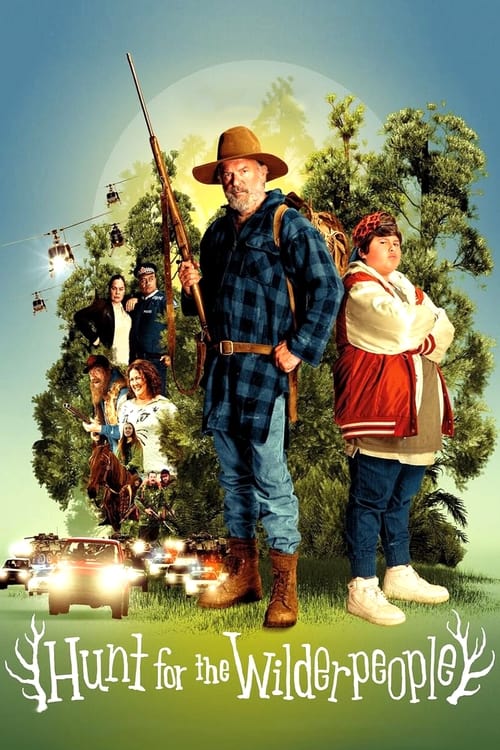
Hunt for the Wilderpeople
2016 · Taika Waititi
For when you need a guaranteed good time — a crowd-pleaser for family movie night or a rough week, funny enough to rewatch and warm enough to fix your mood.
What it's about
Ricky Baker, a chubby city kid with a rap sheet of minor mischief, is dumped with a foster family on a remote New Zealand farm — and ends up fleeing into the bush with Hec, his cantankerous foster uncle. What starts as a misunderstanding snowballs into a full national manhunt, with an odd-couple pair of runaways learning to survive the wilderness and each other.
The experience
Fast, funny, and unexpectedly moving — deadpan Kiwi humor riding on top of real grief and loneliness, so you're laughing one minute and blindsided by feeling the next. It moves like an adventure yarn and lands like a hug.
Performances
Sam Neill's gruff, wounded Hec and Julian Dennison's swaggering, haiku-writing Ricky are a perfect comic pairing — Dennison in particular delivers one of the great kid performances, hilarious without ever being cute.
The craft
Waititi's script, adapted from Barry Crump's novel, braids absurdist gags with genuine melancholy, and the film makes a genuine spectacle of the New Zealand bush — sweeping drone shots, chapter titles, and a montage energy that keeps the chase bouncing along. The needle drops and score are half the fun.
Why it matters
It became a domestic phenomenon — widely reported as the highest-grossing New Zealand film at home — and was the launchpad that carried Waititi from indie favorite to global directing career.
Snapshot
Hunt for the Wilderpeople is a New Zealand adventure-comedy that follows Ricky Baker, a troubled foster child from the city, and Hector "Hec" Faulkner, his gruff foster uncle, as they flee into the bush and inadvertently trigger a national manhunt. Adapted by Taika Waititi from Barry Crump's 1986 novel Wild Pork and Watercress, the film distills Waititi's signature register — deadpan Kiwi melancholy braided with absurdist comedy — into his most commercially successful and widely exported feature to that point. It premiered at the Sundance Film Festival in January 2016 and became a phenomenon on home soil, where it was widely reported as overtaking Waititi's own Boy (2010) to become the highest-grossing New Zealand film domestically (specific gross figures vary by source and are omitted here). Arriving between the mockumentary cult of What We Do in the Shadows (2014) and the Marvel commission of Thor: Ragnarok (2017), Wilderpeople functions as the hinge of Waititi's career: the film in which a distinctly local, low-budget sensibility proved itself scalable to an international audience.
Industry & production
The film was produced through New Zealand's established independent ecosystem, financed with support from the New Zealand Film Commission and produced by partners including Carthew Neal, Leanne Saunders, and Matt Noonan, with Waititi himself involved as producer alongside his directing and screenwriting duties. It was shot on location in the New Zealand bush — the landscape is effectively a co-lead — which grounded the production in the country's practical infrastructure of location shooting, an infrastructure matured by decades of runaway and homegrown production (from the Lord of the Rings films to Waititi's own earlier work).
The property itself carried domestic weight: Barry Crump was one of New Zealand's best-known "man alone" outdoors writers, and Wild Pork and Watercress was a recognizable title. Adapting a beloved local novel gave the project built-in cultural legibility at home while the underdog-on-the-run structure translated cleanly abroad. Internationally, the film was picked up for distribution by The Orchard in the United States, where it rode strong festival word-of-mouth and critical enthusiasm into a healthy specialty release. The commercial pattern is instructive: a modestly budgeted film that recouped and then some by leaning on a director's rising profile and a universally readable premise, exactly the trajectory that made Waititi legible to Hollywood.
Technology
Wilderpeople was made with the digital production tools standard to mid-2010s independent cinema; I have not been able to confirm the precise camera package or capture format from the record, and rather than guess I flag this as a genuinely thin point. What the film does with its tools is clearer than the tool list itself. The production leaned on real wilderness locations rather than sets or heavy digital environment work, so the technological emphasis falls on mobility — capturing performance and landscape across difficult terrain and variable weather — rather than on spectacle. Visual effects are deployed sparingly and comically (a stylized "majestical" register in certain montage flourishes, an escalating action climax), and the film's aesthetic ambition is achieved primarily through framing, color, and cutting rather than through effects-heavy pipelines. This restraint is itself a production strategy: it keeps the budget on screen as landscape and performance.
Technique
Cinematography
Shot by Lachlan Milne — who would go on to lens Stranger Things, Love and Monsters, and the Oscar-nominated Minari — the film's photography is one of its defining pleasures. Milne and Waititi treat the New Zealand bush as an ever-shifting scenic register: intimate and enclosed in dialogue scenes, then opening into sweeping, almost storybook vistas that verge on the mock-epic. The compositions favor Waititi's characteristic centered, slightly presentational framing, which lends the deadpan comedy a formal poise. A recurring device is the seasonal montage, in which the passage of time in the wilderness is rendered through changing light and foliage, using the landscape's grandeur both sincerely (as genuine natural beauty) and ironically (as an oversized backdrop for two bickering fugitives). The camera also indulges genre pastiche in bursts — sweeping crane-like moves and heroic low angles that briefly borrow the grammar of the action blockbuster before puncturing it.
Editing
The editing is central to the film's comic timing and to its distinctive structure. Wilderpeople is organized into titled chapters announced by intertitles, a device that segments the road-and-bush narrative into discrete comic-tragic movements and gives the episodic material a mock-literary shape. Within scenes, the cutting is precise and often abrupt, using the hard cut and the smash to a reaction as punchlines — a rhythm Waititi shares with his mockumentary work. The seasonal and travel montages compress long stretches of survival into brisk visual runs, and the escalating final pursuit is cut for kinetic, deliberately over-scaled excitement. The editing credits belong to a team associated with Waititi's circle; Tom Eagles, who cut Waititi's later Jojo Rabbit (2019) and earned an Academy Award nomination for it, is among the editors associated with the film, and I note that I cannot fully verify every editor's precise credit here without overstating the record.
Mise-en-scène / staging
Waititi stages Wilderpeople around expressive props, costume, and the comic collision of registers. Ricky's aspirational "gangster" persona — his invented "skux" self-image, hip-hop affect, and haiku-writing — is built through wardrobe and behavior that clash productively with the rural setting. Hec's world of dogs, rifles, and worn practical gear anchors the frame in the "man alone" tradition, and the running gag of the two heroes and their dogs (Ricky's Tupac and Hec's Zag) crossing an indifferent, majestic wilderness derives much of its humor from the mismatch between small human stakes and enormous natural scale. Supporting figures — the manic child-services officer Paula, who styles her pursuit as a paramilitary crusade, and the roadside "Bush Man" Psycho Sam — are staged as escalating cartoons within an otherwise grounded natural world, a tonal layering that is the film's signature.
Sound
The score is credited to Moniker — the songwriting collective of Lukasz Buda, Samuel Flynn Scott, and Conrad Wedde, musicians associated with the New Zealand band the Phoenix Foundation, who had scored Waititi's earlier features. The music mixes warm synth textures and pop hooks with more sincere emotional cues, mirroring the film's tonal oscillation between comedy and grief. Sound design exploits the quiet of the bush — birdsong, wind, footfalls — against sudden intrusions of civilization and action-movie bombast, and the film's needle-drops and songs reinforce Ricky's pop-cultural imagination. As with the visuals, the sonic strategy is contrast: the tender undercut by the ridiculous and vice versa.
Performance
The film rests on the chemistry between Sam Neill as Hec and Julian Dennison as Ricky. Neill, a New Zealand screen veteran, plays gruff, wounded reticence with unshowy precision, allowing Hec's grief and gradual thaw to register beneath a resistant surface. Dennison, then a young newcomer, delivers the breakout performance — his timing, self-serious bravado, and vulnerability made Ricky an instantly beloved figure and launched a notable career (he would reunite with Waititi in a Deadpool sequel and elsewhere). Around them, Rima Te Wiata brings disarming warmth as foster mother Bella, whose early loss sets the emotional engine running, and Rachel House plays child-welfare officer Paula with escalating, self-mythologizing zeal. The performance style throughout is calibrated deadpan: sincerity delivered flat, absurdity delivered straight.
Narrative & dramatic mode
Structurally, Wilderpeople is a picaresque road movie relocated to the wilderness — an episodic survival adventure organized into titled chapters. Its dramatic mode is tragicomedy: the inciting event is a death (Bella's), and grief is the undertow beneath the comedy throughout. The central arc is a two-hander of gradual attachment, in which an unwanted child and a closed-off man become, against their intentions, a family. The plot machinery — a misunderstanding that spirals into a national manhunt — supplies escalating external stakes, but the film's true movement is internal and relational. Waititi runs comedy and pathos in close alternation rather than in separate acts, so that a joke and a wound frequently occupy the same beat. The mode is fundamentally humanist and reconciliatory: institutions are absurd and threatening, but the interpersonal bond is redemptive.
Genre & cycle
The film sits at the crossroads of several genres: the coming-of-age story, the odd-couple buddy comedy, the wilderness survival adventure, and the fugitive/manhunt thriller, all filtered through comedy. It belongs to the enduring "man alone" strain of New Zealand storytelling that Crump's novel exemplifies, while also participating in a broader international cycle of quirky indie tragicomedies about found family and outsider misfits. Within Waititi's own filmography it forms a clear cycle with Boy (2010): both center on imaginative, culturally hybrid Kiwi boys, both mix childlike fantasy with real loss, and both treat the New Zealand landscape and social margins with affectionate specificity. Wilderpeople also self-consciously pastiches action-cinema conventions in its climactic chase, briefly enlisting the blockbuster's genre grammar as a comic register.
Authorship & method
Waititi is the film's dominant authorial signature, working here as writer-director and producer. His method is recognizable across his body of work: deadpan improvisation-friendly comedy, symmetrical presentational framing, chapter-structured storytelling, pop-culture-literate child protagonists, and a willingness to let sincerity and silliness share a frame. His adaptation approach transposes Crump's more somber source into his own tonal key without abandoning its emotional core.
The key collaborators extend that authorship. Cinematographer Lachlan Milne supplies the film's blend of intimate character framing and mock-epic landscape. The score by Moniker (Buda, Scott, Wedde, of the Phoenix Foundation circle) provides the warm synth-pop emotional bed that had become part of the Waititi house sound. The editing team — associated with Waititi's regular collaborators, and including Tom Eagles among the credited editors — shapes the chapter structure and the deadpan comic rhythm. Performers Sam Neill and Julian Dennison are, in a real sense, co-authors of the film's tone, translating the script's tragicomedy into lived behavior.
Movement / national cinema
Wilderpeople is emphatically a work of New Zealand national cinema. It draws on a local literary and cultural tradition — the rural "man alone," the bush as national imaginary, the bicultural texture of Pākehā and Māori New Zealand — and Waititi's own Māori heritage informs the film's easy, unforced cultural specificity. It represents a mature moment in a self-confident Aotearoa cinema that could speak in an unmistakably local idiom (slang, landscape, humor) while reaching a global audience. The film also exemplifies a broader trend of small national cinemas exporting directorial voice: Waititi's international breakthrough is inseparable from the film's rootedness in place, not despite it.
Era / period
Made and released in the mid-2010s, Wilderpeople belongs to a moment when festival-launched independent films with strong, tonally distinctive authorial voices could achieve outsized crossover success and when streaming and specialty distribution were expanding the reach of such titles. Its 2016 arrival captures Waititi at the threshold between indie auteur and franchise filmmaker; within roughly a year he would be directing Thor: Ragnarok, and Wilderpeople reads in retrospect as both a culmination of his independent period and a proof of concept for the larger stages to come.
Themes
The film's central theme is found family — the making of kinship between the unwanted child and the reluctant guardian. Around it cluster grief and healing (Bella's death haunts the entire narrative), the outsider's search for belonging (Ricky as a foster child failed by institutions, Hec as a self-exiled loner), and a gentle critique of bureaucratic authority embodied in the overzealous child-welfare pursuit. The wilderness dramatizes a recurring tension between civilization and nature, and between imposed identity and self-invention — Ricky literally narrates himself into a heroic myth. Underlying all of it is a humane insistence that connection, however improbable, is what redeems damage.
Reception, canon & influence
Critically, Wilderpeople was warmly received, praised for its balance of humor and heart, Milne's photography, and the Neill–Dennison partnership, and it became a signature festival crowd-pleaser following its Sundance premiere. Commercially it was a landmark at home, widely reported as the highest-grossing New Zealand film domestically to that point (exact figures omitted, as sources vary).
Looking backward, the film's influences are legible: Barry Crump's novel and the "man alone" tradition supply its narrative spine; Waititi's own Boy supplies its template of the imaginative Kiwi boy and its tragicomic tone; and the wider lineage of odd-couple road movies and coming-of-age indies informs its shape. Its climactic action pastiche openly borrows from Hollywood genre cinema for comic effect.
Looking forward, the film's most consequential legacy is career-shaping: it consolidated Waititi's voice on the world stage and helped make the case that carried him to Thor: Ragnarok and the Oscar-winning Jojo Rabbit. It launched Julian Dennison into an international career and further raised the profile of collaborators such as Lachlan Milne (later Oscar-nominated for Minari) and editor Tom Eagles. More diffusely, Wilderpeople became a touchstone for the exportable "quirky, warm, deadpan" indie tragicomedy and a flagship for contemporary New Zealand cinema's ability to travel. Claims of direct, traceable influence on specific later films should be made cautiously — the record here is more about a sensibility popularized than a school founded — but its status as a beloved modern crowd-pleaser and a pivot point in a major director's career is secure.
A Deleuzian reading
A boy stands in the New Zealand bush in city clothes, a dog called Tupac at his heel, and the camera drops low and looks up at him the way it would at a man about to save a city.
The full Deleuzian reading of Hunt for the Wilderpeople →
Reception
A Sundance 2016 crowd-pleaser that became a full-blown phenomenon at home, smashing New Zealand box-office records. A decade on it's settled in as the consensus 'peak Taika' — the scrappy indie people point back to fondly as his career went blockbuster.
How Hunt for the Wilderpeople was received, from release to now →
Influences: the films it descends from and the films it influenced
- Boy (2010) — Waititi's own prototype for Wilderpeople: an imaginative Kiwi boy whose pop-culture fantasy inserts and abrupt deadpan-to-poignant tonal pivots are reused almost wholesale as the film's tragicomic operating system.
- Rushmore (1998) — Establishes the precocious-outsider child rendered in flat, centered presentational framing and stage-curtain chaptering that Wilderpeople's intertitles and symmetrical compositions directly descend from.
- Moonrise Kingdom (2012) — The near-structural cousin — a child flees civilization into wilderness, shot in storybook symmetry and divided into titled chapters, the exact formal package Waititi adapts to the New Zealand bush.
- The Royal Tenenbaums (2001) — Codifies the literary chapter-intertitle as a comic pacing device that frames deadpan family dysfunction, the editing grammar Tom Eagles borrows for Wilderpeople's chapter cards.
- Kikujiro (1999) — A gruff loner and a lost boy on the road, built from deadpan static compositions, vignette-title chaptering, and a warm synth-and-piano score (Hisaishi) — a structural blueprint for Wilderpeople's odd-couple journey and Moniker's emotional bed.
- Paper Moon (1973) — The mismatched gruff-adult/resourceful-kid two-hander whose bickering-into-bonding road rhythm defines the odd-couple buddy structure Neill and Dennison inhabit.
- The 400 Blows (1959) — Originates the runaway-boy-into-nature coming-of-age that treats juvenile flight from institutions as lyrical rather than delinquent, the emotional template beneath Ricky's bolt into the bush.
- Goodbye Pork Pie (1981) — The foundational New Zealand chase-comedy of fugitives pursued cross-country by police, supplying the national-cinema road-movie shape and the affectionate-authority-farce Wilderpeople replays through Paula's manhunt.
- Sleeping Dogs (1977) — Sam Neill's own debut as a 'man alone' fleeing the state into the New Zealand bush — the wilderness-manhunt archetype Wilderpeople both honors and casts him to gently parody.
- Whale Rider (2002) — The precedent for a New Zealand national-cinema breakout carried by a first-time child performer shouldering real tragicomic weight, the Julian Dennison casting model.
- What We Do in the Shadows (2014) — Waititi's contemporaneous refinement of improvisation-friendly, flatly-framed deadpan and register collision (mundane bickering against genre spectacle) that carries straight into Wilderpeople's comic timing.
- The Darjeeling Limited (2007) — Takes the post-Darjeeling package downstream: chapter-carded picaresque through landscape, symmetrical frontal comic tableaux broken by whip-pans, and a compiled source score doing the emotional lifting for a mismatched surrogate family that never states its feelings aloud.
- Thor: Ragnarok (2017) — Scales up the Wilderpeople climax's comic action-pastiche, house synth score, and needle-drop register collision to blockbuster budget, proving the sensibility travels.
- Jojo Rabbit (2019) — Extends the lonely-imaginative-boy tragicomedy and the deliberate collision of silliness against genuine grief, with the same sincerity-and-absurdity-in-one-frame staging.
- Leave No Trace (2018) — The somber counterpart — a guardian and child living off-grid in the forest, pursued by child-welfare authorities, built on immersive diegetic bush ambience rather than deadpan comedy.
- The Peanut Butter Falcon (2019) — A runaway kid and a reluctant older man on a picaresque wilderness road adventure fleeing well-meaning caregivers, working the same deadpan-warm odd-couple register Wilderpeople popularized.
- Thor: Love and Thunder (2022) — Codified Waititi's deadpan-sincere method and heavy on-set improvisation, undercutting genuine sentiment with awkward comic beats before he scaled it to franchise machinery.
- Little Miss Sunshine (2006) — The dysfunctional-family indie road tragicomedy whose deadpan-warm register and quirky-outsiders-versus-the-system tone Wilderpeople exports to a wider festival audience.
- Up (2009) — The grumpy-old-man/eager-boy wilderness odd couple structured so that adventure metabolizes grief — the same bereavement-under-the-comedy engine driving Hec and Ricky.
- Captain Fantastic (2016) — An off-grid family raising children in the wilderness in defiance of the state, played as wry tragicomedy — the same anti-institutional wilderness-family premise arriving the same year.
- Minari (2021) — Shares cinematographer Lachlan Milne, whose naturalistic, light-driven framing of a child set loose in wild green landscape is the same craft signature he applies to the Arkansas farm.
Similar films
- What We Do in the Shadows (2014) — influence & lineage
- Moonrise Kingdom (2012) — influence & lineage
- Jojo Rabbit (2019) — influence & lineage
- Captain Fantastic (2016) — influence & lineage
- Kikujiro (1999) — influence & lineage · same viewing thread
- First Cow (2020) — same viewing thread · often watched together
- Nope (2022) — shared sensibility
- Buddy (2026) — shared sensibility
All the films related to Hunt for the Wilderpeople →
Watch it with: curated runs of related films
- Unlikely Companions, Gentle Roads — Watch these together for the way a mismatched pair — a yakuza and a lost boy, an old man on a lawnmower bound for his brother, a runaway kid and a grizzled uncle, two frontier drifters with a stolen cup of milk — becomes a whole small world; they rhyme on tenderness carried at walking pace.