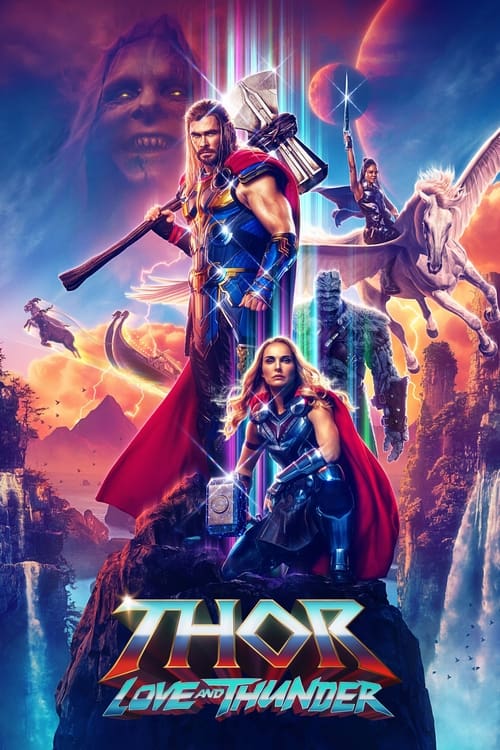
Thor: Love and Thunder
2022 · Taika Waititi
When you want something loud, bright, and undemanding for a fun night — a comfort-food blockbuster you can laugh along with, with just enough feeling to keep it from floating away.
What it's about
Thor's attempt at retirement collapses when Gorr the God Butcher, a grieving killer armed with a god-slaying blade, starts exterminating deities across the cosmos. To stop him, Thor teams up with King Valkyrie, rock-man Korg, and — awkwardly — his ex-girlfriend Jane Foster, who now wields his old hammer as the Mighty Thor while privately fighting cancer.
The experience
A candy-colored, joke-a-minute cosmic romp with a surprisingly sad heart — it swings between screaming goats and genuine grief, sometimes in the same scene. Loud, fast, and gleefully silly, with sincerity that ambushes you under the gags.
Performances
Christian Bale commits fully to Gorr, playing a genocidal villain with an unsettling, whispery grief that cuts through the comedy around him.
The craft
Waititi doubles down on the pop-art register: rock-opera needle drops, day-glo cosmic vistas, and a striking shadow-realm sequence drained to black and white. It's built for big speakers and a bombastic mood.
Why it matters
As the follow-up to a beloved reinvention of the character, it became a flashpoint in the conversation about how much comedy a superhero story can carry — and about franchise fatigue in the modern blockbuster era.
Snapshot
Thor: Love and Thunder is the fourth solo Thor picture and the twenty-ninth feature in the Marvel Cinematic Universe, a direct sequel to Taika Waititi's Thor: Ragnarok (2017) that attempts to reproduce that film's tonal reinvention while grafting on an unusually somber source narrative. The plot fuses two threads from Jason Aaron's celebrated Marvel Comics run: the "God Butcher" arc, in which the alien Gorr wages genocidal war on the pantheons of the universe, and the later storyline in which Jane Foster becomes worthy of Mjolnir and takes up the mantle of Thor even as she battles cancer. Waititi's characteristic register — improvisational comedy, pop-song needle drops, deliberate anachronism, a sincerity that surfaces suddenly beneath the jokes — is stretched here across material about grief, terminal illness, and divine abandonment. The film became one of the more openly debated entries of the MCU's "Phase Four," admired by some for its color and swing and criticized by others for tonal whiplash and a sense of formula fatigue. It is a useful case study in the risks of the "auteur-for-hire" model that Marvel Studios cultivated in the late 2010s.
Industry & production
Love and Thunder was produced by Marvel Studios under Kevin Feige and distributed by Walt Disney Studios Motion Pictures, part of the tightly serialized release cadence Disney restored after the COVID-19 disruptions of 2020. The picture was greenlit on the strength of Ragnarok, which had rejuvenated a flagging sub-franchise and established Waititi as the rare outside director permitted to substantially remake a Marvel property's identity. Principal photography took place largely in Australia — Sydney and New South Wales, at the Fox Studios facilities — reflecting both Waititi's regional base and the incentives that drew several MCU productions to Australia during the pandemic era. Production was affected by the health protocols of that period, and by an on-set injury to a background performer that received press attention; beyond that, the specifics of the shoot's difficulties are not extensively documented in the public record.
The film's commercial performance was substantial without matching Ragnarok's trajectory, and I will not cite specific grosses here to avoid misstating figures. Industrially, the more consequential story is what the film revealed about Marvel's assembly line: an enormous slate of simultaneous productions competing for a finite pool of visual-effects labor, a condition widely reported in 2022–2023 as VFX artists spoke publicly about compressed schedules. Love and Thunder's effects work drew criticism, and it became one of the films frequently invoked in that broader conversation about the sustainability of Marvel's output.
Technology
The film was captured digitally and finished as a large-format spectacle intended for premium formats including IMAX and 3D, consistent with MCU house practice. Its most distinctive technological dimension is the volume of computer-generated environments and creatures — Gorr's monsters, the shadow-realm setting of the third act, New Asgard's tourist-town Norway, and the rainbow-bridge cosmology of Asgardian myth. As noted above, the compressed post-production pipeline that characterized Marvel's 2022 slate is part of this film's technological story; the seams occasionally visible in the compositing became a talking point rather than a background achievement. The picture also leans on virtual and heavily processed lighting to sustain its saturated palette, a look that depends as much on the digital-intermediate color grade as on anything captured in camera.
Technique
Cinematography
Cinematography is credited to Barry "Baz" Idoine, who had shot Disney+'s The Mandalorian and thus arrived versed in the LED-volume and heavily controlled-lighting approaches of contemporary franchise work. (Waititi's Ragnarok had been photographed by Javier Aguirresarobe; the change of collaborator is worth noting for anyone tracing the visual continuity between the two films.) The dominant strategy is maximal color: primary hues, neon rim light, and a comic-book flatness that evokes 1970s–80s fantasy illustration and the airbrushed cosmic imagery associated with Heavy Metal magazine and Flash Gordon, references Waititi discussed in promotion. Against this, the film stages its most striking formal decision — the climactic battle in Gorr's Shadow Realm rendered in near-monochrome, color drained to black-and-white so that Thor's lightning and the characters' costumes register as isolated splashes. This is the film's clearest instance of image design carrying theme: a world literally leached of color to externalize Gorr's nihilism.
Editing
The editing is credited to a team including Matthew Schmidt, Peter S. Elliot, Tim Roche, and Jennifer Vecchiarello — a multi-editor arrangement typical of large VFX-driven productions. The cutting favors rapid comic timing, montage compression of exposition (Thor's recovery montage, the New Asgard "play within the film"), and needle-drop set pieces built around Guns N' Roses tracks. Critics who faulted the film often located the problem at the level of rhythm and structure: an unevenness in which comic beats undercut the emotional and horror registers the script also wanted to reach. Whether one reads this as a virtue of tonal daring or a failure of modulation is the central interpretive question the film poses.
Mise-en-scène / staging
Waititi's staging embraces theatricality and pastiche. The Asgardian stage play that reprises earlier films' events, the tourist-kitsch reinvention of New Asgard, and the parade of borrowed gods in Omnipotence City — presided over by a vain, golden Zeus — all foreground artifice as a mode. Production and costume design tilt toward the bright, the plush, and the deliberately gaudy. This maximalism is thematically legible: a universe of gods rendered as celebrity spectacle, which sharpens Gorr's accusation that the deities are unworthy of worship.
Sound
The score is credited to Michael Giacchino with Nami Melumad, and the soundtrack's most conspicuous element is its use of Guns N' Roses, whose songs (including the title-evoking "Thunderstruck"-adjacent hard-rock register and tracks from the band's catalog) function almost as a musical motif for Thor himself. The needle-drop strategy is inherited directly from Ragnarok's landmark deployment of Led Zeppelin's "Immigrant Song," and more broadly from the pop-scoring vocabulary the Guardians of the Galaxy films made central to the MCU. Giacchino and Melumad's orchestral work threads between these songs; the collaboration is notable as one step in Melumad's rising profile as a franchise composer.
Performance
Chris Hemsworth returns as Thor in a mode that is now fully comic — a self-satirizing heroism honed across Ragnarok and the Avengers films — while being asked, in the film's final movement, to play genuine loss. Natalie Portman returns to the franchise after a long absence as Jane Foster / the Mighty Thor, giving the picture its most direct emotional stake through Jane's illness. Christian Bale plays Gorr as a gaunt, wounded fanatic; his performance was frequently singled out by critics as more textured and menacing than the surrounding film's comic mode could fully accommodate, and the perceived mismatch between villain and vehicle became a recurring critical note. Tessa Thompson's Valkyrie and Waititi's own voice performance as the rock-creature Korg round out the ensemble, and Russell Crowe's broadly comic Zeus is among the film's more polarizing choices.
Narrative & dramatic mode
The film operates in a hybrid dramatic mode that is also its chief source of controversy: a comic-adventure surface wrapped around a tragic armature. Gorr's origin — a devout father who loses his child and then his faith, and vows to kill the gods who ignored his prayers — is genuine tragedy; Jane's arc toward a heroic death shadowed by cancer is melodrama in the older, non-pejorative sense. Around these, Waititi deploys quip, digression, and running gags (the screaming goats, Korg's narration, Thor's jealousy of Stormbreaker). The film gestures toward a mythic quest structure — a descent to the underworld, a bargain with a corrupted king of the gods, a final confrontation at the gates of eternity — but keeps puncturing that structure with irony. Reasonable viewers divide over whether the resulting counterpoint deepens the pathos or defuses it.
Genre & cycle
Generically the film sits at the intersection of superhero spectacle, cosmic fantasy, and comedy, and it belongs to two overlapping cycles. The first is the MCU's serialized "Phase Four," the studio's post-Endgame period of expansion and tonal experimentation across film and Disney+ television, widely discussed as a moment of both ambition and diffusion. The second is the specific "comedic-cosmic" strand within the MCU that Guardians of the Galaxy (2014) inaugurated and Ragnarok extended — irreverent, music-driven, color-saturated space opera. Love and Thunder is at once the fullest expression of that strand and, for many critics, the point at which its formula began to feel exhausted.
Authorship & method
Waititi is the film's presiding author and co-writer, sharing screenplay credit with Jennifer Kaytin Robinson and drawing on characters created for Marvel Comics by Jason Aaron and collaborators. His method — extensive on-set improvisation, comic tonal control, an affection for the awkward and the sincere developed in Hunt for the Wilderpeople (2016) and Jojo Rabbit (2019) — is the film's organizing sensibility, and Love and Thunder is often read as a test of how far a distinctive comic voice can be scaled to franchise machinery before the two work against each other. His key collaborators here are cinematographer Baz Idoine, composers Michael Giacchino and Nami Melumad, and the multi-person editing team above. The change of cinematographer from Ragnarok and the intensification of Waititi's comic register make the film a revealing document of an "auteur-for-hire" pushing his own style further while the surrounding apparatus grows more demanding.
Movement / national cinema
Love and Thunder is a Hollywood studio tentpole and belongs to no art-cinema movement, but two contextual affiliations are worth naming. It is part of the twenty-first-century wave of New Zealand and Australian talent — Waititi, Thompson's Australian shoot, the Sydney production base — absorbed into the American franchise system, and Waititi himself, of Māori and Jewish heritage, is among the most prominent Indigenous-descended directors to helm a major Hollywood franchise. The film does not foreground that identity thematically, but Waititi's broader body of work makes the affiliation a meaningful part of his authorship.
Era / period
The film is a product of the early-2020s superhero-cinema peak and its incipient strain. Released in 2022, it arrived as commentators were beginning to diagnose "superhero fatigue" and to scrutinize Marvel's over-extended production pipeline and reliance on overworked VFX vendors. It is thus a period marker in two senses: a late-stage example of the dominant genre of 2010s American commercial cinema, and an early symptom of that genre's mounting critical and industrial difficulties.
Themes
The film's central theme is faith and its withdrawal: Gorr's crusade poses, in blockbuster terms, the problem of divine indifference, and the narrative's answer is relational rather than theological — love, chosen family, and the willingness to protect what is finite. Mortality is the second axis, carried by Jane's illness and by the film's unusual willingness to let a hero die; the picture ends by reframing loss as a form of continued care. A third theme is worthiness and legacy — who may wield the hammer, who inherits a role, what parenthood and mentorship mean — folded into the Marvel iconography of Mjolnir. Whether the comic packaging adequately honors these themes is precisely the debate the film generated.
Reception, canon & influence
Critically, Love and Thunder received markedly more mixed notices than Ragnarok, with a common critical consensus praising its color, energy, and Bale's villainy while faulting tonal inconsistency, a rushed or thin plot, and visual-effects work that showed the strain of Marvel's schedule. I am describing the shape of that reception rather than quoting specific aggregator scores or reviews, which I cannot verify precisely here.
Its influences run backward to a dense web of sources: Jason Aaron's comics (both the God Butcher and Mighty Thor arcs); the pop-scored, comedic space opera of Guardians of the Galaxy; Waititi's own Ragnarok and his indie filmography; and a visual lineage of 1980s fantasy and Heavy Metal-style illustration, Flash Gordon, and airbrushed album-cover cosmology. Its forward influence is harder to assess so soon and is genuinely thin in the documented record: the film's most cited legacy is negative and industrial, as it became a frequent reference point in the 2022–2023 discourse about Marvel's tonal formula and the treatment of VFX labor — a cautionary example within the very franchise it extends. Its lasting canonical status, both within the MCU and in the broader superhero cycle, remains unsettled and will depend on how the era's fatigue narrative is ultimately written.
A Deleuzian reading
In New Asgard, which is now a tourist town, actors stand on a wooden stage and re-enact events from earlier films for visitors holding souvenirs.
The full Deleuzian reading of Thor: Love and Thunder →
Reception
Landed in 2022 to a shrug-and-a-wince — the moment the 'Waititi magic' consensus from Ragnarok flipped into 'too much Waititi' — and it's since hardened into the go-to exhibit for Marvel's post-Endgame slump. Even Chris Hemsworth later admitted he'd 'become a parody' of himself in it, which fans now quote back at the film constantly.
How Thor: Love and Thunder was received, from release to now →
How to watch Thor: Love and Thunder: what to notice on a first viewing
- Look at how loud the color is in every frame. Idoine works in primary hues and neon rim light, flat like 1970s fantasy illustration and airbrushed Heavy Metal covers. Almost nothing is photographed in neutral tones. Color here is feeling rather than description.
- Watch the actors on the wooden stage in New Asgard. Famous people play Asgardians re-enacting events from earlier films for tourists holding souvenirs. Nobody fights. Somebody performs a fight that already happened. The film keeps staging actions instead of performing them. Once you see it, Omnipotence City and Zeus read the same way.
- Listen for Guns N' Roses arriving whenever Thor does. The needle drops work as Thor's personal motif. Giacchino and Melumad's orchestral score threads between the songs. The method comes straight from Ragnarok and the Guardians films. The songs tell you what register a scene is in before anyone speaks. They also make the sincere moments harder to land.
- Watch how differently Hemsworth and Bale are playing this. Hemsworth plays Thor as self-satire, deflated and jealous of his own axe. Bale plays Gorr gaunt, wounded, and completely serious. The two performances belong to different registers. The gap between them is the film arguing with itself. Decide as you watch whether the counterpoint deepens the story or defuses it.
- Count how much story gets told in montage. A four-person editing team compresses Thor's recovery, the setup, and most exposition into fast comic runs. Scenes get cut for the joke landing rather than for the beat continuing. The rhythm is what critics fought about. Watch whether a serious moment is given time to sit before the next gag arrives.
The whole guide to watching Thor: Love and Thunder, with the keys for a rewatch →
Influences: the films it descends from and the films it influenced
- Thor: Ragnarok (2017) — Established the synth-and-Kirby-crackle saturated palette, improv-driven comic register, and metatheatrical Asgardian stage play (staged by celebrity cameo actors) that Love and Thunder inherits and intensifies.
- Jojo Rabbit (2019) — Perfected Waititi's comedy-tragedy braid — staging a child's and a mother's death through whimsical comic setups — the exact tonal machine reused for Jane's cancer and Gorr's dead daughter.
- Hunt for the Wilderpeople (2016) — Codified Waititi's deadpan-sincere method and heavy on-set improvisation, undercutting genuine sentiment with awkward comic beats before he scaled it to franchise machinery.
- Guardians of the Galaxy (2014) — Invented the cosmic-MCU needle-drop architecture — cutting action and montage to classic-rock tracks — with Love and Thunder's wall-to-wall Guns N' Roses standing in for Gunn's Awesome Mix.
- Flash Gordon (1980) — Modeled the rock-scored camp space opera: lurid, airbrushed album-cover color and gleeful artifice behind the Bifrost/Eternity palette and Omnipotence City spectacle.
- Heavy Metal (1981) — Supplied the airbrushed fantasy-illustration vocabulary — glowing skies, sculpted cosmic vistas, pulp eroticism — that the production design channels for the cosmos and the rainbow-goat voyage.
- Nosferatu (1922) — Christian Bale explicitly built Gorr's crook-fingered silhouette, pallor, and gliding expressionist movement from Murnau's Count Orlok, grafting silent-horror physicality onto the villain.
- Barbarella (1968) — Pioneered the pop-art, sexed-up cosmic production design and unabashed camp tonality that the film's set-piece maximalism descends from.
- Sin City (2005) — Established the monochrome-with-selective-color grammar Waititi and Idoine adopt for the Shadow Realm, where black-and-white staging isolates a single chromatic accent.
- Legend (1985) — Storybook-fantasy production design and gauzy, backlit fairy-tale lighting inform the film's 1980s-fantasy image register.
- Deadpool & Wolverine (2024) — Carries forward the needle-drop, fourth-wall-adjacent comic-MCU mode — structuring action montages to pop songs and foregrounding a self-aware comic voice over plot.
- Doctor Strange in the Multiverse of Madness (2022) — Contemporaneous Phase Four 'auteur-for-hire' experiment importing a director's signature genre register (Raimi horror vs. Waititi comedy) into demanding MCU machinery.
- The Suicide Squad (2021) — Shares the needle-drop-scored, gonzo-saturated comic-book violence and eccentric-outcast ensemble tone, treating superhero carnage as pop spectacle.
- Guardians of the Galaxy Vol. 3 (2023) — Extends the same pop-scored cosmic-MCU comedy braided with real trauma — the tonal hybrid Love and Thunder attempts, executed with tighter tonal control.
- Werewolf by Night (2022) — Directed by Love and Thunder's composer; shares the retro-pastiche, genre-homage MCU register and a full-monochrome experiment akin to the Shadow Realm's desaturation.
- Jupiter Ascending (2015) — A prior maximalist, airbrushed-cosmology space opera whose ornate, saturated world-building and operatic villainy parallel the film's Omnipotence City excess.
Similar films
- Guardians of the Galaxy Vol. 3 (2023) — influence & lineage
- Deadpool & Wolverine (2024) — influence & lineage
- Doctor Strange in the Multiverse of Madness (2022) — influence & lineage
- Guardians of the Galaxy (2014) — influence & lineage
- Hunt for the Wilderpeople (2016) — influence & lineage
- Guardians of the Galaxy Vol. 2 (2017) — shared sensibility
- Thunderbolts* (2025) — shared sensibility
- The Avengers (2012) — shared sensibility