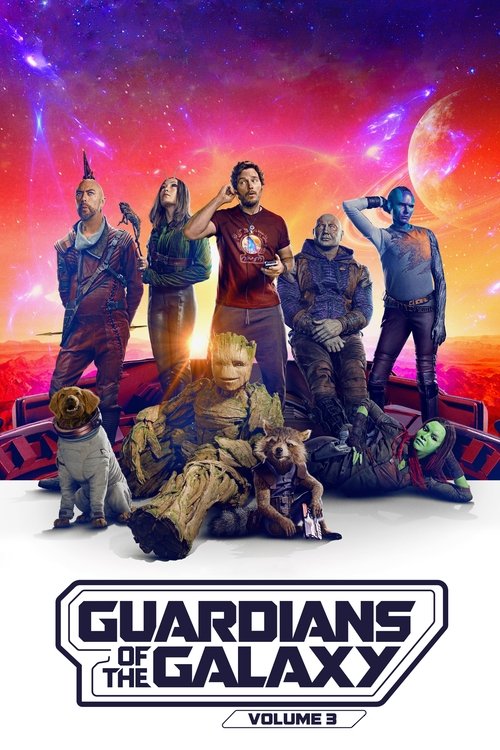
Guardians of the Galaxy Vol. 3
2023 · James Gunn
For when you want blockbuster spectacle that actually makes you feel something — a crowd-pleaser with a bruised heart, and a satisfying goodbye if you've spent years with these characters. Fair warning for animal lovers: it goes to hard places.
What it's about
With Peter Quill adrift after losing Gamora, the Guardians are forced to rally when one of their own is gravely endangered — and saving him means digging into Rocket's hidden past. The wisecracking raccoon turns out to be the wounded soul of the whole saga, his origin bound up with a mad scientist whose experiments on animals give this space adventure a darker, sadder undertow than the franchise usually risks.
The experience
A big, loud, colorful romp that repeatedly stops your heart — it swings between needle-drop comedy and genuinely upsetting tenderness about cruelty to creatures. Expect to laugh a lot and cry more than you signed up for.
Performances
Bradley Cooper's voice work as Rocket carries the film's emotional weight, and Chukwudi Iwuji makes the High Evolutionary a genuinely unnerving villain — vain, volatile, and played entirely without a wink.
The craft
James Gunn leans physical where the genre leans digital: the villain's menagerie of spliced creatures was realized largely through elaborate prosthetics and makeup, giving the film's grotesqueries a texture CGI can't fake. The soundtrack curation and candy-colored production design reward a big screen and loud speakers.
Why it matters
The rare superhero threequel with a real ending — every character granted an actual conclusion — and Gunn's valedictory statement before leaving to run DC, widely received as proof the franchise machine could still deliver a personal film.
The rare superhero threequel with an authentic emotional center of gravity: James Gunn closes his space-opera trilogy by turning it into the story of Rocket — the wisecracking raccoon revealed as the saga's wounded soul — through a backstory of animal experimentation that pushes further into cruelty and tenderness than the franchise machine usually allows. Gunn, who began in the gleeful gore of Troma and never lost his affection for misfits and monsters, made this on his way out the door to run DC, and the valedictory mood is palpable: every character gets a real ending, a courtesy blockbuster serialization almost never extends. The craft leans physical where the genre leans digital — the villain's menagerie of spliced creatures was realized largely through elaborate prosthetics and makeup, giving the film's grotesqueries a weight the eye registers. The needle-drops, always Gunn's signature, reach past the '70s AM gold of earlier entries into the '90s and 2000s. Within a franchise era defined by diminishing returns, it stands as proof that these films could still be authored — and that an audience will follow a talking raccoon anywhere if the feeling is real.
A Deleuzian reading
Something in this movie sits differently in the eye, and it takes a while to place.
The full Deleuzian reading of Guardians of the Galaxy Vol. 3 →
Reception
Landed in May 2023, right as 'Marvel fatigue' discourse peaked — and became the exception that proved the rule, widely received as the emotional high point of a wobbly MCU phase. Its standing has only firmed up since: the trilogy-capper people point to when arguing franchise films can still make you feel something.
How Guardians of the Galaxy Vol. 3 was received, from release to now →
Influences: the films it descends from and the films it influenced
- Guardians of the Galaxy (2014) — Established the diegetic 'Awesome Mix' cassette structure and Rocket's mocap-plus-VFX-fur lead performance that Vol. 3 pays off.
- The Toxic Avenger (1984) — Troma's grotesque practical-prosthetic monster-as-hero and gleeful gross-out cruelty, absorbed by Gunn as a Troma staffer and reapplied to the High Evolutionary's mutilated creatures.
- Tromeo and Juliet (1996) — Gunn's screenwriting apprenticeship, splicing transgressive body-horror with sincere emotion — the tenderness/cruelty tonal whiplash that structures Rocket's flashbacks.
- Slither (2006) — Gunn's directorial debut built sympathetic monsters from squishy practical creature effects and prosthetics, the template for Vol. 3's caged menagerie.
- Super (2010) — Gunn welds superhero iconography to genuine trauma and disturbing violence, the auteur signature of real cruelty lurking beneath comic surfaces.
- Star Wars (1977) — The 'used universe' space-opera look with practical alien makeup and a cantina of misfit creatures that the Guardians' rogues' gallery descends from.
- American Graffiti (1973) — Wall-to-wall pop-song soundtrack keyed to a character's radio/nostalgia, the direct model for scoring an entire film off a personal mixtape.
- Mean Streets (1973) — Codified the needle-drop as ironic/emotional scoring — pop records laid over character scenes rather than an orchestral cue.
- Pulp Fiction (1994) — Curated surf/pop needle-drops played against violence, normalizing the soundtrack-as-curated-mixtape for genre blockbusters.
- The Island of Dr. Moreau (1977) — A god-complex scientist vivisecting human-animal hybrids in prosthetic creature makeup — the direct craft precedent for the High Evolutionary and his engineered beast-people.
- King Kong (2005) — Andy Serkis's motion-capture animal lead proved a mocap creature could carry emotional protagonist duty, the performance technique underpinning Rocket.
- Guardians of the Galaxy Vol. 2 (2017) — Direct continuation completing Rocket's origin trauma and the chosen-family payoff with the same Henry Braham large-format saturated look and mixtape structural spine.
- The Suicide Squad (2021) — Gunn re-runs his formula — practical gore, needle-drop soundtrack, a misfit team, and a pathos-driven mocap animal (King Shark) — in a rival franchise.
- Thor: Ragnarok (2017) — Auteur-driven MCU comedy that weaponizes a signature needle-drop (Led Zeppelin's 'Immigrant Song') and irreverent tone inside the franchise machine.
- Deadpool (2016) — R-rated superhero mixing pop needle-drops and gross-out prosthetic gags with a sincere emotional core, sharing Gunn's tonal register.
- Baby Driver (2017) — Action choreographed and cut precisely to a character's curated playlist — the maximalist extension of building set pieces around diegetic pop music.
- Logan (2017) — The elegiac, valedictory superhero finale that foregrounds trauma and mortality as a franchise send-off, the same closing register Vol. 3 adopts.
- Avengers: Endgame (2019) — The trilogy/franchise-valediction craft of cashing years of continuity for an emotional farewell, the late-MCU mode Vol. 3 works in.
- Thor: Love and Thunder (2022) — Extends the same pop-scored cosmic-MCU comedy braided with real trauma — the tonal hybrid Love and Thunder attempts, executed with tighter tonal control.
Similar films
- Guardians of the Galaxy (2014) — influence & lineage
- Avengers: Endgame (2019) — influence & lineage
- Logan (2017) — influence & lineage
- Deadpool (2016) — influence & lineage
- Guardians of the Galaxy Vol. 2 (2017) — same viewing thread
- Avatar: The Way of Water (2022) — same viewing thread
- Avengers: Infinity War (2018) — shared sensibility
- Deadpool & Wolverine (2024) — shared sensibility
All the films related to Guardians of the Galaxy Vol. 3 →
Watch it with: curated runs of related films
- Worlds Worth Getting Lost In — A run of maximalist, effects-driven pictures that each conjure a whole world from scratch — watch them when you want to be swept somewhere on the biggest screen you can find.