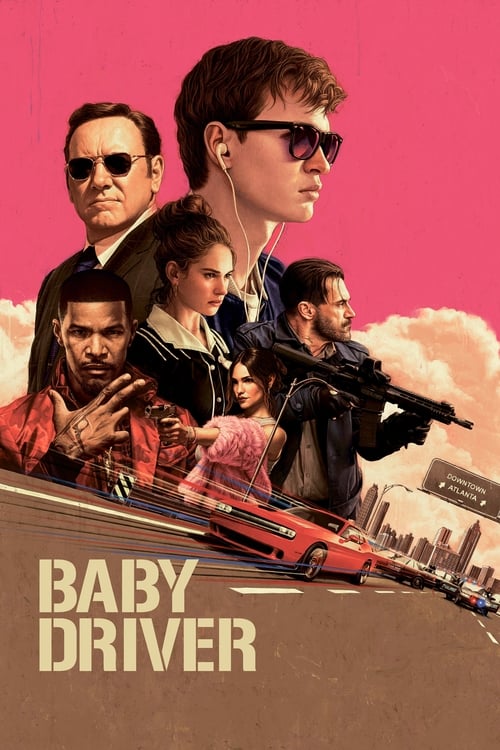
Baby Driver
2017 · Edgar Wright
For when you want a good time, full stop — date night, Friday night, any night you want to grin at a movie and leave humming. Comfort viewing with a pulse.
What it's about
Baby is a young getaway driver in Atlanta who drowns out the ringing in his ears by scoring his whole life to music — including the bank robberies he drives for a crime boss he can't walk away from. When he falls for a diner waitress and starts dreaming of getting out, he's pulled into one last job that smells wrong from the start.
The experience
Pure momentum — a sugar rush of chases, needle drops, and romance where every gunshot and gear change lands on the beat. It's funny, kinetic, and swooning, with real menace creeping in as the walls close.
The craft
The whole film is cut to its soundtrack — chases, shootouts, even a coffee run choreographed to the song playing in Baby's earbuds — with largely practical stunt driving underneath. It earned an Oscar nomination for its editing, and it absolutely demands good speakers.
Why it matters
Edgar Wright's biggest commercial hit and the modern showcase for music-driven action editing — proof a blockbuster could be built like a musical.
Snapshot
Baby Driver is Edgar Wright's fifth feature film and his most genre-committed work: a crime-musical in which every car chase, every shootout, and every stolen glance is choreographed to a song. Its central conceit — a getaway driver uses a rotating library of earworm tracks to drown out a tinnitus caused by a childhood trauma — is simultaneously narrative motivation and formal principle. The film is a love letter to the American action picture, a working experiment in pre-scored cinema, and a demonstration of the thesis that editing rhythm and musical rhythm are, at their best, the same thing. It was Wright's first solo writing credit since Shaun of the Dead (2004) and his most commercially successful picture, earning widespread critical acclaim and three Academy Award nominations, including Best Film Editing.
Industry & production
Baby Driver was produced by Working Title Films and Big Talk Productions — the latter the UK production company of producer Nira Park, Wright's collaborator across his entire career — with distribution by TriStar Pictures (Sony) in North America. Wright had been developing the concept for over a decade. The clearest documented origin point is a music video he directed in 2003 for the British act Mint Royale: "Blue Song" choreographs a criminal getaway sequence frame-perfect to a funky track, with the gang lip-syncing through the windshield of a stolen car. It is, in essence, a two-minute proof of concept for the feature that followed fourteen years later. By the time production began in 2016, Wright had also recently departed a high-profile Marvel assignment — he left Ant-Man in 2015 citing creative differences — and returned to more personal territory.
The film was shot on location in Atlanta, Georgia, a choice reflecting both production economics (Georgia's incentive regime had made the city a hub for studio filming throughout the decade) and genuine topographical suitability: the city's downtown grid, expressways, and parking structures offered varied chase terrain within a coherent urban geography. The reported production budget was approximately $34 million, modest by franchise action standards. The film grossed in the region of $226 million worldwide, a result that confirmed Wright's viability as a commercial auteur operating outside franchise structures.
The ensemble was assembled across registers that initially seem mismatched: Ansel Elgort, known from young-adult adaptations, as the taciturn title character; Lily James as the waitress who becomes his romantic anchor; Kevin Spacey, Jamie Foxx, and Jon Hamm representing successive tiers of criminal menace; Eiza González as Hamm's partner. The casting of Spacey has complicated the film's afterlife in promotional contexts following personal revelations that emerged after the film's release.
Technology
Baby Driver was photographed in anamorphic format by Bill Pope, Wright's returning director of photography from Scott Pilgrim vs. the World (2010). Pope's career is defined by technical precision in demanding action contexts — his work on the Wachowskis' Matrix trilogy established his reputation for marrying complex choreography to consistent visual grammar — and he brought the same exactitude to Baby Driver's vehicular sequences. The anamorphic frame suits the film's dominant compositional logic: wide, laterally organized shots that locate cars relative to each other and to the city, with the horizontal flare occasionally working as a punctuation mark.
The film's most consequential production commitment was its approach to the driving sequences. Rather than relying primarily on green-screen or motion-control process work, the production staged a substantial proportion of the vehicular action practically on Atlanta streets, with stunt drivers rehearsing sequences to the actual music tracks that would appear in the finished film. This produced the tightly timed cuts that give the chases their propulsive quality: the editing responds to the music because the driving was rehearsed to the music. The alignment between image and sound is not a post-production illusion but a planning achievement built into the material.
Technique
Cinematography
Pope's work on Baby Driver is fluid and disciplined without being conspicuous. The film's signature set piece arrives before a single plot point has been established: Baby walks through downtown Atlanta to retrieve coffee, moving in precise synchrony to "Harlem Shuffle" by Bob & Earl while Pope's camera tracks with him. Wright has documented that lyrics from the song appear written in graffiti on the walls Baby passes — environmental layering that rewards repeat viewing and exemplifies Wright's insistence on integrating all formal registers into a single coherent system.
The chase sequences are edited with a kinetic clarity that privileges spatial legibility over disorienting speed. The viewer generally knows where cars are relative to each other, to the street, and to the threat. This distinguishes Baby Driver from much contemporary franchise action, where rapid cutting is often used to generate an impression of velocity in the absence of spatial coherence. Pope's compositions, particularly in wider shots, maintain the cinematic scope of the anamorphic frame against the faster rhythms the music demands.
Editing
Jonathan Amos and Paul Machliss co-edited Baby Driver. Machliss had developed a sustained working relationship with Wright across multiple prior productions; Amos joined for this project. Their work on Baby Driver won the BAFTA for Film Editing and received an Academy Award nomination in the same category — recognitions that accurately locate the film's principal technical accomplishment.
The animating editorial principle is music-synchrony: cuts are timed to beats, downbeats, and transitions in the soundtrack with a precision not typical of action cinema. Where action editing is conventionally governed by dramatic logic or spatial continuity, Baby Driver's editing is governed by musical structure. The pre-score approach meant Amos and Machliss were working from the outset with fixed musical durations and rhythms — a constraint that functions creatively by eliminating the imprecision that typically accumulates in action sequences. Each cut arrives where the musical structure predicts it will, producing editing that reads as simultaneously exciting and formally resolved.
Mise-en-scène / staging
Wright's staging throughout Baby Driver is organized by the principle that character movement and environmental detail should be synchronized with sound. The coffee-walk sequence is the most explicit demonstration, but the principle extends into scenes of apparently lower stakes: background characters' gestures, camera movements, and even incidental sound effects align with musical downbeats in ways that create a subliminal sense of the world as rhythmically organized. This is the logic of the musical transferred without announcement into crime-film territory.
Wright's characteristic environmental density — license plates, background signage, and incidental graffiti carrying narrative significance — is present throughout. This density reflects a directorial intelligence that treats every frame as potentially meaningful, inviting close attention without requiring it. The staging is legible on first viewing and yields further layers on subsequent ones.
Sound
The film's sound design is its most formally ambitious dimension. Baby's tinnitus — the residue of a childhood car crash that killed his parents — is the narrative justification for his perpetual earbuds, but it is also a device that allows the film to interrogate the boundary between diegetic and non-diegetic sound. When Baby removes an earbud, the soundtrack does not simply mute; instead a high-pitched ring intrudes on the ambient sound, a reminder that what the viewer has been hearing is Baby's perceptual experience of the world, not neutral underscoring.
This diegetic instability sits in a tradition of films that explore subjective sound as a formal resource — 8½, the integrated numbers of Singin' in the Rain — though Baby Driver approaches the problem through trauma and tinnitus rather than dream or performance. The film's sound team received Academy Award nominations for both Sound Editing and Sound Mixing, recognizing the technical achievement of making this instability coherent across a feature-length runtime without disorienting the viewer or rupturing the film's tonal consistency.
Performance
Elgort's Baby is constructed around restraint: largely reactive, processing the criminal world around him with minimal dialogue and carefully legible but understated expression. The performance risks opacity, and the film partly manages the risk through the physical pleasure Baby takes in music — the joy of his synchronized movement generates sympathy before character-level motivation has been fully established. Jamie Foxx's Bats operates at the opposite extreme: volatile, menacing, given to sudden eruptions that generate threat in a narrative that might otherwise drift into genre nostalgia. Jon Hamm's Buddy tracks the film's tonal shift, beginning in a register of competent professionalism and modulating across the second and third acts into something considerably darker.
Narrative & dramatic mode
Baby Driver works in the idiom of the "one last job" crime narrative: a protagonist who wants out, a romantic possibility that crystallizes the desire to exit, a chain of escalating jobs that progressively forecloses escape routes. Wright's intervention is to use the musical frame as emotional amplification rather than ironic counterpoint. The pop songs Baby lives inside are not deployed to comment on the action; they are inhabited by it. The film takes seriously the proposition that music can function as a genuine survival mechanism for a traumatized person, and it does not hedge that proposition with irony.
The narrative concludes with Baby's imprisonment — a consequence the film declines to elide or soften — followed by a time-jump in which early release reunites him with Debora. This ending has attracted disagreement about its tonal register: genre concession, or earned optimism? The film's internal logic — that Baby's culpability is real but partial, and that consequence without hope is not the film's moral — inclines toward the latter reading.
Genre & cycle
Baby Driver is most precisely categorized as a musical-action hybrid: a crime film organized by the structural and tonal logic of the musical without deploying the musical's characteristic modes. No character sings. Within the action tradition, the film's most direct American antecedent is The Blues Brothers (1980), which is similarly organized by a musical logic and similarly features elaborate vehicular destruction in the service of a comedic-romantic premise. Wright has cited The Driver (Walter Hill, 1978) and Thief (Michael Mann, 1981) for the getaway driver archetype, and Vanishing Point (Richard C. Sarafian, 1971) for the American road mythos. The French New Wave — Godard's Bande à Part (1964), Demy's integrated musical worlds — provides a more oblique precedent for the permeable boundary between action and musical registers.
The resemblance to Nicolas Winding Refn's Drive (2011), which also features a taciturn getaway driver and a romantic rescue fantasy, has been noted frequently in critical contexts. The similarities reflect shared lineage — both films draw on the same tradition of minimalist crime heroes — rather than direct influence; Wright had been developing Baby Driver's concept since the early 2000s, well before Drive's production.
Authorship & method
Wright's authorial signature involves a consistent set of principles across his career: dense environmental layering, editing as the primary expressive instrument, genre deconstruction conducted from inside the genre rather than at ironic distance, and an unusual degree of pre-visualization. Baby Driver applies these principles at a more earnest emotional pitch than the Cornetto trilogy's genre comedies; there is no satirical gap between Wright and his material here, no protective distance from the conventions being invoked.
The music-first production method is the most documented aspect of Wright's authorial approach on this project. He locked the soundtrack before principal photography, allowing the choreography, editing structure, staging, and stunt work to be organized around fixed musical durations. This inverts the conventional post-production placement of music and elevates the curator to the top of the creative hierarchy — all other departments interpret a pre-existing musical logic. Nira Park, as producer across Wright's career, has been the institutional continuity that makes this kind of extended pre-production investment possible.
Movement / national cinema
Wright is a British filmmaker working emphatically within American genre conventions — the getaway film, the freeway chase, the Southern urban crime picture — shot in an American city with a predominantly American cast. Baby Driver is not a British film in any meaningful industrial or cultural sense. Yet Wright's relationship to American genre cinema has something of the British cinephile's encyclopedic affection: appreciative, precise, slightly external. This is a consistent characteristic of his post-Cornetto work; Scott Pilgrim (2010) was similarly saturated in North American pop culture as seen through a foreign sensibility capable of loving the form while gently systematizing it.
Era / period
Baby Driver was released at a moment when the mid-budget theatrical original was under genuine commercial pressure from franchise extensions and, increasingly, from streaming platforms. The film's commercial success — a substantial worldwide gross on a relatively modest budget — was widely read as evidence that original, non-IP action could still work theatrically when executed with sufficient craft and personality. It was released shortly before streaming-accelerated disruption of theatrical distribution became acute, and it represents something close to a final high-water mark for the mid-budget studio original achieving wide theatrical release on its own terms.
Themes
Music as psychic shelter. Baby's tinnitus and his use of music to contain it literalize a more general human use of music as emotional regulation. The film takes this as a genuine thematic proposition, not an ironic comment on consumer soundtrack culture.
Complicity and innocence. Baby is the most passive participant in the crimes depicted — he drives; he does not plan or injure — but the film declines to allow passivity to constitute innocence. His choice to participate, however constrained by Doc's leverage, forms the film's moral center, and his imprisonment is framed as appropriate rather than unjust.
Escape and the American road. Baby's fantasy is elementary: a car, a girl, an open road, a horizon. The film measures the distance between that fantasy and the closed loop of criminal obligation, and it ends by suggesting, with cautious optimism, that the fantasy is not permanently inaccessible.
Reception, canon & influence
Baby Driver received strong critical acclaim on release, with reviewers consistently praising its formal integration of sound and image, its kinetic precision, and the refreshing directness of its genre pleasures. The film received three Academy Award nominations — Film Editing, Sound Editing, and Sound Mixing — and won the BAFTA for Film Editing. It appeared widely in year-end critical consensus lists for 2017.
Looking backward, the film's debts are legible and largely acknowledged: the driver minimalism of Hill and Mann, the music-action integration of Landis, the American road myth, the innocent-abroad crime narrative. The Mint Royale music video is the most explicit antecedent, a documented self-quotation spanning fourteen years.
Looking forward, Baby Driver's influence on action filmmaking is real but diffuse and difficult to attribute cleanly. Its demonstration that music-synchronized action could sustain a feature-length commercial film has become absorbed as general knowledge rather than generating an explicit wave of direct imitators — a form of influence that is the more durable for being assimilated rather than imitated. The Amos-Machliss editing template has become a reference point in discussions of action editing craft, and their BAFTA recognition formalized an approach that had not previously received that level of industry acknowledgment. Wright's subsequent film, Last Night in Soho (2021), moved toward horror territory, suggesting an ongoing evolution rather than consolidation; Baby Driver remains, within his filmography, the most formally unified marriage of his characteristic method to a genre that required no ironic mediation to inhabit.
A Deleuzian reading
Before you know a single thing about him, Baby goes to get coffee.
The full Deleuzian reading of Baby Driver →
Reception
A critical and box-office darling in summer 2017 — the rare original studio hit — its afterlife got complicated fast: the Kevin Spacey scandal broke months after release, and later allegations against Ansel Elgort left fans renegotiating their relationship with it.
How Baby Driver was received, from release to now →
Influences: the films it descends from and the films it influenced
- Singin' in the Rain (1952) — Every number was filmed to pre-recorded playback tracks locked before shooting, requiring camera movement, choreography, and cutting to be built around fixed musical durations — the industrial prototype for Wright's music-first production method.
- Bullitt (1968) — Yates shoots the San Francisco chase with real vehicles and camera positions prioritizing spatial comprehension over visual excitement, establishing practical stunt driving and geographic legibility as the aesthetic ground of the American car-chase film that Baby Driver claims as its legitimating tradition.
- The French Connection (1971) — Friedkin mounts a camera on the car and shoots at real speeds through live New York traffic, establishing the realist aesthetic — genuine danger, real geography, no process shots — that Baby Driver's practical stunt work inherits.
- American Graffiti (1973) — Wolfman Jack's unbroken AM radio broadcast provides a continuous pre-existing musical program that organizes episodic structure and crosscutting — the first major American film to use a curated licensed-music soundtrack as the film's structural spine rather than a composed score.
- The Driver (1978) — Hill's protagonist speaks almost no dialogue across the entire film, communicating exclusively through driving skill; Wright inherits this grammar of vehicular expressivity and driver-as-cipher for Baby's minimalist performance register.
- À bout de souffle (1960) — Godard's jump-cut technique makes the edit itself rhythmically expressive rather than invisible, establishing that continuity can be violated in ways that create pulse — Wright's cut-on-beat method is the musical formalization of this principle applied to genre cinema.
- Bande à part (1964) — The Madison dance sequence inserts three characters performing synchronized choreography in a café without generic justification — crime film absorbing musical-film vocabulary without explaining itself, the structural precedent for Wright's genre fusion.
- The Blues Brothers (1980) — Landis integrates live musical performance directly into action set-pieces, organizing car chases around diegetic numbers rather than scored underscore — establishing that spectacular action and pop-music performance can be simultaneous rather than alternating.
- Thief (1981) — Tangerine Dream's synthesizer score pulses continuously beneath action and dialogue alike, refusing classical silence-as-neutral-ground — the score as environmental texture rather than punctuation, a mode Baby Driver's subjective soundscape develops.
- Streets of Fire (1984) — Hill explicitly frames the film as 'a rock and roll fable,' staging action sequences around live rock performance and using the concert format as both narrative engine and generic container — the Hollywood precedent for Wright's action-musical hybrid.
- Reservoir Dogs (1992) — K-Billy's radio broadcast simultaneously constitutes diegetic source music and ironic score during the ear-cutting sequence, collapsing the diegetic/non-diegetic distinction in a way Baby Driver systematizes across an entire feature.
- Scott Pilgrim vs. the World (2010) — Wright develops his cut-on-sound method in pre–Baby Driver form: diegetic band performances determine the rhythm of action editing, and sound effects function as musical punctuation — testing the music-picture synchrony that Baby Driver unifies into a seamless system.
- Atomic Blonde (2017) — Leitch builds action sequences around era-specific licensed tracks used as both period signifier and action accompaniment, applying the music-as-structural-spine logic to Cold War thriller choreography and extending the template Wright formalized the same year.
- Last Night in Soho (2021) — Wright applies his pre-score method to horror: period pop songs function as psychological trigger mechanisms activating temporal instability, converting Baby Driver's diegetic-nondiegetic blur from an action device into a horror device that signals subjective breakdown.
- The Running Man (2025) — The music-lock pipeline — action choreographed to a pre-recorded track at previs and Paul Machliss cutting live on set — is the same apparatus that drives the countdown structure's metrically exact cutting.
- Drive (2011) — Refn's taciturn near-nonverbal driver inherits the same driver-as-cipher grammar as Hill's, and his use of Kavinsky and Chromatics as punctuating non-diegetic interludes represents a contemporaneous alternative solution to the music-action integration problem Baby Driver solves differently.
- Whiplash (2014) — Chazelle edits jazz performance sequences at beat-level precision, cutting between instruments and faces in exact synchrony with the musical pulse — applying the same music-locked editing method Baby Driver uses for action to interiority and psychological pressure.
- La La Land (2016) — Chazelle stages original musical numbers using pre-recorded playback in a contemporary dramatic film otherwise obeying naturalistic register, achieving the same generic-hybrid form — dramatic film containing musical-film conventions — as Baby Driver by independent means.
- Kingsman: The Secret Service (2015) — Cuts action to the diegetic beat as dramaturgical source music, the same sound-driven editing logic that syncs Kingsman's violence to its track choices.
- Kingsman: The Golden Circle (2017) — Pushes the ironic needle-drop further by cutting and choreographing every action beat to the precise rhythm of its pop soundtrack.
- Ambulance (2022) — Sibling LA-adjacent heist-chase that fuses cutting rhythm to a driving score — a music-locked editing approach kin to Balfe's momentum-engineered electronic-orchestral track.
- Guardians of the Galaxy Vol. 3 (2023) — Action choreographed and cut precisely to a character's curated playlist — the maximalist extension of building set pieces around diegetic pop music.
- Sound of Metal (2020) — Renders a character's tinnitus as a persistent sound-design motif woven into the edit, tying subjective hearing damage directly to the film's rhythmic cutting.
- Guardians of the Galaxy (2014) — Pushes music-locked cutting to its limit, editing every action beat in precise sync to pre-selected pop tracks — the logical extreme of Gunn's write-the-songs-into-the-script approach.
- Guardians of the Galaxy Vol. 2 (2017) — Action and cutting synchronized frame-precise to a diegetic pop-song mix, opening on a music-driven set-piece — a formal cousin to Baby Groot's dance over the title fight.
- The Gentlemen (2020) — Paul Machliss's method — cutting live on set to a locked rhythmic track so performance and camera are edited during the take — carries directly into The Gentlemen's beat-precise interruption-and-restaging cuts inside Fletcher's pitch.
Similar films
- Drive (2011) — influence & lineage
- The Driver (1978) — influence & lineage
- Whiplash (2014) — influence & lineage
- La La Land (2016) — influence & lineage
- Hot Fuzz (2007) — shared sensibility
- Good Time (2017) — shared sensibility
- Tuner (2026) — shared sensibility
- Birdman or (The Unexpected Virtue of Ignorance) (2014) — shared sensibility
All the films related to Baby Driver →