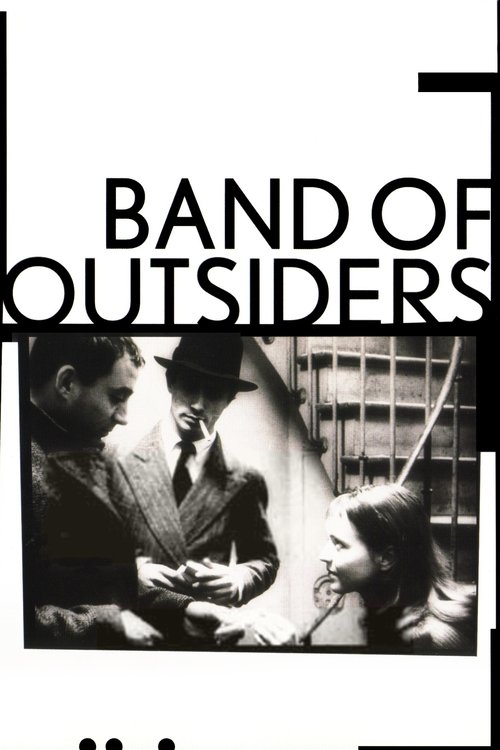
Band of Outsiders
1964 · Jean-Luc Godard
For when you want charm over plot — a stylish, low-stakes evening for falling in love with movies themselves. Great with coffee or wine, alone or with someone you want to impress.
What it's about
Two movie-mad Parisian slackers, Franz and Arthur, compete for the affection of Odile, a shy young woman who mentions that the house where she lodges holds a pile of unguarded cash. The three drift toward an amateur robbery, but the film keeps getting gloriously distracted — a dance in a café, a dash through the Louvre, English lessons, rain-slicked streets — because the detours are the point.
The experience
Playful, wistful, and effortlessly cool — a crime movie that would rather flirt, dance, and daydream than get to the crime. It's light on its feet with a melancholy undertow, and it makes you fall in love with Paris in winter.
Performances
Anna Karina is luminous as Odile — awkward, funny, and heartbreaking, often all in the same shot; the café dance alone is one of cinema's most stolen moments.
The craft
Godard toys with the medium at every turn — a narrator who talks over his own story, a literal minute of imposed silence, a choreographed dance number dropped into a heist picture — all in gorgeous wintry black and white. Its inventions feel casual, which is the trick.
Why it matters
One of the most beloved and imitated films of the French New Wave, its dance scene and Louvre sprint echoing through decades of later filmmakers who wear its influence proudly.
Snapshot
A crime film that refuses to behave like one, Band of Outsiders (Bande à part) follows two young men — Franz (Sami Frey) and Arthur (Claude Brasseur) — and the object of their competing desires, Odile (Anna Karina), through a Paris of rain-slicked streets, English-language classes, and daydreams about American gangsters. The three hatch a half-hearted plan to rob the house where Odile lodges with her aunt, who is rumored to have a cache of cash. The heist, when it comes, is fumbling and lethal. Everything interesting happens along the way: an improvised café dance, a sprint through the Louvre, a literal minute of silence imposed on the soundtrack by the director himself. Godard described the film at the time as something like a novel by Série noire paperback standards — nimble, popular, unashamed of its pleasures. That combination of genre accessibility and formal audacity has made it, across sixty years, one of the most imitated and beloved artifacts of the French New Wave.
Industry & production
The film was produced by Godard's own company, Anouchka Films — named after Anna Karina's nickname — in partnership with Orsay Films. The budget was lean even by New Wave standards, and the production schedule was rapid, typical of Godard's working method in his early-sixties peak. The screenplay was adapted from Dolores Hitchens's American crime novel Fools' Gold (1958), part of the Série noire tradition of hard-boiled American fiction that Godard and his Cahiers du cinéma contemporaries had consumed throughout the 1950s. Godard translated the California source material to the Parisian suburb of Joinville-le-Pont and to the city's streets and institutions, reshaping the plot to accommodate digressions, dance breaks, and metaleptic voiceover. The shoot unfolded in roughly chronological order across Paris and the near suburbs, keeping costs low through location work and available-light cinematography. The casting was partly personal: Karina was then Godard's wife, and her presence — luminous, slightly bewildered — inflects every scene she inhabits.
Technology
Band of Outsiders was shot in 35mm black and white on fast film stock, allowing Raoul Coutard to work with natural and available light in bars, apartments, and the corridors of the Louvre. The use of sensitive emulsions — a signature of the New Wave's pragmatic rejection of studio lighting rigs — produces the grain and contrast that give the film its documentary texture even in moments of studied artifice. The Éclair Cameflex and related cameras favored by the New Wave offered the mobility for handheld street shooting and the nimble repositioning the Louvre sequence demands. No proprietary technology distinguishes the production; the achievement is craft and eye rather than equipment innovation.
Technique
Cinematography
Coutard's work here is deliberately deflating in the best sense. He photographs Paris without glamorizing it — the cafés are fluorescent-lit and plain, the suburban streets are wet and undistinguished — so that when the characters inject their cinematic fantasies into these spaces, the gap between dreaming and reality becomes the film's visual subject. The camera moves with the characters rather than around them, and the handheld passages have an improvised quality that was already a Coutard and Godard trademark. The Louvre sequence is a notable set piece: the camera must track three running figures through one of the world's most surveilled buildings, and Coutard handles it with practical urgency. The depth of field, the framing of faces in medium close-up, and the willingness to let characters drift partially out of frame all serve the film's anti-spectacular sensibility.
Editing
Agnès Guillemot edited the film, working closely with Godard's characteristic loose approach to the cut. Where Breathless deployed the jump cut as an aggressive formal manifesto, Band of Outsiders uses discontinuity more softly — gaps in time, elisions of action, abrupt transitions between scenes that treat narrative continuity as a convenience rather than a law. The editing rhythm is responsive to the film's tonal shifts: brisk in the crime plot, lingering in the dance, and precisely timed around Godard's voiceover interpolations, which arrive as post-production additions that reframe what the image shows without explaining it.
Mise-en-scène / staging
The film's most celebrated sequence of mise-en-scène is also its most influential: the Madison dance in the café on the rue de Rivoli. Franz, Arthur, and Odile abruptly rise from their table and dance together, Godard cutting the ambient soundtrack — the noise of the café, the sound of other patrons — so that the three figures move through a silence punctuated only by Michel Legrand's score. The staging is casual and entirely unsentimental about its own charm; the trio are not performing for the camera so much as performing for each other and for a private mythology of American popular culture. The Louvre run is a complementary set piece: the three attempt to race through the museum and beat a previously established tourist speed record, and Godard tracks them with a newsreel-like urgency that makes the grandeur of the institution absurd against their breathless, giddy nihilism. The minute of silence — Arthur proposes it, and Godard obliges by cutting the entire soundtrack — is perhaps the most extreme gesture of the film's mise-en-scène, an act of theatrical emptying that reminds the viewer of the artifice sustaining every other moment.
Sound
Michel Legrand's score is jazzy, airy, and deceptively sweet — it romanticizes the three protagonists while the plot is quietly undermining them. Legrand had collaborated with Godard on A Woman Is a Woman (1961) and My Life to Live (1962), and the partnership produced a musical idiom that is emphatically non-diegetic in its commenting function: the music arrives and departs in mid-scene, emphasizing emotional temperature rather than dramatic continuity. Godard's use of silence — most dramatically in the literal soundtrack shutdown — treats sound design as an editorial instrument of the same order as the cut. The voiceover is delivered in Godard's own voice, dry and slightly nasal, offering interior monologue in the third person and occasional narrative stage directions. The effect is literary in a way that distances the viewer from emotional identification while paradoxically making the characters more vivid by speculating openly about their inner lives.
Performance
The three leads operate in an idiom that is somewhere between natural behavior and stylized attitude. Karina's Odile has the quality Godard consistently drew from her in this period: an unforced melancholy behind apparent brightness, a sense that the character is performing accessibility while remaining deeply private. Brasseur's Arthur is the film's most purely genre-typed figure — cocky, dim, fatally romantic about his own outlaw self-image — and Brasseur plays him with a physicality that is almost all surfaces. Frey's Franz is more introverted, more literary, and Frey finds in him a kind of helpless sincerity that the film treats with unusual tenderness. None of the three perform in the theatrical manner of conventional French cinema of the period; the style owes more to Godard's admiration for actors who seemed to inhabit rather than deliver their lines.
Narrative & dramatic mode
The film's plot is borrowed from a pulp novel but its narrative mode is resolutely literary and essayistic. Godard's voiceover does not advance the story so much as annotate it, offering the characters' interior states in a register borrowed from the nineteenth-century novel and filtered through the Série noire. The heist plot provides the structural skeleton, but the film's actual subject is the gap between how Franz and Arthur imagine themselves — as American movie gangsters — and what they are: bored, aimless young Parisians acting out. The narrative is organized around digression rather than complication; the dance, the Louvre run, and the silence are not obstacles or developments but episodes in a picaresque that happens to end in violence. The ending, including a brief text announcing Odile and Franz's departure for Latin America, reads as both genre convention and self-conscious farewell, a pastiche of the happy ending that the preceding events have made impossible to take straight.
Genre & cycle
Band of Outsiders occupies the intersection of the crime film, the romantic comedy, and the New Wave essay film. It belongs to a cluster of early-sixties French films that used the American gangster picture as raw material for formal experimentation: Jean-Pierre Melville's Bob le Flambeur (1956) is a key precedent, and Godard's own Breathless (1960) had already established the template of the doomed American-influenced outlaw in Paris. Where Breathless pursued that premise with existential weight, Band of Outsiders is more playful and more openly melancholic about its genre borrowings. The characters know they are imitating movie archetypes; the film knows they know; and the resulting doubling gives the crime plot a permanent quality of unreality. Within the New Wave corpus, the film also belongs to the cycle of Godard's early works centered on Karina, which include A Woman Is a Woman, My Life to Live, Le Mépris, and Pierrot le fou — a loosely linked body of work exploring female interiority and male romantic projection.
Authorship & method
Godard's authorship over this film is total in the sense of control and partial in the sense of collaboration. The screenplay is his adaptation, the voiceover his voice, the conceptual gambits his invention. But Coutard's cinematography is not merely technical execution; his eye shapes what the film looks like as profoundly as any directorial decision. Legrand's score is an independent aesthetic layer that Godard integrates but does not absorb — the music has its own charm and sophistication. Guillemot's editing shaped the film's rhythm in post-production under Godard's supervision. Anna Karina's performance, which was for Godard both a creative resource and a personal relationship, gives the film its emotional anchor in ways that no amount of directorial intention could manufacture from outside. The film is, in this sense, a collaborative document that Godard's authorship organizes rather than simply produces.
Movement / national cinema
Band of Outsiders is a central text of the French New Wave — the movement associated with Godard, François Truffaut, Claude Chabrol, Éric Rohmer, and Jacques Rivette that emerged from the critical culture of Cahiers du cinéma in the late 1950s and remade French cinema by the mid-1960s. The movement's shared commitments — location shooting, small budgets, stylistic self-consciousness, engagement with American popular culture, the auteur as primary creative agent — are all present in concentrated form. The film also belongs to the specifically Parisian strand of New Wave work: the city is a character, its streets and institutions carrying meaning and texture that studio production could not have replicated. As a national cinema document, it captures a particular Parisian youth culture of the early 1960s — Anglo-American music, genre-paperback dreams, café idleness — that the New Wave both observed and helped construct.
Era / period
The film was made and released in 1964, the middle of the New Wave's most productive decade and a transitional moment in French cultural history. The Algerian War had ended in 1962; France was prosperous, modernizing, and culturally restless. The generation of the characters — young, underemployed, saturated with American movies and music — would, within four years, explode into the events of May 1968. Band of Outsiders looks back at this pre-1968 moment with an innocence that is already contaminated by knowledge of how such games end: someone always gets hurt when amateurs play at crime. The mid-sixties also marks the moment when the New Wave's formal innovations were beginning to be absorbed internationally, and Band of Outsiders sits at the point of maximum influence — radical enough to be genuinely original, accessible enough to be imitable.
Themes
The film is organized around a set of recurring preoccupations that Godard returns to throughout his early career. The most visible is the relationship between American popular culture and French experience — the way that Hollywood movies and pulp novels have colonized the imagination of young Europeans who have no direct access to the myths those forms traffic in. Franz and Arthur do not merely like gangster films; they model their behavior, their postures, and their aspirations on them, with fatal results. The film is also about romantic projection: Arthur and Franz project onto Odile a desire she neither fully shares nor entirely refuses, and the film is quietly sympathetic to her position without making her a victim. Alienation, class (the money in the house, the English lessons, the sense of a world just out of reach), and the unreliability of language — characters say things they do not mean, withhold things they feel — are persistent minor themes. At its core, the film asks what it costs to live inside a borrowed mythology, and whether the borrowed life can be distinguished from any other kind.
Reception, canon & influence
Critical reception and backward influences. Upon release, Band of Outsiders received respectful but not ecstatic notices; it was seen as minor Godard relative to Breathless and My Life to Live, a lighter entertainment from a filmmaker associated with gravity. Its critical reputation has climbed steadily since. Contemporary scholarship treats it as one of Godard's most fully achieved films precisely because of its lightness — it does not strain for significance, which makes its moments of genuine feeling more forceful. The influences the film absorbs are transparent: American film noir and B-movie crime from the 1940s and 1950s; the Série noire novels (translated into French in mass-market paperbacks) that Godard's generation consumed compulsively; Melville's French reworking of noir; the nouvelle vague critical revaluation of Hollywood directors including Howard Hawks, Samuel Fuller, and Nicholas Ray; and the neo-realist precedent for location shooting and nonprofessional-adjacent performance.
Legacy and forward influence. The film's downstream effect on world cinema is disproportionate to its modest scale. Quentin Tarantino named his production company A Band Apart after it — an explicit act of homage — and the Madison dance sequence is the acknowledged antecedent of the twist contest in Pulp Fiction (1994). The café dance, more broadly, has become a touchstone for any filmmaker wishing to invoke spontaneous group pleasure and cinephile self-awareness simultaneously; its echoes appear in music video culture, in independent American cinema of the 1990s, and in European art cinema across several generations. The Louvre run has been referenced, remade, and parodied repeatedly, becoming a cultural shorthand for irreverence toward institutional high culture. Wim Wenders, Jim Jarmusch, and Whit Stillman have all acknowledged the film's formal and tonal influence; its combination of romantic melancholy, genre pastiche, and formal playfulness describes a mode of filmmaking that has outlasted both the New Wave and any single national context. The Criterion Collection release cemented its canonical status in the anglophone film-culture sphere. What the film invented — or concentrated into a newly usable form — is the possibility of a crime picture that is primarily a meditation on the desire for cinema itself.
A Deleuzian reading
Three kids get up from a café table on the rue de Rivoli and dance.
The full Deleuzian reading of Band of Outsiders →
Reception
A commercial disappointment on release — even Godard called it a minor work — it has since become the consensus 'gateway Godard': the warm, playful one people recommend before the difficult stuff.
How Band of Outsiders was received, from release to now →
Influences: the films it descends from and the films it influenced
- Breathless (1960) — Coutard's hand-held fast-stock 35mm cinematography and the Série noire genre frame are both directly inherited; where Breathless uses the jump cut as aggressive rupture, Band of Outsiders refines it into softer elliptical gaps that treat narrative continuity as optional.
- My Life to Live (1962) — Anna Karina's luminous, partly opaque screen presence and Godard's interpolated third-person literary voiceover — a narrator who comments on characters without inhabiting them — migrate unchanged into Band of Outsiders.
- Shoot the Piano Player (1960) — Truffaut's adaptation of an American Série noire novel into French location shooting established the New Wave formula Band of Outsiders refines: hard-boiled genre frame used as pretext for tonal digression, romantic fatalism, and jokes at genre's own expense.
- Bob le Flambeur (1956) — Melville's unglamorous Montmartre heist film shot on Paris locations with available light is the direct pre-New Wave model for treating American Série noire mythology through French streets rather than studio artifice — the template the Cahiers generation absorbed before Godard remade it.
- Chronicle of a Summer (1961) — Rouch and Morin's cinéma vérité practice — available light, lightweight camera mobility, direct sound in real Parisian locations — is the documentary template Coutard synthesized into Band of Outsiders' fiction-film texture and anti-spectacular visual idiom.
- Hiroshima Mon Amour (1959) — Resnais's use of temporal ellipsis as structural principle rather than continuity error, and the literary voiceover that reframes image without narrating it, establishes the essayistic mode Godard adapts into his narrative interpolations and the minute-of-silence gesture.
- Bonnie and Clyde (1967) — Dede Allen's discontinuity editing — cutting on movement, omitting transitional beats, using pop-music montage — imports the New Wave's elliptical continuity into American genre cinema, and the romanticized outlaw mythology echoes Band of Outsiders' use of Série noire as borrowed self-image.
- Badlands (1973) — Sissy Spacek's third-person literary voiceover narrates characters who mythologize themselves through movie-star outlaw imagery, directly descending from Godard's Band of Outsiders narrator who frames Franz and Arthur through the same borrowed Série noire fantasy.
- Mean Streets (1973) — Scorsese absorbed Godard's available-light location shooting and deploys pop-music dance sequences as formal punctuation within a crime film, replicating the structural move Band of Outsiders crystallized with the Madison sequence.
- Chungking Express (1994) — Christopher Doyle's available-light handheld cinematography deliberately channels Coutard's unglamorous texture, and Wong Kar-wai's elliptical time-gaps and popular-song punctuation within criminal romance digression are direct structural descendants of Band of Outsiders' formal method.
- Pulp Fiction (1994) — Tarantino staged the Mia/Vincent twist-contest as an explicit re-enactment of the Madison café dance — deadpan couple dance in a diner as the film's formal pivot — and named his production company 'A Band Apart' in direct homage to Godard's original title.
- The Dreamers (2003) — Bertolucci explicitly re-enacts the Louvre sprint within a film about three young people inhabiting borrowed cinematic mythology, making Band of Outsiders' most celebrated set piece a literal quotation and subjecting its cinephilic rapture to retrospective irony.
- La Chinoise (1967) — Godard first deploys his own voice-over interrupting the diegesis mid-scene—narrating the Madison dance over his characters, addressing the audience directly above their heads—originating the authorial-voice-intervention device that La Chinoise radicalizes into systematic Brechtian political commentary.
- The Royal Tenenbaums (2001) — Godard's chapter-title intertitles and his staging of characters who perform theatrical gestures for the camera rather than inhabit space naturalistically — the Louvre sprint, the café dance — are formal antecedents to Anderson's anti-naturalist blocking in which actors face the lens more often than they face each other.
- Inglourious Basterds (2009) — Godard's technique of constructing scenes as genre performances — dialogue and behavior that cite American genre conventions as love-letter quotation rather than naturalistic action — is the model for IB's chapter structure in which each set piece functions as tribute to a specific cinematic tradition.
- Days of Being Wild (1990) — The Madison dance sequence — characters performing an impromptu popular dance cut against diegetic silence and period music — directly prefigures the staging logic and emotional irony of Leslie Cheung's mirror solo dance.
- Tokyo Drifter (1966) — The choreographed Madison dance sequence — genre characters spontaneously performing a pop routine that halts narrative causality — is the direct structural template for Suzuki's interpolation of diegetic musical performance into crime-genre action, treating the ballad as formal punctuation rather than emotional accompaniment.
- Baby Driver (2017) — The Madison dance sequence inserts three characters performing synchronized choreography in a café without generic justification — crime film absorbing musical-film vocabulary without explaining itself, the structural precedent for Wright's genre fusion.
- A Woman Is a Woman (1961) — The Karina/Legrand/Coutard creative triangle is identical to Band of Outsiders; both films use a deadpan café dance staged with flat artifice — the tarantella here, the Madison there — as the film's formal and emotional pivot.
- Lola (1961) — Demy uses unglamorous Nantes location shooting with available light and a Série noire-adjacent romantic crime plot as pretext for formal digression, working the same New Wave idiom as Band of Outsiders without Godard's metaleptic self-commentary.
- Alphaville (1965) — Coutard photographs contemporary Parisian hotels and offices as noir-generic dystopian space using available light alone — the identical approach to treating real French locations as vessels for borrowed American genre mythology that defines Band of Outsiders' Paris.
- Ocean's Twelve (2004) — Template for New Wave hangout-comedy crime — characters loitering and goofing between the mechanics of a caper, tone privileged over plot.
- Masculin Féminin (1966) — Adjacent Godard-Guillemot-Léaud-circle youth film sharing the digressive episodic structure, café staging and the famous distancing direct-address interruptions.
Similar films
- A Woman Is a Woman (1961) — influence & lineage
- Breathless (1960) — influence & lineage
- Bob le Flambeur (1956) — influence & lineage
- Shoot the Piano Player (1960) — influence & lineage
- Alphaville (1965) — influence & lineage
- Bonnie and Clyde (1967) — influence & lineage
- Pierrot le Fou (1965) — same viewing thread
- Vivre Sa Vie (1962) — same viewing thread
All the films related to Band of Outsiders →
Watch it with: curated runs of related films
- Adrift in the Modern World — Watch these when you want to drift through postwar Rome and Paris alongside people who have everything and feel nothing — they rhyme on beautiful boredom, aimless days, and a search for meaning that modern comfort keeps failing to supply.