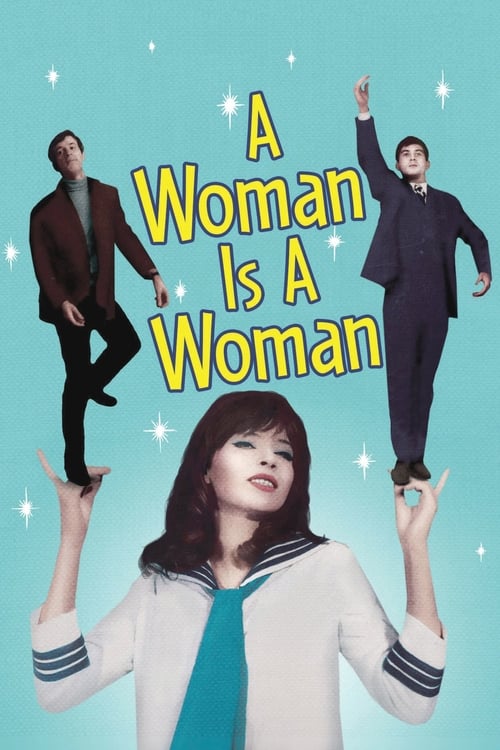
A Woman Is a Woman
1961 · Jean-Luc Godard
For when you want Paris, primary colors, and mischief — a stylish, short, endlessly charming date-night pick for anyone curious about the French New Wave but wanting its most purely pleasurable door in. Comfort viewing with an experimental sparkle.
What it's about
Angéla, a stripper in a small Paris club, wants a baby — now, tonight. Her boyfriend Émile refuses, so she threatens to have one with his best friend Alfred instead. From this slender lovers' quarrel comes a playful, color-drenched almost-musical: a film that keeps yearning to burst into song and dance and keeps puckishly declining to.
The experience
Light on its feet and constantly surprising — winking, flirtatious, gag-filled, and then suddenly, briefly, genuinely wounded. It's a movie in love with movies, and its jokes about its own artifice sit right next to real romantic hurt; it can flip from farce to ache within a single cut.
Performances
Anna Karina is the whole show — radiant, funny, and quicksilver, mugging for the camera one moment and quietly breaking your heart the next. The film is openly a valentine to her, and she earns every frame of it.
The craft
Godard's first feature in color and CinemaScope, and he plays the format like an instrument: saturated reds and blues, music that starts and stops mid-scene, characters who nod to the audience. It's an experiment disguised as a romantic comedy — a film about the musical rather than a musical — and it looks gorgeous on a big screen.
Why it matters
A pivotal French New Wave work marking Godard's leap from ragged monochrome to self-aware color spectacle, and the film that made Anna Karina the movement's iconic face. Its rule-breaking play with genre and artifice echoes through decades of self-aware romantic comedy.
Snapshot
A Woman Is a Woman (Une femme est une femme) is Jean-Luc Godard's giddy, aching valentine to the Hollywood musical — a film that yearns to burst into song and dance and then, again and again, declines to. Angéla, a stripper in a Paris club, wants a child now; her lover Émile refuses; she threatens to have one with his friend Alfred. From this slender domestic quarrel Godard builds a color-and-CinemaScope experiment that runs the emotional register from farce to genuine hurt within a single cut. It is the director's first feature in color and widescreen, his first sustained collaboration with Anna Karina (whom he married around this period and who is the film's radiant center and its subject), and a pivotal document of the French New Wave's turn from the ragged monochrome of Breathless toward saturated, self-aware artifice. Godard reportedly described it, in one of his characteristic paradoxes, as a "neorealist musical" — a contradiction in terms that is exactly the point. The film matters because it demonstrates, early and brilliantly, that the New Wave's freedom was not only a matter of shooting in the street with available light but of dismantling and reassembling genre itself in full view of the audience.
Industry & production
The film was produced by Georges de Beauregard, the producer behind Breathless and much of early Godard, in partnership with the Italian producer Carlo Ponti (Rome-Paris Films). This Franco-Italian arrangement was typical of the era's co-production economics, which pooled capital and secured distribution across two markets, and it gave Godard access to resources — color stock, anamorphic widescreen — well beyond the shoestring of his debut. The picture came at a hinge moment in Godard's career and in the New Wave's fortunes: Breathless (1960) had been a critical and commercial breakthrough, while his second feature, Le Petit Soldat (shot 1960), had been banned by French censors over its treatment of the Algerian War and would not be released until 1963. A Woman Is a Woman, therefore, functioned in part as the film that kept Godard's momentum alive with audiences after the censorship blockage. The reliance on a bankable young cast — Karina, Jean-Claude Brialy, and Jean-Paul Belmondo, the last fresh from Breathless stardom — reflects the commercial calculation underlying even Godard's most playful work. Precise budget and box-office figures are not something I can state with confidence, and I will not invent them; the film is generally understood to have been a modestly scaled production rather than a hit on the order of Breathless.
Technology
This was Godard's first encounter with two technologies that would reshape his image-making: color and the anamorphic wide screen. It was shot on Eastmancolor stock in a CinemaScope-type format (Franscope, the French anamorphic system in common use at the time). Both choices are deeply ironic in Godard's hands. Widescreen and Technicolor-era color were the tools of exactly the Hollywood spectacle — the MGM and Fox musical — that the film pastiches, and Godard adopts their grammar while draining it of its usual smoothness. Where the studio musical used scope to organize dance in deep, balanced friezes, Godard uses it to isolate figures against big blocks of primary color and to leave conspicuous empty space. The production remained committed to New Wave methods within these richer means: much was shot on location and in a real apartment set, retaining the sense of lived Parisian space that distinguishes the film from its studio-bound models even as it quotes them.
Technique
Cinematography
Raoul Coutard, Godard's essential cameraman of the 1960s, shot the film, and it stands as one of the great early demonstrations of how the New Wave could make color and scope feel handmade rather than industrial. Coutard's palette leans into bold, primary reds and blues — Karina's costumes, the café and apartment interiors — recalling the comic-strip vividness Godard would push further in Pierrot le Fou. The camera is restless and self-conscious: it pans across the apartment to follow domestic combat, it holds long takes that let performance breathe, and it repeatedly acknowledges its own presence. Coutard's willingness to work fast, with relatively lightweight equipment and a tolerance for imperfection, is what allowed the film's spontaneity to survive the move into a more elaborate format.
Editing
The editing — credited, as on many Godard features of the decade, to Agnès Guillemot (I state this on the strength of her long association with Godard's early-sixties work; treat the specific credit as attribution rather than certainty) — is where the film's musical impulse is most radically frustrated and expressed. Cuts are used as punctuation and as jokes: sound bridges start and stop abruptly, Legrand's score swells as if to launch a number and is then guillotined by a cut to silence. The result is a rhythm that mimics the anticipation of a musical number without the fulfillment, so that the audience feels the withheld song as a structuring absence. This discontinuity is continuous with the jump-cut logic Godard pioneered in Breathless, here applied to the tempo of comedy and romance rather than to a getaway.
Mise-en-scène / staging
Most of the film unfolds in Angéla and Émile's cramped apartment, and Godard stages the couple's warfare with a theatrical, almost boulevard-farce sense of blocking. The most celebrated set piece is the "book quarrel": having sworn not to speak to each other, the lovers communicate by pulling books from the shelf and thrusting the titles at one another as insults — mise-en-scène converted into dialogue. Doorways, mirrors, and the apartment's confined geometry organize the couple's advances and retreats. Karina's turn as a stripper is staged with a deliberate coyness that comments on the striptease convention rather than delivering it straight. Throughout, objects, colors, and neon signage are arranged as flat graphic elements, keeping the frame legible as a composed image rather than a transparent window.
Sound
Sound is the film's most aggressive formal instrument. Godard treats the soundtrack as detachable and manipulable: Michel Legrand's lush, romantic music surges and is abruptly cut, ambient noise drops in and out, and the relationship between what we hear and what we see is repeatedly disjointed. This is the mechanism by which the film "quotes" the musical without becoming one — the score keeps promising the transport of song and is denied. Characters also break the fourth wall aurally and visually, tipping winks and curtsies to the camera, so that sound and address together keep reminding us we are watching a constructed entertainment.
Performance
Anna Karina's performance as Angéla is the film's heart and its raison d'être: alternately petulant, seductive, funny, and wounded, she carries the tonal whiplash between farce and pathos, and her Berlin acting prize (see Reception) recognized this. Jean-Claude Brialy plays Émile with a dry, put-upon comic exasperation, and Jean-Paul Belmondo brings his Breathless charisma to Alfred — a role whose surname, Lubitsch, is Godard's open homage to Ernst Lubitsch, master of romantic comedy. The playing style is deliberately presentational: the actors perform for the camera, acknowledge it, and shift register on a dime, in keeping with the film's insistence that this is a show.
Narrative & dramatic mode
The plot is a comedy of a single wish — Angéla's demand for a baby — refracted through jealousy, bluff, and reconciliation. Godard renders this thin premise in an anti-illusionist dramatic mode: intertitles, direct address, on-screen winks, and abrupt tonal switches keep the viewer aware that the story is a pretext. The film oscillates between the mechanics of bedroom farce (the love triangle, the threatened infidelity, the tit-for-tat) and sudden pockets of real feeling, so that the "dramatic mode" is itself the subject — the film is about the gap between the tragedy and comedy masks it explicitly invokes. Narrative causality is loose and often subordinated to digression, mood, and the pleasures of watching Karina.
Genre & cycle
A Woman Is a Woman is a deconstructed musical comedy — a film that inhabits the genre as commentary. It belongs to the New Wave cycle of movies made by former Cahiers du cinéma critics who loved American genre cinema and set about reworking it: as Breathless did the gangster film and Truffaut's Shoot the Piano Player the noir, this does the Hollywood musical and the Lubitsch-style romantic comedy. It is also part of the specific cycle of Godard–Karina films of the early-to-mid 1960s (running through Vivre sa vie, Bande à part, and Pierrot le Fou) in which Karina is both muse and interrogated icon. The film's relationship to its genre is citational rather than fulfilling: it evokes the musical's iconography and promise while refusing its wholeness.
Authorship & method
The film is a paradigmatic Godard authorial statement of the period, made with the core collaborators who defined his early-sixties style. Godard wrote and directed, working from an original scenario and, characteristically, incorporating improvisation, quotation, and on-set invention. Raoul Coutard's cinematography and Michel Legrand's score are not decorative additions but structural partners in the film's argument about genre — Legrand's romantic idiom is deployed precisely so it can be interrupted. The editing (attributed to Agnès Guillemot) enacts the film's stop-start musicality. Above all, the authorship is inseparable from Anna Karina: the film is widely read as a portrait of and gift to her, and the collaboration between director and star is itself part of the method, blurring the boundary between the fiction and the couple making it. Godard's approach here — dedicating a film simultaneously to a genre he adores and to a woman he loves, and letting both adorations show their seams — is the essence of his politique-des-auteurs sensibility turned into practice.
Movement / national cinema
The film is a central artifact of the French Nouvelle Vague, the movement of young French directors — many of them former critics at Cahiers du cinéma — who from roughly 1959 onward broke with the polished "cinema of quality" in favor of personal, low-cost, formally adventurous filmmaking. Godard is one of its two or three defining figures, and A Woman Is a Woman shows the movement's cinephilia in its purest form: French national cinema openly metabolizing Hollywood, quoting it, arguing with it, and remaking it in a Parisian key. The film's Franco-Italian production also situates it within the broader European art-cinema economy of the early 1960s, even as its aesthetic remains unmistakably tied to Left Bank and Cahiers Paris.
Era / period
Made in 1960–61, the film sits at the crest of the New Wave's initial breakthrough and at the threshold of the color, pop-inflected 1960s. It reflects a moment when the movement's early monochrome improvisation was giving way to more elaborate formal experiment, and when the wider culture's turn toward saturated color, consumer imagery, and self-conscious style was beginning. It is worth noting the political shadow of the period — the Algerian War that had gotten Godard's own Le Petit Soldat banned — against which this film's determined lightness reads as its own kind of statement. The picture belongs to that brief, fertile window before Godard's work turned overtly political later in the decade.
Themes
The film's overt theme is desire — Angéla's want of a child, and the erotic and emotional bargaining that want sets off. Beneath that runs Godard's abiding preoccupation with the impossibility of communication between men and women: the "book quarrel" literalizes a couple who can no longer speak yet cannot stop fighting. Equally central is the tension the title itself gestures toward — the performance and definition of femininity, with Karina's Angéla both embodying and being framed by male desire and the camera's gaze. And threading through everything is a meta-theme of cinema itself: the film is a sustained meditation on genre, artifice, and the emotional promises movies make (the musical's promise of transcendence through song) and withhold. The recurring invocation of comedy versus tragedy makes the film's deepest subject the very act of choosing how to feel.
Reception, canon & influence
The film premiered to the mixture of enthusiasm and bafflement that greeted much early Godard, and it was honored at the 1961 Berlin International Film Festival, where it received the Special (Extraordinary) Jury Prize and Anna Karina was named Best Actress — early institutional recognition of both Godard's daring and Karina's screen presence. (I state these awards on the strength of the well-established record; I have not re-verified the exact wording of the jury citation.) Over time critics came to read it less as minor Godard and more as a key transitional work — the bridge between the black-and-white shock of Breathless and the color-drenched experiments to come.
Its influences flow backward to the classical Hollywood musical (the MGM Freed-unit tradition of Kelly, Donen, and Minnelli) and to the sophisticated romantic comedy of Ernst Lubitsch, whose name Godard stitches directly into Belmondo's character; behind those loom the Cahiers du cinéma critical culture and the auteurist celebration of American genre cinema that shaped the whole New Wave.
Its influence forward is twofold. Within Godard's own filmography it inaugurates the great Karina cycle (Vivre sa vie, Bande à part, Pierrot le Fou) and establishes the Coutard–Legrand-era palette and sound-play he would keep developing. More broadly, its strategy of loving genre pastiche — inhabiting a form in order to comment on it, quoting film history inside the fiction, and letting emotion and irony coexist — became a template for later self-aware, cinephile filmmaking, visible in directors from the French tradition through to contemporary admirers of Godard. The film endures in the canon precisely as the place where the New Wave learned it could be joyful, artificial, and heartbroken all at once.
A Deleuzian reading
Two people have sworn not to speak to each other, so they fight with books.
The full Deleuzian reading of A Woman Is a Woman →
Reception
A commercial disappointment in France in 1961 and a puzzler for critics who'd expected another Breathless, it's since been embraced as Godard's warmest, most purely charming film — the sunlit entry point to his 60s run.
How A Woman Is a Woman was received, from release to now →
How to watch A Woman Is a Woman: what to notice on a first viewing
- Listen for the score swelling right before it gets cut off. Michel Legrand's music surges as if a musical number is about to start, and Godard cuts it to silence before the number ever begins. You feel a whole song get promised and then taken away, again and again.
- Watch red and blue fill entire walls behind Karina. Raoul Coutard shoots the apartment and the club in blocks of bold primary color, often isolating Karina against a single flat hue rather than a lived-in room. The color is doing the emotional work a musical number would normally do.
- Watch Karina's face switch from playful to hurt in one shot. She alternates between a held, curtsying performance aimed straight at the camera and small, pressured features building toward feeling that never fully discharges. The switch is the whole tonal argument of the film, carried on one face.
- Watch the couple fight by pulling books off a shelf. Having sworn not to speak, Angéla and Émile thrust book titles at each other as insults, turning the argument into a row of objects instead of words. A silent apartment becomes as expressive as any shouted fight.
- Notice how often a scene ends before anything resolves. Godard cuts away mid-argument or mid-gesture, the same jump-cut habit from Breathless now applied to comedy and romance instead of a getaway. The choppiness keeps you slightly off balance, the way the characters are.
The whole guide to watching A Woman Is a Woman, with the keys for a rewatch →
Influences: the films it descends from and the films it influenced
- Pierrot le Fou (1965) — The culmination of the Karina color cycle begun here — genre pastiche (musical, crime), interrupted songs, and primary-color CinemaScope compositions pushed to their limit.
- Women on the Verge of a Nervous Breakdown (1988) — Primary-color theatrical staging of a Paris apartment as a self-consciously artificial domestic stage, the comedy/melodrama tonal mixture held deliberately unstable through genre-signal interruption — a formal precedent for Almodóvar's pop-art penthouse and the film's moment-to-moment mobility between farce and genuine lament.
- Daisies (1966) — Pop-saturated color, self-aware artifice, and a playful female protagonist toying with the frame model Daisies' tongue-in-cheek treatment of color and performance.
- Trouble in Paradise (1932) — The 'Lubitsch touch' of eliding consummation into innuendo and sophisticated ellipsis is Godard's direct model — Belmondo's character is literally named Alfred Lubitsch as an on-screen dedication.
- The Merry Widow (1934) — Supplies the model of the operetta-comedy where song is treated as knowing artifice rather than emotional overflow, the 'genre worn as costume' stance Godard adopts toward the musical.
- Singin' in the Rain (1952) — The Freed-unit Technicolor exuberance and the impulse to break into number at any domestic moment is the object of Godard's loving pastiche — he quotes the form's joy then withholds its seamless integration.
- An American in Paris (1951) — Minnelli's saturated MGM color and the fantasy of Paris-as-musical-set feed Godard's Eastmancolor palette and his framing of a Parisian apartment as a stage awaiting a number.
- The Pirate (1948) — Its openly theatrical, presentational performance mode — characters playing at roles, artifice foregrounded — anticipates Karina's direct-to-camera 'presentational' address to the audience.
- The Golden Coach (1952) — Renoir's life-as-theater framing, curtain motifs, and color used to blur stage and world model Godard's anti-illusionist staging where the fiction keeps announcing itself as performance.
- Breathless (1960) — The immediate ancestor within Godard's own work: Coutard's fast handheld street shooting, the jump-cut as expressive interruption, and characters addressing the camera all carry directly forward into color.
- Lola (1961) — A sibling New Wave film released the same year that also reveres the Hollywood musical, treating the genre as a wistful memory to be evoked rather than performed straight.
- Vivre sa vie (1962) — Extends the Godard–Karina method — the film-as-portrait-of-the-star and the tableau/chapter structure grow directly out of framing Karina as both fiction and beloved subject.
- Bande à part (1964) — Carries forward the detachable-score gambit and the spontaneous-number impulse into the Madison dance, where Legrand-style music cuts in and out against a deadpan narration.
- The Umbrellas of Cherbourg (1964) — Demy and Legrand answer Godard's deconstructed musical with the inverse experiment — through-sung recitative in saturated color — sharing the same collaborator's interruptible romantic idiom.
- The Young Girls of Rochefort (1967) — A Legrand-scored, Gene-Kelly-featuring homage to the MGM musical that, like Godard's film, inhabits the Freed-unit form self-consciously as cinephile tribute.
Similar films
- Vivre Sa Vie (1962) — influence & lineage
- Pierrot le Fou (1965) — influence & lineage
- Breathless (1960) — influence & lineage
- Band of Outsiders (1964) — influence & lineage
- Lola (1961) — influence & lineage
- The Umbrellas of Cherbourg (1964) — influence & lineage
- Masculin Féminin (1966) — shared sensibility
- Happiness (1965) — shared sensibility