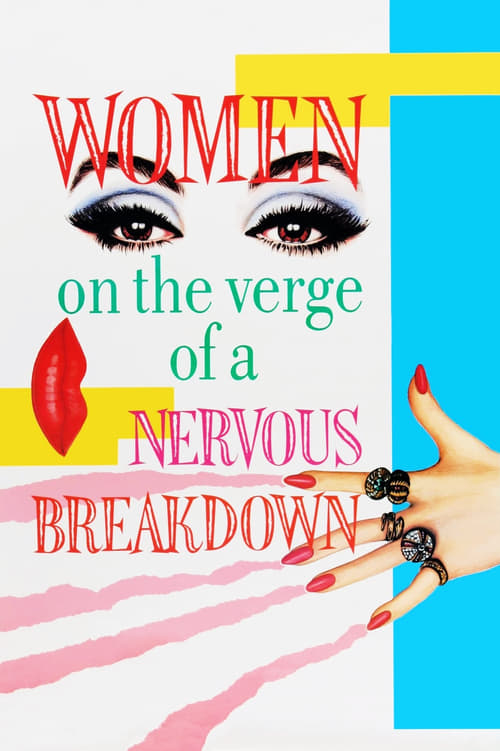
Women on the Verge of a Nervous Breakdown
1988 · Pedro Almodóvar
Spain's institution entered his English-language era (The Room Next Door, Venice Golden Lion) amid discourse about late style and euthanasia on film; his refusal to soften political statements at ceremonies keeps him quotable.
For when you need a good laugh with some style to it — heartbreak turned into comedy, perfect after your own bad week or as a lift for a night in with friends. Pure comfort with a wicked streak.
What it's about
Pepa, a Madrid voice actress, is dumped by her longtime lover via answering machine and spends one frantic day trying to reach him before he leaves the country. Her penthouse becomes a crossroads for his unraveling wife, his son and the son's new fiancée, her own terrified best friend on the run from a terrorist boyfriend, a pitcher of spiked gazpacho, and a taxi driver who keeps turning up at exactly the right moment.
The experience
Fast, candy-colored, and genuinely funny — a farce that keeps accelerating until the whole apartment is full of people at cross purposes. Underneath the slapstick there's a real ache about being left, which is what makes the laughs land.
Performances
Carmen Maura is the engine of the whole film — furious, glamorous, and heartbroken all at once, playing a woman on the verge who never quite tips over. A young Antonio Banderas is a delight as the sweetly clueless son.
The craft
Almodóvar composes the film like a pop artwork: saturated reds, deliberately artificial Madrid rooftop views, and costumes and sets that turn melodrama into design. The screwball plotting is watchmaker-precise — every stray prop and passing character pays off.
Why it matters
The film that made Almodóvar an international name, earned an Oscar nomination for Best Foreign Language Film, and became the flagship of post-Franco Spain's exuberant new cinema.
Snapshot
A screwball melodrama set in a single delirious Madrid afternoon-into-night, Women on the Verge of a Nervous Breakdown is the film that transformed Pedro Almodóvar from a cult provocateur of La Movida into a director of international standing. Pepa (Carmen Maura), a television voice-actress, is left by her long-time lover Ivan (Fernando Guillén) via answering-machine message; her efforts to reach him before he flees the country ignite a chain-reaction of entanglements involving his abandoned wife, his terrorist girlfriend, a skittish new fiancée, a Shia lawyer, a mambo-mad taxicab, and a pitcher of Valium-laced gazpacho. The film operates simultaneously as farce, feminist comedy of manners, and barely suppressed lament — the hysteria of the title is both the film's mode and its subject. Its success opened the North American and European art-house market to contemporary Spanish cinema and established Almodóvar as one of the defining auteurs of the late twentieth century.
Industry & production
By 1988 Almodóvar had already made seven features, but Women on the Verge marked a decisive institutional shift. In 1986 he and his brother Agustín had founded El Deseo S.A., their own production company, after separating from Tesauro, the firm that had produced his rougher early work. El Deseo gave Almodóvar creative control and a larger budget than anything he had previously commanded, enabling the highly finished production design and the wider commercial ambitions the film required. The Spanish state broadcaster TVE co-produced, and Lauren Films handled domestic distribution. The film was selected as Spain's submission to the Academy Awards and received a nomination for Best Foreign Language Film at the 61st ceremony (1989) — a significant marker of international arrival for a Spanish production. It swept the Spanish Goya Awards that year, winning Best Film, Best Director, Best Original Screenplay, Best Actress (Maura), and Best Supporting Actress (María Barranco). Outside Spain it won the BAFTA Award for Best Film Not in the English Language and the New York Film Critics Circle award for Best Foreign Language Film, cementing a critical consensus rare for comedies of any nationality. Specific box-office figures are not reliably documented in the public record, but the film's commercial performance in Spain and across European and North American art houses was by contemporary accounts exceptional for a Spanish language picture, generating the capital and confidence that secured El Deseo's independence through the following decade.
Technology
Photographed on 35mm spherical format, the film's technological signature is less a matter of innovation than of purposeful excess in existing tools. The answering machine — then still a relatively novel domestic appliance — functions as the film's narrative engine and its thematic emblem: Ivan communicates entirely through recorded messages, his voice omnipresent but his body absent, which Almodóvar exploits for both comedy and pathos. The recording-studio sequences, in which Pepa dubs dialogue for foreign films, deploy a playful meta-cinematic awareness of voice-as-technology. In the pre-digital era, the saturated, highly controlled color palette required careful choice of film stock and close collaboration between the cinematographer and the laboratory during timing; the results look deliberately artificial in ways that owe as much to photographic craftsmanship as to set dressing.
Technique
Cinematography
José Luis Alcaine, already one of Spain's most distinguished directors of photography, brought to the film a palette of dense, warm primaries — electric reds, taxi-cab yellows, the lush greens of Pepa's implausible terrace garden. The look is neither naturalistic nor camp for its own sake but calibrated to a heightened emotional register, matching the tonal temperature of classical Hollywood melodrama while pointing toward the supersaturated consumer culture of 1980s Madrid. Alcaine's framing tends toward the intimate and slightly claustrophobic inside the apartment, then opens — occasionally and pointedly — onto the wide Madrid skyline visible from Pepa's penthouse, emphasizing how sealed-off and theatrical the central space is. Lighting is high-key throughout, consistent with the comedy register and at odds with the existential desperation the narrative describes; this tension is one of the film's central formal ironies.
Editing
José Salcedo, who edited the large majority of Almodóvar's output from the mid-1980s onward, cuts the film at a pace calibrated to farce: the rhythm tightens with each new complication arriving at the apartment door, exploiting the geometry of classical comedy — characters who must not meet kept barely separate, exits and entrances timed to near-miss. The editing also mediates between the film's two emotional registers: Salcedo and Almodóvar cut away from Pepa's genuine grief before it can stabilize into pathos, keeping tone mobile and unpredictable. The intercutting of the answering machine tape — its messages heard in varied and strategic sequence — is a structurally important device that controls information flow and delayed revelation.
Mise-en-scène / staging
Production designer Félix Murcia created Pepa's penthouse apartment as an openly theatrical set, its brightly painted walls, plastic garden furniture, improbably lush terrace plantings, and color-coordinated props evoking a pop-art stage rather than a realistic Madrid interior. The space functions as a container for the comedy's mechanism: a stage where characters enter and exit at timed intervals. The gazpacho — prepared in a wide shot that emphasizes its vivid red against the kitchen's primary colors, then moved through the narrative like a Chekhov prop — exemplifies the film's tendency to make objects bear both symbolic and comic weight simultaneously. The staging throughout is tightly choreographed; actors rarely move through space casually but arrive at positions that serve pictorial as well as dramatic purposes.
Sound
Sound design is central to a film whose plot turns on recorded voices and unanswered phones. The answering machine tape is acoustically the most important object in the film, and Almodóvar exploits the texture of recorded voice — slightly degraded, disembodied, authoritative — with care. Bernardo Bonezzi's score, along with Almodóvar's customary use of pre-existing popular recordings, blends period mambo (the mambo taxi is both a running gag and a musical environment) with melodramatic orchestral swells that are always slightly in excess of the situation, underlining the film's double consciousness about its own genre conventions.
Performance
Carmen Maura delivers what is widely regarded as the finest performance of her career in a role that requires her to modulate grief, slapstick, rage, and dignity often within a single scene. She had been Almodóvar's central collaborator through the preceding decade — appearing in Pepi, Luci, Bom (1980), Dark Habits (1983), What Have I Done to Deserve This? (1984), and Law of Desire (1987) — and her command of the film's emotional range is inseparable from that accumulated trust. Antonio Banderas, in an early role as Carlitos (the son of Ivan and his abandoned wife), displays the awkward physical comedy that would later be refracted into his Hollywood persona. Rossy de Palma, whose angular, Picassoid features Almodóvar had discovered by chance, brings an unclassifiable presence to the role of Candela; her scenes are among the film's most formally adventurous because her face itself reads as a kind of visual argument about beauty and convention.
Narrative & dramatic mode
The film's narrative mode is classical farce structured around a tight unity of time and place — almost all action occurs within a single day and within or immediately adjacent to Pepa's apartment — with a mechanical escalation of complication that is legible as a Feydeau-adjacent machine. What complicates this template is an undertow of genuine feeling: Pepa's loss is real and her longing is played straight even as the apparatus around her is cartoonish. Almodóvar has described the project as beginning with Jean Cocteau's one-act monologue La Voix Humaine (1930), in which a woman conducts an entire telephone conversation with an ex-lover the audience cannot hear; he expanded and pluralised this scenario, multiplying the women and their crises, but the Cocteau core — voice without body, desire without reciprocation, the telephone as both lifeline and instrument of abandonment — remains structurally present.
Genre & cycle
Women on the Verge is a hybrid of screwball comedy, domestic farce, and what might be called feminist melodrama: it uses the comic apparatus of misunderstanding and mistiming to examine the unequal emotional labor women perform in heterosexual relationships. The film belongs to a strain of late-1980s European art comedy — alongside work by Nanni Moretti and Bertrand Blier — that adopted popular genre formats for politically inflected purposes without sacrificing entertainment value. Within Almodóvar's own filmography it represents a decisive move away from the transgressive underground energy of his early features toward a more polished and internationally legible register, a shift that would define his 1990s work. It also participates in a specifically Spanish cycle of post-Transition urban comedies that emerged after Franco's death, though it is distinguished from most of that cycle by its production finish and its conscious reworking of international genre conventions.
Authorship & method
Almodóvar wrote the screenplay entirely himself, as is his practice. The script is notable for its structural precision — the complication mechanism is intricate but the emotional logic is clean — and for dialogue that sustains both comic and serious registers simultaneously without the two canceling each other out. His method involved extensive rehearsal and close collaboration with Maura, whose instincts shaped the tone of Pepa's performance throughout development.
José Luis Alcaine (cinematographer) brought a formal discipline and chromatic ambition that had been more diffuse in Almodóvar's earlier films; his contribution to the film's visual identity is substantial. Bernardo Bonezzi (composer), a Movida-associated musician who had scored several previous Almodóvar films, provided a score that satirizes melodramatic convention from within it. José Salcedo (editor) had edited What Have I Done to Deserve This? and Matador and would continue as Almodóvar's primary collaborator for decades; his editing grammar — agile, tone-sensitive, built on classical Hollywood cutting rather than European montage — is indispensable to the film's rhythm. Agustín Almodóvar (producer) provided the institutional infrastructure that made the film's level of finish possible.
The famous rupture between Pedro Almodóvar and Carmen Maura that followed the film's success is a documented fact of Spanish film history: the two did not work together again for nearly twenty years, reuniting only on Volver (2006). The causes remain subject to competing accounts and neither party has offered a definitive public statement; the record on the specific nature of their disagreement is genuinely thin.
Movement / national cinema
The film is the central document of La Movida Madrileña's transition to international legitimacy. La Movida — the cultural explosion of youth, sexuality, drugs, and artistic experiment that erupted in Madrid in the years immediately following Franco's death in 1975 — had produced Almodóvar's first films in its own image: DIY, deliberately offensive, indifferent to production values or foreign markets. By 1988, the Movida's raw energy had been absorbed into a more stable (and marketable) cultural formation; Women on the Verge represents its aesthetic and commercial maturation. The film is set in an unmistakably contemporary Madrid — the city's rooftops, taxis, television studios, pharmacies — and implicitly celebrates the social freedoms of post-Transition Spain: female independence, open sexuality, the irrelevance of Catholic guilt. It participates in the emergence of a New Spanish Cinema that broke with both the austere social realism of the anti-Franco years and the folkloric exoticism that international audiences had associated with Spain.
Era / period
The film is a precise document of Spain in the late 1980s: a country a decade out of dictatorship, newly admitted to the European Community (1986), experiencing rapid economic modernization and a transformation of urban social life. The answering machine, the penthouse apartment with its consumer-culture furnishings, the professional woman navigating independence and romantic disappointment — all read as markers of a specific historical moment. The film also belongs to the broader art-house moment of the late 1980s, when European and Latin American cinema was finding unusually large North American audiences through channels like Miramax's early distribution model; Women on the Verge benefited from and contributed to that receptive climate.
Themes
The film's central preoccupation is communication and its failure: phone calls that go unanswered, messages that substitute for presence, voices without bodies. Ivan exists in the film almost entirely as a recorded voice — an absence who nonetheless organizes the desire of multiple women. This structural absence of the man anchors the film's feminist argument: women's emotional lives are held hostage to someone who will not and need not engage, since the system of desire ensures he is always wanted and never accountable.
Female solidarity emerges as the film's affirmative counter-movement. The women who converge on Pepa's apartment — rivals, strangers, a potential victim — end the film in a state of provisional alliance rather than competition. The gazpacho, initially prepared in an act of self-destruction (Pepa adds sleeping pills while imagining ending the affair definitively), becomes the film's comedy instrument: it incapacitates the wrong people, deflects violence, and produces an involuntary equality among those who consume it.
Camp sensibility runs through the film as a sustained formal attitude: the exaggeration of emotion, the theatricalisation of space, the deployment of popular cultural forms (melodrama, soap opera, mambo) with affection and irony simultaneously. This is less a subversive strategy than a fundamental aesthetic, one rooted in Almodóvar's formation in the Madrid underground of the 1970s and his long engagement with Hollywood melodrama, Italian neorealism's popular successors, and the aesthetic of excess that Almodóvar associates with female experience.
Reception, canon & influence
Critical reception. The film was an immediate critical success in Spain and internationally, earning reviews that recognized it as a formal advance on Almodóvar's previous work as well as a comedy of unusual emotional intelligence. In the United States it generated substantial press coverage as the Spanish language film that most successfully bridged art cinema and popular entertainment; the Oscar nomination consolidated this perception. Over subsequent decades its canonical status has only strengthened: it is regularly placed among the finest European films of the 1980s and is taught widely in Spanish cinema, gender studies, and film theory contexts as an exemplary instance of genre hybridization and camp politics.
Influences on the film (backward). Cocteau's La Voix Humaine is the acknowledged structural source. Classical Hollywood screwball comedy — Hawks, Wilder, the French door farce tradition distilled through Georges Feydeau — provides the mechanical architecture. The melodramas of Douglas Sirk and the female-centred pictures of mid-century Hollywood (films starring Bette Davis, Joan Crawford, Barbara Stanwyck) are absorbed and quietly feminised rather than simply cited. The pop-art visual vocabulary owes something to Andy Warhol's influence on Almodóvar's Movida formation. The Italian commedia tradition, filtered through Fellini and De Sica's engagement with popular genres, is another recognizable current. The neo-realist social comedy of What Have I Done to Deserve This? is this film's immediate predecessor and its plainer, rougher sibling.
Legacy (forward). Women on the Verge established the template for Almodóvar's mature international career: Tie Me Up! Tie Me Down! (1990), High Heels (1991), The Flower of My Secret (1995), All About My Mother (1999, Oscar for Best Foreign Language Film), and Talk to Her (2002, Oscar for Best Original Screenplay) are all legible as expansions of possibilities the film opened. More broadly, its commercial success demonstrated to distributors and financiers that Spanish-language cinema could find large international audiences, a demonstration that bore on the careers of subsequent Spanish directors. A Broadway musical adaptation, with book by Jeffrey Lane and music and lyrics by David Yazbek, opened at the Belasco Theatre in November 2010; it ran for sixty-nine performances and received mixed notices, suggesting the film's theatrical vitality does not translate straightforwardly to the stage but confirming the cultural reach of its premise. Within academic film studies, it remains one of the most cited films in discussions of queer aesthetics, feminist genre theory, and the politics of camp, a scholarly afterlife that Almodóvar has viewed with characteristic bemused detachment.
A Deleuzian reading
A woman sits on the floor of a penthouse the color of a candy box and presses play.
The full Deleuzian reading of Women on the Verge of a Nervous Breakdown →
Reception
A smash hit from day one — Spain's box-office champ, a Best Foreign Film Oscar nominee, and the film that turned Almodóvar from Madrid cult figure into international brand. Today it's less reappraised than repositioned: the fizzy 'gateway Almodóvar' fans revisit after the heavier late masterpieces.
How Women on the Verge of a Nervous Breakdown was received, from release to now →
Influences: the films it descends from and the films it influenced
- La Voix humaine (1948) — Adapts the same Cocteau monologue play, establishing the formal template Almodóvar inherits: the telephone as technology of romantic abandonment, with the woman's anguish performed into an absent receiver while her lover exists only as transmitted voice — Almodóvar mechanizes this into the answering machine and multiplies the cast.
- Orpheus (1950) — Cocteau's radio-of-the-dead transmits disembodied voices that compel desire and drive the entire plot — the structural precedent for Almodóvar's answering machine, where a pre-recorded male voice orchestrates the narrative without the body ever appearing; the device is secularized but the mechanics are identical.
- Bringing Up Baby (1938) — Establishes the screwball architectural template Almodóvar mechanizes: a farcical confined space into which an expanding cast of strangers is deposited and held barely separate by near-miss editing timed to within seconds, arrivals and exits choreographed as the film's primary comic mechanism rather than its subject.
- The Lady Eve (1941) — The feminist screwball comedy in which prop objects (the snake, the card tricks) function simultaneously as comic instruments and symbolic agents, and delayed revelation through strategic intercutting controls audience knowledge against the characters' — both central to Almodóvar's method with the gazpacho and the answering-machine tape.
- All That Heaven Allows (1955) — Sirkian ironic melodrama in which high-key lighting exposes the gap between social surface and emotional truth, and domestic objects are charged with symbolic weight through framing (the television set as substitute life) — the technique Almodóvar and production designer Félix Murcia amplify into pop-art register.
- The Umbrellas of Cherbourg (1964) — Deploys fully saturated primary-color environments as emotional temperature gauges in a melodrama of romantic abandonment, the palette declaring feeling that characters cannot articulate — the direct chromatic precedent for Alcaine's supersaturated warm primaries, where color calibration replaces naturalism as the emotional instrument.
- Une femme est une femme (1961) — Primary-color theatrical staging of a Paris apartment as a self-consciously artificial domestic stage, the comedy/melodrama tonal mixture held deliberately unstable through genre-signal interruption — a formal precedent for Almodóvar's pop-art penthouse and the film's moment-to-moment mobility between farce and genuine lament.
- Cleo from 5 to 7 (1962) — Real-time unity of time and place — a woman's single afternoon compressed into the film's running time — deployed as structural pressure, the ticking clock converting domestic and urban space into a psychological container; the identical formal architecture Almodóvar applies to Pepa's delirious Madrid day.
- Juliet of the Spirits (1965) — Theatrical color saturation and the treatment of the domestic apartment as a space of barely-suppressed psychological crisis directly inherit Juliet's model of chromatic mise-en-scène excess as the primary register of female interiority.
- Johnny Guitar (1954) — Literally folds Johnny Guitar into its texture via the heard Spanish dubbing of the 'Lie to me' material, inheriting its high-color, dialogue-as-incantation melodrama register.
- Law of Desire (1987) — Grows directly out of the Cocteau 'Human Voice' material seeded here, again built around Carmen Maura as a woman monologuing into a phone at an absent lover, with Salcedo's tonal editing carrying the comic-melodramatic modulation.
- Strictly Ballroom (1992) — Inherits the pop-art production design strategy — saturated primaries calibrated as emotional register, domestic interiors staged theatrically with color-coded props — and deploys a Spanish paso doble score as melodramatic underliner in the same gesture Almodóvar makes with mambo: Latin dance music as emblem of authentic feeling set against social constraint.
- Muriel's Wedding (1994) — Pop-art suburban palette and preexisting pop music (ABBA) deployed as melodramatic emotional underliner in a feminist comedy about romantic obsession — the Almodóvar tonal register transposed to an Australian idiom, preserving the same unstable mixture of broad farce and genuine lament that Women on the Verge introduced to international art-house audiences.
- All About My Mother (1999) — Extends the feminist ensemble melodrama form with Carmen Maura's multi-register performance method applied across a full female cast, theatrical staging, and Chekhovian prop-objects (the donated heart) bearing simultaneous comic and symbolic weight — the mature elaboration of the mode Women on the Verge established.
- Amélie (2001) — Fully saturated primary palette calibrated to a character's emotional state, domestic objects charged with symbolic and narrative weight through deliberate framing, Parisian interiors staged as theatrical containers — the visual and mise-en-scène vocabulary of Women on the Verge absorbed and transposed into a French register of whimsy.
- Far from Heaven (2002) — Consciously revives the Sirkian ironic melodrama mode — the saturated palette, the high-key lighting exposing the gap between social surface and emotional truth, domestic objects as symbolic props — returning to the same Sirk inheritance that Almodóvar had re-energized a decade earlier, now applied to its original American source material.
- Talk to Her (2002) — Pushes the disembodied-voice/communication-failure device to its logical extreme — the answering-machine message is replaced by comatose silence, the absent lover becomes a man speaking to a woman who cannot respond; the formal asymmetry of Women on the Verge is inverted, the comedy evacuated, and the same structural device darkened into tragedy.
- Wild Tales (2014) — Establishes the El Deseo house sensibility Szifron works in — melodrama pushed to the edge of farce, transgression rendered pleasurable, characters detonating past composure in saturated, high-key frames.
- Diva (1981) — High-gloss artificial visual style in which a voice recording functions as the narrative's central mechanical engine — the pirated soprano tape operates structurally as Almodóvar's answering-machine messages, both films making recording technology simultaneously a plot device and an argument about mediated desire and the body's absence from its own voice.
Similar films
- All About My Mother (1999) — influence & lineage · same viewing thread · often watched together
- Talk to Her (2002) — influence & lineage · often watched together
- Volver (2006) — often watched together
- Law of Desire (1987) — shared sensibility
- Tie Me Up! Tie Me Down! (1990) — shared sensibility
- Pain and Glory (2019) — shared sensibility
- Amores Perros (2000) — shared sensibility
- 8½ (1963) — shared sensibility
All the films related to Women on the Verge of a Nervous Breakdown →
Watch it with: curated runs of related films
- All the World's a Stage — Watch these together when you want the theater seen from the wings — faded stars angling for a comeback, hungry understudies, actresses in extremity, and a director who walked away — each film besotted with performance and clear-eyed about its cost.