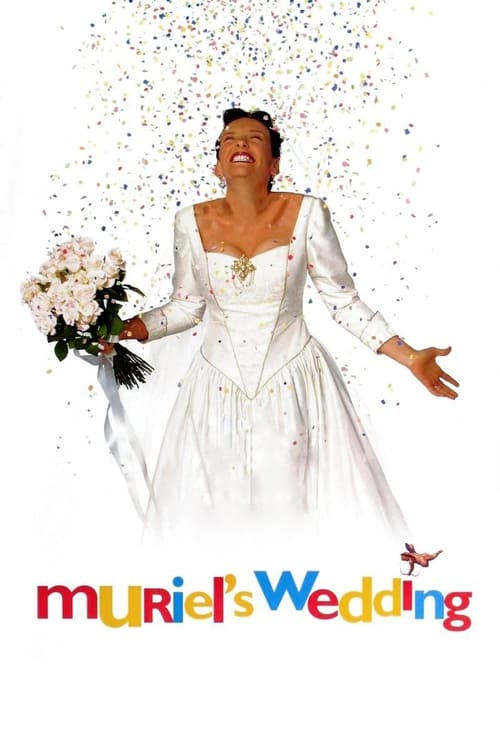
Muriel's Wedding
1994 · P.J. Hogan
For when you want a comedy that actually means something — to laugh, sing along, and have a proper cry in the same sitting. Comfort viewing with a bruise; ideal for anyone who's ever wanted to escape their hometown or their own reputation.
What it's about
Muriel Heslop is unemployed, mocked by her so-called friends, crushed under a bullying politician father in a small Australian resort town — and convinced that a wedding, any wedding, will transform her life. When she falls in with the wilder, warmer Rhonda, the two escape to Sydney, where Muriel reinvents herself and chases her dream of marriage with alarming single-mindedness. ABBA songs carry her fantasies; real life keeps interrupting them.
The experience
It looks like a feel-good comedy and often is one — big, brash, and genuinely funny — but it keeps swerving into real hurt: cruelty, family failure, loneliness. That whiplash between karaoke joy and quiet devastation is exactly what makes it land; you laugh hard and then find yourself unexpectedly wrecked.
Performances
Toni Collette, in her breakout role, is astonishing — she makes Muriel's delusion, shame, and hope all visible at once, so you cringe for her and root for her in the same beat. Rachel Griffiths' Rhonda is the film's live wire, and their friendship becomes its true love story.
The craft
P.J. Hogan's debut script pulls off a rare tonal high-wire act, swinging from broad social satire to musical fantasy to genuine despair without breaking. The ABBA soundtrack isn't decoration — it's the language of Muriel's dreams, and the film uses it to devastating, joyous effect.
Why it matters
A landmark of 1990s Australian cinema that launched Toni Collette internationally and helped define the era's bittersweet Aussie comedy — proof that a crowd-pleaser could carry real darkness. 'You're terrible, Muriel' entered the vernacular.
Snapshot
Muriel's Wedding is a bruising tragicomedy disguised as a feel-good pop fantasy — a film that lets ABBA carry its heroine's dreams while quietly documenting the cruelty of the world those dreams are meant to escape. Written and directed by P.J. Hogan as his feature debut, it follows Muriel Heslop (Toni Collette), an unemployed, socially derided young woman from the fictional Queensland resort town of Porpoise Spit, who is convinced that a wedding will transform her life. Alongside the wilder, warmer Rhonda (Rachel Griffiths), Muriel decamps to Sydney, reinvents herself as "Mariel," and pursues marriage as an end in itself. The film's tonal audacity — swinging between broad social comedy, showstopping musical fantasy, and genuine despair (an ailing mother, a bullying father, a partner acquired by transaction) — is its signature achievement. It emerged from the early-1990s wave of glittery, misfit-centered Australian comedies and became one of that cycle's most emotionally serious entries, launching two of Australia's most durable screen actors.
Industry & production
Muriel's Wedding was an Australian production financed through a mixture of national and international capital, a structure typical of the period. The Australian Film Finance Corporation (the FFC), the federal body then underwriting much of the country's feature output, was central to the film's financing; the French production and sales company CiBy 2000 — active in prestige international cinema in the early-to-mid 1990s — was also involved on the financing and distribution side. The producers were Lynda House and Jocelyn Moorhouse; Moorhouse, herself a director (Proof, 1991) and Hogan's partner, lent the project both craft credibility and industry standing. Precise budget and box-office figures vary across sources and I won't assert a specific number, but the film was a substantial commercial success relative to its modest scale, performing strongly in Australia and traveling widely on the international art-house and specialty circuit.
The project was Hogan's calling card as writer-director after years working in Australian television and as a screenwriter. Its Cannes exposure in 1994 — the film screened at the festival — helped position it for global release and gave it the imprimatur that CiBy 2000's involvement implied. Domestically, the film arrived at a moment when Australian cinema was enjoying unusual visibility abroad, and it benefited from being read as part of a recognizable, exportable national brand of comedy. Its success also had a career-making dimension typical of well-financed but performer-dependent films: it made Toni Collette and Rachel Griffiths internationally castable almost overnight.
Technology
Muriel's Wedding was shot and finished on photochemical film using conventional early-1990s 35mm production technology; there is nothing about the film that reads as technologically experimental, and its innovations lie entirely in craft and needle-drop rather than in apparatus. What is worth noting technologically is the film's dependence on licensed pop recordings — principally ABBA — as a structural element rather than mere garnish. Securing and integrating master recordings of well-known international hits into an Australian film of this budget was a nontrivial rights-and-production undertaking, and the decision to build fantasy sequences around the actual ABBA recordings (rather than cover versions or score pastiche) shaped both the film's cost profile and its texture. The record on the exact licensing arrangements is not something I can detail precisely, so I'll flag that as a genuine gap rather than speculate. Otherwise the film's "technology" is the standard toolkit of the era: film cameras, practical locations in coastal Queensland and Sydney, and a conventional optical/laboratory finish.
Technique
Cinematography
The cinematography, by Martin McGrath, works in a bright, saturated register appropriate to a story about tacky paradise and the gaudy allure of fantasy. Porpoise Spit is rendered in the hard, over-lit palette of a sun-blasted resort town — swimwear colors, hibiscus prints, chlorine blue — a look that makes the setting simultaneously cheerful and slightly nauseating, which is exactly the film's attitude toward it. McGrath's camera is largely unobtrusive and character-serving, favoring clear compositions that let performance and blocking do the work; the visual flourishes are reserved for the ABBA fantasy interludes, where the framing tilts toward the frontal, presentational spectacle of a music video or stage act. The contrast between the flat naturalism of Muriel's real life and the heightened glow of her imagined one is a deliberate cinematographic strategy rather than an accident of budget.
Editing
The film was edited by Jill Bilcock, one of Australian cinema's most consequential editors, whose work across this era (including Strictly Ballroom and, later, Romeo + Juliet and Moulin Rouge!) helped define a nationally recognizable rhythm of comic and musical cutting. Bilcock's editing is essential to Muriel's Wedding's tonal tightrope: the film has to pivot, sometimes within a single scene, from farce to humiliation to grief, and the cutting manages those hairpin turns without whiplash. The musical set-pieces — most famously the poolside ABBA lip-sync — are cut for performative release, while the domestic scenes are held longer, allowing discomfort and cruelty to accumulate. It is largely through editing that the film earns the right to be devastating in its final act after being so buoyant earlier.
Mise-en-scène / staging
Hogan's staging is built on a comedy of social embarrassment: characters arranged in cliques, weddings, and family gatherings where Muriel is perpetually the wrong body in the wrong place. Production and costume design lean into a very specific vernacular of Australian suburban and resort kitsch — floral prints, function-room décor, the aesthetics of the bridal magazine and the shopping-mall boutique. The wedding-dress shop and the bridal fantasy are staged as sites of near-religious longing. Against this, the Heslop family home is a space of stagnation and defeat, dominated by the father's contempt and the mother's exhausted passivity. The film's most pointed staging gag — Muriel trying on wedding gowns for photographs with no groom in sight — captures its whole thesis in a single tableau: the ceremony as fetish object, detached from love or partnership.
Sound
Sound is where the film is boldest. The ABBA songs function as Muriel's interior life made audible — a Swedish pop group's soaring, uncomplicated emotion standing in for feelings she cannot otherwise express or attain. The needle-drops are not ironic distancing devices so much as sincere emotional prostheses, which is what gives them their peculiar poignancy. Peter Best's original score fills the connective tissue between the pop cues, providing the film's more conventional dramatic underscoring. The interplay — diegetic and fantasy pop for aspiration, original score for the encroaching reality — organizes the film's emotional grammar. The sound design of the "real" world, by contrast, is often deliberately banal, throwing the musical fantasies into higher relief.
Performance
The performances are the film's engine. Toni Collette's Muriel is a study in interiority under a graceless exterior: she plays the character's social ineptitude without condescension, letting flashes of cunning, hunger, and shame show through the awkwardness. It is widely noted that Collette gained weight for the role, a physical commitment that reads on screen as vulnerability rather than caricature. Rachel Griffiths, as Rhonda, provides the film's blast of unguarded life force — and then, in the second half, becomes the vehicle for its most serious turn, as illness strips away the comedy. Bill Hunter, an Australian screen institution, plays the father, Bill Heslop, as a monster of petty ambition and casual cruelty; his repeated dismissal of his family as "useless" is the wound the whole film circles. Jeanie Drynan's performance as the defeated, near-invisible mother, Betty, is the film's quiet devastation and the counterweight to all its brightness. It is the ensemble's willingness to be genuinely unlikable, or genuinely broken, that keeps the movie from curdling into whimsy.
Narrative & dramatic mode
The film operates in a mode of ironic bildungsroman: a coming-of-age story in which the heroine's stated goal (marriage) is revealed to be the wrong goal, and her real maturation lies in relinquishing it. Structurally it is a two-part movement — escape from Porpoise Spit to Sydney, then a reckoning that pulls Muriel back toward family and consequence. The dramatic mode is tragicomic in the fullest sense: the comedy is not a sweetener applied to serious material but is generated by the same social cruelty that produces the tragedy. Hogan withholds the conventional payoff (a wedding built on love) and substitutes a harder, more valuable one (friendship, self-knowledge, refusal). The narrative repeatedly uses fantasy — the ABBA sequences, the bridal photographs — as a device to externalize Muriel's inner state, so that the film's "plot" is partly a contest between the life she imagines and the life she's in.
Genre & cycle
Muriel's Wedding belongs to a distinct early-1990s cluster of Australian comedies about outsiders, self-invention, and flamboyant spectacle — most often grouped with Baz Luhrmann's Strictly Ballroom (1992) and Stephan Elliott's The Adventures of Priscilla, Queen of the Desert (1994), the latter released the same year. Together these films are frequently discussed as a "glitter" or "feel-good misfit" cycle, marked by kitsch aesthetics, musical or dance spectacle, camp sensibility, and heroes who triumph by embracing artifice and difference. Within that cycle, Muriel's Wedding is the most tonally severe: where Strictly Ballroom is a fairy tale and Priscilla a road-movie celebration, Hogan's film keeps a current of real pain running under the sequins. It also participates in the broader traditions of the wedding comedy and the female friendship film, both of which it partly honors and partly subverts.
Authorship & method
The film is unmistakably an auteur debut in the sense that it originates from a single writer-director's voice: Hogan wrote and directed it, and its blend of savagery and sentiment is his authorial signature, one he would carry into subsequent projects. But it is equally a product of a tight collaborative unit. Producer Jocelyn Moorhouse — an accomplished director in her own right and Hogan's creative partner — and producer Lynda House shaped the project's development and financing. Cinematographer Martin McGrath established the film's sun-struck, ironic surface. Editor Jill Bilcock engineered its treacherous tonal shifts and musical rhythm. Composer Peter Best supplied the original score that mediates between fantasy and reality, while the ABBA catalog functions as a kind of found-object second score. The casting — Collette and Griffiths in particular — was itself an act of authorship, wagering the film's emotional credibility on then-largely-unknown performers. Hogan's method here is to weaponize pop pleasure: he lets the audience enjoy the same fantasies as Muriel, then holds them accountable for what those fantasies cost.
Movement / national cinema
The film is a landmark of 1990s Australian national cinema, a period when a state-supported industry (via the FFC and related bodies) produced a run of internationally successful, distinctly Australian films. It engages directly with Australian self-image: the coastal-resort setting, the vernacular of suburban aspiration, the specific texture of small-town social hierarchy, and the recurring national figure of the corrupt, blustering local-politician patriarch. Its treatment of "Porpoise Spit" is a satirical portrait of a certain Australian ordinariness — sunny, conformist, quietly brutal — that the film both mocks and mourns. At the same time, its use of a Swedish pop group as the vector of its heroine's dreams speaks to a globalized, mediated interior life, complicating any purely nationalist reading. It stands as one of the defining exports of the era's Australian cinema alongside its glitter-cycle siblings.
Era / period
Muriel's Wedding is a product and portrait of the mid-1990s. Its ABBA obsession is already, in 1994, a knowing act of retro revival — 1970s pop reclaimed as camp sincerity — which places the film squarely in a decade newly comfortable with ironic nostalgia. The film's world is pre-internet and analog: fantasies are fed by bridal magazines, videotapes, and cassette tapes, and social life is organized around physical cliques and function-room events. Its politics of the body, its frank treatment of a heroine outside conventional beauty standards, and its ambivalence about the institution of marriage all register as of their moment, even as they anticipate later, more explicit conversations. The film also belongs to the specific economic era of publicly financed Australian features aimed at both domestic audiences and international specialty markets.
Themes
At its core the film is about fantasy versus reality — the seductive, dangerous work of imagining a self and a life better than one's own. Marriage is the film's central symbol: not romance but validation, a socially sanctioned proof of worth that Muriel pursues to the point of entering a loveless transactional union. Adjacent to this is the theme of self-invention and its limits — the name change to "Mariel," the reinvention in Sydney — and the eventual discovery that a fabricated identity cannot outrun real relationships and real obligations. Cruelty and belonging run throughout: the casual viciousness of Muriel's "friends," the corrosive contempt of her father, and, against it, the redemptive, chosen family of her friendship with Rhonda. Family dysfunction and maternal erasure supply the film's darkest register, embodied in Betty's fate. And underlying everything is a critique of the culture of aspiration — the way consumer and ceremonial fantasies (weddings, magazines, pop songs) are sold as escape hatches while the structures that produce unhappiness stay firmly in place. The film's final movement reframes maturity as the courage to want the right things.
Reception, canon & influence
Muriel's Wedding was widely praised on release, singled out especially for its tonal daring and for the performances of Collette and Griffiths, and it was recognized within Australia's film-awards ecosystem as a significant achievement of the year; I'll refrain from listing specific award tallies I can't verify precisely, but its status as a major domestic critical and popular success is well established. It has since entered the canon of 1990s Australian cinema and of the broader tradition of tragicomic films about female friendship and misfit self-realization.
Looking backward, the film draws on several lineages: the wedding comedy and the woman's picture; the camp reclamation of disposable pop culture; the Australian tradition of satirizing suburban conformity; and, in its structural use of pop music to voice interiority, a sensibility shared with the contemporaneous glitter-cycle films. Its most obvious cultural forebear is ABBA itself, whose songbook the film treats as an emotional scripture.
Looking forward, its legacy is considerable. It functioned as a launchpad: Toni Collette went on to a major international career, and Rachel Griffiths likewise became a fixture of prestige film and television. More diffusely, the film contributed to a durable template for the tragicomedy of the ordinary, awkward heroine — the mixing of broad comedy with real pathos around an "unglamorous" protagonist — that later films and television would draw on. Its wholehearted, non-ironic deployment of pop hits as emotional payload prefigured a broader turn toward the needle-drop as narrative device, and it is frequently cited within the wave of ABBA-driven popular culture that would culminate, years later, in the Mamma Mia! phenomenon (a separate stage-and-screen property, but part of the same reclamation the film helped normalize). Muriel's Wedding itself was later adapted into a stage musical in Australia, an afterlife that confirms both its enduring affection among audiences and the centrality of its music. Its most lasting influence, though, may be tonal: the demonstration that a film can be genuinely funny and genuinely heartbreaking about the same small, ordinary life, and that pop fantasy and human devastation can share a single frame.
Reception
Sold in 1994 as another quirky Aussie feel-good comedy in the Strictly Ballroom mold, it's since been reappraised as something much darker and sadder than its marketing let on — and firmly canonized as one of the great Australian films and Toni Collette's star-making turn.
How Muriel's Wedding was received, from release to now →
How to watch Muriel's Wedding: what to notice on a first viewing
- Watch how bright and saturated Porpoise Spit looks. McGrath shoots the town in hard, over-lit swimwear colors and hibiscus prints, a palette that reads as cheerful and slightly nauseating at the same time. The color tells you how to feel about this town before a single joke lands.
- Watch the ABBA scenes shift into frontal, stagelike framing. McGrath's camera is otherwise plain and character-serving, but the fantasy sequences tilt toward the presentational look of a music video, held straight on like a performance for you. The camera changes style whenever Muriel steps into her own fantasy instead of her actual life.
- Listen for the ABBA songs arriving at her most private moments. The needle-drops play sincerely rather than ironically, standing in for feelings Muriel cannot otherwise express, while Peter Best's score handles the more ordinary reality around her. The music is not commenting on her, it is doing the feeling she cannot do out loud.
- Watch how fast a scene turns from joke to wound. Bilcock's cutting pivots within a single scene from farce to humiliation to grief, holding domestic moments long enough for the cruelty in them to accumulate. The film earns its later heartbreak because it has already trained you to feel the tone shift fast.
The whole guide to watching Muriel's Wedding, with the keys for a rewatch →
Influences: the films it descends from and the films it influenced
- Now, Voyager (1942) — Supplies the woman's-picture 'ugly duckling' transformation arc — a repressed, unglamorous heroine remade through spectacle — that Muriel's Toni-Collette metamorphosis inherits and then sours with irony.
- Hairspray (1988) — Models the camp reclamation of disposable pop culture and a plump, un-starry misfit heroine framed in saturated primary color, treating kitsch as sincere emotional currency rather than punchline.
- Sweetie (1989) — Establishes the Australian idiom of the suburban grotesque — flat presentational framing and lurid domestic color turning the ordinary backyard into a stage for family shame.
- Proof (1991) — Comes from the same Moorhouse/House creative-producing unit and pioneers its house tone — deadpan cruelty braided with sudden pathos — that Hogan scales up as his authorial signature.
- Strictly Ballroom (1992) — Editor Jill Bilcock's rhythmic cutting and Luhrmann's satire of suburban conformity through sequin-and-color excess directly prefigure Muriel's tonal-tightrope montage and bridal kitsch.
- Women on the Verge of a Nervous Breakdown (1988) — Pop-art suburban palette and preexisting pop music (ABBA) deployed as melodramatic emotional underliner in a feminist comedy about romantic obsession — the Almodóvar tonal register transposed to an Australian idiom, preserving the same unstable mixture of broad farce and genuine lament that Women on the Verge introduced to international art-house audiences.
- Billy Elliot (2000) — Uses pop needle-drops (T. Rex) to externalize a working-class dreamer's fantasy life through dance, the fantasy-versus-reality music strategy Muriel pioneered with ABBA.
- Hedwig and the Angry Inch (2001) — Treats a pop songbook as emotional scripture and splits diegetic performance from interior fantasy, the found-object-second-score device Muriel builds around ABBA.
- Moulin Rouge! (2001) — Jill Bilcock's frenetic cutting plus a jukebox of anachronistic pop deployed as sincere emotional payload is Muriel's needle-drop-as-narrative-device taken to maximalist extreme.
- Napoleon Dynamite (2004) — Adopts the flat, presentational deadpan framing of the suburban misfit, staging awkwardness head-on for a comedy that never quite mocks its outsider.
- Little Miss Sunshine (2006) — Reunites Toni Collette in the tragicomedy-of-the-ordinary ensemble mode — an unglamorous family whose broad comedy is anchored by real ache, the template Muriel helped set.
- Mamma Mia! (2008) — The full flowering of the non-ironic ABBA reclamation Muriel normalized — treating the songbook as sincere emotional scripture for female self-realization and wedding fantasy.
- Bridesmaids (2011) — Extends the comedy of embarrassment staged around the wedding-industrial complex, wagering emotional credibility on an unglamorous, self-sabotaging heroine who is hard to like.
- The Adventures of Priscilla, Queen of the Desert (1994) — Its twin in the 1994 Australian glitter-misfit cycle, using lip-synced pop performance and hyper-saturated outback presentational tableaux to voice interiority the characters can't speak.
- Welcome to the Dollhouse (1995) — Extends the comedy of embarrassment built around a genuinely unlikable, unglamorous protagonist, holding the audience in discomfort rather than granting easy sympathy.
- Romeo + Juliet (1996) — Jill Bilcock again engineers the treacherous swing between broad comedy and devastation, the same tonal-tightrope editing grammar she cut into Muriel.
- The Full Monty (1997) — Carries forward the tragicomedy of ordinary working-class misfits, mining real pathos and dignity from staged humiliation and unglamorous bodies.
- Shine (1996) — A contemporaneous Australian breakout that weaponizes diegetic source-music (ABBA) as the carrier of a suburban-family melodrama's emotional peaks — the same 'recording/repertoire as event' device Shine applies to the classical canon.
- The Castle (1997) — Contemporaneous portrait of Australian suburban family life mined simultaneously for cringe and warmth, sharing The Castle's satirical-yet-tender balance and its ear for vernacular household ritual.
- Holding the Man (2015) — Defined the Australian national-cinema use of era-marking pop needle-drops as an emotional structuring device, the sonic strategy Holding the Man deploys to date its decades.
Similar films
- Mamma Mia! (2008) — influence & lineage
- The Adventures of Priscilla, Queen of the Desert (1994) — influence & lineage
- Sweetie (1989) — influence & lineage
- Monsoon Wedding (2001) — shared sensibility
- The Worst Person in the World (2021) — shared sensibility
- The Color Purple (1985) — shared sensibility
- Anyone but You (2023) — shared sensibility
- The Graduate (1967) — shared sensibility