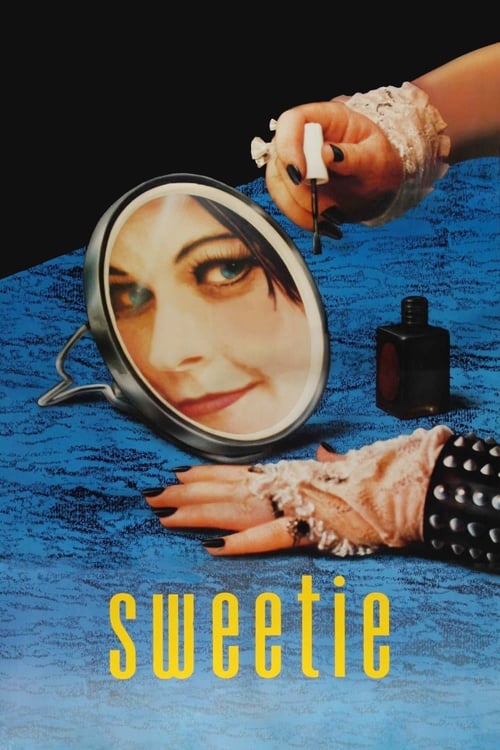
Sweetie
1989 · Jane Campion
For when you want something prickly and offbeat rather than comforting — a film about family dysfunction that's too weird and too honest to be a downer in the usual way. Bring patience; this one rewards a mood for the strange.
What it's about
Kay is a nervous, superstitious young woman trying to build a quiet life with her new boyfriend in the sun-bleached suburbs of Sydney. Then her sister Sweetie crashes back into her world — loud, reckless, childlike, and convinced she's destined for stardom — dragging their whole damaged family in behind her. What starts as a sibling reunion becomes a slow exposure of everything the family has spent years not saying.
The experience
Blackly funny and deeply uncomfortable, often in the same scene — you laugh, then wince at yourself for laughing. It moves at its own strange rhythm, less plot than pressure, and the unease builds until it's genuinely upsetting.
Performances
Genevieve Lemon is fearless as Sweetie, playing a woman with no filter and no shame without ever begging for sympathy, while Karen Colston makes Kay's buttoned-down anxiety just as vivid in the opposite register.
The craft
This is Jane Campion's first feature, and the visual imagination is already fully formed: off-kilter framings, odd angles, and suburban spaces made to look quietly alien, so that even an ordinary backyard feels charged with dread. The comedy and the menace live in the compositions themselves — it's a film you watch as much as follow.
Why it matters
It announced Campion as one of the most distinctive directors to come out of Australia, dividing its first audiences at Cannes before being recognized as the start of a major career.
Snapshot
Sweetie is Jane Campion's first feature film, and it announced one of the most distinctive directorial voices to emerge from Australian cinema with a confidence that startled — and, at its Cannes premiere, divided — its first audiences. A blackly comic family drama set in the flat, sun-bleached suburbs of Sydney, it follows Kay (Karen Colston), a brittle, superstitious young woman whose carefully managed life with her new partner Louis (Tom Lycos) is detonated by the arrival of her sister Dawn, called Sweetie (Genevieve Lemon) — an overweight, childlike, volatile woman convinced of her own impending stardom, indulged into ruin by an adoring father. Around the collision of these two sisters Campion builds a study of a family rotted from within: a portrait of repression and chaos as two faces of the same inheritance, in which Kay's tight-lipped fear of the world and Sweetie's grandiose appetite for it are both products of the same damaged household. The film is at once grotesque and tender, very funny and finally devastating, and it is rendered in a visual style so deliberately skewed — odd angles, foreground clutter, blocks of saturated color, bodies pushed to the edges of the frame — that it reads as a manifesto for a new kind of Australian art cinema. Where the Australian New Wave of the 1970s had favored handsome period landscapes, Sweetie turned inward and downward, to the suburban backyard and the family's buried roots, and made of them something unsettling and original.
Industry & production
Sweetie was produced by John Maynard through Arenafilm, an independent Australian production house, and it arrived at the end of a decade in which the Australian film revival had matured and begun to fragment into more idiosyncratic, personal work. Campion came to the feature as a graduate of the Australian Film, Television and Radio School and as an already-noticed maker of short films: Peel (1982), which would win the Short Film Palme d'Or at Cannes in 1986, Passionless Moments (1983), and A Girl's Own Story (1984), along with the television feature Two Friends (1986) written by Helen Garner. This body of short work had built a reputation for a sensibility at once formally adventurous and acutely attuned to family strangeness, and it earned Campion the latitude to make a first feature on her own terms.
The screenplay was written by Campion with Gerard Lee, a collaborator with whom she had worked on the short Passionless Moments and with whom she would reunite decades later for the television series Top of the Lake. The script's origins lie in the kind of intimate, observational comedy of family dysfunction that Campion had been developing in miniature; the feature expands that mode into a sustained, escalating domestic tragedy. The film was shot on location in suburban Sydney, its production design and locations chosen to render an ordinary Australian milieu of brick-veneer houses, scrubby backyards, and net curtains as a landscape of quiet menace.
The film's first major exposure came in competition at the 1989 Cannes Film Festival, where, by widely repeated accounts, it met a hostile and divided reception — reportedly booed by some of the audience even as it gathered a devoted body of admirers among critics. This polarized debut is itself part of the film's history: it marked Campion as a filmmaker whose work demanded a recalibration of expectation, and the critical championing that followed helped convert initial controversy into lasting reputation.
Technology
Sweetie is a 35mm production made with conventional late-1980s film equipment, and it makes no claim to technological innovation; its radicalism is entirely one of vision rather than apparatus. What is worth noting technically is the precision with which its images are constructed in-camera — the film's distinctive look depends on deliberate choices of lens, focal length, framing, and lighting rather than on optical effects or post-production manipulation. Deep focus is exploited so that obtrusive foreground objects and distant figures share the same plane of sharpness; wide and sometimes near-distorting framings flatten and estrange ordinary spaces. These are the tools of classical cinematography turned to disorienting ends. The record gives no indication of unusual technical processes, and it would be invention to claim any; the film's strangeness is achieved through compositional and chromatic control on a standard photochemical platform.
Technique
Cinematography
The cinematography is by Sally Bongers, and it is the film's most immediately arresting feature — one of the boldest pieces of camerawork in Australian cinema of the period, and notable as the work of a woman director-of-photography at a time when few worked on features. Bongers and Campion devised a visual grammar of calculated wrongness: low angles that loom up at characters, compositions that bury the human figure in a corner or behind some intervening object, foregrounds crowded with mundane clutter that the eye must negotiate to reach the action. Color is deployed in saturated, almost expressionist blocks — reds, blues, and sickly domestic pastels — and interiors are lit to feel airless and strange. The cumulative effect is to make the familiar suburban world appear subtly hostile and dreamlike, the camera itself seeming to share Kay's apprehension that ordinary things conceal threat. This is cinematography as psychological architecture: the off-kilter frame externalizes a family's interior derangement, and the film's images carry meaning that the dialogue leaves unspoken.
Editing
The editing organizes the film as a steadily tightening spiral from comedy toward catastrophe. Early passages have an observational, almost sketch-like rhythm, accumulating odd domestic moments and deadpan exchanges; as Sweetie's presence destabilizes the household, the cutting grows more claustrophobic and the tonal floor drops away beneath the comedy. The film withholds easy exposition — relationships, histories, and the precise nature of Sweetie's condition emerge obliquely, through behavior rather than explanation — and the editing trusts the viewer to assemble the family's pathology from fragments. Campion structures the film around recurring motifs (trees, roots, the childhood treehouse) that the cutting returns to, so that the imagery accrues symbolic weight across the running time and pays off in the final movement. The record does not warrant detailed claims about specific editorial decisions beyond what is visible on screen, but the overall design is unmistakable: a controlled modulation from the absurd to the unbearable.
Mise-en-scène / staging
Campion's staging is the heart of the film's authorship. The suburban house and its backyard are organized as a stage for dysfunction, every object and arrangement charged with meaning. Bodies are blocked in awkward, non-naturalistic relations — characters turned away from one another, crammed into ill-fitting spaces, framed against patterned wallpaper and net curtains that press in on them. The film's governing visual idea is the tree and its roots: Kay's superstitious dread fastens onto a sapling Louis plants, which she secretly uproots, and the family's buried damage is figured throughout as a matter of roots — what is planted, what is pulled up, what grows crooked. The childhood treehouse, painted and decorated, becomes the film's central symbolic object and the site of its climax. Costume and physical presentation are used pointedly: Sweetie's heaviness and grubby, childish self-presentation against Kay's pinched neatness make the sisters' opposed pathologies legible at a glance. The whole is a mise-en-scène of the uncanny — the suburban ordinary rendered grotesque without ever leaving the realm of the recognizable.
Sound
The score is by Martin Armiger, and the film's sound world contributes materially to its unsettling tonal mixture, supporting the slide from comedy into dread without underlining it crudely. Campion uses sound and music to estrange as much as the image does, and the film's aural texture favors the slightly off, the discomfiting, and the quietly absurd. Beyond the score, the film's use of domestic ambient sound — the dead air of suburban rooms — reinforces the sense of a world both ordinary and wrong. The detailed record of specific musical choices is thin enough that further attribution would be speculation; what can be said securely is that the soundtrack is of a piece with the film's larger strategy of making the familiar feel haunted.
Performance
The performances are pitched with great precision along the film's knife-edge between comedy and horror. Genevieve Lemon's Sweetie is a fearless, unguarded creation — by turns funny, infuriating, frightening, and finally heartbreaking — a woman arrested in a destructive childhood, ravenous for love and attention, incapable of restraint, and Lemon refuses to soften her into easy pathos or reduce her to a monster. Karen Colston's Kay is the necessary opposite: tense, fearful, controlling, her superstition a brittle armor against a world she finds unbearable, and Colston makes the character's repression as vivid and troubling as her sister's excess. Tom Lycos's Louis is the relative outsider, the ordinary man drawn into the family's strangeness, while Jon Darling and Dorothy Barry as the parents embody the indulgence and weakness from which the sisters' damage flows — the father's helpless adoration of Sweetie figured as a kind of complicity. The ensemble plays the material absolutely straight, which is precisely what allows the film's comedy and its tragedy to coexist.
Narrative & dramatic mode
Sweetie's dramatic mode is tragicomedy of the family, built not on conventional plot mechanics but on the escalating pressure of a disruptive figure introduced into an unstable system. The film opens in the register of off-kilter domestic comedy — Kay's superstitions, her wary courtship and cohabitation with Louis — before Sweetie's arrival converts the comedy into something darker. There is little in the way of a propulsive external plot; the engine is character and family dynamic, the slow exposure of "the rotten roots" of the household, as the premise has it. Campion's method is elliptical and observational, accumulating incident rather than building toward a conventional climax, and she trusts behavior over explanation. The film's structure is finally tragic: the indulgence and repression that have shaped both sisters drive toward a catastrophe at the childhood treehouse that the film's tree-and-roots imagery has prepared throughout. It is a drama of recognition in which the family's buried pathology is forced, at last, into the open — and the dramatic power comes from the refusal to resolve or redeem, only to expose.
Genre & cycle
The film resists tidy genre placement, which is part of its identity. It can be described as a family drama and a black comedy, but it belongs most clearly to a strain of suburban gothic — the rendering of ordinary domestic life as a site of the uncanny and the grotesque — that flourished in the late 1980s. Within Australian cinema it stands somewhat apart from the period-landscape tradition of the 1970s revival, turning instead to a contemporary suburban setting treated with surreal and satirical estrangement. Internationally it shares territory with the suburban-surrealist sensibility that David Lynch had crystallized in Blue Velvet (1986) — the discovery of menace and derangement beneath the placid surface of ordinary domestic life — though Campion's idiom is distinctly her own, more attuned to female experience, family inheritance, and a deadpan Antipodean comedy of embarrassment. The film also participates in a broader art-cinema tendency toward the grotesque body and the photography of the marginal, with affinities to the visual tradition of Diane Arbus in its unflinching attention to the strange and the excluded.
Authorship & method
Sweetie is, above all, a Jane Campion film, and it lays out with remarkable completeness the concerns and methods of an authorship that An Angel at My Table (1990) and The Piano (1993) would soon make internationally famous. The Campion signature is already fully present: an intense focus on women's interior lives and on the dynamics of family; a fascination with repression, desire, and the unstable boundary between sanity and madness; a willingness to make the audience uncomfortable; and a formal daring that uses the frame itself as an instrument of psychology. Her method here is collaborative and visually driven — the script written with Gerard Lee, but the realization shaped decisively by her partnership with cinematographer Sally Bongers, whose camerawork is so integral that it functions as co-authorship of the film's meaning. Composer Martin Armiger supplied the unsettling musical undertone, and producer John Maynard provided the independent-production framework within which such an uncompromising debut could be made. What distinguishes Campion's method on Sweetie is the integration of all these elements toward a single end: a vision of family pathology made tangible through deliberately disordered images, performances pitched between comedy and horror, and a refusal of the consoling resolutions of conventional drama.
Movement / national cinema
Sweetie belongs to a late-1980s phase of Australian cinema in which the confident, internationally successful revival of the 1970s gave way to more personal, formally adventurous, and often darker work. It is a key text in the emergence of a distinctively Australian art cinema that looked away from the bush and the colonial past toward contemporary suburban life and the family, treating these with irony, surrealism, and unease. The film is inseparable from the rise of Jane Campion as the most significant figure of this moment and as a filmmaker who would carry Australian (and subsequently New Zealand–associated) cinema to the center of world art film. Its making within the independent sector, with public-cultural and private financing characteristic of the Australian industry of the period, situates it firmly within a national cinema that had built institutional support for ambitious local filmmaking — even as the film's sensibility pointed toward an international art-house audience.
Era / period
The film is a precise artifact of the late 1980s, and its suburban Australia — the brick houses, the small backyards, the petit-bourgeois domestic interiors — locates it in a specific contemporary social texture rather than the period settings favored by earlier Australian cinema. Its preoccupations register concerns of its moment: the family as a site of psychological damage, the treatment of mental instability within the home rather than the institution, and the suffocations of conformist suburban life. The film's interest in superstition, fortune-telling, and the search for signs and meaning speaks to an anxious contemporary sensibility, while its unsentimental depiction of how families manage — and fail to manage — a member who cannot be socialized reflects an era increasingly willing to look hard at domestic dysfunction. Sweetie captures, without nostalgia, the underside of a comfortable late-twentieth-century suburbia.
Themes
The film's governing theme is the family as a system of inherited damage, in which repression and chaos are revealed as twinned outcomes of the same poisoned root. Kay's fearful, controlling rigidity and Sweetie's boundless, destructive appetite are presented not as opposites but as siblings in the literal and figurative sense — two responses to the same parental failure, the same starvation for love. Around this run several interlocking concerns. There is the theme of roots and growth, carried throughout by the imagery of trees, planting, and uprooting — the family's buried history figured as something organic, crooked, and impossible to escape. There is the theme of indulgence and its costs, embodied in the father's helpless adoration of Sweetie, which has confirmed her in a destructive childhood she cannot leave. There is the theme of superstition and control, Kay's dread of signs and omens standing for a more general human attempt to manage a frightening world through ritual. And there is, persistently, Campion's interest in the female body, in madness and normality, and in the difficulty and necessity of separating oneself from one's family. Beneath the comedy runs a serious vision of love that cannot save, and of inheritances that cannot be refused.
Reception, canon & influence
Sweetie's reception was, from the first, sharply divided and then increasingly admiring. Its 1989 Cannes competition premiere is remembered for a polarized response — by repeated accounts greeted with boos by part of the audience — but it was also quickly championed by influential critics who recognized in it the arrival of a major new filmmaker, and the film went on to garner significant critical honors and a place on a number of best-of lists. The polarization was itself a kind of credential: this was work that could not be received indifferently. Over time the consensus has settled firmly in the film's favor, and it is now regarded as a landmark debut and an essential early statement of Campion's art.
Influences on the film run to the suburban-surrealist sensibility of David Lynch's Blue Velvet and to a broader art-cinema tradition of the grotesque and the uncanny, including the photographic legacy of figures like Diane Arbus in its attention to the strange and the marginalized. They run also to Campion's own short films, whose preoccupations with family oddity and formal experiment Sweetie expands to feature length. Beyond these affinities the record is thin enough that more specific claims of derivation would be speculation.
Its influence forward is felt first and most directly within Campion's own career: Sweetie established the visual daring, the focus on women's interior lives and family pathology, and the willingness to unsettle that she would carry into An Angel at My Table and the internationally triumphant The Piano, which won the Palme d'Or at Cannes in 1993. More broadly, the film helped open a space for a darker, more personal and formally adventurous Australian art cinema, and it stands as an influential model of the suburban gothic — the treatment of ordinary domestic life as a landscape of the uncanny — that later filmmakers in Australia and beyond would explore. For its collaborators, too, it was a marker: a demonstration of how radically expressive a first feature could be when image, performance, and theme are bent toward a single uncompromising vision. Sweetie retains a secure place in the canon of Australian cinema and of the international art film, valued both as a remarkable debut and as a fully achieved work in its own right.
A Deleuzian reading
Start with the sapling.
The full Deleuzian reading of Sweetie →
Reception
Booed and walked out on at its 1989 Cannes premiere, where critics found it willfully strange; it's since been rehabilitated as one of the great directorial debuts, complete with a Criterion edition and a permanent spot in the Campion origin story.
How Sweetie was received, from release to now →
Influences: the films it descends from and the films it influenced
- Blue Velvet (1986) — Establishes the suburban-uncanny method Campion adopts: a hyper-ordinary domestic surface rendered in saturated, over-bright color so that the placid frame itself feels diseased and primed to rupture.
- Eraserhead (1977) — Pioneers the continuous estranging-drone soundscape under banal domestic action — the model for Martin Armiger's unsettling sonic undertow that makes a tract house feel like a site of dread.
- Repulsion (1965) — Treats a domestic interior as the externalized projection of a woman's psychic disintegration, using wide-angle skewed framing to warp familiar rooms — the spatial grammar Sweetie inherits for Kay's and Dawn's pathology.
- Citizen Kane (1941) — Gregg Toland's deep-focus, low-angle wide-angle compositions that entrap and distort figures within the frame supply the formal vocabulary Sally Bongers redeploys to make bodies look pinned and grotesque in domestic space.
- Daisies (1966) — A female-authored anarchic comedy that escalates to gleeful destruction, using formally disruptive, saturated imagery as provocation — the precedent for Sweetie's comedy-to-catastrophe arc driven by an unruly woman.
- Picnic at Hanging Rock (1975) — Founds the Australian art-cinema sense of the uncanny seething beneath placid colonial-suburban order, the national tradition Sweetie inherits and turns inward onto the family home.
- Freaks (1932) — The empathetic-grotesque gaze on marginalized bodies that Diane Arbus revered and reframed; Sweetie channels that Arbus-mediated attention to the strange and the off-kilter in its portraiture of family oddity.
- An Angel at My Table (1990) — Carries forward Sweetie's authorial signature — the unstable boundary between sanity and madness in a woman's interior life — extending the frame-as-psychology approach to biographical narrative.
- The Piano (1993) — Scales up Sweetie's integration of repression, desire and disordered imagery, retaining the use of the frame itself as an instrument of female psychology now in period-international register.
- The Babadook (2014) — Inherits the Australian suburban-gothic template: a mundane home and maternal repression made literally monstrous, female-authored, with domestic space photographed to curdle from familiar to threatening.
- Muriel's Wedding (1994) — Extends the Australian family-tragicomedy mode, with broad suburban comedy curdling into genuine catastrophe and the family home as a site of cruelty and delusion.
- The Virgin Suicides (1999) — Renders suburban gothic through a saturated, dreamy palette and treats female family pathology as opaque domestic mystery — the suburban-uncanny aesthetic Sweetie helped license.
- We Need to Talk About Kevin (2011) — Deploys elliptical-exposition editing and a saturated red color-coding to make domestic life vibrate with dread — a female-auteur refinement of Sweetie's fractured, image-led storytelling.
- Welcome to the Dollhouse (1995) — Sustains the comedy-horror balance over suburban family pathology, pitching deadpan humiliation so that laughter and discomfort are inseparable — Sweetie's tonal tightrope walked in American suburbia.
- Safe (1995) — Uses clinical deep-focus framing to render suburbia as a sickening environment dwarfing a disintegrating woman, sharing Sweetie's strategy of letting composition diagnose repression.
- Heavenly Creatures (1994) — Builds on the comedy-to-catastrophe structure, letting repressed desire and shared fantasy escalate from giddy comedy to domestic violence in an Antipodean register.
- Dogtooth (2009) — Renders extreme family pathology in deadpan comedy-horror and estranging static framing, refusing consoling resolution exactly as Sweetie does with repression-and-chaos.
Similar films
- Dogtooth (2009) — influence & lineage
- An Angel at My Table (1990) — influence & lineage
- Eve's Bayou (1997) — shared sensibility
- Hard Truths (2024) — shared sensibility
- Blue Heron (2026) — shared sensibility
- Julien Donkey-Boy (1999) — shared sensibility
- My First Summer (2020) — shared sensibility
- Promising Young Woman (2020) — shared sensibility