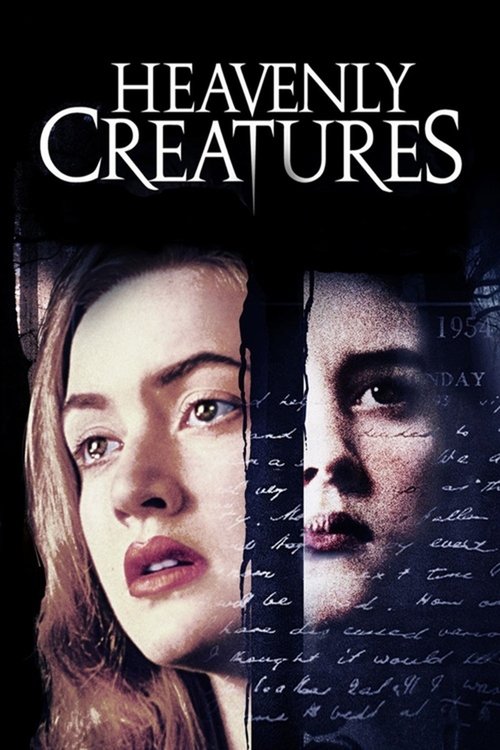
Heavenly Creatures
1994 · Peter Jackson
For when you want to be swept up and then shaken — a film to watch when you're ready for something intoxicating that tips into darkness, and to talk about immediately after.
What it's about
Christchurch, New Zealand, in the early 1950s: Juliet, a dazzling English transplant, befriends Pauline, a quiet, brooding local girl, and the two spin a shared fantasy kingdom out of novels, opera records, and pure imagination. Their bond grows so intense that the adults around them decide it must be broken — with consequences drawn from one of the most notorious true crimes in New Zealand's history.
The experience
Giddy, rapturous, and increasingly frightening — it puts you inside the girls' euphoria so completely that the mounting dread feels like betrayal. Few films capture both the ecstasy of teenage friendship and its capacity to turn dangerous.
Performances
Kate Winslet, in her screen debut, is incandescent as Juliet — imperious, fragile, utterly magnetic — and Melanie Lynskey's inward, smoldering Pauline is every bit her equal; the film lives entirely in the charge between them.
The craft
Jackson swings between grim period naturalism and delirious flights into the girls' imagined 'Fourth World,' with a restless, swooning camera and early digital effects that render fantasy as physical reality. The whiplash between registers is the point — you feel the fantasy pressing against the real.
Why it matters
The film that transformed Peter Jackson from splatter-comedy cult figure into a serious international filmmaker, and it launched Kate Winslet and Melanie Lynskey; it remains a touchstone for portraying obsessive adolescent friendship on screen.
Snapshot
Heavenly Creatures dramatizes one of the most notorious crimes in New Zealand history: the 1954 murder of Honorah Rieper by her fifteen-year-old daughter, Pauline Parker, and Pauline's schoolfriend, Juliet Hulme. Peter Jackson and his partner and co-writer Fran Walsh reconstruct the intense, mutually intoxicating friendship between the two Christchurch girls — their shared literary fantasy life, their invented kingdom of Borovnia, their veneration of tenor Mario Lanza and actor James Mason — and follow it to the point where the prospect of separation drives them to bludgeon Pauline's mother to death in a public park. The film is at once a true-crime reconstruction and a delirious fantasia, alternating grim period naturalism with computer-assisted flights into the girls' imagined "Fourth World." It marked a decisive turn in Jackson's career, away from the gleeful splatter comedies that had made his name toward controlled, emotionally serious filmmaking, and it introduced two future stars — Melanie Lynskey and Kate Winslet — in their screen debuts.
Industry & production
Heavenly Creatures was produced within New Zealand's small, state-supported film sector, with backing that included the New Zealand Film Commission, and released by Miramax internationally, which placed a modestly budgeted local production into arthouse distribution abroad. It was Jackson's first film after the notoriety of Bad Taste (1987), Meet the Feebles (1989) and Braindead/Dead Alive (1992), and the shift in register — from low-budget gore made largely with friends to a period drama about real, recently deceased people — represented a considerable reputational gamble. The Parker–Hulme case remained a live and painful memory in Christchurch, and Jackson and Walsh drew heavily on the documentary record, above all Pauline Parker's diaries, which had been used in evidence at the 1954 trial. The production was shot in and around Christchurch and other New Zealand locations, using the real geography of the case. I do not have a reliable production budget or box-office figure to cite, and won't invent one; the film is generally understood to have been made economically by international standards while performing strongly on the festival and arthouse circuit rather than as a wide commercial release.
A footnote of production history became inseparable from the film's public life: around the time of release, journalism revealed that Juliet Hulme had, in adulthood, become the successful historical and detective novelist Anne Perry, living under that name. The reveal, which the filmmakers have said they did not orchestrate, gave the film an added charge and raised ethical questions about depicting living people whose later lives had taken very different shapes.
Technology
The film is a significant early landmark for digital visual effects in New Zealand. Its production coincided with the founding of Weta (the effects house established by Jackson, Richard Taylor, Jamie Selkirk and collaborators), and Heavenly Creatures became one of the first projects to draw on Weta's fledgling digital-effects capability alongside practical work. The most conspicuous technical achievements are the sequences in which the girls' plasticine figures — the clay inhabitants of Borovnia — come to life at human scale, and the morphing transitions between the mundane world and the fantasy realm. These blended practical model work, life-size costumed figures, and early computer-generated imagery and digital compositing. In an era when CGI was still associated chiefly with big-budget Hollywood spectacle, the film demonstrated that a small national industry could deploy the new tools expressively rather than merely for scale — a proof of concept that fed directly into the infrastructure Jackson would later marshal for The Lord of the Rings.
Technique
Cinematography
Shot by New Zealand cinematographer Alun Bollinger, the film's visual style is defined by mobility and subjective heightening. Bollinger and Jackson use restless, swooping camera movement — gliding tracking shots and Steadicam-style motion — to render the girls' euphoria as physical momentum, most memorably in scenes of the two running and spinning through gardens and fields. Color is used programmatically: the "real" Christchurch of the early 1950s is rendered in a controlled, slightly drab period palette, while the fantasy interludes and the girls' shared ecstasies are saturated and dreamlike, the light softening and intensifying as the imagination takes over. The camera frequently adopts a low or subjective vantage that pulls the viewer inside the folie à deux rather than observing it clinically.
Editing
Jamie Selkirk's editing is the film's structural engine, because the narrative depends on rapid, fluid movement between registers — from diary voiceover to dramatized event, from documentary-flavoured reconstruction to full-blown fantasy. Transitions are often designed as transformations rather than cuts: the world of Christchurch dissolves or morphs into Borovnia and back, so that the fantasy is not bracketed off as separate but bleeds continuously into lived reality. The pacing accelerates as the girls' bond tightens and the plan to kill takes shape, and the cross-cutting between the mounting fantasy and the approaching act builds the climax's terrible momentum.
Mise-en-scène / staging
The production design reconstructs 1950s Christchurch — Girls' High School, the Hulmes' comparatively grand household, the Riepers' more modest boarding house — with period specificity, then sets against it the hand-made grotesquerie of Borovnia, its plasticine court and outsized clay figures. The contrast between repressive mid-century propriety (school uniforms, parental authority, medical and psychiatric intervention) and the girls' baroque interior kingdom is staged as a war between surfaces. The climactic murder is staged in a park path in Victoria Park, the ordinariness of the setting sharpening the horror.
Sound
Music is central to the girls' world and to the film's sound design. Their idolization of Mario Lanza means his recordings recur as objects of worship, and opera and romantic song saturate their fantasy life. The score by Peter Dasent works alongside this diegetic and source music to knit the naturalistic and fantastical strands together. The murder sequence is scored to swelling operatic music — the film sets the brutal act against soaring song from the operatic repertoire (associated with Puccini's La Bohème), a wrenching counterpoint that fuses the girls' aesthetic rapture with the violence it curdles into. Pauline's diary is delivered in voiceover, her flat, matter-of-fact narration providing an intimate, chilling access to her interior logic.
Performance
The two central performances are the film's foundation, and both actors were newcomers. Melanie Lynskey, cast from a New Zealand school in her screen debut, plays Pauline Parker as sullen, watchful and inward, her resentment and devotion held tightly beneath the surface. Kate Winslet, also in her film debut, plays Juliet Hulme as voluble, imperious and magnetic — the more theatrical of the pair. The performances chart the friendship's escalation from shared enthusiasm into a sealed, delusional intimacy, and they refuse both easy condemnation and easy sympathy. Sarah Peirse plays Honorah Rieper, the mother whose murder the whole film moves toward, and the adult ensemble (parents, teachers, doctors) embodies the adult world's alarmed, clumsy attempts to break the girls apart.
Narrative & dramatic mode
The film operates in a hybrid mode: true-crime reconstruction fused with subjective fantasy. Its architecture is essentially tragic and inevitable — it opens near the aftermath, so the viewer knows a killing is coming, and the drama lies in watching how an adolescent friendship becomes lethal. Pauline's diaries supply a first-person spine, and much dialogue and incident is drawn from the documentary record, lending the naturalistic scenes a reportorial authority. Against that, the fantasy sequences give the film access to the girls' own account of themselves — their sense of being exceptional beings sharing a private genius the adult world cannot grasp. The dramatic tension is generated by the collision between these two modes: the more vividly the film inhabits the girls' rapturous inner kingdom, the more unbearable the ordinary, physical fact of the murder becomes.
Genre & cycle
Heavenly Creatures sits at the intersection of several traditions: the true-crime drama, the coming-of-age film, and the psychological study of folie à deux — the shared delusional intimacy of two people. It belongs to a lineage of films fascinated by murderous or obsessive female pairs and by adolescent intensity turned dangerous. Its blending of grounded drama with expressionist fantasy also aligns it with a strain of cinema that externalizes interior states rather than merely depicting them. Within Jackson's own filmography it is the pivot film — retaining the transgressive energy and appetite for the grotesque of his early horror-comedies while redirecting them toward psychological and emotional ends.
Authorship & method
The film is authored jointly by Peter Jackson and Fran Walsh, who share the screenplay credit and whose creative partnership it consolidated; their collaboration would define Jackson's subsequent career. Their method here fused meticulous archival research — the diaries, trial record and period detail — with a bold formal willingness to dramatize subjectivity through effects and fantasy. Key collaborators include cinematographer Alun Bollinger, whose mobile, color-conscious camera realizes the tonal split; editor Jamie Selkirk, whose transformational cutting sustains the movement between worlds; and composer Peter Dasent, whose score integrates the operatic and romantic music the girls worshipped. The effects work, drawing on the newly forming Weta with figures including Richard Taylor and Steve Ingram's collaborators (practical) and George Port among the digital artists, was integral to the authorial vision rather than decorative. Jackson's directorial signature — kinetic camerawork, a taste for the grotesque, and an unashamed emotional directness — is fully present, but disciplined here by the gravity of the real story.
Movement / national cinema
Heavenly Creatures is a landmark of New Zealand cinema and of the broader flowering of Antipodean filmmaking in the early-to-mid 1990s. It draws on a specifically New Zealand history and geography, and treats a national trauma — the Parker–Hulme case had long been a byword for shocking crime in the country — with unusual seriousness and formal ambition. It appeared in the same mid-decade moment that saw New Zealand cinema gain unprecedented international visibility, and it demonstrated that a small, publicly supported industry could produce work of festival-level distinction while building indigenous technical capacity. For Jackson specifically, it proved that a director rooted in local, low-budget genre filmmaking could command international critical attention without relocating his base of operations — a precedent for the New Zealand-centred production model he would later scale up enormously.
Era / period
The film is set in Christchurch in the early 1950s, and its period texture is bound up with its themes. The mid-century setting — with its rigid propriety, its distrust of intense same-sex adolescent attachment (which the adult characters pathologize), and its medical and psychiatric responses to the girls' bond — is not mere backdrop but the pressure that helps produce catastrophe. The film reconstructs this world with care while resisting nostalgia; the period's respectability is shown as suffocating, and the adults' well-meaning attempts to intervene as blunt instruments. Made in 1994, the film also carries the marks of its own moment: the early flush of digital effects and a renewed cultural interest in reopening historical crimes from the perspective of their perpetrators' interior lives.
Themes
At its center is the theme of shared fantasy as both liberation and prison — the way two lonely, gifted adolescents build a private world so complete that it displaces reality and its moral constraints. Related themes include the intensity and danger of adolescent friendship and desire; the ambiguity of the girls' bond, which the film presents as passionate and all-consuming without reducing it to a single label; the clash between imagination and repression; and the terrible logic by which love and the fear of separation can rationalize violence. The film also probes the relationship between art, beauty and cruelty — the girls' aesthetic ecstasies and their capacity for murder spring from the same overflowing sensibility — and, in its true-crime frame, the question of how a society understands, judges and remembers a crime committed by children.
Reception, canon & influence
Heavenly Creatures was widely acclaimed on release and is generally regarded as Jackson's breakthrough into serious international regard. It was recognized at the Venice Film Festival, where it received a Silver Lion, and it earned Jackson and Walsh an Academy Award nomination for Best Original Screenplay at the 1995 ceremony — a striking honor for a low-budget New Zealand picture and for a director previously known for splatter comedy. Critical writing praised its formal daring, its refusal of easy moralism, and the two lead performances.
Its influences run backward to the documentary record of the Parker–Hulme case — the diaries, the trial, the real Christchurch settings — and to a cinematic tradition of subjective fantasy and of films about obsessive, isolated pairs; the girls' own cultural idols (Mario Lanza, James Mason, the romantic and operatic repertoire) are woven into the film's texture as objects of the period's aspirational fantasy.
Its legacy runs forward on several tracks. It launched the screen careers of Melanie Lynskey and, especially, Kate Winslet, who would move quickly to Sense and Sensibility and international stardom. It confirmed the Jackson–Walsh partnership and the New Zealand-based, technically self-reliant production model that would culminate in The Lord of the Rings, and it was an early proving ground for the digital-effects expertise that became Weta. More broadly, it stands as a touchstone for the subgenre of empathetic, formally adventurous true-crime cinema told from inside the perpetrators' experience, and its afterlife was extended by the real-world revelation of Juliet Hulme's identity as novelist Anne Perry, which kept the film — and the case it dramatizes — in public conversation for years afterward.
A Deleuzian reading
Two girls are running through a garden in Christchurch, and the camera runs with them, low and swooping, ducking the hedges.
The full Deleuzian reading of Heavenly Creatures →
Reception
In 1994 it stunned people that the splatter-gore guy behind Bad Taste and Braindead could make this — it won the Silver Lion at Venice and an Oscar nod for its screenplay. Now it's read as the hinge of Peter Jackson's whole career, the film that proved he could handle scale and feeling before Lord of the Rings, and many fans still call it his best.
How Heavenly Creatures was received, from release to now →
How to watch Heavenly Creatures: what to notice on a first viewing
- Watch the camera run and spin with the girls. Bollinger keeps the camera low and mobile, gliding and swooping as Pauline and Juliet run through gardens and fields, so their excitement becomes the camera's own movement. The camera does not watch their joy from outside. It moves the way the joy itself feels.
- Notice when the color turns rich and dreamlike. Christchurch is shot in a drab, controlled period palette. Whenever the girls slip into their invented kingdom the light softens and the color saturates, with no cut marking the change. Color is not decoration here. It tells you, shot to shot, whether you are in Christchurch or inside the girls' shared mind.
- Listen for Mario Lanza's recordings playing like relics. The girls play Lanza's tenor recordings and worship James Mason's face, treating them as sacred objects rather than entertainment. Opera and romantic song saturate every scene of their invented world. Their fandom is not a hobby. It is the raw material their private religion is built from.
- Watch how differently Lynskey and Winslet hold themselves. Melanie Lynskey plays Pauline sullen and watchful, keeping everything held in. Kate Winslet plays Juliet voluble and theatrical, projecting outward. The friendship escalates from that contrast into a sealed, shared world. Two opposite temperaments feed each other until neither girl needs anyone else.
- Notice the hand-made clay figures appear at human size. Borovnia's court, plasticine courtiers and a clay prince, is staged at human scale inside ordinary New Zealand settings: gardens, bedrooms, hillsides. The homemade grotesquerie sits inside real 1950s Christchurch rather than a separate world. The fantasy is built by hand into the same space as everyday life, not kept apart from it.
The whole guide to watching Heavenly Creatures, with the keys for a rewatch →
Influences: the films it descends from and the films it influenced
- Bad Taste (1987) — Established the DIY, New Zealand self-reliant production model — homemade rigs and in-house effects built by the filmmakers themselves — that Heavenly Creatures industrialized into the nucleus of Weta.
- Meet the Feebles (1989) — Jackson's grotesque latex-and-foam puppet craft directly prefigures the plasticine Borovnia courtiers who lumber through the girls' fantasy kingdom.
- Braindead (Dead Alive) (1992) — The swooping, careening handheld camera and the practical gore crew that would become Weta are carried wholesale into the delirious camera moves of the fantasy set-pieces.
- Willow (1988) — ILM's pioneering computer morph (the sorceress transformation) established the seamless dissolve-of-forms as a narrative tool that Jackson repurposes for the real-to-fantasy morph transitions.
- Terminator 2: Judgment Day (1991) — The T-1000's liquid digital morphing supplied the just-invented CGI technique Jackson and George Port adapted to melt Christchurch reality into the plasticine Fourth World.
- Badlands (1973) — Its romantic, incantatory diary voiceover — a young girl narrating a real killing spree from inside a dreamy adolescent interior — is the template for Pauline's rapturous diary narration.
- In Cold Blood (1967) — Model for meticulously researched true-crime reconstruction that inhabits the killers' subjective experience rather than judging it from outside.
- Repulsion (1965) — Renders a young woman's psychological unraveling as literal distortion of her physical environment — the subjective-camera device by which the girls' shared delusion warps the world onscreen.
- A Matter of Life and Death (1946) — Its programmatic color-coding of two coexisting worlds (one Technicolor, one monochrome) is the precedent for HC's palette shifts that mark the boundary between Christchurch and Borovnia.
- The Red Shoes (1948) — Fuses an operatic/romantic score with a heightened fantasy set-piece and idol-worship of the artistic sublime — the operatic counterpoint and Mario Lanza reverence woven through HC's soundtrack.
- The Strange Ones (1950) — Dramatizes the same two-person sealed fantasy world structured by a recited private myth that escalates toward catastrophe.
- The Frighteners (1996) — Weta's first fully CGI-driven feature, built directly on the digital-effects pipeline and personnel that Heavenly Creatures had incubated.
- The Lord of the Rings: The Fellowship of the Ring (2001) — The New Zealand-based, technically self-reliant Weta production model and the Jackson–Walsh authorial partnership that HC consolidated reach full scale.
- The Virgin Suicides (1999) — Extends the same subjective adolescent reverie — period romantic idols, soft diary-driven interiority, girls' fantasy life as a sealed sensory world set against a repressive milieu.
- Pan's Labyrinth (2006) — Intercuts a child's meticulously designed escapist fantasy realm with brutal reality, using the fantasy world as psychic liberation from an oppressive prison — HC's fantasy-versus-reality architecture.
- I, Tonya (2017) — Formally playful, empathetic true-crime told from inside the perpetrators' subjectivity, refusing easy moralism about a notorious real case.
- The Lovely Bones (2009) — Jackson's own template for braiding a subjective, effects-built fantasy world against a real adolescent murder — the imagined register rendered as literal spectacle intercut with mounting dread, the direct precursor to the in-between heaven.
- The Craft (1996) — Jackson shoots two girls' shared invented world with full subjective conviction, the camera adopting the fantasy rather than framing it as pathology — the permission that lets The Craft's rituals be played straight instead of ironized.
- Excision (2012) — Cuts a teenage girl's lavish, effects-built fantasy world against a drab domestic reality and builds to a real act of violence, the same structure as Excision's tableau interludes breaking into the suburban scenes.
- Memento Mori (1999) — Uses a schoolgirl's diary as both narration and a way into a private world, so that an obsessive friendship between two girls is told through the artefact they leave behind. Critics compare the two films, but neither director has confirmed it as an influence.
- Sister My Sister (1994) — Same-year dramatization of a real folie à deux between two isolated women (the Papin sisters) whose sealed private world escalates to murder — the identical genre of the sealed-pair true-crime study.
- Fun (1994) — Two teenage girls locked in an intoxicating mutual fantasy commit a real thrill-killing — the same folie à deux structure told from inside the bond.
- La Cérémonie (1995) — A female folie à deux whose private bond escalates, via cross-cut momentum, into a domestic murder — the same year's parallel anatomy of two women killing as one.
- Sweetie (1989) — Builds on the comedy-to-catastrophe structure, letting repressed desire and shared fantasy escalate from giddy comedy to domestic violence in an Antipodean register.
- An Angel at My Table (1990) — Extends New Zealand national cinema's turn to real local figures — girls violently at odds with their world — riding the international profile Angel helped raise for NZ film.
- Heathers (1989) — Jackson runs a girl's own diary prose as voiceover over a folie-à-deux that escalates to murder, using the private-document narration to make the audience complicit in a fantasy logic before the killing lands — the same complicit-narrator machine, sourced from a real diary rather than an invented one.
Similar films
- Repulsion (1965) — influence & lineage · often watched together
- When Marnie Was There (2014) — often watched together
- Romeo and Juliet (1968) — often watched together
- The Lovely Bones (2009) — shared sensibility
- The Piano (1993) — shared sensibility
- Moonrise Kingdom (2012) — shared sensibility
- Little Amélie or the Character of Rain (2025) — shared sensibility
- Breaking the Waves (1996) — shared sensibility