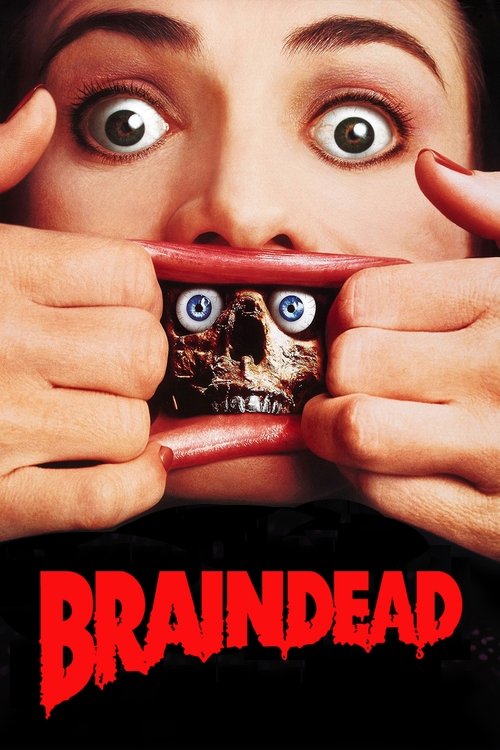
Braindead
1992 · Peter Jackson
For a rowdy night with friends and a strong stomach — when you want to laugh and shriek at the same time. Pure midnight-movie energy; do not pair with dinner.
What it's about
A meek Wellington son lives under the thumb of his domineering mother — until she's bitten by a Sumatran rat-monkey and starts to change into something that bites back. As the infection spreads through the neighborhood, Lionel tries desperately to keep the growing horde of undead hidden in the family house, all while courting the girl he loves. Suburban propriety and total carnage are on a collision course.
The experience
Deliriously funny and unbelievably gross in equal measure — gore staged with the timing of slapstick comedy, escalating until you're laughing at things you can't believe you're watching. Underneath the mayhem it's oddly sweet, which is its secret weapon.
The craft
Peter Jackson, pre-Middle-earth, turns latex, puppetry, and reputedly record-breaking quantities of fake blood into handmade folk art — the finale alone pumped hundreds of liters through the set. The practical-effects invention is relentless, and the infamous lawnmower sequence is a masterclass in escalation; the messier your screen setup, the better it plays with a crowd.
Why it matters
The delirious peak of Jackson's splatter years and a cornerstone of the horror-comedy canon — the film fans point to when explaining how the director of Lord of the Rings learned his craft.
Before Middle-earth, Peter Jackson was New Zealand's mad prince of splatter, and this is his delirious masterpiece — the film that reputedly holds the record for the most fake blood ever pumped through a single production, some 300 liters in the finale alone. A meek Wellington son, a domineering mother, a Sumatran rat-monkey, and suburban propriety collapsing into carnage: Jackson plays it as pure slapstick, staging gore gags with the timing of silent comedy — Buster Keaton by way of the abattoir. Shot with the resourceful DIY ingenuity that defined the Kiwi genre boom of the era, it turns latex and karo syrup into a kind of folk art. The lawnmower sequence has passed into legend, but the film's secret weapon is its sweetness — a genuine love story and a portrait of maternal smothering lurk under the viscera. Released stateside in a trimmed cut as Dead Alive, it circulated for decades on battered tapes among horror devotees. Jackson's next film was Heavenly Creatures; the leap suddenly made sense.
A Deleuzian reading
A man walks into a house party holding a lawnmower at waist height, blades pointed out.
The full Deleuzian reading of Braindead →
Reception
Too gory for many markets in 1992 — it was cut or banned in several countries and stayed a horror-circuit secret — but it's since been canonized as the pinnacle of splatter comedy and the go-to 'can you believe the LOTR guy made this?' watch.
How Braindead was received, from release to now →
Influences: the films it descends from and the films it influenced
- Bad Taste (1987) — Jackson's own DIY debut established his homemade-latex, garden-shed practical-effects method — brains scooped and eaten on camera — that Braindead scales up with the same backyard-engineering ethos.
- The Evil Dead (1981) — Raimi's kinetic prowling camera and the fusion of gooey full-body practical gore with comic timing is the 'splatstick' grammar Braindead inherits wholesale.
- Evil Dead II (1987) — Its Three-Stooges-meets-Grand-Guignol tone — a hero battling his own possessed body parts in choreographed slapstick — is the direct template for Braindead's gag-driven dismemberment set pieces.
- Re-Animator (1985) — Gordon's straight-faced medical-splatter comedy, where reanimated corpses spill absurd volumes of viscera as punchlines, pioneered the deadpan mad-science gore Braindead pushes to its arterial limit.
- Blood Feast (1963) — Lewis invented the gore film as folk-art spectacle — bright offal displayed for its own tactile shock — the naive viscera-as-craft tradition Braindead consciously exaggerates.
- Night of the Living Dead (1968) — Romero codified the escalating single-location siege by shambling undead that Braindead's house-party climax turns into a slapstick massacre.
- The General (1926) — Keaton's precise silent-comedy physical timing and escalating mechanical gags are the editing rhythm Braindead borrows to make gore land as a laugh rather than a scare.
- Dawn of the Dead (1978) — Carries Savini's practical-prosthetic gore to absurdist extremes, treating latex splatter as slapstick — the direct maximalist heir of Dawn's effects.
- House (1977) — Carries forward the splatstick register where escalating, absurd practical gore is played for cartoon comedy rather than dread.
- The Return of the Living Dead (1985) — Takes Return's containment farce to its endpoint: sedation, basement storage and dismemberment each fail in sequence inside a domestic space, executed entirely with articulated practical puppetry and pumped fluids rather than optical work.
- Heavenly Creatures (1994) — Jackson channels Braindead's rubber-corpse craftsmanship into the morphing plasticine fantasy figures and suffocating maternal dread, proving the splatter workshop was training for tonal control.
- Shaun of the Dead (2004) — Wright extends Braindead's love-story-buried-under-viscera structure, using silent-comedy match cuts and rhythmic editing to time zombie violence to comic beats.
- Slither (2006) — Gunn revives Braindead's suburban-order-drowning-in-practical-goo template, favoring squishy animatronic creature effects over CGI for the same tactile gross-out joy.
- Deathgasm (2015) — A direct heir of the Kiwi genre boom, it stages a lawnmower-and-power-tool splatter finale with the same buckets-of-blood DIY practical craft Braindead made a national signature.
- Housebound (2014) — Johnstone carries forward the New Zealand horror-comedy lineage Jackson founded, mining maternal-smothering and suburban-propriety collapse for genre laughs on a homegrown craft budget.
- Tokyo Gore Police (2008) — Nishimura's geysering arterial-spray excess and prosthetic mutation set pieces escalate Braindead's principle that absurdly over-scaled practical gore becomes its own comic spectacle.
- Terrifier 2 (2022) — Jackson's escalation calculus, in which every practical gore gag must exceed the last in sheer volume until excess tips into comedy, governs Terrifier 2's climb from the diner to the bedroom.
- The Toxic Avenger (1984) — Troma's gleeful cartoon ultra-violence played for gross-out comedy shares Braindead's aesthetic of excess-as-punchline and low-budget rubber carnage.
- Basket Case (1982) — Henenlotter's grimy stop-motion-and-latex monster comedy weds a tender relationship story to eruptions of homemade gore, the same viscera-plus-heart formula Braindead runs.
- Society (1989) — Screaming Mad George's climactic 'shunting' body-melt uses the same lavish practical-goo prosthetics and social-propriety-dissolving-into-flesh imagery as Braindead's finale.
- Meet the Feebles (1989) — Jackson's immediately preceding film applies the same gross-out maximalism and technical-craft-in-service-of-taboo approach, a puppet dry run for Braindead's mechanical mayhem.
- Street Trash (1987) — Its meltdown effects — bodies dissolving into rainbow sludge as comic set pieces — share Braindead's conviction that lovingly crafted practical goo is itself the entertainment.
- Evil Dead Burn (2026) — Splatstick maximalism directly descended from Evil Dead II — practical bodily excess pushed to theatrical spectacle, the 'effective gross-out Guignol' register.
- Death Becomes Her (1992) — The contemporaneous splatstick extreme of the reanimated, falling-apart body played for grotesque laughs, sharing DBH's horror-comedy of literal bodily disintegration.
- Evil Dead (2013) — Extends the Raimi splatter tradition into practical-gore maximalism — the shared conviction that excess should be achieved with physical goo, blades, and prosthetics on set.
- Riki-Oh: The Story of Ricky (1991) — Contemporaneous maximalist splatstick that pushes gore volume past any realism into absurd excess while committing with earnest energy — the same trust-the-excess bet Riki-Oh makes.
- Army of Darkness (1992) — Released the same year and working the same problem — gore staged as silent-comedy choreography, with pumped practical rigs and blood volumes so absurd they read as slapstick rather than horror; Jackson's lawnmower set piece is the antipodean twin of Raimi's windmill.
Similar films
- Re-Animator (1985) — influence & lineage
- Evil Dead II (1987) — influence & lineage
- Night of the Living Dead (1968) — influence & lineage
- Shaun of the Dead (2004) — influence & lineage · same viewing thread
- The Return of the Living Dead (1985) — same viewing thread
- One Cut of the Dead (2017) — same viewing thread
- Army of Darkness (1992) — same viewing thread
- Dawn of the Dead (1978) — same viewing thread
All the films related to Braindead →
Watch it with: curated runs of related films
- The Undead, Played for Laughs — A run of horror comedy — vampire flatmates bickering over the dishes, slackers fumbling through the zombie apocalypse — set against the Romero classic they're all winking back at.