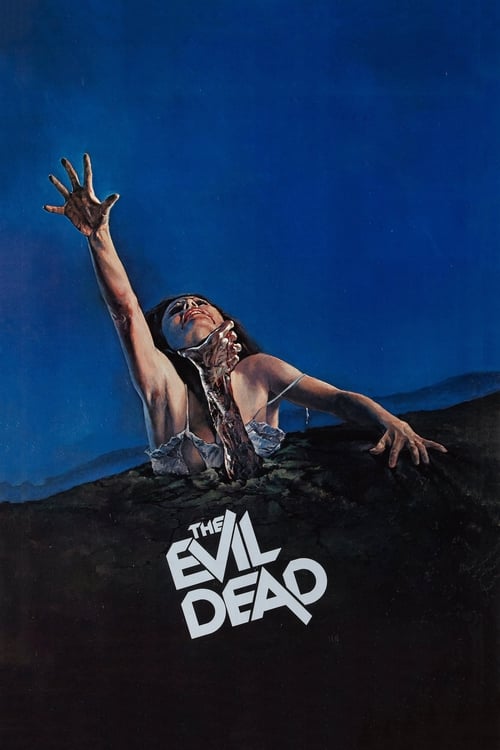
The Evil Dead
1982 · Sam Raimi
For when you want horror raw and unpolished — a midnight movie to watch loud, ideally with friends who can handle it. This is challenge viewing, not a cozy scare; the squeamish should sit it out.
What it's about
Five college friends rent a rundown cabin deep in the Tennessee woods for a cheap weekend away. In the cellar they find an ancient book bound in strange skin and a tape recording of an archaeologist reading from it — and playing the tape wakes something in the forest that gets into the group one by one, turning friends into the things that have to be destroyed.
The experience
Relentless, grimy, and gleefully excessive — the camera itself feels possessed, hurtling through the woods and around the cabin. It's frightening and grueling in equal measure, with gore so over-the-top it tips into a kind of delirium.
Performances
Bruce Campbell, in the role that launched a cult career, spends the film being physically demolished as Ash — his escalating, wide-eyed endurance is the movie's human anchor.
The craft
Made by three friends from Detroit on almost no money, it's a masterclass in what a camera can do when there's no budget for anything else: Sam Raimi mounts it on boards, shoves it through windows, and sends it screaming through the forest at ground level. The homemade practical effects — stop-motion, latex, gallons of fluid — give it a handcrafted intensity slicker films can't fake.
Why it matters
A foundational text of DIY independent horror, it launched Raimi and Campbell, spawned a beloved franchise, and became the template for a generation of cabin-in-the-woods movies and no-budget filmmakers.
Snapshot
A first feature made by three friends from suburban Detroit — director Sam Raimi, producer Robert Tapert, actor Bruce Campbell — in a collapsing cabin in rural Tennessee, The Evil Dead is the purest surviving specimen of American regional horror at the moment that mode passed into the video era. Five students find a Sumerian book of the dead and a reel-to-reel recording in the cellar of a rented cabin; the recording, played aloud, wakes something in the woods, and the group is destroyed one by one from inside its own ranks. The plot is threadbare on purpose. What the film actually delivers is a demonstration of what a camera can be made to do when nobody involved has the money to do anything else, and when the director has decided that momentum is a substitute for coverage.
Its historical importance is threefold. It supplied the template for the "cabin in the woods" horror film as a self-conscious subgenre. It established a grammar of aggressive, unmotivated camera movement — the low sprint through undergrowth, the whip pan, the crash zoom into a face — that entered the mainstream through Raimi's own later career and through the filmmakers who imitated him. And its distribution history, from the Cannes market to a Stephen King rave to the British "video nasty" prosecutions, made it a case study in how a horror film's reputation is manufactured outside the studio system.
Industry & production
Raimi, Tapert and Campbell had been making Super 8 comedies and horror shorts around Michigan State University and the Detroit suburbs through the late 1970s. Their production entity, Renaissance Pictures, was formed to make a saleable feature, and their route to financing was itself the innovation: rather than pitch a script, they shot a roughly half-hour Super 8 prototype, Within the Woods (1978), and screened it for prospective investors — dentists, doctors, lawyers and small businesspeople in the Detroit area — as proof that they could deliver a finished, frightening object. The feature was capitalized as a limited partnership. Budget figures reported over the years vary considerably and should be treated as approximate; the commonly cited range runs from an initial raise in the low six figures to a total, including post-production and the blow-up to 35mm, of roughly a third of a million dollars.
Principal photography began in late 1979 near Morristown, Tennessee, in an abandoned cabin the production winterised badly. The shoot is one of the better-documented ordeals in independent film — Bill Warren's The Evil Dead Companion remains the standard account — and the conditions bear directly on what is onscreen: freezing temperatures, no working plumbing, furniture burned for heat, a schedule that ran far past its plan, and a crew that thinned as weeks passed. Cast members endured hours in latex and painful scleral contact lenses. When actors became unavailable for the extensive pickups shot later in Michigan, Raimi doubled them with whoever was around, crediting these substitutes as "Fake Shemps" — a Three Stooges joke, after the shorts completed with stand-ins following Shemp Howard's death, and a fair index of the production's temperament.
Distribution was secured not through a studio but through Irvin Shapiro, the veteran sales agent whose credits included handling Night of the Living Dead. Shapiro is generally credited with changing the title from Book of the Dead — too studious, he judged — to The Evil Dead, and with placing it at the Cannes market in 1982. Stephen King saw it there and wrote a rave in Twilight Zone Magazine, calling it the most ferociously original horror film of the year; that endorsement did more for the picture's commercial life than any review. New Line Cinema took U.S. rights and opened it in April 1983; Palace Pictures handled the U.K. The film's gore placed it at the outer edge of what the MPAA would certify, and it circulated in America as a hard-edged, essentially unrestricted release marketed on the tagline "The Ultimate Experience in Grueling Terror." New Line's success with it is routinely cited as part of the run-up to the company's financing of A Nightmare on Elm Street the following year.
Technology
The film is a catalog of format constraint turned into style. It was shot on 16mm and optically blown up to 35mm for theatrical release, which is why the image carries so much grain and such saturated, slightly unstable color — a texture that reads today as authenticity but was, at the time, simply the cheapest path to a projectable print. The 16mm camera's light weight is the enabling condition for the entire visual scheme: a 35mm body could not have been run through the woods on a plank.
Effects were achieved in-camera and on the bench. Tom Sullivan designed and built the Naturom Demonto prop — the leathered, hand-inked book that became the franchise's central icon — along with the creature makeup and much of the animation; Bart Pierce handled optical and photographic effects work. The extended final "meltdown," in which the possessed bodies decompose, is a hybrid of stop-motion, replacement puppetry, latex appliances and organic material, shot over an extended period with a skeleton crew after the main unit had dispersed. Nothing in it is composited in the modern sense; the illusions are physical events recorded in real time, and the sequence's peculiar rhythm — too long, too detailed, weirdly tender toward its own ugliness — follows from the labor required to produce it frame by frame.
Technique
Cinematography
Tim Philo shot the film, with additional photography during the Michigan pickups. The scheme has three registers. The first is the ground-level demonic point-of-view: a camera mounted on a length of timber and carried at a run by two operators, a rig the crew nicknamed the shaky-cam, which produces the film's signature shot — the evil force tearing through the forest floor, over stumps and through windows, at a speed and altitude no human could match. It is a Steadicam effect achieved by refusing the Steadicam's premise; the instability is the content. The second register is the wide-angle close-up: faces pushed into a short lens at low angle, distorted, isolated against the cabin's low ceilings. The third is the punitive crash zoom, used to convert a static composition into an assault without a cut.
What unifies them is that the camera is a character with intentions. Its movements are not motivated by any character's attention, which is precisely how the film establishes the presence of something that is never given a body.
Editing
Edna Ruth Paul cut the picture in New York, with Joel Coen among the assistants — the beginning of a genuine professional friendship. Raimi and the Coens went on to co-write Crimewave (1985), and the Coens' method of financing Blood Simple by shooting a demonstration trailer for investors follows Raimi's Within the Woods strategy closely enough that the debt is usually acknowledged.
The cutting is percussive rather than elegant. Sequences are built from short, hard-contrasting shots — an insert of a hand, a pendulum swing of a wall clock, a face — assembled at a tempo faster than the staging strictly requires, so that the film seems to be flinching. The pickups shot months later in Michigan required the edit to carry considerable geographic and continuity strain; the aggressive rhythm partly conceals it. In the last act, the pace inverts: the meltdown is held far past comfort, and the sudden refusal to cut away is the film's most effective cruelty.
Mise-en-scène / staging
The set is a trap with a fixed inventory: a main room, a cellar reached by a trapdoor, a porch, a bridge out, and the woods. Raimi maps this space early and then systematically closes it — the bridge collapses, the cellar fills, the doors fail — so that the second half plays as a siege in the tradition of Night of the Living Dead, with the crucial variation that the enemy is generated from within the group. Staging exploits verticality obsessively: the trapdoor, the cellar stairs, bodies dragged down and hands coming up. Blood is not naturalistic; in the finale it arrives in unnatural volumes and colors, closer to a gag structure than to gore realism.
Sound
The unseen force is largely a sound design. Animal shrieks, pitched-down growls, wind, and the distorted chorus of voices calling to the living do the work that no visible antagonist can. The reel-to-reel recording is both plot device and thesis: what damns the characters is playback, an archived voice reproduced in a room. Joseph LoDuca, scoring his first feature, wrote a small-forces score mixing strings, piano and electronics, avoiding the synthesiser-ostinato conventions of the contemporaneous slasher cycle; he would score every subsequent Raimi Evil Dead entry and much of the Renaissance television work that followed.
Performance
The acting is amateur in the technical sense and mostly unhelped by the direction, which is uninterested in interiority. Its value is elsewhere. Bruce Campbell's Ash is not yet the wisecracking hero of the sequels — he is passive, terrified and slow to act, a rare male "final" survivor played without competence — and the contrast with what the character became is a large part of why the first film reads differently from the franchise. Ellen Sandweiss (Cheryl), Betsy Baker (Linda) and Theresa Tilly and Richard DeManincor, both billed under pseudonyms, carry the heavier physical burden: the possessed performances, played in full makeup with white lenses, are the film's most committed work, closer to sustained physical theater than to screen acting.
Narrative & dramatic mode
The screenplay is deliberately minimal — an inciting object, an isolated location, an attrition structure — and the film is best understood as ordeal cinema rather than mystery. There is no investigation, no rule-set to master, and no rescue plot; the one attempt to leave establishes that leaving is impossible. The dramatic engine is the conversion of intimates into threats, which the film stages as a betrayal of care: the survivors keep trying to contain and comfort people who are no longer people. What tonal complexity exists comes from the friction between the sincerity of the terror and the gleeful excess of the effects, a friction Raimi would resolve four years later by tipping the same material openly into farce.
Genre & cycle
The Evil Dead arrives inside the slasher boom that followed Halloween (1978) and Friday the 13th (1980) but is not a slasher. Its antagonist is demonic rather than human, its violence supernatural rather than criminal, and it has no interest in the whodunit or the moralized kill order. Structurally it descends from Romero's siege film and from The Texas Chain Saw Massacre's rural-trap horror, with the possession premise of The Exorcist redistributed across an entire cast. What it invented, or at least fixed permanently, is the cabin-in-the-woods configuration as a recognizable, repeatable form: young people, remote structure, cellar, cursed text, no exit.
Authorship & method
Raimi's authorship here is not thematic but instrumental. The recurring signature — a camera that behaves like a predator, staging built around thresholds and low angles, violence choreographed as slapstick — is present in embryo and would be refined across Evil Dead II (1987), Darkman (1990), Drag Me to Hell (2009) and the Spider-Man films. The method is collaborative and durable: Tapert produced, Campbell starred, LoDuca scored, and the same core team carried into Xena and Hercules and the later franchise entries. Sullivan's designs, Philo's photography and Paul's cutting are the other decisive hands. Raimi has been candid in later interviews about regretting the sequence in which Cheryl is assaulted by the forest, judging it gratuitous — an unusual instance of a director publicly disowning a scene that is among his film's most notorious.
Movement / national cinema
The film belongs to American regional independent horror: work made outside Los Angeles and New York, financed locally, staffed by non-professionals, and sold through independent agents into drive-ins, grindhouses and, decisively by 1982, video shops. Its peers are Romero's Pittsburgh, Hooper's Austin and Craven's early East Coast productions. Raimi's Michigan cohort is the last significant node in that lineage, and its afterlife — the Coen connection, Renaissance's move into studio and syndicated television work — marks the point where regional horror stopped being a dead end and became a recognized career path, a decade before Sundance formalized the route.
Era / period
Everything about the film's reception is conditioned by the arrival of the home video cassette. In the United States, video turned a modest theatrical performer into a permanent catalog title and a rental-shelf rite of passage. In Britain, the same technology produced a moral panic: The Evil Dead became one of the most prominent titles on the Director of Public Prosecutions' "video nasty" list, was seized and prosecuted under the Obscene Publications Act, and was cut for its subsequent U.K. video release, only passing uncut by the BBFC in 2001. It is difficult to overstate how much of the film's mystique was built by that suppression.
Themes
The governing idea is contagion through media. Evil enters not by trespass but by reproduction — a book transcribed, a voice recorded, a recording played. The film is unusually literal about this: the characters are destroyed by pressing play. Around that sits a study of the body as unreliable property, with possession rendered as the loss of self-ownership and the survivors forced into dismembering people they love. The forest is granted agency, most disturbingly in the assault sequence, collapsing the distinction between landscape and antagonist. And the film is thoroughly pessimistic about rescue: no authority is contacted, no explanation is offered, and the final shot withholds even survival.
Reception, canon & influence
Contemporary notices were divided along predictable lines — appalled at the gore, impressed by the technique — and the record of individual reviews from 1982–83 is patchier than the film's later fame suggests. King's Twilight Zone Magazine endorsement was the pivotal critical event, functioning as both blurb and legitimation. Reliable box-office figures are inconsistent across sources; what is clear is that theatrical returns were modest and that the film's profitability came from international sales and home video.
Backward, its debts are visible and largely acknowledged: EC horror comics for the punchline structure of the violence, the Three Stooges for the physical comedy that surfaces intermittently and would take over the sequels, Romero and Hooper for the siege and the rural trap, Lovecraft's Necronomicon for the cursed-text conceit — the later films drop the pretense and name the book Necronomicon Ex-Mortis — and Ray Harryhausen for the stop-motion craft ethic of the finale.
Forward, the film's reach is disproportionate to its scale. It generated a franchise that includes Evil Dead II (1987), part remake and part sequel and the point at which the horror-comedy hybrid was perfected; Army of Darkness (1992); Fede Álvarez's 2013 remake; Evil Dead Rise (2023); the Ash vs Evil Dead series; and a stage musical. Its camera style was absorbed by Peter Jackson's early splatter comedies and by a generation of kinetic stylists including Edgar Wright. Its cabin premise became so canonical that The Cabin in the Woods (2012) could be built entirely as commentary on it. Its influence on survival horror gaming — the isolated house, the cursed text, the sudden reversal of a familiar space — has been acknowledged by developers in the Resident Evil lineage, though the specific attributions vary in the telling. And its financing model, prototype short and all, became a standard piece of independent-film folklore, transmitted directly to the Coens and from there into the received wisdom of American independent production.
A Deleuzian reading
Something comes through the woods at knee height.
The full Deleuzian reading of The Evil Dead →
Reception
It arrived as a $400k regional indie that got banned as a 'video nasty' in the UK even as Stephen King was championing it — and it's since climbed from grindhouse notoriety to undisputed horror canon, the film that launched Sam Raimi and Bruce Campbell.
How The Evil Dead was received, from release to now →
How to watch The Evil Dead: what to notice on a first viewing
- Watch the camera race through the woods at knee height, not walking. The crew ran flat out carrying a camera lashed to a plank; this rushing shot recurs whenever the force approaches, moving too fast and low for any person, answering to nobody's gaze. The camera itself becomes the monster: a way of seeing with no body behind it.
- Listen for growls and shrieks with no visible source. The unseen force is built almost entirely from sound: pitched-down growls, animal shrieks, and a chorus of voices calling to the living, never matched to a visible body. Withholding a monster's image makes the threat impossible to locate, contain, or defeat.
- Notice the cabin's fixed spaces: main room, trapdoor, porch, bridge. Raimi maps this small inventory early, then closes each exit one by one across the film: the bridge, the cellar, the doors. Sealing the space raises pressure on everything outside it instead of shrinking the danger.
- Watch how slow and frightened Ash is, not decisive or quick. Bruce Campbell plays this final survivor as passive and terrified throughout, a rare male lead with no early competence or cool. This makes the later franchise's wisecracking hero read as a startling reversal.
- Count how many short, hard-cut shots fill a single ordinary scene. Raimi and editor Edna Ruth Paul assemble sequences from clipped, contrasting shots faster than the staging needs, so the film seems to flinch. This percussive rhythm builds dread and hides the seams of a shoot pieced together months apart.
The whole guide to watching The Evil Dead, with the keys for a rewatch →
Influences: the films it descends from and the films it influenced
- Within the Woods (1978) — The $1,600 proof-of-concept short shot in the same Michigan woods with Campbell — the low demon-POV forest rush, the cursed-object trigger, and the pencil-through-the-ankle gag were blocked there first and re-executed as a shot-for-shot sales reel that raised the feature's money.
- Night of the Living Dead (1968) — Supplies the siege architecture Evil Dead inherits wholesale: a rural house boarded from inside and progressively breached while the survivors' own number is converted into the besieging force, so the plot advances purely by subtraction.
- The Texas Chain Saw Massacre (1974) — The template for 16mm blown to 35mm with the grain used as texture rather than concealed, and for a final reel that abandons narrative for unrelieved sonic assault — screaming, animal noise and machine drone standing in for score.
- Jason and the Argonauts (1963) — Harryhausen's replacement-animation ethic — articulated armatures, frame-by-frame clay decay, dissolution staged as craft spectacle — is exactly what Tom Sullivan and Bart Pierce imitate in the melting-deadite finale.
- The Exorcist (1973) — Codified possession as a combined makeup-and-sound performance system — milky ocular lenses, a pitch-shifted second voice dubbed over the actor's body, taunting mockery aimed at the living — which Raimi miniaturizes into the deadite's sing-song address from the trapdoor.
- Deep Red (1975) — Establishes the unmotivated prowling camera that stands in for an entity the film refuses to show, plus wide-angle fetish inserts of objects; Argento later personally cut and released Evil Dead in Italy, closing the loop.
- Once Upon a Time in the West (1968) — The snap-zoom-into-extreme-wide-angle-close-up grammar — face distorted at the lens edge, zoom used as a percussive punctuation mark rather than a reframing — which Raimi simply runs at horror tempo.
- Men in Black (1934) — Three Stooges gag-cutting where every blow lands on a hard synchronized sound effect and a cut, a timing scheme Raimi transplants onto gore so that mutilation resolves as a punchline rather than a wound.
- The Shining (1980) — Adopted relentless low, gliding Steadicam-style point-of-view movement through interior space to embody a malign force stalking victims — the Overlook's hallway grammar turned into a roving menace.
- Dawn of the Dead (1978) — Low-budget indie horror that escalates the latex-and-Karo-syrup practical-splatter maximalism Dawn legitimized into pure kinetic set-piece.
- House (1977) — Extends the 'house attacks its occupants' kineticism — POV possession-cam, comic bodily dismemberment and gleeful in-camera prop gags.
- Evil Dead II (1987) — Part remake, part sequel — same shot vocabulary rebuilt with the purpose-made 'shakycam' 2x4 rig for the forest charge, and the possession-as-physical-theater premise finally handed to the protagonist himself in the possessed-hand sequence.
- Braindead (1992) — Home-fabricated camera rigs replicating the low ground-skimming predator move through undergrowth, plus the splatstick calculus of escalating practical gore volume against slapstick timing rather than shock.
- Shaun of the Dead (2004) — Converts Raimi's percussive whip-pan-and-hard-sound-cut grammar into a comic engine — the sound effect lands the joke and the cut lands the beat — and stages its third act as a boarded-in siege by attrition.
- Drag Me to Hell (2009) — Raimi's own refinement of the unseen-antagonist design: the entity is announced almost entirely through wind, door pressure, off-screen roar and camera lunge, with the crash-zoom preserved as its signature arrival cue.
- The Cabin in the Woods (2012) — Built as explicit commentary on Evil Dead's own furniture — the isolated cabin, the cellar trapdoor discovered by falling into it, and the cursed Latin diary that must be read aloud to arm the ordeal.
- Evil Dead (2013) — Remakes the film under a practical-effects-first mandate — prosthetics, pumped blood and on-set rigs with digital work restricted to cleanup — deliberately reproducing the 1982 film's tactile-materials constraint as an aesthetic choice.
- Spider-Man 2 (2004) — Raimi's untethered, low-mounted camera charging unbroken through space is the direct grammar behind the web-swinging first-person rushes.
- Tetsuo: The Iron Man (1989) — DIY low-budget kineticism: undercranked chase-cam frenzy, aggressive handheld POV and homemade stop-motion gore proving a tiny crew could generate relentless visual velocity.
- Bad Black (2016) — Homemade practical gore engineered from household materials plus kinetic rig-built camera moves — the same 'fabricate the effect from junk' ethos behind Nabwana's welded props and DIY squibs.
- The Ritual (2017) — Codifies the animate, malevolent woodland where trees and terrain function as an active antagonist rather than passive setting.
- Evil Dead Rise (2023) — Establishes the low-mounted 'Shakycam' force-POV rig — the camera bolted to a plank and hurtled through the space — that renders the demonic presence as a roving first-person camera, a device Rise reprises through its apartment corridors.
- Send Help (2026) — Origin of Raimi's low, gliding subjective 'shakycam' that races through space as an unseen predator-POV — the forced-perspective mobile-camera device Bill Pope extends in Send Help.
- Blood Simple (1984) — Direct transmission of Raimi's production model — limited-partnership financing raised off a shot-for-shot proof-of-concept short, shared crew — along with the low unmotivated floor-level glide that hops obstacles in a single unbroken move.
- A Nightmare on Elm Street (1984) — Parallel commitment to in-camera practical rigs (the rotating bedroom, the pressing wall membrane) over optical work, and an attrition ordeal with no safe interval; the two films cite each other, Evil Dead's poster in Nancy's basement answered by Freddy's glove in the Evil Dead II shed.
- Re-Animator (1985) — Treats a Lovecraft text as a gag engine rather than a mood source, running pump-and-latex gore at comic tempo with the same straight-faced-performer-against-absurd-effect contract Campbell holds.
- Demons (1985) — Extends the media-contagion device outward: where Evil Dead's reel-to-reel playback of the incantation summons what it describes, Demons makes the projected film itself the vector that infects its own audience.
- Raising Arizona (1987) — The low-mounted, ground-skimming 'shaky-cam rush' that hurtles the camera through space is lifted directly from Raimi's kinetic horror POV — the Coens were friends and collaborators of Raimi and adapted his demonic-force gliding camera into comic propulsion.
- Bound (1996) — Direct source of the Wachowskis' virtuoso low-budget 'roving camera' — the swooping, object-hugging, wall-piercing moves (down a phone cord, through paint) learned from Raimi, who produced Bound-adjacent Wachowski scripts and mentored their kinetic grammar.
- Evil Dead Burn (2026) — Establishes the subjective possessing 'force-cam' — a low-mounted rig skimming through the woods to voice the unseen evil's POV — the single grammar Burn inherits from Raimi and Tapert's producing hand.
- Doctor Strange in the Multiverse of Madness (2022) — The seed inherits Raimi's roving, low-to-the-ground predatory 'force-POV' camera that rushes through space as an unseen malevolent presence — deployed in Doctor Strange when the Scarlet Witch stalks the Illuminati.
Similar films
- Evil Dead II (1987) — influence & lineage · same viewing thread
- Evil Dead (2013) — influence & lineage
- The Cabin in the Woods (2012) — influence & lineage
- The Texas Chain Saw Massacre (1974) — influence & lineage
- Night of the Living Dead (1968) — influence & lineage
- The Exorcist (1973) — influence & lineage
- A Nightmare on Elm Street (1984) — influence & lineage
- Evil Dead Rise (2023) — same viewing thread
All the films related to The Evil Dead →
Watch it with: curated runs of related films
- Trapped in the Dark — Watch these as a run of survival horror where the place itself — a chained-shut bathroom, a cabin cellar, a lightless cave, an endless fluorescent nowhere, an emptied city — turns into the thing hunting you.