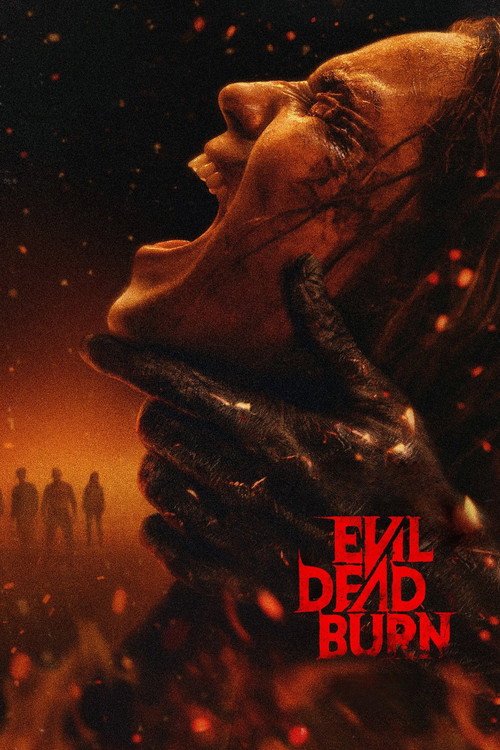
Evil Dead Burn
2026 · Sébastien Vaniček
For when you're craving a real scare with some splatter and swagger — a loud, late-night horror pick to watch with the lights off, not a gentle one. Pure challenge, zero comfort.
What it's about
A grieving widow, undone by her husband's sudden death, moves in with his family hoping to heal. Instead the household starts turning against her — one by one, her in-laws are taken over by something demonic tied to the Book of the Dead, and the promises she made at the altar prove horribly binding. It's a Deadite siege told from inside a family that was already fractured before the demons arrived.
The experience
Relentless once it ignites — the dread builds through funeral-parlor quiet, then tips into gleeful, gory chaos where grief and possession blur together. It's punishing and darkly funny in the way the best Deadite stories are, leaving you wrung out and grinning.
The craft
Sébastien Vaniček comes to the franchise from tense, physical creature horror, and this leans into practical mayhem: cramped domestic spaces turned hostile, sound design that makes every whisper and creak count. It rewards good speakers and a dark room — the assault is as much sonic as visual.
Why it matters
Part of the ongoing revival of one of horror's most beloved franchises, which has been handing its demons to a new generation of directors and letting each reinvent the nightmare. It's also a marker of how European genre filmmakers are being recruited into big American horror.
Horror · Possession & occult · Splatter & gore. A grieving widow's in-laws turn demonic one by one: a cramped, nasty, splatter-soaked possession siege with a vicious streak of dark humor.
Variety is paywalled, but I have ample grounding from the other sources. Writing the dossier now.
Snapshot
Evil Dead Burn is the sixth theatrical entry in the Evil Dead franchise Sam Raimi launched in 1981, and the first to be directed by Sébastien Vaniček, the French filmmaker who broke through internationally with the creature feature Vermines (Infested, 2023). Released in France on July 8, 2026 and in the United States on July 10, it runs 109 minutes and carries a hard R for what its rating summary calls strong bloody horror violence, gore, and language. The premise refits the series' possession template to a grief chamber piece: Alice (Souheila Yacoub), newly widowed, gathers with her husband's family at a lakeside house for his cremation, and the household turns Deadite one member at a time as the Necronomicon and the Kandarian Dagger resurface. The TMDB logline — that "the vows she took in life survive even in death" — points to the film's organizing idea, marriage as a bond that outlasts the body, which Vaniček has described as the reason for the title. Produced on a reported $20 million budget for roughly $28 million worldwide, it landed as a modest commercial performer and a mixed-to-favorable critical proposition (69% on Rotten Tomatoes across 164 reviews, 54 on Metacritic, a B CinemaScore), with near-unanimous praise for its practical gore and Yacoub's lead performance, and reservations about its relentless brutality. It is a franchise continuation that positions itself as a sequel to Lee Cronin's Evil Dead Rise (2023) while reaching back to the series' roots.
Industry & production
The film sits at the intersection of a long-running American horror IP and a new generation of international genre directors imported to steward it. It was produced by series creator Sam Raimi and his longtime partner Rob Tapert through their Ghost House Pictures banner, with Bruce Campbell — the franchise's foundational star — and Lee Cronin serving as executive producers, and distribution/production support from New Line Cinema and Screen Gems. That producing configuration is the through-line of the modern Evil Dead: since the 2013 Fede Álvarez remake, Raimi and Tapert have handed each installment to a rising director with a distinctive festival calling card rather than a franchise veteran, a strategy that produced Álvarez's remake, Cronin's Rise, and now Vaniček's Burn.
Principal photography took place in New Zealand — long the franchise's production home through the Ash vs Evil Dead television years and Evil Dead Rise — from July 22 to October 17, 2025, largely around Auckland. Reporting indicates the production leaned on practical locations, including a secluded house that had previously served as "Ruby's House" in the third season of Ash vs Evil Dead, combined with purpose-built studio sets, a continuity of physical infrastructure that helps explain the series' consistent tactile look. The written record on financing specifics and the deal that attached Vaniček is comparatively thin; the well-documented facts are the producing lineage, the New Zealand shoot, and the summer 2026 dating.
Technology
The defining technological choice is a deliberate bias toward practical, in-camera effects over digital construction — the aesthetic contract of the entire Evil Dead line since 1981. Coverage of the production stresses that "everything that could have been done practically was done practically," with prosthetic and appliance makeup carrying the Deadite transformations and the climactic creature realized as a physical build augmented by CGI only for select features. This hybrid discipline — practical foundation, digital assist — mirrors the approach Álvarez took in 2013 and Cronin in 2023, and it is the franchise's answer to a horror landscape that increasingly defaults to full digital gore. Beyond that, granular technical specifications — camera systems, lens packages, whether the film was captured digitally or on film — are not well established in the available record, and I won't guess at them; the safe, documented claim is the practical-first methodology and its CGI supplementation.
Technique
Cinematography
The film was shot by Philip Lozano. The staging inherits the series' signature spatial logic: a single, largely sealed domestic space — here the lakeside family house — treated as a pressure cooker in which the camera becomes an antagonist. Reviews characterize the imagery as visceral and physically punishing, consistent with a Evil Dead house style that favors low, prowling, subjective camera movement (the Raimi "force" POV racing through rooms) and hard, unflinching framing of bodily damage. Detailed technical documentation of Lozano's lighting and lensing scheme is limited in the current record, so the confident reading is confined to what critics observed on screen: an oppressive, close-quartered visual field built to trap both characters and viewer.
Editing
Maxime Caro edited the film, carrying over from Vaniček's French work rather than being drawn from the franchise's prior New Zealand teams — a sign that the director brought his own cutting sensibility into the studio system. Vaniček has described his intended rhythm as a "rollercoaster," alternating comedy and horror, silence and intensity, and the editing is the primary instrument of that oscillation. Critics who admired the film pointed to its escalation — a steady tightening of the screws as family members fall one by one — while detractors located their fatigue in the back half's unrelenting brutality, which is as much an editorial pacing question as a content one.
Mise-en-scène / staging
The production design is credited to Nick Connor, with costumes by Sarah Voon. The core scenario is a chamber horror: a bereaved family assembled in a remote house for a cremation, an occasion whose ritual solemnity the film weaponizes. The one-by-one possession structure is a staging device as much as a plot — it converts a domestic ensemble into a shrinking pool of survivors, and it lets the house's rooms function as discrete arenas. Vaniček has said he deliberately front-loaded "grief, resentment, and old wounds clashing together" before any supernatural rupture, so the mise-en-scène of the early scenes is built to read as a real family under strain, making the subsequent bodily grotesquerie land against a recognizable emotional ground.
Sound
Sound is, by the director's own account, the center of gravity of his method: "That's 80% of the work for me. The sound is so important." The score is by Double Danger — the duo of Douglas Cavanna and Xavier Caux — reuniting with Vaniček after Infested, a continuity that gives the film an electronic-leaning sonic identity distinct from the orchestral-horror tradition. Vaniček credits a longtime sound team that understands his vision well enough to work semi-autonomously, and he frames sound as the tool that manages his tonal "rollercoaster," the silences that precede intensity and the aural assault that follows. In a series whose most iconic effects are aural — the buzz of the possessing force, the wet register of transformation — this emphasis reads as both personal signature and franchise fidelity.
Performance
Souheila Yacoub, coming off Dune: Part Two, anchors the film as Alice, and she is the element critics single out most consistently, praised for bringing strength and genuine emotion to a role that must sustain both a grief narrative and the physical demands of a final-girl gauntlet. The ensemble of Price family members — Tandi Wright, Hunter Doohan, Erroll Shand, Maude Davey, George Pullar, and Luciane Buchanan — must each pivot from grieving relative to Deadite, a double register that is one of the franchise's durable acting challenges (playing a person and then the leering thing wearing them). Evil Dead Rise's Alyssa Sutherland appears as Ellie Bixler, threading continuity to the previous film, and Bruce Campbell surfaces via a photograph cameo — a franchise wink rather than a role.
Narrative & dramatic mode
Structurally the film is a siege-and-attrition horror: an isolated group in a sealed location, an unleashed evil, and a countdown as the group is picked off and possessed. What distinguishes Burn within that mode is its framing device of mourning. The inciting occasion is a cremation, not a vacation or a move; the antagonist force does not merely kill the family but perverts the very bonds — spousal, parental, filial — that brought them together to grieve. Vaniček has said he built the film "around exploring relationships and the many forms of love," treating the horror as a stress test of family dynamics, and the vow motif in the logline reframes possession as a grotesque literalization of "till death do us part" — and then past it. The dramatic mode thus braids two registers Vaniček explicitly wants in tension: a sincere domestic drama of grief and resentment, and a splatter-comic "rollercoaster" that alternates dread with dark fun. That braid is the film's central bet, and it is also where critical opinion splits.
Genre & cycle
Evil Dead Burn belongs to the supernatural-possession strain of horror and, more specifically, to the Evil Dead cycle — a lineage running from The Evil Dead (1981), Evil Dead II (1987), and Army of Darkness (1992) through the Ash vs Evil Dead series (2015–2018), the 2013 remake, and Evil Dead Rise (2023). Since 2013 the cycle has followed a clear pattern: relocate the Necronomicon-and-cabin premise into a fresh domestic setting (a remote cabin detox in 2013, an urban apartment tower in 2023, a lakeside family house in 2026) and hand it to a new auteur. Burn also participates in a broader 2010s–2020s tendency to graft a serious thematic spine — grief, motherhood, family trauma — onto extreme practical-gore horror, the terrain of the post-Babadook, post-Hereditary "elevated horror" conversation, even as Evil Dead keeps one foot firmly in gross-out spectacle. The film's B CinemaScore and the recurring critical note that its brutality may narrow its audience mark exactly this cycle tension: a prestige-adjacent premise executed at splatter intensity.
Authorship & method
Vaniček's authorship is legible here as a set of transferable commitments rather than franchise mimicry. He co-wrote the screenplay with Florent Bernard, his Infested collaborator, and imported key craftspeople — editor Maxime Caro and composer duo Double Danger — from that film, so Burn is best read as a studio-scale extension of the working method he established in French genre cinema. That method, by his own description, is character-first and sound-led: establish an authentic web of relationships and "universal statements" before the monster arrives, then govern the resulting horror through sound design he considers "80%" of the work, and shape the whole as an instinctive tonal rollercoaster rather than a rule-bound structure. His cinematographer here is Philip Lozano, with production design by Nick Connor, effects and makeup by Jane O'Kane, and costumes by Sarah Voon. The producing hand of Raimi and Tapert supplies the franchise grammar — the possessing POV, the practical-gore ethic, the Deadite iconography — while Vaniček supplies the emotional architecture and sonic identity. It is, in short, an auteur-for-hire arrangement of the kind the modern Evil Dead has made its signature, and the seams between imported personal method and inherited franchise house style are the most interesting thing about the film's authorship.
Movement / national cinema
The film is a genuinely transnational object. Its IP, producers, and distribution are American; its shoot, crew infrastructure, and much of its below-the-line ecosystem are New Zealand — the same Auckland-based production base that has hosted the franchise since the Ash vs Evil Dead years, giving the modern Evil Dead an unusual through-line of place. Its authorship, however, is French: Vaniček, Bernard, and Double Danger emerge from the contemporary French genre revival — the strain of ambitious, internationally exportable French horror that has repeatedly served as a talent pipeline into Anglophone studio horror. Burn thus exemplifies a now-familiar circuit in which a European genre filmmaker is recruited to reanimate an American franchise on antipodean soundstages. It is less the product of a single national cinema than of the traffic between three.
Era / period
Evil Dead Burn is very much a mid-2020s studio horror release. It arrives in a period defined by the theatrical resilience of horror as a genre — one of the few reliably profitable big-screen categories — and by a producing model that pairs recognizable IP with distinctive directorial voices and disciplined budgets (here, roughly $20 million). Its practical-effects emphasis reads as a period-specific reaction against a decade of digital-heavy blockbuster spectacle, a tactility marketed as authenticity. And its grief-and-family thematic framing situates it squarely in the 2020s horror moment, in which even splatter properties are expected to carry an emotional or allegorical charge. Released in the summer of 2026, it belongs to the ongoing, IP-driven consolidation of horror around a handful of durable franchises revived by new auteurs.
Reception, canon & influence
Critical reception was mixed-to-positive. The film holds a 69% on Rotten Tomatoes (6.2/10 average across 164 critics) and a 54 on Metacritic ("mixed or average," 35 critics), with a B CinemaScore indicating a somewhat divided general audience. The consensus threads are consistent across outlets: the practical effects and body horror drew strong praise — critics described gore that is "hard to look at in the best possible way," accomplished through a mix of practical work, makeup, and selective CGI — and Souheila Yacoub's lead performance was widely admired for its strength and emotional depth. The recurring reservation was that the film's sheer brutality could limit its appeal, a note that appears in the Rotten Tomatoes consensus framing and multiple reviews; Variety's review, whose full text sits behind a paywall, headlined it an "effective piece of gross-out Guignol," a phrase that captures the split — effective, but squarely in the tradition of theatrical spectacle-horror rather than restraint.
Its influences (backward) are the franchise's own DNA — Raimi's foundational trilogy and the subjective possessing camera, the Necronomicon/Kandarian Dagger mythology, and the direct continuity with Evil Dead Rise, whose Alyssa Sutherland returns — filtered through Vaniček's own Infested, from which he carried his co-writer, editor, composers, and character-first-then-terror method. Its legacy (forward) cannot yet be responsibly assessed: released only days before this writing in July 2026, the film has no measurable downstream influence, and any claim to lasting impact would be speculation. What can be said is structural — as the latest proof-of-concept for the "new auteur, old franchise" model, its modest but real commercial success and its favorable notice for craft reinforce a producing template that will likely continue to shape how legacy horror IP is revived. Whether Burn itself becomes a referenced entry in the Evil Dead canon, as opposed to a competent continuation, is a judgment the record is genuinely too young to support.
Sources consulted for grounding: Wikipedia · Bloody Disgusting · That Hollywood Show interview · Variety review · Daily Dead · Rotten Tomatoes · Horror Movie Lists
A Deleuzian reading
Start with the occasion.
The full Deleuzian reading of Evil Dead Burn →
Reception
How Evil Dead Burn was received, from release to now →
How to watch Evil Dead Burn: what to notice on a first viewing
- Watch the camera prowl low and fast through the rooms. Vaniček inherits Raimi's force-cam. The camera drops near the floor and races through the house on its own errand, belonging to no character. It arrives in rooms before anyone does. You are watching the evil look at the family, not a person looking. The house gets an eye of its own.
- Watch each actor's face switch from grief to a grin. Every member of the Price family plays two registers. First a relative under strain at a cremation, then the thing wearing that relative, keeping the posture and voiding the person. The horror is not a monster arriving. It is a familiar body still holding its family shape with nothing familiar inside.
- Notice how rarely anyone gets out of the lakeside house. Nick Connor's design treats the house as a pressure cooker. Rooms work as separate arenas, and the film keeps sending people back into them. Doors and floors matter more than the lake outside. The sealed house turns a family reunion into a countdown, because there is nowhere for anyone to go.
- Listen for the silence that arrives just before each attack. Vaniček calls sound eighty percent of his work, and the pattern is quiet then assault. Double Danger's electronic score drops out, the room goes still, and the noise lands on top of you. The film trains you to dread quiet. Once you hear the drop-outs coming, your body starts bracing before the image does.
- Look at the funeral objects the family handles early on. Before anything supernatural surfaces, Vaniček fills the house with the equipment of mourning. A cremation is the occasion, and its ritual objects are passed around like ordinary household things. The film plants its ground rules in props. Grief is already physical here, so the later bodily damage lands on prepared ground.
The whole guide to watching Evil Dead Burn, with the keys for a rewatch →
Influences: the films it descends from and the films it influenced
- The Evil Dead (1981) — Establishes the subjective possessing 'force-cam' — a low-mounted rig skimming through the woods to voice the unseen evil's POV — the single grammar Burn inherits from Raimi and Tapert's producing hand.
- Evil Dead II (1987) — Codifies the instinctive splatter tonal rollercoaster (slapstick shading into gore without rule-bound structure), the exact tone-over-structure ethos Vaniček names as his organizing principle.
- Evil Dead (2013) — Blueprints the 'new auteur, old franchise' revival on a practical-effects-first, minimal-CGI gore ethic — the producing template and craft brief Burn is the latest proof-of-concept for.
- Evil Dead Rise (2023) — Direct narrative and casting continuity — Alyssa Sutherland's Deadite matriarch returns — and the shift of the outbreak into a confined domestic/urban dwelling rather than the cabin.
- Infested (2023) — Vaniček's own source method transferred wholesale: co-writer Florent Bernard, editor Maxime Caro and composers Double Danger, plus the 'authentic relationships and universal statements before the monster arrives' architecture.
- The Texas Chain Saw Massacre (1974) — Founds the endurance-brutality 'gross-out Guignol' — spectacle-horror whose relentless assault is itself the point — the tradition Variety places Burn squarely within.
- The Beyond (1981) — Italian set-piece gore that privileges tactile, hard-to-look-at practical carnage as spectacle over narrative logic — the 'gore that is hard to look at in the best possible way' lineage.
- Dawn of the Dead (1978) — Tom Savini's practical-makeup gore-effects ethic — mechanical rigs and prosthetics over optical trickery — that Jane O'Kane's effects-and-makeup work here descends from.
- Drag Me to Hell (2009) — The franchise originator's own sibling text: kinetic camera-as-attacker staging with gross-out gags detonated by sound-design jolts, the sonic-punchline method Vaniček calls '80%' of the work.
- Dead Alive (Braindead) (1992) — Splatstick maximalism directly descended from Evil Dead II — practical bodily excess pushed to theatrical spectacle, the 'effective gross-out Guignol' register.
- Talk to Me (2022) — Contemporary possession horror built character-first around an authentic relationship web, then governed by sound design leading the scares — the same emotional-architecture-then-terror sequence.
- Terrifier 2 (2022) — Practical body-horror brutality taken so far it becomes the film's identity and divides audiences (walkouts, B-grade splits) — the 'sheer brutality limits its appeal' reservation shared with Burn.
Similar films
- Evil Dead Rise (2023) — influence & lineage · same viewing thread
- Evil Dead (2013) — influence & lineage
- Evil Dead II (1987) — influence & lineage
- Drag Me to Hell (2009) — influence & lineage · same viewing thread
- When Evil Lurks (2023) — same viewing thread
- Exhuma (2024) — same viewing thread
- Incantation (2022) — same viewing thread
- Lee Cronin's The Mummy (2026) — same viewing thread
All the films related to Evil Dead Burn →
Watch it with: curated runs of related films
- Cursed and Contagious — Watch these back to back for how each imagines evil as something that moves — a curse handed off by a smile, a demon incubated in a neighbor, a possession creeping family member by family member.