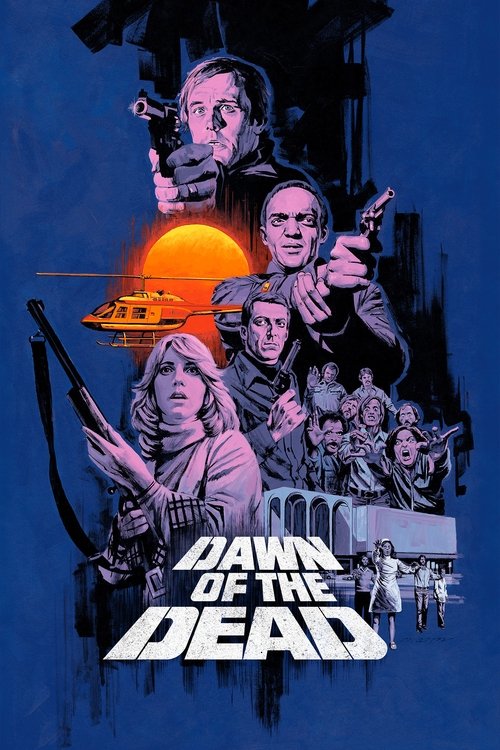
Dawn of the Dead
1978 · George A. Romero
For when you're craving a real horror classic with brains behind the gore — great with friends, great loud, equally good as a Halloween staple or a first plunge into old-school horror. Fun first, unsettling on the way home.
What it's about
The dead are walking, civilization is buckling on live television, and four survivors — two SWAT officers, a traffic reporter, and a TV producer — hole up in a suburban Pennsylvania shopping mall. Fully stocked and sealed off, it looks like paradise; the film is about what that paradise does to them, while the ghouls keep shuffling past the fountains outside.
The experience
A wild ride that swings between splattery action, genuine dread, and sharp satirical comedy — the sight of zombies drifting through a mall to muzak is funny right up until it's terrifying. It's pulpy, propulsive, and smarter than it has any obligation to be.
The craft
Romero shoots in bright comic-book colors that refuse horror's usual shadows, with Tom Savini's gleefully rubbery gore effects setting the standard for a generation of makeup artists. Shot guerrilla-style overnight in a real mall, it's grungy, inventive filmmaking that plays best big and loud — and Dario Argento's involvement yielded a faster European cut scored by the band Goblin.
Why it matters
The film that expanded the modern zombie from monster movie into full-blown social satire — its consumers-as-ghouls joke has been echoed, remade, and parodied for nearly fifty years, and virtually every zombie story since lives in its shadow.
With the dead walking and civilization buckling on live television, four survivors barricade themselves inside a suburban Pennsylvania shopping mall — and discover that paradise, fully stocked, is its own kind of trap. A decade after Night of the Living Dead invented the modern zombie, George A. Romero returned to expand it into full-blown social satire: the ghouls shuffling past the fountains and escalators are consumers stripped to pure reflex, and the film's sharpest joke is how comfortable its heroes become. Shot in the Monroeville Mall on overnight shoots, in bright comic-book colors that refuse horror's usual shadows, with Tom Savini's gleefully rubbery gore effects setting the standard for a generation of makeup artists. Dario Argento co-financed the production and supervised a faster European cut scored by Goblin, giving the film a strange double life across continents. Nearly every zombie story since — the remakes, the video games, the prestige television — is furniture arranged inside the floor plan Romero drew here.
A Deleuzian reading
The fountains are still running.
The full Deleuzian reading of Dawn of the Dead →
Reception
Released unrated in 1978 because Romero refused to cut it for an X rating, it was too gory for mainstream critics' comfort even as Roger Ebert championed it — now it's routinely ranked among the greatest horror films ever made, the consensus peak of the zombie genre.
How Dawn of the Dead was received, from release to now →
Influences: the films it descends from and the films it influenced
- Night of the Living Dead (1968) — Romero's own prototype codifies the flesh-eating-ghoul rules, the board-up-the-interior siege blocking, and the vérité radio/TV-cutaway structure that Dawn simply scales from a farmhouse to a mall.
- The Last Man on Earth (1964) — Its Matheson-derived nightly siege of a barricaded lone survivor against slow, arm-clawing revenants is the direct staging model for Romero's besieged-interior geometry and shambling-ghoul choreography.
- The Birds (1963) — Supplies the board-up-the-windows set-piece and the deliberately unexplained apocalypse that ends without restored order — a siege whose cause is never diagnosed.
- The Crazies (1973) — Romero's earlier contagion film hands Dawn its opening: the hand-held, jump-cut montage of collapsing military/media authority scrambling to contain an outbreak.
- Suspiria (1977) — Argento's Goblin-scored, primary-color comic-book lighting scheme is the aesthetic Argento carried directly into co-producing and scoring Dawn's European 'Zombi' cut.
- Deep Red (1975) — Establishes the Argento–Goblin prog-rock scoring partnership and prowling first-person camera that Argento brought to the Italian co-production.
- Zombi 2 (1979) — Marketed abroad as a sequel to Argento's 'Zombi' cut, it directly extends Dawn's Savini-style gut-munching and eye-trauma splatter into feature-length spectacle.
- Friday the 13th (1980) — Tom Savini exports the exploding-head, arterial-squib practical-gore vocabulary he built on Dawn straight into the emerging slasher, seeding the '80s FX-artist-as-star era.
- The Evil Dead (1981) — Low-budget indie horror that escalates the latex-and-Karo-syrup practical-splatter maximalism Dawn legitimized into pure kinetic set-piece.
- Day of the Dead (1985) — Romero and Savini push the bio-gore further into a claustrophobic underground-bunker siege, continuing the class/consumer allegory in a military register.
- The Return of the Living Dead (1985) — Keeps the barricaded-holdout structure and literalizes zombie appetite ('braaains') as consumer hunger while punking up the shuffle into a run.
- Braindead (Dead Alive) (1992) — Carries Savini's practical-prosthetic gore to absurdist extremes, treating latex splatter as slapstick — the direct maximalist heir of Dawn's effects.
- Shaun of the Dead (2004) — An explicit homage that reuses Romero's slow-shuffling ghoul as a literal mirror of somnambulant consumer routine, plus the fortify-a-familiar-space siege.
- Dawn of the Dead (2004) — A direct remake that retains the shopping-mall-as-fortress premise and consumer-cathedral staging while swapping slow ghouls for sprinting infected.
- Train to Busan (2016) — Extends the strangers-trapped-together siege-survival architecture into a confined moving space, keeping the social-microcosm-under-outbreak allegory.
- 28 Days Later (2002) — Extends Romero's template to the survivor-ensemble road/refuge journey laced with social satire, the narrative armature 28 Days Later borrows for its trek north to the army blockade.
- 28 Weeks Later (2007) — Establishes the zombie picture as undisguised topical allegory; 28 Weeks swaps Romero's consumerism for occupation-biopolitics while keeping the genre's editorial pointedness.
- 28 Years Later: The Bone Temple (2026) — Tom Savini's tactile practical splatter and the use of the undead horde as direct social allegory set the gore-as-meaning standard the rage films work within.
- Assault on Precinct 13 (1976) — A parallel Rio Bravo-descended modern siege where a mixed band fortifies a single building against anonymous, relentless waves — the same '70s reworking of the western holdout as horror.
- The Texas Chain Saw Massacre (1974) — Regional, self-financed American horror that weaponizes documentary grain and unromanticized slaughterhouse imagery, the same indie-production model Romero worked in.
- Evil Dead Burn (2026) — Tom Savini's practical-makeup gore-effects ethic — mechanical rigs and prosthetics over optical trickery — that Jane O'Kane's effects-and-makeup work here descends from.
- Invasion of the Body Snatchers (1978) — Contemporary in its municipal/consumer-space horror and its uncanny shuffling crowd, sharing the era's read of the massed body as vector of dehumanization.
Similar films
- The Return of the Living Dead (1985) — influence & lineage · same viewing thread
- Shaun of the Dead (2004) — influence & lineage · same viewing thread
- Night of the Living Dead (1968) — influence & lineage
- Day of the Dead (1985) — influence & lineage
- The Texas Chain Saw Massacre (1974) — influence & lineage
- One Cut of the Dead (2017) — same viewing thread · often watched together
- Suspiria (1977) — influence & lineage · often watched together
- Army of Darkness (1992) — same viewing thread
All the films related to Dawn of the Dead →
Watch it with: curated runs of related films
- The Undead, Played for Laughs — A run of horror comedy — vampire flatmates bickering over the dishes, slackers fumbling through the zombie apocalypse — set against the Romero classic they're all winking back at.