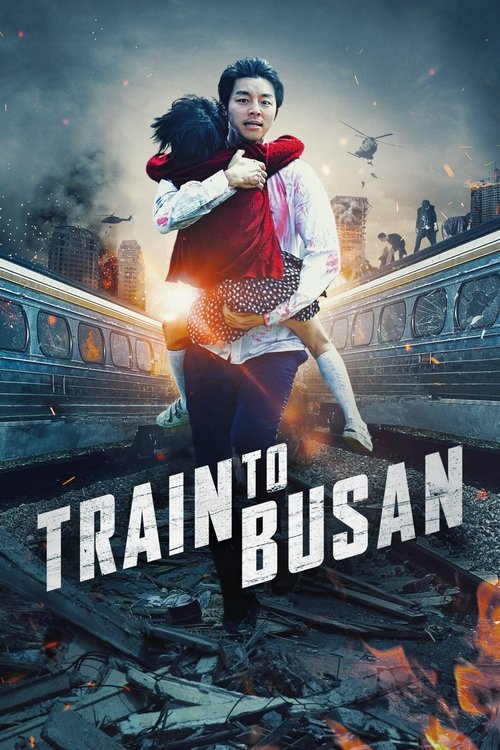
Train to Busan
2016 · Yeon Sang-ho
The Train to Busan director became Netflix Korea's genre engine (Hellbound, Jung_E), central to arguments about whether streaming is empowering or strip-mining Korean genre cinema.
For when you want a white-knuckle ride with substance — movie night with friends, edge of the couch, and don't be surprised if someone's wiping their eyes by the end. Intense but hugely accessible, even if you think you're done with zombies.
What it's about
A workaholic Seoul fund manager, barely present in his small daughter's life, boards the express train to Busan with her just as a virus outbreak tips the country into chaos — and the infection is already on board. What follows is survival worked out car by car, where the other passengers' selfishness proves as dangerous as the infected behind the doors.
The experience
Relentless — a two-hour pressure cooker that barely lets you breathe, then blindsides you by making you cry. The scares are physical and the stakes are emotional; it's a horror film with a heart working overtime.
Performances
Gong Yoo anchors it as the father, selling a thaw from cold self-interest to something fiercer, and Ma Dong-seok is an instant-classic scene-stealer as a burly expectant dad who punches his way through carriages.
The craft
The choreography is the star: infected that pour through doors like floodwater, and set pieces solved compartment by compartment, each carriage a fresh tactical puzzle with its own geometry. Tight, propulsive editing makes the confined space feel endless — this one earns good speakers and a dark room.
Why it matters
A Cannes Midnight sensation and Korea's biggest hit of its year, it reinvigorated the zombie genre with class-conscious anger and announced to global audiences what Korean genre cinema could do — several years before the rest of the world fully caught on.
The zombie picture re-engineered as a bullet-train morality play: a distracted Seoul fund manager escorts his small daughter toward Busan just as an outbreak turns the country — and the carriages behind them — into a churning tide of the infected. Yeon Sang-ho arrived from independent animation, where brutal social fables like The King of Pigs had already mapped Korean class resentment; here he pours that anger into blockbuster form, making cowardice and corporate self-interest as lethal as any bite. The craft is in the choreography: hordes that pour through doors like floodwater, set pieces solved car by car, each compartment a fresh tactical problem with its own geometry. A sensation in Cannes' Midnight section and the year's biggest hit at home, it told the wider world what Korean audiences already knew — that the national genre cinema could beat Hollywood at its own game, three years before Parasite made the point unanswerable. The sentimental streak is real and earned; Yeon aims for the heart as squarely as the jugular.
A Deleuzian reading
Bodies against glass.
The full Deleuzian reading of Train to Busan →
Reception
A Cannes Midnight Screenings premiere that became South Korea's biggest hit of 2016 — the year's first film to cross ten million admissions — it's since been canonized as the gateway Korean blockbuster of the pre-Parasite era and a fixture on best-zombie-films-of-the-century lists.
How Train to Busan was received, from release to now →
Influences: the films it descends from and the films it influenced
- Night of the Living Dead (1968) — Establishes the besieged-in-a-single-structure template where survivors trapped together fracture along self-interest and become deadlier to each other than the undead outside — the exact interpersonal engine Yeon runs inside the carriages.
- Dawn of the Dead (1978) — Codifies the zombie horde as social satire, using the confined consumer space to indict a class/economic order — the 'social fable' mode Train to Busan inherits and points at Korean corporate self-interest.
- 28 Days Later (2002) — Replaces the shambling Romero ghoul with the sprinting, twitching infected, inventing the kinetic fast-zombie kinematics that Yeon's actors perform with contorted, jerking full-body speed.
- Dawn of the Dead (2004) — Weds the running-zombie to studio blockbuster tempo and set-piece scale, proving the fast-horde can carry a mainstream action film — the commercial register Train to Busan operates in.
- World War Z (2013) — Models the horde as a single fluid mass that piles, climbs and floods like an insect colony rather than discrete monsters — the swarm-physics Yeon uses when zombies avalanche through doorways and pile up against carriage glass.
- The Host (2006) — Blueprints the Korean creature-blockbuster that fuses monster spectacle with a family-survival melodrama and pointed institutional critique — the tonal recipe (earned sentiment plus genre thrills plus social barb) Yeon reproduces.
- The Poseidon Adventure (1972) — Supplies the disaster-movie architecture of a cross-section-of-society ensemble fighting through a sealed vessel while members are sacrificed in sequence — the tactical, attrition-based progression through hostile compartments.
- The King of Pigs (2011) — Yeon's own animated feature that establishes his obsessions with class cruelty, cowardice and social predation as fable — the thematic DNA he transplants into the train.
- 28 Weeks Later (2007) — Inherits the sprinting-infected kinetic body horror and the motif of state/military authority abandoning or endangering the people it claims to protect.
- Peninsula (2020) — Yeon's direct sequel that scales the horde into vehicular Mad Max-style spectacle, extending the swarm-choreography and animator's action-blocking into open-road set pieces.
- Kingdom (2019) — Transposes the Korean fast-sprinting horde into a Joseon-era political thriller, inheriting Busan's kinetic zombie kinematics and class-critique-as-genre engine.
- All of Us Are Dead (2022) — Confines the outbreak to a single high school and choreographs mass pile-up hordes flooding stairwells and corridors — a direct descendant of Busan's single-location siege and swarm-avalanche staging.
- #Alive (2020) — Distills the Korean zombie wave into a single-apartment survival chamber piece, extending Busan's confined-space tension and fast-infected threat into a hyper-minimalist location.
- Parasite (2019) — The class-resentment social fable that the Korean-wave lineage crests into — genre mechanics deployed as a scalpel on economic hierarchy, the mode Train to Busan primed international audiences for.
- Kill (2024) — Solves the narrow-gauge fight: taped forearms and a bat swung in a space too tight for a full arc, low berth-level camera under luggage racks, and progress measured car by car — the exact spatial vocabulary Kill works in.
- Colony (2026) — Yang Jin-mo's carriage-by-carriage cutting and Park Jae-in's choreography of the infected as a movement company rather than a CG crowd, with each setpiece built on a stated rule (they hunt by sound, they cannot see through the dark tunnel) the audience can play along with.
- Snowpiercer (2013) — Turns a moving train into a linear single location whose carriages spatialize class, so forward motion literally stages a class war — the same carriage-by-carriage advance structure and class-resentment reading Train to Busan builds its set pieces on.
- Mission: Impossible – Ghost Protocol (2011) — Demonstrates the animator-turned-live-action director's gift for legible spatial geometry in action, framing each set piece so audiences always read the threat's position — the storyboard-clear staging discipline Yeon carries from animation into the tactical carriage sequences.
- Seoul Station (2016) — Yeon's animated companion/prequel to the same outbreak, where he first works out the horde choreography and social-collapse fable in the medium he came from before executing it in live action.
Similar films
- The Host (2006) — influence & lineage · same viewing thread
- Parasite (2019) — influence & lineage · same viewing thread
- Snowpiercer (2013) — influence & lineage
- A Taxi Driver (2017) — same viewing thread
- Hope (2026) — same viewing thread
- A Tale of Two Sisters (2003) — same viewing thread
- Okja (2017) — same viewing thread
- Oldboy (2003) — same viewing thread
All the films related to Train to Busan →
Watch it with: curated runs of related films
- New Korean Cinema — Watch these in a run and you feel one national cinema flip between monster movie, revenge thriller, gothic horror, and slow-burn procedural without ever loosening its grip on class, history, and family.