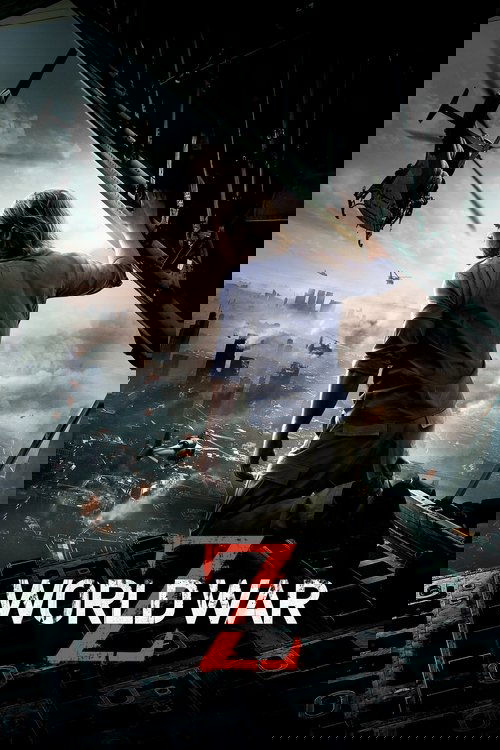
World War Z
2013 · Marc Forster
For when you want a white-knuckle blockbuster night — apocalypse spectacle you can inhale with the lights off, intense but not gory. A crowd-pleaser thrill ride, not a slow-burn horror commitment.
What it's about
A former United Nations investigator is living a quiet family life when a mysterious infection erupts worldwide, turning the bitten into sprinting, swarming attackers within seconds. After barely getting his family out of a collapsing Philadelphia, he's pressed back into service to trace the outbreak's origin — a race across continents, from military ships to walled cities, while civilization falls apart around him.
The experience
Relentless — it opens at a dead sprint and keeps escalating, staging the apocalypse at a scale zombie movies had never attempted, with waves of infected moving like floodwater. Big, loud, and gripping, then surprisingly tense and quiet when it finally slows down.
Performances
Brad Pitt anchors the chaos with a grounded, unshowy turn — a competent, weary problem-solver whose star presence keeps a globe-hopping catastrophe humanly scaled.
The craft
The set pieces are the draw: massed digital hordes piling into tidal waves of bodies, a city siege of astonishing scale, and a claustrophobic final stretch that trades spectacle for held-breath suspense. It's built for a big screen and a loud room, and its famously troubled production — including a rebuilt third act — is invisible in the finished momentum.
Why it matters
It proved the zombie movie could work as a PG-13, A-list global tentpole rather than a grindhouse staple, became one of Brad Pitt's biggest hits, and cemented the fast, swarming infected as the modern default.
Snapshot
World War Z is a $190-million studio gamble that turned the zombie picture — historically a low-budget, grindhouse-adjacent form — into a globe-spanning, PG-13 summer tentpole built around a single A-list star. Adapted in name only from Max Brooks's 2006 novel World War Z: An Oral History of the Zombie War, it discards the book's polyphonic, retrospective structure of testimonies in favor of a propulsive present-tense chase: Gerry Lane (Brad Pitt), a retired United Nations investigator, is pulled from domestic retirement to trace the origin of a pandemic that converts the infected into hyper-fast, swarming aggressors within seconds. The film is now remembered as much for its tortured production — a scrapped third act, months of reshoots, ballooning costs — as for its commercial vindication, becoming Pitt's highest-grossing leading role and demonstrating that the zombie apocalypse could be scaled to blockbuster proportions and a family-friendly rating. It sits at the intersection of disaster cinema, pandemic thriller, and the "fast zombie" cycle, and its signature image — the living dead surging like a fluid, self-assembling mass over Jerusalem's defensive walls — became one of the decade's defining digital spectacles.
Industry & production
The project was developed through Brad Pitt's Plan B Entertainment with Paramount Pictures, with Pitt both starring and producing — a configuration that made the film a vehicle for his star authority as much as an adaptation. The rights to Brooks's novel had been competitively pursued in the mid-2000s, and the long gestation reflected the difficulty of translating an episodic oral history into a conventional narrative feature.
The production is one of the canonical case studies in modern Hollywood troubleshooting. After principal photography, the filmmakers concluded that the original third act — reportedly culminating in a large-scale sequence set in Russia — did not work. Damon Lindelof was brought in to consult on the ending and, when his schedule conflicted, recommended Drew Goddard; both are credited on the final screenplay alongside Matthew Michael Carnahan, with story credit shared by Carnahan and J. Michael Straczynski. The climax was substantially rewritten and reshot: the bombastic finale gave way to a tense, small-scale infiltration of a World Health Organization research facility (shot in Wales). These reshoots reportedly added many weeks of additional shooting and pushed the budget to roughly $190–200 million, extraordinarily high for the genre, and delayed the release. I should note the most lurid production figures circulated in trade and tabloid coverage at the time; the broad facts — a discarded third act, Lindelof and Goddard's late rewrites, and extensive reshoots — are well established, while precise cost line-items remain contested.
Crucially, the gamble paid off commercially. The film opened in June 2013 to strong business and went on to gross over half a billion dollars worldwide, vindicating the decision to spend on salvaging the ending. A sequel was pursued for years, with David Fincher attached to direct and Pitt to return, before Paramount canceled it in 2019.
Technology
World War Z is a heavily digital production whose central innovation is crowd simulation. The film's defining set pieces depend on rendering zombie hordes not as individuated extras but as a quasi-physical fluid — masses of bodies that climb over one another, pile into living ramps, and pour over barriers in the manner of swarming insects or a breaking wave. This required large-scale crowd and physics simulation work from the visual-effects vendors, and the resulting imagery (the Jerusalem wall assault above all) is the film's primary technological signature. The approach deliberately departs from the shambling, individually-blocked zombie of the Romero tradition, treating the horde as an emergent system rather than a collection of performers.
The film was also released in 3D via post-production conversion rather than native stereoscopic capture — standard practice for the period's tentpoles — and exhibited in premium large-format venues. Its reliance on digital crowd extension also allowed urban catastrophe (Philadelphia gridlock, the fall of Jerusalem) to be staged at a scale the genre had rarely attempted.
Technique
Cinematography
Ben Seresin photographed the film. The visual scheme favors a desaturated, naturalistic palette and a restless, often handheld camera in the outbreak sequences, where the chaos of the Philadelphia street attack and the Jerusalem collapse is conveyed through proximity, partial views, and the kinetic instability of bodies entering frame from the edges. The film withholds clean, comprehensive views of the threat early on, building dread from glimpses. By contrast, the late WHO-facility climax shifts to a darker, more controlled, suspense-oriented register — confined corridors, low light, a deliberate slowing of tempo — a tonal pivot that reflects its origin as a wholesale replacement of the original ending.
Editing
The film was cut by Roger Barton and Matt Chesse. The editing carries an unusually heavy burden here, since the picture had to be reassembled around a new final act. The first two-thirds are built on rapid, impact-driven cutting that emphasizes velocity and disorientation — appropriate to "fast" zombies whose threat is a matter of seconds — while the reconstructed climax is paced for sustained tension and near-silence. The structural seam between the spectacle-driven body of the film and its quieter, almost chamber-thriller resolution is the clearest editorial trace of the production's history.
Mise-en-scène / staging
Forster stages the film as a sequence of discrete, geographically distinct crisis zones — a domestic Philadelphia morning, a military carrier at sea, a walled Jerusalem, a Welsh laboratory — strung along Gerry Lane's investigative itinerary. Each location is organized around a different spatial logic of containment and breach: traffic-choked streets, the deck of an aircraft carrier functioning as a floating command center, the fortified city whose walls invite the horde's defining vertical assault, and finally the maze-like interior of the research facility. The recurring staging idea is the failure of barriers — the constant motif is a wall, perimeter, or quarantine that holds until it catastrophically doesn't.
Sound
Marco Beltrami composed the score, combining propulsive percussion and tense, textural underscoring with quieter passages that support the suspense of the finale. Sound design is integral to the horde's characterization: the collective clicking, snapping, and chattering of the infected functions as an aural signature, and the contrast between deafening crowd chaos and the near-total silence required to evade the zombies in the laboratory climax is a structuring device. The plane and Jerusalem sequences in particular use sound to track threat before it is fully seen.
Performance
Pitt anchors the film with a deliberately unflashy, competent-everyman performance: Gerry Lane is defined less by interiority than by procedural calm under pressure, a functional protagonist whose star presence supplies the audience's stability. Mireille Enos plays his wife Karin, largely confined to the carrier as the emotional tether to the family he is protecting. The supporting cast is a string of brief, single-location turns — among them Daniella Kertesz as the young Israeli soldier Segen who becomes Lane's companion, and a memorable scene with a Mossad official who articulates the film's "Tenth Man" doctrine of contrarian preparedness. The performance mode throughout is grounded and reactive rather than heroic in a traditional action register.
Narrative & dramatic mode
The film operates as an investigative procedural grafted onto a disaster spectacle. Where Brooks's novel is a mosaic of after-the-fact testimony, the film is relentlessly forward-driving and singular: one man follows a chain of clues across continents toward the pandemic's logic. The dramatic engine is epidemiological detective work — Lane reasons from anomalies (who the infected do and don't attack) toward a provisional solution involving "camouflage," the masking of healthy hosts behind terminal illness so that the zombies pass them by. This is a notable shift from kill-the-monster action to outwit-the-pathogen problem-solving, and the climax stakes survival on stealth and hypothesis-testing rather than firepower. The stakes are pitched at the level of civilizational collapse, yet the resolution is deliberately modest and inconclusive — a possible countermeasure, not a victory — leaving the war ongoing.
Genre & cycle
World War Z belongs to the post-2002 "fast zombie" cycle inaugurated by 28 Days Later (2002) and Zack Snyder's Dawn of the Dead remake (2004), which replaced the slow Romero ghoul with sprinting, ferocious infected. It pushes that cycle to its blockbuster extreme, fusing zombie horror with the pandemic-outbreak thriller (Contagion, 2011) and the large-scale disaster film. Its most consequential generic move is its PG-13 rating: by minimizing on-screen gore, the film severed the zombie picture from its R-rated, splatter-defined heritage to reach a mass summer audience — a commercially decisive but, for many genre adherents, controversial choice. It thus marks the moment the zombie narrative completed its migration from cult horror to mainstream franchise property, paralleling the contemporaneous success of television's The Walking Dead.
Authorship & method
Marc Forster is a genre-agnostic director whose filmography — Monster's Ball (2001), Finding Neverland (2004), Stranger Than Fiction (2006), The Kite Runner (2007) — is rooted in character drama, with his prior large-scale credit being the Bond film Quantum of Solace (2008). He is not a horror specialist, and World War Z reflects a producer-driven, star-vehicle model of authorship more than a singular directorial vision: the film's final shape was substantially determined by Pitt and Plan B's commitment to fixing it and by the late-stage writers (Lindelof, Goddard) brought in to rebuild the ending. The screenplay's credited architecture — Carnahan and Straczynski's story, Carnahan, Goddard, and Lindelof's script — is itself a record of serial intervention. Among the key collaborators, cinematographer Ben Seresin, composer Marco Beltrami, and editors Roger Barton and Matt Chesse shaped a film whose coherence was achieved in assembly and reshooting as much as in original conception. Forster's contribution is best read as orchestration of a fraught, collaborative salvage rather than personal authorship in the auteur sense.
Movement / national cinema
This is a thoroughly transnational Hollywood product: an American studio (Paramount) and star-producer financing a film shot across multiple countries (including the UK and Malta standing in for global locations) with international visual-effects labor and an Israeli supporting cast for the Jerusalem act. It does not belong to a national-cinema movement so much as to the globalized blockbuster system, designed from the ground up for worldwide theatrical distribution. Its very subject — a pandemic crossing borders — mirrors its production and marketing logic of frictionless global reach.
Era / period
The film is a product of the early-2010s blockbuster economy, when studios concentrated resources in fewer, larger, IP-derived tentpoles and when the pandemic anxieties of the post-SARS, post-H1N1 years had entered the popular imagination. It arrives at the crest of the cultural zombie boom — The Walking Dead having established the figure's mainstream television dominance — and exemplifies the period's confidence that visual-effects spectacle could be scaled almost without limit. Viewed retrospectively after 2020, its imagery of cascading global contagion, overwhelmed hospitals, and improvised quarantine reads as eerily prescient, and the film has accrued a second life as a touchstone in discussions of pandemic cinema.
Themes
The film's governing theme is systemic fragility — how quickly the infrastructures of modern civilization (traffic, medicine, the state, the family unit) buckle under exponential, fast-moving catastrophe. Against that, it sets a counter-theme of preparedness and contrarian thinking, crystallized in the Israeli "Tenth Man" doctrine: the institutional duty of one designated dissenter to assume the unthinkable is true. The climactic "camouflage" solution extends this into a meditation on vulnerability as protection — the idea that sickness and weakness can be the very thing that renders one invisible to predation, inverting the genre's usual logic of strength and survival. Throughout, the family — Lane's wife and daughters on the carrier — functions as the emotional stake and the moral horizon that justifies his mission, grounding the global apocalypse in a domestic register.
Reception, canon & influence
Critical reception was mixed-to-positive and frequently surprised: many reviewers, primed by the production's troubled reputation, found the finished film a more competent and tense thriller than expected, while others faulted its bloodless PG-13 caution and its near-total abandonment of Brooks's novel. Max Brooks himself publicly distanced the film from his book, noting that it shared little beyond the title — a point widely acknowledged in the critical record. Commercially it was a clear success, becoming Pitt's highest-grossing leading vehicle and validating the expensive reshoot strategy.
Its influences run backward to the fast-zombie template of 28 Days Later and the Dawn of the Dead remake, to the outbreak-procedural mode of Contagion, and to the large-scale destruction grammar of contemporary disaster cinema. Looking forward, its legacy is double-edged. As spectacle, its swarming, fluid-dynamics horde redefined what a zombie mass could look like on screen and influenced subsequent depictions of the living dead as an emergent collective rather than individuated monsters. As an industry case study, it became a standard reference for the economics of the troubled-tentpole rescue — proof that a film could survive a discarded third act and emerge profitable. The long-developed, Fincher-attached sequel that was ultimately canceled in 2019 underscores both the appetite the film generated and the difficulty of building a franchise on its expensive, hard-won foundation. Finally, in the wake of the COVID-19 pandemic, World War Z has been frequently revisited as a prominent example of pre-2020 pandemic cinema, its imagery of contagion and collapse lending it a cultural resonance its makers could not have anticipated.
A Deleuzian reading
Picture the wall at Jerusalem.
The full Deleuzian reading of World War Z →
Reception
Written off as a doomed mess before release — a ballooning budget, a delayed date, and an entire third act thrown out and reshot — it shocked everyone by becoming a genuine hit and the highest-grossing zombie movie ever made. The production chaos is now more famous than the film's flaws.
How World War Z was received, from release to now →
Influences: the films it descends from and the films it influenced
- Night of the Living Dead (1968) — Establishes the barricade-siege grammar — survivors fortifying a structure whose every barrier inevitably fails — that WWZ scales up to the Jerusalem wall and the WHO lab.
- The Birds (1963) — Models the threat as an emergent, motiveless collective rather than individuated monsters, complete with boarded-window failure-of-barriers set pieces and a deliberately inconclusive non-resolution ending.
- 28 Days Later (2002) — Supplies the sprinting rage-virus 'infected' template that displaced Romero's shamblers, which WWZ adopts wholesale for its kinetic, fast-twitch undead.
- Dawn of the Dead (2004) — Its cold-open of instantaneous suburban collapse and studio-scale fast-running zombies normalized the kinetic horde for mainstream tentpole horror, the mode WWZ inherits.
- Black Hawk Down (2001) — Pioneers the desaturated palette, handheld coverage, and impact-driven cutting of competent operators overwhelmed in chaotic urban combat that defines WWZ's action texture.
- War of the Worlds (2005) — Provides the ground-level everyman POV fleeing incomprehensible large-scale catastrophe — the ordinary protagonist running through emergent mass destruction that Pitt's Lane reprises.
- Children of Men (2006) — Pairs a desaturated handheld documentary aesthetic with a reluctant everyman navigating institutional collapse, the visual register WWZ borrows for its procedural realism.
- The Lord of the Rings: The Return of the King (2003) — Weta's Massive crowd-simulation software made emergent, agent-driven swarming masses renderable — the direct technical lineage of WWZ's fluid-dynamics horde pouring over walls.
- The Bourne Ultimatum (2007) — Codifies the shaky-cam, impact-cut editing grammar of post-2002 action that WWZ's close-quarters combat scenes directly inherit.
- Quantum of Solace (2008) — Forster's own prior large-scale credit, where he first deployed the frenetic handheld and impact-driven cutting he carries into WWZ's set pieces.
- Contagion (2011) — Supplies the epidemiological-procedural structure of a globe-trotting investigator racing patient-zero across labeled cities, mirrored in WWZ's UN-investigator narrative.
- I Am Legend (2007) — Renders its infected as a CGI fluid pack moving with collective hive-physics rather than individuated menace, the same depersonalized-swarm approach WWZ would push further.
- Train to Busan (2016) — Pushes WWZ's emergent-mass horde into clambering zombie pile-ups and tower physics, treating the undead explicitly as a fluid collective that overwhelms barriers by sheer aggregate force.
- The Girl with All the Gifts (2016) — Fuses the fast-zombie sprint with an epidemiological-procedural built on fungal-contagion science, continuing WWZ's marriage of outbreak rationalism and massed sprinting infected.
- A Quiet Place (2018) — Builds a failure-of-barriers survival procedural around emergent predators and a 'vulnerability as protection' reversal — silence as camouflage — echoing WWZ's terminal-illness masking gambit.
- Outbreak (1995) — Scales Outbreak's procedural-epidemiologist-as-action-hero into a global contact-tracing chase, an investigator following the outbreak to its source as institutions collapse.
- Maze Runner: The Death Cure (2018) — Contemporary swarming-horde set pieces married to a race-against-quarantine search-for-a-cure structure, using CG massing of bodies over practical action anchors.
Similar films
- War of the Worlds (2005) — influence & lineage
- Contagion (2011) — influence & lineage
- 28 Days Later (2002) — influence & lineage
- 28 Weeks Later (2007) — influence & lineage
- I Am Legend (2007) — influence & lineage
- 13 Hours: The Secret Soldiers of Benghazi (2016) — same viewing thread
- 300 (2007) — same viewing thread
- Maze Runner: The Death Cure (2018) — shared sensibility
All the films related to World War Z →
Watch it with: curated runs of related films
- The Set-Piece Machine — A run of hard-charging, forward-driving action cinema — watch these back-to-back when you want mission-structured, physical-stakes spectacle built by people who know exactly how to escalate.