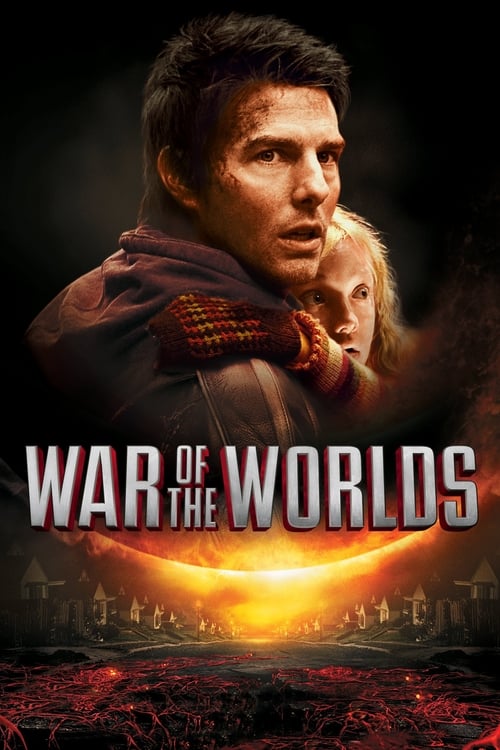
War of the Worlds
2005 · Steven Spielberg
For when you're craving a real scare with scale — an invasion movie that plays like a survival horror film. Choose it when you want intensity, not popcorn fun; it's a white-knuckle watch, not a rah-rah one.
What it's about
Ray Ferrier is a divorced New Jersey dockworker and a mediocre father, stuck with his teenage son and young daughter for the weekend when a freak lightning storm hits — and machines of unimaginable scale rise from beneath the streets. What follows is not a fight-back movie but a flight: one inadequate man trying to keep two kids alive as civilization comes apart around them.
The experience
Relentless and genuinely frightening — this is Spielberg using all his blockbuster skill to make you feel small, hunted and helpless rather than thrilled. The panic of the crowds is as scary as the machines, and it grants you very little comfort along the way.
Performances
Tom Cruise, stripped of heroics as a father improvising badly under pressure, and a young Dakota Fanning, whose terror is so convincing it drives half the film's dread.
The craft
Spielberg keeps the camera at street level, showing the catastrophe only as one family can see it — a discipline that makes the effects sequences land with documentary panic. Several long, seemingly unbroken shots and the machines' foghorn bellow are showcase filmmaking; it demands the biggest screen and loudest speakers you have.
Why it matters
The defining alien-invasion film of the post-9/11 moment, channeling real images of fleeing crowds and falling ash into genre form, and a dark counterpoint to Spielberg's earlier, friendlier visions of contact.
Snapshot
War of the Worlds is Steven Spielberg's lean, terrifying, and deliberately unconsoling adaptation of H.G. Wells's 1898 novel, transposed to the New Jersey and New England of the early twenty-first century and filtered through the trauma of the post-9/11 United States. It is the second collaboration between Spielberg and Tom Cruise, following Minority Report (2002), and in many ways its dark inverse: where Spielberg's earlier encounters with extraterrestrial life — Close Encounters of the Third Kind, E.T. — had been founded on wonder and benevolence, this film imagines the alien as pure annihilating force, indifferent and exterminatory. The story narrows the global catastrophe of Wells's novel to a single, fallible family: Ray Ferrier (Cruise), a divorced, immature dockworker in Bayonne, New Jersey, who is left with his estranged teenage son Robbie (Justin Chatwin) and young daughter Rachel (Dakota Fanning) just as buried alien war-machines erupt from beneath the city's streets and begin vaporizing the human population. The film never leaves Ray's vantage; there are no scenes of generals, presidents, or scientists explaining the threat. The result is an unusually claustrophobic and primal disaster movie — a chronicle of flight, panic, and dwindling moral coherence under apocalyptic pressure — that uses one of the most expensive production apparatuses in Hollywood to dramatize helplessness rather than heroism. Released in the summer of 2005 to enormous commercial success and a divided but largely admiring critical response, it remains one of Spielberg's most formally rigorous and emotionally bleak large-scale entertainments.
Industry & production
War of the Worlds was produced by Paramount Pictures and DreamWorks Pictures, with Cruise's production company involved, and was made on a fast, almost compressed schedule that became part of its legend within the industry. Spielberg and Cruise, energized by their Minority Report partnership, committed to the project and drove it from greenlight to a fixed summer 2005 release date in roughly a year — a remarkably short window for a tentpole of its scale and effects burden. Principal photography took place largely in late 2004 across New Jersey, New York, California, and Virginia, and Industrial Light & Magic executed the visual effects under intense time pressure to meet the locked release.
The screenplay was credited to Josh Friedman and David Koepp, the latter a frequent Spielberg collaborator who had written Jurassic Park (1993). Their adaptation preserved the novel's essential spine — an unstoppable Martian (here cosmically unspecified) invasion that humanity cannot defeat, ended not by human ingenuity but by Earth's microorganisms — while modernizing the iconography and grounding the narrative in a single domestic relationship. The decision to keep the perspective relentlessly ground-level, refusing the panoramic command-center scenes that had defined the disaster cycle of the 1990s, was central to the production's conception.
Casting placed Cruise, then among the most bankable stars in the world, in a deliberately unflattering role: a self-centered, barely competent father rather than a conventional action hero. Dakota Fanning, already an acclaimed child actress, was cast as Rachel, and much of the film's emotional and visceral charge runs through her terror. Tim Robbins took the pivotal supporting role of Harlan Ogilvy, the unstable survivalist in whose cellar Ray and Rachel take refuge; Miranda Otto and Justin Chatwin played the ex-wife and son; and Morgan Freeman supplied the opening and closing narration, much of it drawn closely from Wells's own prose. The film opened in late June 2005 and was a major worldwide box-office hit, one of the highest-grossing films of its year, though precise figures should be checked against the financial record rather than asserted here.
Technology
The film is a showcase of mid-2000s visual-effects practice, executed by ILM at the moment when photorealistic digital creature and destruction work was reaching maturity but before such spectacle had become routine. The alien tripods — towering, three-legged machines that rise from beneath the earth rather than landing from the sky as in Wells and in the 1953 film — were realized as fully computer-generated entities integrated into live-action plates, their heat-rays reducing human beings to drifting ash. The "disintegration" effect, in which victims are vaporized while their empty clothes flutter down, is among the film's most discussed technical and thematic gestures.
Equally significant is the film's camera technology in service of its signature long takes. The most celebrated sequence — the family's escape by minivan as society collapses around them — was achieved with an elaborate multi-camera rig mounted on and around the moving vehicle, including a remotely operated camera that travels continuously around and through the car's interior and exterior in what appears to be a single unbroken shot. This demanded specialized mounts, remote heads, and meticulous choreography to sustain the illusion of a fluid, uninterrupted moving-camera passage. The production combined such practical, in-camera ingenuity with digital effects throughout, and the film stands as a strong example of the era's hybrid methodology, in which physical staging and CGI were knit together to ground spectacle in tactile reality.
Technique
Cinematography
Janusz Kamiński, Spielberg's regular director of photography since Schindler's List, shot War of the Worlds in a deliberately drained, overcast register. The palette favors bleached, sickly skies, desaturated greens and grays, and a pervasive atmosphere of ash, smoke, and diffused light that evokes both natural disaster and the photographic memory of 9/11. Kamiński's camera stays close to Ray and Rachel, frequently handheld or restlessly mobile, privileging cramped, embodied points of view over the god's-eye master shots typical of the genre. The film's most virtuosic camerawork — the 360-degree pass around the speeding minivan, and the long unbroken tracking of the family through chaos — exemplifies a strategy of immersion: the spectator is locked into the characters' physical space and denied the orienting overviews that would make the catastrophe legible and therefore manageable. Set-pieces such as the burning commuter train roaring through a crossing, glimpsed in a single shocking passage, and the ferry sequence on the Hudson are staged for maximum disorientation within continuous, witnessed space.
Editing
Michael Kahn, Spielberg's longtime editor, cuts the film for sustained dread rather than the rapid-fire montage of much contemporary action cinema. The editing honors the film's long takes, allowing extended passages to play out with minimal cutting so that tension accumulates within the shot. The structure follows Ray's journey as an unbroken chain of flight and concealment — from Bayonne to the ferry to the besieged farmhouse and Ogilvy's cellar, and finally to Boston — and the cutting maintains a strict adherence to his point of view, never relieving the audience with the reassurance of a wider strategic picture. The film's pacing alternates eruptions of overwhelming violence with longer, near-silent sequences of hiding and waiting, most notably the protracted cellar episode, where the rhythm slows to an almost unbearable suspense.
Mise-en-scène / staging
Spielberg's staging is organized around the iconography of mass catastrophe and refugeeism. Crowds of fleeing civilians, abandoned vehicles, walls papered with photographs of the missing, a downed passenger jet strewn across a suburban neighborhood, and a river carrying the bodies of the dead — these compositions draw directly and consciously on the imagery of 9/11 and of wartime exodus. The buried, ancient war-machines emerging from beneath familiar American streets literalize a threat that comes from within the homeland rather than from a recognizable enemy. Against this vast canvas, the staging keeps returning to intimate, enclosed spaces — the basement, the minivan, the farmhouse cellar — where the family drama plays out. The Ogilvy sequence in particular is staged as a chamber piece of moral horror, in which the question of how far one will go to protect a child collapses into something monstrous.
Sound
The film's sound is among its most powerful and unsettling elements. The tripods announce themselves with a vast, bone-deep foghorn-like bellow — an instantly iconic piece of sound design that signals doom before the machines are even seen, and which functions throughout as the film's most efficient generator of terror. The sound team built a dense, physical soundscape of collapsing structures, the crackle of the heat-ray, the eerie mechanical articulation of the tripods, and, in the quieter passages, an oppressive, near-total silence punctuated by small human sounds. John Williams's score, discussed below, is deployed with unusual restraint for a Spielberg picture, frequently withdrawing to let sound design and silence carry the dread.
Performance
Cruise's performance is built against his star image: Ray Ferrier is petulant, irresponsible, and frightened, a man whose competence is repeatedly shown to be inadequate to the crisis and whose paternal instincts emerge raggedly and incompletely. The film withholds the redemptive heroism the audience expects from a Cruise vehicle, and the performance is the braver for it. Dakota Fanning's Rachel is the film's emotional barometer: her screaming, her catatonic shock, and her wide-eyed witnessing carry much of the picture's visceral impact, and her sustained child's terror is one of its most remembered features. Tim Robbins, in a brief but pivotal turn as the unhinged Ogilvy, supplies a study in how catastrophe breeds derangement and how survival can require the abandonment of conscience. The ensemble works in service of a single thesis — ordinary, flawed people overwhelmed — rather than of star spectacle.
Narrative & dramatic mode
The dramatic mode is survival horror grafted onto a domestic drama of an absent father forced into responsibility. The narrative is structured as a single, escalating flight, restricted with near-total consistency to Ray's experience and knowledge; the audience learns nothing the characters do not learn, and the larger war is glimpsed only in fragments — a downed plane, a defeated military convoy, rumors among refugees. This first-person restriction is faithful to the epistemology of Wells's novel and produces a drama of helplessness rather than agency: the protagonists do not solve the crisis or defeat the enemy, and the invaders fall, as in the source, to terrestrial microbes against which they have no immunity — a deus ex machina that is also the novel's deepest irony, humbling human pretension by making humanity's survival an accident of biology rather than a triumph of will. The familial through-line — Ray's struggle to keep Rachel alive and to recover his bond with the rebellious Robbie — supplies the conventional emotional resolution, and the film's somewhat abrupt, tidy ending (the family reunited in an intact Boston) has been a point of critical contention, read by some as an unconvincing concession to reassurance after two hours of relentless despair.
Genre & cycle
War of the Worlds belongs to the alien-invasion subgenre of science fiction and to the disaster film, but it pointedly revises the conventions of the 1990s blockbuster cycle exemplified by Independence Day (1996). Where that cycle offered global panoramas, heroic counterattack, and the eventual human defeat of the invaders, Spielberg's film strips out the triumphalism, the command centers, and the cathartic victory, retaining only the ground-level experience of terror. It also stands in dialogue with the long lineage of War of the Worlds adaptations — Wells's novel, Orson Welles's notorious 1938 radio broadcast, and the 1953 George Pal/Byron Haskin film — and with the broader Cold War tradition of invasion narratives as allegory. By relocating the threat to a post-9/11 American homeland and saturating the imagery with that event's visual memory, the film converts the genre into a vehicle for processing contemporary trauma, aligning it with a cycle of mid-2000s American films grappling, directly or obliquely, with terrorism, vulnerability, and the collapse of national invulnerability.
Authorship & method
The film is unmistakably a Spielberg work, and it represents the darker pole of his career-long preoccupation with extraterrestrial contact and with families fractured by absent or inadequate fathers. The motif of the divorced, immature father compelled by crisis toward responsibility recurs across his filmography, and here it is rendered without sentimental softening. Spielberg's method on this picture emphasized speed, restricted point of view, and the integration of bravura long takes with overwhelming spectacle. His key collaborators are the constants of his late-career workshop: cinematographer Janusz Kamiński, whose desaturated, ash-laden imagery defines the film's look; editor Michael Kahn, who sustains its dread through patient cutting; and composer John Williams, whose score is comparatively spare and dissonant, eschewing soaring melody for tension and unease in keeping with the film's mood. Screenwriters Josh Friedman and David Koepp supplied the adaptation's structural decision to keep the apocalypse intimate; Koepp's prior work on Jurassic Park makes him a natural fit for Spielberg's blend of spectacle and family peril. Morgan Freeman's narration, drawn from Wells, frames the human drama within the novel's cosmic perspective on human insignificance.
Movement / national cinema
As a product of the Hollywood studio system at the height of the digital-effects blockbuster era, War of the Worlds is not a movement film in the art-cinema sense, but it is a significant artifact of American national cinema's reckoning with the aftermath of September 11, 2001. It belongs to a loose body of mainstream American films of the mid-2000s that channel the era's anxieties — the sudden vulnerability of the homeland, the imagery of dust and falling debris, the spectacle of mass flight — into genre frameworks. Spielberg himself occupies a singular position in American cinema as the preeminent director of the blockbuster, and the film can be read as that figure turning his own established vocabulary of wonder inside out to confront national fear. Within the tradition of the Hollywood disaster and science-fiction film, it marks a notable inflection toward darkness and away from the reassuring nationalism of the immediately preceding cycle.
Era / period
The film is a precise artifact of the United States circa 2005, made and received in the long shadow of 9/11 and amid the ongoing wars in Afghanistan and Iraq. Its imagery — vaporized civilians, a missing-persons memorial wall, a river of the dead, the collapse of ordinary suburban life into refugee chaos — is suffused with the visual and emotional memory of the 2001 attacks, a connection Spielberg has acknowledged. The film registers a specific national mood of helplessness before an enemy that strikes without warning from within familiar spaces and against which conventional military power is impotent. The breakdown of social order it depicts — the mob that swarms the family's minivan, the violence among survivors competing for transport and shelter — reflects period anxieties about the fragility of civic cohesion under catastrophic stress. As a technological document, it captures the moment when digital effects had matured sufficiently to render mass destruction with photorealistic conviction, and when a director could marry that capability to old-fashioned long-take craft.
Themes
The film's governing theme is human helplessness in the face of an indifferent, overwhelming force — a deliberate refusal of the genre's customary reassurance that courage and ingenuity will prevail. From this flow several entwined concerns. There is the theme of fatherhood and inadequate protection: Ray's central, almost animal imperative to keep his daughter alive, set against his manifest unfitness for the role and the impossibility of truly shielding a child from horror. There is the theme of survival and its moral costs, crystallized in the Ogilvy cellar sequence, where the will to live curdles into something Ray must commit and then conceal from his daughter. There is the post-9/11 theme of homeland vulnerability — the dread of an enemy buried within one's own ground, striking the ordinary spaces of American life. And, inherited directly from Wells, there is the theme of human insignificance: the framing narration's cosmic perspective, and the invaders' eventual defeat by microbes, insist that humanity's survival is not earned but contingent, a matter of biological accident rather than moral or martial superiority. Beneath these runs an unsentimental vision of social order as a thin membrane, easily torn, beneath which lies panic and predation.
Reception, canon & influence
War of the Worlds was a major commercial success on its summer 2005 release and drew a largely positive but genuinely divided critical response. Reviewers widely praised its technical mastery, the relentless intensity of its set-pieces, Kamiński's photography, and the audacity of Spielberg's decision to render an alien invasion as sustained, ground-level terror; the long-take minivan sequence and the sound design of the tripods were singled out as among the most effective passages in his late work. Criticism concentrated on the ending — the reunion in an unscathed Boston, including the survival of a son last seen walking into apparent death — which many found unconvincingly neat after the unsparing despair of the preceding film, and on the thinness of the human characters as written. The performances of Cruise, against type, and especially of Dakota Fanning were generally admired.
Influences on the film run backward most obviously to H.G. Wells's 1898 novel and its tradition of adaptation, including Orson Welles's 1938 radio panic and the 1953 Pal/Haskin film, as well as to the Cold War invasion cycle and to Spielberg's own earlier alien films, which this picture consciously inverts. Its imagery draws, profoundly and avowedly, on the visual record of 9/11. Its formal lineage includes Spielberg's own Jaws and Jurassic Park in the management of suspense and the withholding of the threat.
Its influence forward lies chiefly in helping to model a darker, more immersive, more trauma-inflected mode of the disaster and invasion film, in which catastrophe is experienced from within rather than surveyed from above — an approach echoed in subsequent found-footage and ground-level catastrophe pictures of the following decade. Within Spielberg's own career it stands as a key entry in the run of darker, more anxious twenty-first-century films that includes Minority Report and Munich, the latter released the same year. The film also helped sustain the early-2000s revival of the alien-invasion genre and demonstrated how a major star vehicle could be turned to deeply uncomfortable, anti-heroic ends. It retains a secure, if debated, place in the canon of Spielberg's later work and in the history of the War of the Worlds material's long cultural life.
A Deleuzian reading
The dust on Ray Ferrier's jacket is other people.
The full Deleuzian reading of War of the Worlds →
Reception
In 2005 it was a monster hit that critics shrugged at and fans grumbled about — the discourse got swallowed whole by Tom Cruise jumping on Oprah's couch mid-press-tour. Twenty years on it's been thoroughly reappraised as one of Spielberg's darkest, best films: the definitive post-9/11 blockbuster.
How War of the Worlds was received, from release to now →
Influences: the films it descends from and the films it influenced
- The War of the Worlds (1953) — The direct adaptation source whose manta-ray war-machines and heat-ray design Spielberg consciously reworks into ambulatory tripods, and whose climactic bacterial deus ex machina he retains verbatim from Wells via this film.
- Signs (2002) — Immediate sibling that pioneers rendering global alien invasion entirely through one family's restricted vantage in a rural house, withholding the wider war off-screen.
- The Lost World: Jurassic Park (1997) — Same Spielberg–Kamiński partnership applies the low-key, high-contrast palette and suburban domestic-incongruity invasion that this film inaugurated for the duo.
- World War Z (2013) — Descendant deploying the same star-vehicle-as-everyman-fleeing-collapse structure and ground-level swarming-crowd panic imagery descended from the film's 9/11-inflected evacuation set-pieces.
- Disclosure Day (2026) — The direct method ancestor: the Koepp script and Kamiński camera fuse alien threat with ground-level human flight, including long-take car-interior staging the reactive everyman is trapped inside.
- A Quiet Place Part II (2021) — The Day 1 prologue sequences Spielberg's family-in-peril grammar almost literally — small-town Saturday-afternoon normality (baseball diamond, families in bleachers) catastrophically ruptured by alien attack — with Krasinski's camera blocking and crowd choreography citing Spielberg's mise-en-scène for the New Jersey ferry sequences directly, an acknowledged homage Krasinski has named in production materials.
- The Darkest Hour (2011) — Models the civilian-POV invasion grammar in which characters flee energy weapons that disintegrate people, keeping the alien apparatus partial and overwhelming rather than legible.
- Jurassic World Rebirth (2025) — Koepp's ground-level survival scripting — catastrophe filtered through a small unit's terrified POV rather than a god's-eye view — is the narrative discipline he reimports into Rebirth.
- Jaws (1975) — Establishes Spielberg's grammar of withholding the threat — keeping the tripods' full reveal delayed and partial — and of staging terror through reaction shots and off-screen menace rather than continuous monster display.
- Close Encounters of the Third Kind (1977) — Supplies the awe-of-the-sky vocabulary (upturned faces, light from above, suburban man drawn skyward) that this film deliberately inverts from benevolent contact into annihilating menace.
- Jurassic Park (1993) — Koepp's screenwriting template of fusing ILM spectacle with a fractured-family-in-peril structure carries directly here, as does the technique of building set-pieces around children hiding from an apex predator.
- Saving Private Ryan (1998) — Kamiński's desaturated, ash-and-grime palette, stuttering handheld immersion, and visceral ground-level chaos — debris streaking past the lens, bodies in the frame — are transplanted from the Omaha Beach idiom into the invasion.
- Minority Report (2002) — Sibling in Spielberg's anxious twenty-first-century run, sharing Kamiński's bleached high-contrast look and a paranoid, surveillance-haunted hero forced into flight across a hostile landscape.
- Munich (2005) — Released the same year, it shares the desaturated Kamiński photography and the project of turning a major star toward morally uncomfortable, anti-heroic ends within a trauma-saturated frame.
- The Birds (1963) — Models the escalating, unexplained assault experienced through a strictly restricted civilian POV, the siege of a boarded-up house, and an ending that withholds rational cause — the structural ancestor of the cellar standoff.
- Night of the Living Dead (1968) — Originates the ground-level apocalypse confined to a single besieged dwelling — the chamber-piece siege in the basement with strangers — that the Ogilvy cellar sequence explicitly echoes.
- Invasion of the Body Snatchers (1956) — The Cold War invasion-cycle ancestor whose paranoia of infiltration and ordinary-man-fleeing-an-unstoppable-takeover structure feeds the film's everyman-victim perspective.
- Children of Men (2006) — Sibling in immersive catastrophe filmmaking, extending the bravura long-take-through-chaos device (the minivan shot) into sustained handheld single takes that trap the viewer inside collapse.
- Cloverfield (2008) — Descendant that radicalizes the film's ground-level, restricted-POV catastrophe and 9/11 iconography — dust clouds, fleeing crowds, falling debris — into full found-footage.
- Monsters (2010) — Descendant extending the experience-invasion-from-within ethos, keeping the creatures mostly off-screen and observing the aftermath at human scale rather than surveying it from above.
Similar films
- The War of the Worlds (1953) — influence & lineage · same viewing thread
- Invasion of the Body Snatchers (1956) — influence & lineage · same viewing thread
- Minority Report (2002) — influence & lineage · often watched together
- Disclosure Day (2026) — influence & lineage
- Close Encounters of the Third Kind (1977) — influence & lineage
- Jaws (1975) — influence & lineage
- World War Z (2013) — influence & lineage
- Jurassic Park (1993) — influence & lineage
All the films related to War of the Worlds →
Watch it with: curated runs of related films
- The Shadow of the Bomb — Watch these when you want the Cold War's dread the way it actually landed — not in war rooms but at kitchen tables — the same annihilation refracted from pulp sci-fi to a submarine standoff to a retired couple brewing tea as the fallout arrives.