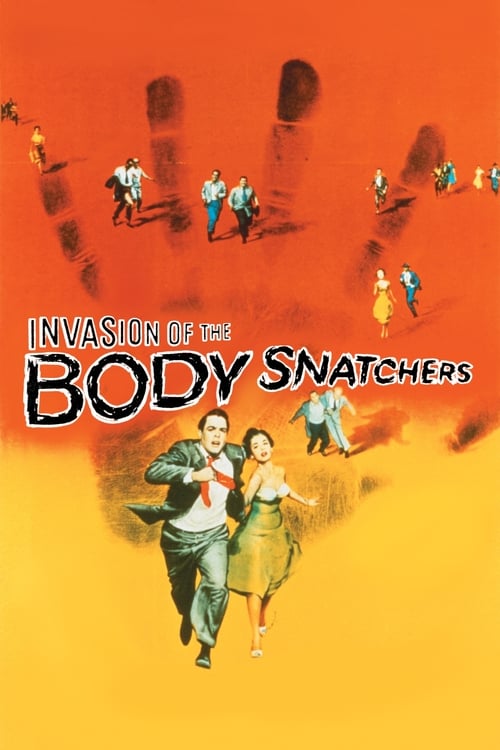
Invasion of the Body Snatchers
1956 · Don Siegel
For when you want a classic that still gets under your skin — an easy watch in length and pace, an uneasy one in effect. Perfect late-night black-and-white paranoia.
What it's about
A doctor returns to his small California town to find patients insisting their loved ones aren't their loved ones — same faces, same memories, something essential missing. As he investigates with an old flame, the delusion starts looking less like hysteria and more like an invasion: people are being replaced, quietly, in their sleep.
The experience
Lean, fast, and genuinely creepy — seventy-six minutes with no fat on them, tightening from unease into open panic. The scares come from faces, not monsters, and the idea keeps working on you after it ends.
Performances
Kevin McCarthy carries it as the doctor, sliding believably from small-town confidence into wild-eyed desperation — his mounting panic is what sells the whole premise.
The craft
Don Siegel directs with ruthless B-movie economy: every scene advances the dread, and the ordinary daylight of a small town becomes the scariest set imaginable. The horror is done almost entirely with suggestion and behavior rather than effects, which is why it hasn't dated.
Why it matters
It became one of the defining films of Cold War paranoia — read as an allegory of both communism and conformist witch-hunts — and its premise has been remade and imitated for decades.
Snapshot
Invasion of the Body Snatchers is the rare B-picture that outgrew its origins to become one of the central texts of postwar American paranoia. Made cheaply and quickly for Allied Artists, it adapts Jack Finney's 1955 novel into a tight seventy-six-minute fable in which the residents of a small California town, Santa Mira, are quietly replaced by emotionless duplicates grown from extraterrestrial seed pods. Its premise is elegantly horrifying precisely because the monsters look exactly like the people they supplant: the threat is not invasion from without but transformation from within, and its victims surrender not in violence but in sleep. Don Siegel directed it with the lean, propulsive economy that would define his career, and the picture has since been read as both an allegory of McCarthy-era anti-communist hysteria and, conversely, of the conformity that hysteria demanded—an ambiguity that has kept it alive in critical argument for seventy years.
Industry & production
The film was produced by Walter Wanger for Allied Artists Pictures, the studio that had recently rebranded itself out of the Poverty Row outfit Monogram in a bid for greater respectability. Wanger, a veteran independent producer then rebuilding his career after a notorious personal scandal and prison term, had already collaborated with Siegel on the prison drama Riot in Cell Block 11 (1954), and he brought a seriousness of purpose to what was nominally a low-budget genre assignment. The screenplay was written by Daniel Mainwaring—who under the pen name Geoffrey Homes had authored the noir landmark Out of the Past—adapting Finney's novel, which had run as a serial in Collier's magazine before its 1955 book publication as The Body Snatchers. The now-iconic prefix "Invasion of" was a studio addition.
The production was modest in budget and shot quickly over a matter of weeks in late 1955, using locations in and around Sierra Madre and other Los Angeles–area towns to stand in for the fictional Santa Mira; the small-town verisimilitude of real streets, storefronts, and staircases is integral to the film's unease. The most consequential industrial intervention came after Siegel and Mainwaring delivered their cut. The studio, nervous that audiences would find the unrelieved bleakness intolerable, imposed a framing device: a prologue and epilogue in which a frantic Miles Bennell, picked up raving on a highway, recounts the story from a hospital, with the closing scene allowing a doctor to believe him and reach for the telephone to call the authorities. Siegel and Mainwaring both objected, having intended to end on Bennell's direct, unresolved address to the camera. The studio also retitled and trimmed the film. That the picture survives as a masterpiece despite this externally imposed reassurance is a testament to the strength of everything preceding it.
Technology
The film was shot in black and white and released in SuperScope, a widescreen process in which a standard Academy-ratio negative was cropped and optically re-squeezed in the lab to yield an anamorphic print projected at roughly 2:1. This was a cheaper alternative to CinemaScope, suited to a budget-conscious production, and it gave Siegel a wide, horizontal frame without the cost of anamorphic taking lenses. The pod effects were achieved practically and with deliberate restraint: the half-formed duplicates—blank, soapy, foam-like bodies emerging from the giant seed pods—were rendered with simple prosthetic and bladder effects, and the film wisely keeps them in shadow and partial view, trusting suggestion over spectacle. There is no reliance on elaborate optical trickery; the horror is generated almost entirely through performance, staging, and the implication that the duplicate is indistinguishable from the original.
Technique
Cinematography
Ellsworth Fredericks shot the film, and his images do much to lift it above its budget. The early scenes bathe Santa Mira in bright, ordinary daylight, the better to let wrongness creep into the familiar; as the conspiracy tightens, the film turns increasingly to deep shadow, low-key noir lighting, and oppressive nighttime compositions. The widescreen frame is exploited for entrapment—characters pinned in corners of the image, hemmed by doorways, dwarfed by the geometry of staircases and streets. The celebrated sequence of Miles and Becky fleeing through the town, and the later escape across a hillside as the pod-people give silent pursuit, draws on a noir vocabulary of diagonal stairs, pooled darkness, and figures pursued through deserted spaces.
Editing
Robert S. Eisen's cutting is brisk and economical, in keeping with Siegel's preference for momentum over ornament. The film accelerates as it proceeds: early scenes breathe, establishing the town and Miles's rekindled romance with Becky, while the second half compresses into a near-continuous flight, sleep itself becoming a ticking clock. The framing-device material, imposed in editing, sits somewhat awkwardly against this drive, but the body of the film maintains a relentless forward pressure.
Mise-en-scène / staging
Siegel's staging is the film's secret engine. He treats the ordinary surfaces of small-town life—the family barbecue, the pool hall, the doctor's office, the town square—as a stage from which emotion has been drained, and he directs the converted townspeople to behave with an eerie, affectless normality that is more disturbing than any overt menace. The single most famous image, the discovery of a blank, unfinished duplicate laid out on a billiard table and in the greenhouse, is staged for clinical horror rather than shock. The pods themselves are kept mundane—stacked in a truck, distributed by neighbors—which domesticates the apocalypse and makes it spread like gossip.
Sound
Carmen Dragon composed the score, which is emphatic and at times bombastic, leaning on stingers and surging orchestral cues to underline menace; some later critics have found it overwrought against Siegel's otherwise restrained surfaces. More effective is the film's use of silence and of the wrongness of human sound—the flatness in a converted voice, the absence of a dog's bark or a child's laughter, the calm reasonableness with which the pod-people explain that surrender is painless. The horror is partly aural: the seduction of the duplicates is delivered in soothing, rational tones.
Performance
Kevin McCarthy anchors the film as Dr. Miles Bennell, and his performance is essential to its lasting power. He begins as a competent, faintly complacent professional and is driven, by degrees, into wild-eyed desperation; his final, unhinged plea—"You're next!"—is one of the most indelible moments in 1950s cinema, a fourth-wall rupture that implicates the audience directly. Dana Wynter plays Becky Driscoll with poise that makes her eventual conversion genuinely devastating: the moment Miles realizes, after she has slept, that the woman he loves is gone behind unchanged eyes is the film's emotional climax. King Donovan and Carolyn Jones provide grounded support as the couple whose alarm first sets the plot in motion. The young director Sam Peckinpah, then working as Siegel's assistant, is generally reported to have appeared in a small role and contributed in a minor uncredited capacity; the precise extent of his involvement is part of the film's lore and should be treated with some caution.
Narrative & dramatic mode
The film operates in a paranoid-investigative mode that gradually inverts the conventions of the detective story: the doctor-protagonist accumulates evidence not toward a solution but toward an inescapable trap. It is structured as a steepening curve of dawning horror—isolated complaints ("my uncle isn't my uncle") that the rational hero first diagnoses as mass hysteria, before the delusion proves true and the diagnostician becomes the last sane man. The dramatic engine is the reversal of trust: every ally is a potential duplicate, and the protagonist's own body becomes a liability the moment he sleeps. The imposed hospital frame converts this open-ended nightmare into a recovered testimony, but the native mode of the film is the closed trap, the dread that has no exit.
Genre & cycle
The picture belongs to the great cycle of 1950s American science-fiction and alien-invasion films—a wave that included The Thing from Another World (1951), The Day the Earth Stood Still (1951), It Came from Outer Space (1953), Them! (1954), and Invaders from Mars (1953). Within that cycle it is the purest expression of the "invasion as infiltration" strain, dispensing with spaceships and ray guns in favor of a contagion that spreads invisibly through a community. It is equally a descendant of film noir, sharing personnel sensibilities and a visual grammar of shadow and pursuit, and it anticipates the later body-horror tradition by locating dread inside the human form itself. Its fusion of science fiction, horror, and thriller is seamless precisely because it refuses the genre's usual hardware.
Authorship & method
Don Siegel is the film's decisive author. A former Warner Bros. montage specialist turned director, Siegel built a career on lean, tough, unsentimental genre filmmaking—Riot in Cell Block 11, The Lineup, Madigan, and later the Clint Eastwood collaborations culminating in Dirty Harry. His method was speed, clarity, and an instinct for pressure; he disliked decoration and trusted action and behavior over exposition. He regarded the studio's framing device as a betrayal of the film's design, and in later interviews tended to frame the picture's meaning broadly, as being about the loss of individual feeling and the human tendency toward conformity, rather than as a narrow political tract.
His key collaborators shaped the result decisively: screenwriter Daniel Mainwaring, whose noir sensibility lent the material its hardboiled fatalism; cinematographer Ellsworth Fredericks, whose lighting carries the tonal descent; editor Robert S. Eisen, whose pacing sustains the dread; and composer Carmen Dragon, whose score, for better or worse, supplies the film's overt emotional underlining. Jack Finney's source novel furnished the central conceit and much of the plot, including the small-town setting and the pod mechanism.
Movement / national cinema
The film is a product of mid-1950s Hollywood working at its industrial margins—an independent producer and a craft-driven director making a genre picture for a minor studio. It belongs to no formal movement, but it stands at the intersection of two American currents: the science-fiction boom of the atomic age and the residual energies of film noir, then in its late phase. It is a quintessentially American work, rooted in the iconography of the small town and the anxieties of the early Cold War, and it has come to be seen as one of the defining documents of that national moment.
Era / period
Invasion of the Body Snatchers is inseparable from its historical instant: 1956, at the tail end of the Red Scare, with Senator Joseph McCarthy's influence recently collapsed but the climate of suspicion, loyalty oaths, and enforced consensus still pervasive. The film's central horror—neighbors transformed into outwardly identical but inwardly hollowed conformists who insist everything is fine—maps with uncanny precision onto the era's competing fears. It can be read as a parable of communist subversion (the enemy that looks just like us) or, with equal force, as a parable of the conformist anti-communist mainstream itself, in which to resist the consensus is to be branded hysterical and dangerous. The film's enduring richness lies in its refusal to resolve this question; both readings are fully supported by the text, and the artists involved gave varying and often deflecting accounts of their intentions.
Themes
The governing theme is the loss of the self—specifically, the loss of feeling, individuality, and the capacity to love, surrendered in exchange for a frictionless, painless existence. The pods promise relief from the burdens of human emotion, and the film treats this offer as a genuine seduction, not merely a threat: the converted are calm, untroubled, and reasonable. Adjacent themes include conformity and the pressure to assimilate; the fragility of community and the way trust, once poisoned, cannot be restored; the vulnerability of consciousness itself, since the takeover happens in sleep; and the terror of being disbelieved, of seeing the truth while being treated as mad. Becky's conversion crystallizes the film's deepest fear—that intimacy offers no protection, and that the beloved can be replaced by an identical stranger.
Reception, canon & influence
On release the film was treated as a modest genre picture and earned respectful notices rather than prestige; its reputation grew steadily over the following decades as critics recognized the depth beneath its B-movie surface. By the 1970s it was firmly established as a classic of American science fiction and a touchstone of Cold War cultural studies, and in 1994 it was selected for preservation in the United States National Film Registry as a culturally, historically, and aesthetically significant work.
Looking backward, the film draws on Finney's novel for its premise, on the alien-invasion cycle of the early 1950s for its genre context, and on film noir for its visual and tonal language; its anxieties are those of the atomic age and the Red Scare. Looking forward, its influence is vast. The phrase "pod people" entered the language as shorthand for soulless conformity. The film established a durable template for paranoid science fiction in which the threat is indistinguishable from ourselves, a lineage that runs through The Stepford Wives, John Carpenter's The Thing, and countless tales of infiltration and replacement. It has been remade directly several times—Philip Kaufman's acclaimed 1978 version (in which Kevin McCarthy makes a cameo, still screaming his warning), Abel Ferrara's 1993 Body Snatchers, and the 2007 The Invasion—each relocating the conceit to a new decade's anxieties. Few films of its budget and era have proven so adaptable or so enduring; its central image of the duplicate that is perfect in every way except the one that matters remains among the most potent metaphors the American cinema has produced.
A Deleuzian reading
The body on the billiard table has everything a man has and nothing a man is.
The full Deleuzian reading of Invasion of the Body Snatchers →
Reception
Released in 1956 as a modest B-picture on double bills and largely ignored by critics, it's since been canonized as one of the defining sci-fi films of the decade — selected for the National Film Registry in 1994 and treated as the ur-text of paranoid genre cinema.
How Invasion of the Body Snatchers was received, from release to now →
Influences: the films it descends from and the films it influenced
- Invaders from Mars (1953) — Pioneered the affectless-duplicate dread from a paranoid first-person POV — loved ones and authority figures returning emotionally hollowed-out — the exact 'replaced from within' staging Siegel adopts.
- It Came from Outer Space (1953) — Established the desert-town premise of ordinary residents duplicated by aliens, the doppelganger-among-us conceit Finney and Mainwaring tighten into the pod mechanism.
- The Thing from Another World (1951) — Anchored the early-50s alien-invasion cycle with its group-under-siege staging and naturalistic overlapping dialogue, the genre context Siegel's film answers.
- Out of the Past (1947) — Screenwriter Daniel Mainwaring's own noir; its hardboiled fatalism and doomed narration are the sensibility he transplants into Bennell's voice.
- Detour (1945) — Model for the trapped-narrator confessional — a man recounting his own entrapment in flashback — the imposed-frame device the studio forced onto the picture.
- Cat People (1942) — Val Lewton's method of horror by suggestion — threat kept off-screen, dread carried by silence and aural wrongness rather than spectacle — feeds Fredericks's low-key restraint.
- Riot in Cell Block 11 (1954) — Siegel's prior exercise in lean, documentary-tough, low-budget filmmaking that trusts behavior and pressure over exposition — the method he brings intact.
- Invasion of the Body Snatchers (1978) — Direct remake relocating pod paranoia to post-Watergate urban San Francisco, with Kevin McCarthy's cameo still screaming the original warning — descent made literal.
- Body Snatchers (1993) — Remake transposing the replacement conceit to a military base, exploiting the regimented affectless-normality of soldiers as ready-made pod conformity.
- The Stepford Wives (1975) — Extends the perfect-duplicate-minus-feeling template to suburban marriage — spouses replaced by serene, affectless copies, conformity dramatized as domestic horror.
- The Thing (1982) — Inherits the 'anyone beside you may already be one of them' paranoid-investigative structure, swapping seed pods for practical body-horror effects as the replacement mechanism.
- Night of the Living Dead (1968) — Extends the body-horror template of ordinary people overwhelmed by their own transformed neighbors, with the same bleak, unrescued downbeat ending Siegel originally intended.
- The Faculty (1998) — Explicit pod-people homage — a parasite quietly converting a closed community while survivors test one another for lingering humanity.
- Get Out (2017) — Reworks loss-of-self-by-replacement as racial allegory; the 'sunken place' converts produce the same uncanny affectless-normality that tips Bennell off to the pods.
- The Manchurian Candidate (1962) — Shares the Cold War paranoid-conformity nerve — a person hollowed out and remotely controlled, the menace indistinguishable from a trusted intimate.
- Bright Future (2003) — Siegel's B-cinema conceit of a spreading alien organism as social-conformity critique — the biological agent as legible political allegory — is the genre template Kurosawa consciously invokes and dissolves, substituting jellyfish bioluminescence for pods as the film's central invasive figure.
- Seconds (1966) — The conformity-replacement premise — a self quietly substituted by an unseen system — that Seconds recasts as a paid corporate transaction.
- Dirty Harry (1971) — The lean, paranoid model of one alienated man who sees the threat while the institution sleepwalks — Siegel's career-long individual-vs-conformist structure that Dirty Harry restages in a police register.
- The Arrival (1996) — Originates the infiltration-already-complete structure The Arrival inherits: the hero realizes the people around him have been quietly replaced and that institutional authority is already on the enemy's side, leaving him a disbelieved lone voice.
- They Live (1988) — Carries the infiltration-as-conformity allegory forward — the replaced hiding in plain sight among us — as overt social critique in genre clothing.
- War of the Worlds (2005) — The Cold War invasion-cycle ancestor whose paranoia of infiltration and ordinary-man-fleeing-an-unstoppable-takeover structure feeds the film's everyman-victim perspective.
- It Follows (2015) — The paranoid horror of a contagion passed person-to-person where anyone in the crowd may be the threat — the 'it could be anybody walking toward you' transmission structure.
- The Day the Earth Stood Still (1951) — Shares the Cold War allegory delivered through documentary-realist small-town staging, treating the fantastic as an intrusion into ordinary domestic space rather than spectacle.
Similar films
- Invasion of the Body Snatchers (1978) — influence & lineage
- The Manchurian Candidate (1962) — influence & lineage
- The Thing (1982) — influence & lineage
- Night of the Living Dead (1968) — influence & lineage
- The Stepford Wives (1975) — influence & lineage
- The Incredible Shrinking Man (1957) — same viewing thread · often watched together
- The War of the Worlds (1953) — same viewing thread
- War of the Worlds (2005) — same viewing thread
All the films related to Invasion of the Body Snatchers →
Watch it with: curated runs of related films
- The Shadow of the Bomb — Watch these when you want the Cold War's dread the way it actually landed — not in war rooms but at kitchen tables — the same annihilation refracted from pulp sci-fi to a submarine standoff to a retired couple brewing tea as the fallout arrives.