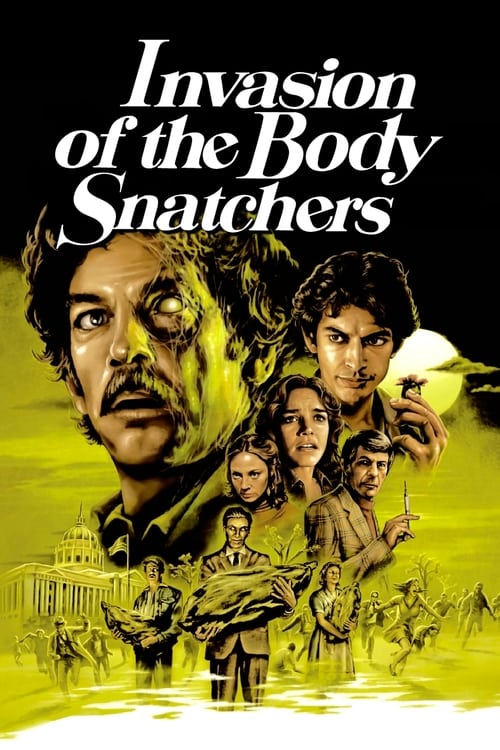
Invasion of the Body Snatchers
1978 · Philip Kaufman
When you're craving a real scare of the slow-dread kind — ideal for a late night alone with the lights off, best if you like your horror smart and your paranoia earned. Challenge, not comfort.
What it's about
In late-1970s San Francisco, a health inspector and his colleague start noticing that people around them are subtly wrong — friends and lovers reported as 'not themselves,' placid, hollow, watching. As the complaints multiply, the two trace the strangeness to its source and realize something is replacing human beings, one sleeping body at a time, with perfect emotionless duplicates. The horror isn't a monster in the dark; it's that the person next to you might already be gone.
The experience
Creeping, paranoid, and genuinely frightening — it tightens like a slow noose, trading jump scares for the mounting wrongness of ordinary faces. The sound design gets under your skin, the city itself starts to feel hostile, and it ends on one of the most chilling notes in horror. You'll eye strangers differently for a day or two.
Performances
Donald Sutherland anchors it with mounting, haggard desperation, Brooke Adams gives the dread its human center, and a young Jeff Goldblum and Veronica Cartwright round out a cast that plays escalating terror as something horribly plausible.
The craft
Philip Kaufman shoots San Francisco through fog, odd angles, and half-glimpsed background action so the whole city seems complicit, and the film's sound — the shrieks, the wet organic effects, the uneasy score — does as much scaring as the images. The practical pod effects remain repulsively convincing; watch it loud, in the dark.
Why it matters
Widely held up as the rare remake that equals or surpasses its original, it recast a 1950s parable as post-Watergate urban paranoia and became a benchmark for intelligent, adult horror — its final image alone is a permanent piece of genre iconography.
Snapshot
Philip Kaufman's Invasion of the Body Snatchers is that rare thing: a remake that eclipses, or at least equals, the film it revisits. Working from Jack Finney's 1955 novel and Don Siegel's celebrated 1956 adaptation, Kaufman and screenwriter W.D. Richter relocate the story of the emotionless "pod people" from a fictional California small town to the fog and asphalt of contemporary San Francisco. Two health-department workers, Matthew Bennell (Donald Sutherland) and Elizabeth Driscoll (Brooke Adams), notice that the people around them have become subtly wrong — placid, affectless, purposeful in a way that curdles into menace — and slowly grasp that humanity is being replaced, one sleeping body at a time, by perfect vegetal duplicates. Where the 1956 film was a taut B-picture parable, the 1978 version is a lush, paranoid, texturally dense studio production, arriving at the tail end of the New Hollywood moment and carrying that era's disillusion in its bones. It is remembered above all for one of American cinema's great downbeat endings.
Industry & production
The film was produced by Robert H. Solo and released by United Artists in December 1978, at a moment when the studio was riding high on prestige and genre successes and when the horror and science-fiction genres were being taken newly seriously by both audiences and financiers — the wake of Jaws (1975), Carrie (1976), and Star Wars (1977). It was a comparatively modest production by the standards of that boom, made largely on San Francisco locations, and it performed well enough commercially and critically to be regarded as a success; precise budget and box-office figures vary across sources, so I won't assign specific numbers here.
Casting reflected an unusual blend of countercultural and character-actor sensibilities. Donald Sutherland, then near the height of his 1970s run, anchors the film; Brooke Adams, Jeff Goldblum (as neurotic writer Jack Bellicec), and Veronica Cartwright (as his wife Nancy) fill out the ensemble, with Leonard Nimoy cast against type as a smooth pop-psychiatrist, Dr. David Kibner. The production also folded in a set of pointed cameos that function as historical annotation: Kevin McCarthy, star of the 1956 film, appears pounding on car windows in traffic and screaming "They're here!" — extending, or perhaps completing, the desperate warning that ended Siegel's picture; Don Siegel himself turns up as a taxi driver; and Robert Duvall appears fleetingly and uncredited as a priest on a playground swing. These are not merely in-jokes but a way of situating the remake explicitly as a continuation of, and commentary on, its predecessor.
Technology
The film is a product of late-1970s photochemical, location-based filmmaking rather than any technological novelty. Its effects are overwhelmingly practical: the pods themselves — pulsing, membranous seed casings that gestate a duplicate as its human template sleeps — are achieved through physical puppetry, articulated foam, and prosthetics, most memorably in the extended sequence in which the half-formed duplicates emerge slick and umbilical in a greenhouse and mud-bath tableau. The film's most notorious single image, a dog with a human face, is likewise a practical creation, and its very tactility — the sense that it exists in the same photographed space as the actors — is central to its power to unsettle. The opening sequence, in which gelatinous spores drift off a dying world, travel through space, and settle as rain onto San Francisco's vegetation to bloom as small pink-and-red flowers, uses optical and miniature techniques of the period rather than the emergent computer imaging that would arrive in the following decade.
Technique
Cinematography
Michael Chapman — coming directly off Taxi Driver (1976) and shortly before Raging Bull (1980) — is arguably the film's decisive craftsman. His camera treats San Francisco as a maze of obstructed sightlines and hostile geometry. He shoots through foreground clutter — railings, foliage, glass, blinds — so the viewer is forever peering at the characters as if surveilling them or being surveilled alongside them. Telephoto lenses compress crowds into flattened, watchful masses; low and canted angles make ordinary architecture loom. Handheld movement lends the pursuit sequences a lurching immediacy, while the palette leans into sodium-lit nights, wet pavement, and institutional interiors. The cumulative effect is a city that has been made subtly uninhabitable before we ever understand why.
Editing
Douglas Stewart's cutting sustains a slow-burn escalation from social comedy of manners toward outright nightmare. Early scenes accumulate small wrongnesses — a glimpsed exchange, a face that doesn't fit its expression — through editing that lets the audience notice discrepancies slightly ahead of, or alongside, the protagonists. As the film accelerates into flight and pursuit, the rhythm tightens without ever fully surrendering the eerie, dilated tempo that defines the picture's dread.
Mise-en-scène / staging
Kaufman stages the takeover as a matter of atmosphere and blocking rather than spectacle. The pod people are defined by their stillness, their coordinated non-reaction, and above all by their pointing and shrieking — the community's silent conformity weaponized into a mob signal. A recurring motif of the film is the ordinary crowd turned uncanny: people who move with too much collective purpose, who converge, who distribute pods across the city with bureaucratic calm. The garbage trucks hauling gray drifts of pod matter, the rooftop distribution of pods, the transformation of civic infrastructure into the machinery of replacement — all of it stages the horror as institutional and municipal, an invasion routed through the systems of everyday urban life.
Sound
Sound is one of the film's signature achievements. The pod duplicates announce themselves and summon their kind with a piercing, inhuman scream — a sound frequently credited to Ben Burtt, then fresh from Star Wars — that has become one of the most recognizable audio motifs in the genre. Beyond that scream, the design layers the wet, organic tearing and pulsing of the pods against the ambient hum of the city, so that the sonic world itself feels contaminated. Silence, too, is deployed as threat: the pod people's affectless quiet is as frightening as any shriek.
Performance
The performances calibrate carefully to the film's central problem — how to play a human being becoming, or pretending not to be, something else. Sutherland gives Bennell a rumpled decency curdling into exhaustion and terror. Brooke Adams registers the earliest, most intimate horror, sensing that her own partner has been replaced. Goldblum and Cartwright supply nervy, verbal energy that makes their eventual fates land harder. Nimoy, trading Spock's logic for the honeyed reassurance of a bestselling therapist, embodies a specifically 1970s figure of false comfort. And Cartwright's Nancy carries the film's devastating final beat.
Narrative & dramatic mode
The film operates as paranoid thriller first and creature-feature second. Its dramatic engine is epistemological: how do you prove that a person is no longer a person, when the duplicate is physically identical and only the interior — affect, love, individuality — has been hollowed out? For much of its length the film withholds certainty, letting the audience share the characters' vertiginous doubt about whether they are perceiving a conspiracy or losing their minds. This aligns it with the "paranoid" storytelling mode that dominated 1970s American film. Its structure is a steady constriction — the circle of trustworthy humans shrinking scene by scene until it collapses entirely — and it famously refuses the reprieve of a rescue. The ending, in which the last apparent holdout is revealed as converted and levels the pod-shriek at a former ally, inverts every convention of survival that the genre had trained audiences to expect.
Genre & cycle
Invasion of the Body Snatchers sits at the intersection of two cycles. Backward, it belongs to the 1950s tradition of alien-infiltration and body-horror science fiction that Siegel's original helped define — narratives in which the threat is not a visible monster but the neighbor who looks the same and is not. Forward, it is a keystone of the late-1970s and early-1980s revival of ambitious, adult-oriented horror and its particular fascination with bodily transformation. It is also a defining example of the "serious remake": a film that treats an earlier genre picture as material worth reinterpreting for a changed cultural moment, a model later imitated widely.
Authorship & method
Philip Kaufman approached the material as an eclectic, literate director rather than a genre specialist. His prior work — the revisionist Western The Great Northfield Minnesota Raid (1972), the Arctic drama The White Dawn (1974), and his early, contested involvement with The Outlaw Josey Wales (1976), from which he was famously removed — had marked him as a filmmaker drawn to atmosphere, cultural texture, and moral ambiguity. He would go on to The Right Stuff (1983), The Unbearable Lightness of Being (1988), and Henry & June (1990), a body of work notable for its literary sources and sensuous surfaces. Body Snatchers fits that profile: an idea-driven horror film unusually attentive to milieu, performance, and mood.
His key collaborators shape the film as much as he does. W.D. Richter's screenplay updates Finney and Siegel with contemporary irony and a keen ear for the therapeutic patois of the era. Michael Chapman's cinematography supplies the visual grammar of surveillance and unease. Douglas Stewart's editing manages the film's long crescendo. And the score is the work of Denny Zeitlin — a jazz pianist and practicing psychiatrist for whom this was, by his own account, a singular and stressful venture into film scoring, and to which he did not return; his music blends dissonant, anxious orchestral and electronic textures with a jazz sensibility, and the biographical detail of a psychiatrist scoring a film about the loss of the self is a genuine and much-noted irony.
Movement / national cinema
The film is a late bloom of New Hollywood — the generation of American directors who, through the late 1960s and 1970s, brought European art-cinema technique, moral pessimism, and auteur ambition to genre and studio filmmaking. Its handheld realism, location shooting, downbeat worldview, and refusal of consolation are hallmarks of that movement, even as the broader industry was already pivoting toward the blockbuster model that Star Wars had inaugurated the year before. It is American cinema at a hinge point, deploying New Hollywood craft in service of what would become a mainstream genre revival.
Era / period
Made in 1978, the film is saturated with the disillusion of its moment: the aftermath of Vietnam and Watergate, the collapse of 1960s idealism, and the ascendance of what Tom Wolfe had christened the "Me Decade." Its San Francisco — once the capital of the counterculture — is now a city of self-help gurus, therapy-speak, and affectless professionals, which makes it the perfect stage for a story about the surrender of individuality to a placid, conformist collective. Nimoy's celebrity psychiatrist crystallizes the theme: an era's promise of self-actualization reframed as an invitation to stop feeling. The horror is period-specific — the fear that liberation had curdled into a new, smiling emptiness.
Themes
At its core the film is about dehumanization and the loss of the self — the terror of a world in which people are physically preserved but emotionally erased. It dramatizes conformity as an existential threat: the pods promise an end to pain, loneliness, and conflict at the price of everything that makes a person a person, and they extend that promise with something like compassion, which is precisely what makes them frightening. Paranoia and the erosion of trust run through every relationship, as intimacy becomes the very vector of betrayal — you are replaced while you sleep, by those closest to you. Where the 1956 film has long invited competing readings as either anti-McCarthyist or anti-Communist allegory, the 1978 version reads more legibly as a lament for the death of the counterculture and a critique of therapeutic, self-absorbed late-1970s culture — though, like all durable allegories, its power lies partly in its refusal to resolve into a single meaning.
Reception, canon & influence
The film was well received critically on release and its standing has only grown; it is now routinely cited as one of the finest remakes in American cinema and among the strongest science-fiction–horror films of its decade. Its critical reputation rests especially on Chapman's cinematography, its sound design, and its uncompromising ending.
Its lines of influence run clearly in both directions. Backward, it draws on Finney's novel and Siegel's 1956 film — a debt it acknowledges openly through the McCarthy and Siegel cameos — as well as on the 1950s alien-infiltration cycle and, crucially, on the paranoid conspiracy thrillers of its own moment, such that its dread of unseen, systemic replacement rhymes with the political cinema of the mid-1970s. Forward, its influence is substantial. It helped establish the template for the prestige horror remake and stands as an important immediate precursor to the body-horror wave of the early 1980s; John Carpenter's The Thing (1982), another paranoid, practical-effects-driven film about perfect duplication and the impossibility of trust, is its clearest descendant in spirit. The Body Snatchers property itself continued to be revisited — by Abel Ferrara in 1993 and again in 2007's The Invasion — but Kaufman's version remains the benchmark against which those returns are measured, and its final image endures as a byword for the horror film that dares to let the darkness win.
A Deleuzian reading
A priest sits alone on a playground swing.
The full Deleuzian reading of Invasion of the Body Snatchers →
Reception
A rarity: acclaimed on release in 1978 — Pauline Kael was a vocal champion — and its stock has only risen since, now routinely cited as the gold standard for how to remake a classic.
How Invasion of the Body Snatchers was received, from release to now →
Influences: the films it descends from and the films it influenced
- Invasion of the Body Snatchers (1956) — Supplies the pod-duplication mechanism and the 'you're next' paranoid-mode structure Kaufman inherits wholesale — acknowledged in Siegel's and McCarthy's cameos — which Kaufman then inverts from a studio-softened frame into an unbroken downbeat ending.
- The Conversation (1974) — Establishes the surveillance-thriller grammar of long-lens eavesdropping and figures glimpsed through obstructing foreground that Chapman restages as the film's watched, obstructed sightlines.
- The Parallax View (1974) — Gordon Willis's telephoto compression flattening lone figures against monolithic architecture, plus the 'the conspiracy simply wins' bleak coda, model the film's systemic dread and refusal of rescue.
- Taxi Driver (1976) — Michael Chapman's own immediately prior method — telephoto street compression and the alienating, uncanny urban crowd — is carried directly into the visual language of Body Snatchers.
- Night of the Living Dead (1968) — Provides the template for the horror film that dares to let the darkness win, plus handheld, unglamorous municipal dread over any studio gloss.
- Rosemary's Baby (1968) — Pioneers the urban conspiracy-of-neighbors horror in which an entire social milieu is quietly complicit, its menace masked by soothing professional and therapeutic patois — exactly Richter's updated register.
- The Birds (1963) — Its scoreless electronic/organic sound design (Sala's Trautonium) and the uncanny massing crowd deployed as the horror instrument itself prefigure Zeitlin's dissonant textures and the film's staging of crowds-as-threat.
- Don't Look Now (1973) — Associative, premonitory slow-burn editing that accumulates unease and detonates in a cruel final reversal supplies the model for Douglas Stewart's long crescendo and the gut-punch closing shot.
- The Thing (1982) — The clearest heir in spirit: paranoid, practical-effects-driven perfect duplication in which no one can be trusted, resolving in ambiguous defeat rather than deliverance.
- The Fly (1986) — Advances the early-'80s body-horror wave the remake precedes, foregrounding practical-effects transformation of the self as the locus of terror.
- They Live (1988) — Reworks the paranoid-mode politics of invisible, systemic replacement — society covertly overwritten by conformist duplicates only the sighted protagonist can perceive.
- The Faculty (1998) — Directly riffs on the pod-infiltration structure of 'who is still human,' rebuilding the escalating tests-of-trust among a shrinking group of the uninfected.
- The Invasion (2007) — A direct franchise return that restages the replacement mechanism as viral contagion, explicitly measured against Kaufman's version as the benchmark it fails to surpass.
- Get Out (2017) — Inherits the prestige-horror-remake sensibility and the therapeutic patois-as-camouflage, dramatizing the body-snatching of identity as a conspiracy hiding behind liberal reassurance.
- Under the Skin (2013) — Extends the telephoto capture of unwitting real crowds and the alien-organic sound design into a study of the uncanny human collective observed from outside itself.
- Us (2019) — Kaufman visualizes body-substitution paranoia through physically identical doubles emerging from underground, and closes with the protagonist's complicit signal; Peele inverts this mechanics precisely — locating authenticity below ground rather than above, and making the compromised figure the film's nominal hero.
- Weapons (2025) — Ensemble community horror in which the threat is indistinguishable from the social fabric; the progressive revelation of collective complicity through procedural discovery by an epistemically disadvantaged protagonist who cannot trust the community as witness.
- The Arrival (1996) — Models the modernized body-snatcher idiom Twohy uses — telephoto urban paranoia, sound design as creeping dread, and the slow accretion of evidence that the replacement is systemic rather than local.
- They Cloned Tyrone (2023) — Models the your-neighbor-is-a-copy dread and the paranoid escalation from personal unease to citywide conspiracy that Tyrone's clone reveal runs on.
- Obsession (2026) — Perfected the loved-one-returns-altered horror in which familiar intimacy becomes uncanny replacement, the possession-and-substitution engine Obsession runs on.
- The Stepford Wives (1975) — Runs the same replacement-by-conformity engine — loved ones returning as placid, affectless duplicates — as a suburban companion piece to the film's urban strain.
- Dawn of the Dead (1978) — Contemporary in its municipal/consumer-space horror and its uncanny shuffling crowd, sharing the era's read of the massed body as vector of dehumanization.
- Alien (1979) — Extends the same wet, organic creature-sound design and enclosed-community slow-burn escalation, dread accreting until trust and safety collapse.
Similar films
- Invasion of the Body Snatchers (1956) — influence & lineage
- The Fly (1986) — influence & lineage
- The Thing (1982) — influence & lineage
- Alien (1979) — influence & lineage
- The Stepford Wives (1975) — influence & lineage
- The Birds (1963) — influence & lineage
- The Conversation (1974) — influence & lineage
- Rosemary's Baby (1968) — influence & lineage