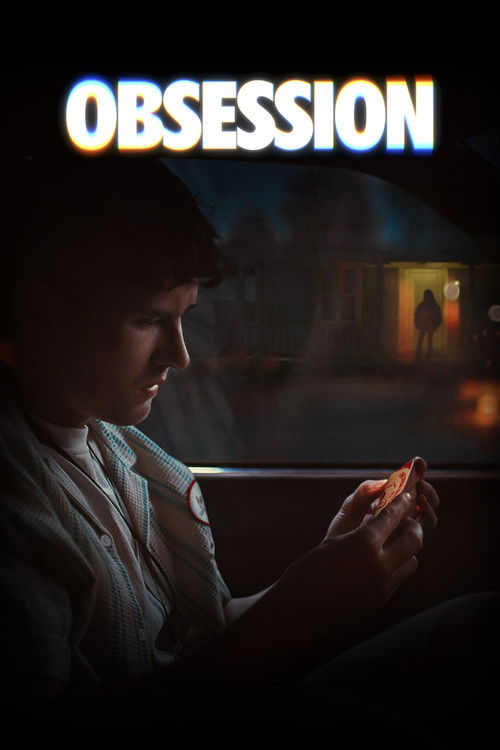
Obsession
2026 · Curry Barker
For when you want your horror with a dark sense of humor — a date-night scary movie about the danger of getting what you want. More unsettling than gory, but it goes to uncomfortable places, so bring a little nerve.
What it's about
A hopeless romantic breaks a legendary wishing tree — the 'One Wish Willow' — to make the woman he adores fall for him, and the wish takes. What follows is a courtship that starts as a dream and curdles into something wrong, as he learns that a granted desire has its own appetite and its own fine print. It follows the new couple as the supernatural bargain tightens around them.
The experience
It plays like a romantic comedy sliding inch by inch into dread — funny and awkward at first, then genuinely unnerving, with an absurdist streak that makes the scares hit stranger. You spend the back half braced, waiting to find out what the wish actually costs.
The craft
Independent horror built on a tight premise rather than a big budget: the film wrings tension from escalation and tone control, letting the wish's logic play out with deadpan patience before turning the screws. The mix of psychological horror and absurdism asks the filmmaking to pivot between laughs and menace, and the shifts are the show.
Why it matters
It belongs to the current wave of low-budget, high-concept indie horror finding audiences through word of mouth — a calling-card film for a young writer-director working outside the studio system.
Horror · Horror comedy & camp · Psychological horror · Possession & occult. A deadpan romantic comedy that curdles into dread: a granted love wish turns wrong, and the laughs keep going stranger, not lighter.
Snapshot
Obsession is a romance-horror film written, directed, and edited by Curry Barker. It turns the old "be careful what you wish for" tale into a study of desire, consent, and control. Baron "Bear" Bailey (Michael Johnston) is a shy music-store clerk who cannot bring himself to tell his coworker Nikki Freeman (Inde Navarrette) how he feels. Instead he makes a supernatural wish that she will love him, and obsessive consequences follow. The horror is built into the premise: the wish does not go wrong by accident. Getting what he asked for is the violation. Critics have described the film as a love story gone badly wrong, played with a streak of darkly absurd humor.
The film premiered at the Toronto International Film Festival on September 5, 2025, and opened in US theaters on May 15, 2026, with a running time of 109 minutes. It was shot digitally in 26 days in and around Los Angeles on a budget well under a million dollars. Its reported worldwide gross runs to the hundreds of millions, an extreme ratio of return to cost even by the standards of low-budget horror. It is Barker's first studio-backed feature after a career built almost entirely on YouTube, and it is the most commercially visible case yet of a YouTube-born horror director crossing into theatrical filmmaking.
Industry & production
Obsession sits on the increasingly porous boundary between internet-native filmmaking and the studio system. Its production model came over almost unchanged from Barker's online work: a small, close-knit team, a very short schedule, and a director who writes, shoots, and cuts. The 26-day shoot took place in October 2024 across ordinary working locations in the San Fernando Valley and nearby: a music store in San Fernando, a crystal shop and a tavern in Burbank, and a pizzeria in North Hollywood. These are real storefronts and neighborhood haunts rather than built sets, and they place the supernatural premise in the plain commercial geography of the Valley.
The budget was a few hundred thousand dollars, which is micro-budget territory for a theatrical release. The film's box-office run, reported in the hundreds of millions worldwide, makes it a textbook case of the low-cost, high-ceiling horror bet. A modest outlay is made safe by disciplined spending, and a hit returns far more than the cost. What sets Obsession apart within that model is that the efficiencies came from a filmmaker trained in self-production for an online audience, not from studio cost control. Film Stories critic Maria Lattila placed it in a wave of YouTube-born directors receiving studio backing, alongside Iron Lung and Backrooms. Seen that way, Obsession is less a one-off than a sign of the industry's new scouting ground.
Technology
The film combines micro-budget means with planning tools borrowed from much larger productions. It was captured digitally and edited in Adobe Premiere, the everyday software of the online creator rather than a high-end finishing suite. Its prep work is where the technology mattered most. Cinematographer Taylor Clemons scanned the shooting locations with a phone-based scanner, rebuilt them as 3D environments in Unreal Engine, and posed virtual figures inside them to design shots. Barker then edited those storyboards into sequence to plan how shots would cut together. He has said the team storyboarded the entire film and that he went further and actually edited the boards. The result was a previsualized film, cut before it was shot, which let a 26-day schedule carry precise, designed compositions.
The finished film's dark look was also a technical achievement. Clemons worked with gaffer Chris Oh and digital imaging technician Andrew Nibbi to build an underexposed style: frames that let large areas fall into shadow while keeping enough information for the viewer to search the image. On a digital production, holding that line between readable darkness and murk depends on close coordination among camera, lighting, and on-set image management, and the DIT's role in that workflow is part of the film's visual signature.
Technique
Cinematography
Taylor Clemons came to the film from skate and surf videos and commercial work. With Barker, he built a style around stillness, darkness, and the centered frame. The camera is largely static, and long stretches play out in dark frames where the viewer has to search the shadows for what is there. Clemons has spoken of his interest in empty dark space that the mind fills in. He has also said that the shadowy shapes around Nikki's obscured face can feel like someone the viewer knows, an uncanniness built from what is withheld rather than what is shown.
Barker wanted centered compositions with extra headroom, framing characters in a way that feels uncomfortable in its loneliness. He has described central framing as forcing the viewer to look and pulling them in. The film also has an overall visual arc: its early scenes are brighter, and after a point of no return it settles into sustained darkness, so the lighting traces the story's moral descent. Reviewers noted the warm amber light and earthy palette of the early stretches, an inviting atmosphere set up as a contrast to what follows. The Scoop's Jacqui Moore observed that Barker evokes 1990s horror through locations, costume, lighting, lens choices, props, and casting.
Before shooting, Barker and Clemons watched Ari Aster's whole filmography together, Hereditary included. Clemons also cites David Fincher's Se7en as a model for a risky, oppressive atmosphere. Not every critic was persuaded. Eddie Averill, writing at Vintage Violence, found the frames badly underlit and lacking texture. He saw the film leaning on shallow-focus shot-reverse-shot patterns, with carefully storyboarded compositions that he felt lacked purpose. The approach that admirers found suggestive, he found merely dim.
Editing
Barker cut the film himself, continuing the habit of total authorship he developed making YouTube shorts, where writing, directing, and editing all sit with one person. In Obsession editing began before production: the storyboards were themselves edited to plan transitions, so the cut was largely designed in advance and the shoot served as a way of gathering planned pieces. The rhythm the reviewers describe depends on pacing in the cut. Shots linger, stillness is held, and then sudden gestures or jarring sounds break it. Moore singled out the film's "safety beats," as she called them: passages of brighter light and calmer sound that build false security before a scare. The film's structure of reassurance and rupture is an editorial strategy as much as a photographic one.
Mise-en-scène / staging
Production designer Vivian Gray grounded the premise in recognizable, slightly worn places. The music store is the hub of the ordinary world, and around it sit a crystal shop, a tavern, and a pizzeria. A crystal shop is a nicely chosen setting for a story about wishes, a place where the mystical is sold over the counter. Reviewers emphasized the warm, earthy look of these spaces and their deliberate echoes of 1990s horror. The film declines gothic distance and lets dread build inside cozy, everyday interiors. The staging uses stationary compositions and silhouettes, figures placed against darkness, and the centered, high-headroom frame that isolates characters within their surroundings. That isolation is the film's emotional subject made visible: loneliness as the condition that drives the wish.
Sound
The score is by Rock Burwell. The reviewers' comments focus on the overall sound design, which works on the same pattern of comfort and shock as the images. Moore noted calm, consonant sound used to create false security before scares, and other reviewers pointed to jarring sound cues and voice modulation as sources of tension. This interplay between a soothing register and sudden aural attack suits the film's blend of romance and horror. The soundtrack keeps switching between the two, and the switch itself becomes a source of unease.
Performance
The film rests on its two leads, and critics singled them out. Writing from TIFF, Josh Korngut of Dread Central judged Inde Navarrette's performance genuinely startling and likened its intensity to Mikey Madison's in Anora. He felt the film's purest horror lies in brief glimpses of Nikki's inner torment. Moore praised Navarrette's physicality, her contorted facial expressions, and her vocal control, which together make Nikki's transformation feel disturbingly real. The role asks Navarrette to play a person whose inner life is under assault while staying recognizably herself.
Michael Johnston's Bear has the harder job of staying sympathetic enough that the audience follows him into the premise. Korngut called the performance expertly tragic. Johnston has said his biggest challenge was sustaining intensity across the shoot, and that he soon learned to hold some back for later, since many of the most emotionally demanding scenes were shot overnight. Cooper Tomlinson, Barker's longtime creative partner, plays Ian, and Megan Lawless plays Sarah Harper. Moore credited both with grounded supporting work. Andy Richter appears as Carter.
Narrative & dramatic mode
The film's dramatic mode is dramatic irony with an ethical edge. The audience understands from the start what Bear will not admit: a love conjured by a wish is not love but an override of another person's will. The fairy-tale structure, in which a wish is granted and a price comes due, is turned inward, so that the twist is not an outside punishment but the wish working as asked. That is the source of both its horror and its comedy. The darkly absurd humor critics noted comes from the gap between Bear's romantic self-image and what he has actually done.
Structurally, the film moves from light to dark. Its brighter opening stretch sets up the workplace, the yearning, and the wish. After a point of no return it shifts into the sustained darkness that defines the rest. Reviewers differed on how well the later horror mechanics work. Averill found the genre beats predictable, while Korngut and Moore were absorbed by the emotional and physical horror of the central relationship.
Genre & cycle
Obsession belongs to a contemporary cycle of horror films that turn the language of romance against itself, in which the "nice guy" who feels owed affection becomes the source of the threat. It draws on the long tradition of wish-horror, the monkey's-paw tale and its many screen descendants, and on stories in which a loved one becomes subtly or monstrously wrong. It routes both through current conversations about consent and control. Critics placed it in that romance-horror space, with Moore framing it around consent and codependency.
It also belongs to two industrial cycles. One is the micro-budget-to-blockbuster horror success, a film made cheaply and sold on concept and word of mouth that breaks out far beyond its cost. The other is newer: YouTube-born horror directors moving into studio features, the wave Film Stories links with Iron Lung and Backrooms. Its mix of real terror and cringe-comic register reflects Barker's grounding in sketch comedy as much as in horror, and its deliberate echoes of 1990s horror give it a revivalist texture within that cycle.
Authorship & method
Curry Barker (born September 22, 1999, in Mobile, Alabama) is the film's dominant author: writer, director, and editor. His method is the story of the film. He came up through YouTube rather than the studio pipeline, co-creating the sketch-and-horror channel "that's a bad idea" with Cooper Tomlinson, whom he met in his first week at the New York Film Academy before dropping out. He has called YouTube a film school outside of film school, and his practice of writing, shooting, cutting, and releasing his own work, then learning from the public response, carries straight into Obsession. His formative horror text was The Texas Chainsaw Massacre, specifically the 2003 version, seen at age 11. His breakthrough short The Chair (2023), which drew millions of views, and his roughly $800 found-footage feature Milk & Serial (2024) showed the micro-budget skill that Obsession scales up.
On this film that skill took the form of extreme pre-planning. With Clemons, Barker scanned locations, built virtual versions of them, storyboarded every shot, and edited those boards into sequence before the camera rolled. That process is a filmmaker's answer to a short schedule, and an editor's way of directing. Watching Aster's films together and citing Se7en show a director looking past the internet toward a tradition of high-craft, oppressive horror.
The key collaborators are cinematographer Taylor Clemons, whose skate-video and commercial background suits fast, resourceful production; gaffer Chris Oh and DIT Andrew Nibbi, who helped build the underexposed look; production designer Vivian Gray; and composer Rock Burwell. Barker's collaborative circle is personal and long-running, and Cooper Tomlinson appears on screen as Ian. This is a contemporary kind of auteurism: one creator's sensibility, formed in public on a platform, carried into a theatrical feature with its quirks largely intact.
Movement / national cinema
Obsession is an American film and, more specifically, a product of a distinctly 2020s American development: the pipeline from YouTube to theatrical release. It is tied less to a regional or art-cinema movement than to an emerging, platform-native mode of horror authorship, made up of creators who build audiences online and then cross into the studio system with their aesthetics and audiences intact. Its San Fernando Valley locations place it in the film industry's home geography, though far from its glamour: music stores, crystal shops, taverns, and pizzerias rather than soundstages. Its creative roots lie in the decentralized internet rather than in film school or the festival circuit, even though it entered public view through TIFF.
Era / period
The film is a document of the mid-2020s, when the barrier between online creators and legacy studios came down and that change became one of the industry's defining stories. Film Stories' grouping of Obsession with Iron Lung and Backrooms captures the moment. It arrives amid a strong cycle of concept-driven horror and amid sharp cultural attention to consent, coercion, and the pathologies of online masculinity. Some readers took the film to literalize those concerns, and others thought it only skimmed them.
Technologically, it belongs to a moment when phone-based location scanning and game-engine previsualization became cheap enough for a micro-budget feature, and when a feature could be cut in the same consumer editing software creators use for online video. Aesthetically it looks backward too, deliberately recreating 1990s horror. It is a very 2025–2026 object that is consciously nostalgic for an earlier era of the genre.
Themes
The film's governing theme is romantic entitlement as horror: the idea that love pursued as possession destroys the person it claims to cherish. Its premise asks how readily a viewer forgives a man's violation when he presents it as longing, and its dark comedy works to sharpen that question rather than soften it. Critics drew out related themes. Moore read the film through consent and codependency. Korngut found consent violations, mental illness, grief, and regret woven through it. Barker's own account of the centered, lonely frame suggests that isolation is the soil the obsession grows from.
Not every reader found the themes fully developed. Averill read the film as a story of an incel receiving karmic punishment that it explores only on the surface, and saw its most striking images as built to circulate as memes rather than to deepen the idea. That split is itself telling. The film's subject sits at a cultural pressure point, and it is read as either a sharp indictment or a well-packaged gesture toward one.
Reception, canon & influence
Critical reception was strong but polarized. Out of TIFF, Korngut hailed the film at Dread Central as a next-generation horror masterpiece he had not been prepared for. Moore at The Scoop praised its craft, its 1990s textures, and its performances. Averill at Vintage Violence dissented sharply, faulting the underlit images, the purposeless compositions, and the predictable genre beats. The strongest praise centered on Navarrette's performance and the film's atmosphere, and the strongest objection was to the same dark visual style that its makers set out to achieve. Commercially it became a mainstream event, a micro-budget film whose reported worldwide gross reached the hundreds of millions.
Influences on the film (backward): The documented creative inputs include Ari Aster's filmography, Hereditary in particular, which Barker and Clemons studied together before shooting, and Fincher's Se7en, Clemons's model for oppressive atmosphere. Reviewers also saw a deliberate recreation of 1990s horror in the film's locations, costume, lighting, lenses, props, and casting. Beyond these, the film draws on the monkey's-paw tradition of wish-horror, on stories of loved ones who become wrong, and on Barker's own formation: The Texas Chainsaw Massacre, his found-footage work on Milk & Serial, and the cringe and sketch comedy of his YouTube channel.
Legacy / what it shaped (forward): Obsession's most concrete legacy is as proof of concept. It showed that a YouTube-trained horror director could lead a theatrical release to blockbuster returns, and critics already discuss it as part of a wave of such filmmakers. Its production method, which planned a short shoot through phone scans, game-engine previsualization, and an edited storyboard, offers a model for ambitious filmmaking on a small budget. Its divisive dark aesthetic, admired by some and dismissed by others, has made it a reference point in arguments about how much darkness a frame can hold.
A Deleuzian reading
Start with Nikki's face, or what you can see of it.
The full Deleuzian reading of Obsession →
Reception
A $750k, 20-day production that pulled $16M its opening weekend on pure word of mouth — the Reddit threads and YouTube comments are wall-to-wall horror fans telling each other to go, and half of them campaigning for an Inde Navarrette Oscar nomination.
How Obsession was received, from release to now →
How to watch Obsession: what to notice on a first viewing
- Notice how often a character sits dead center with empty space above. Barker and Clemons frame people in the middle of the shot with extra headroom, and the camera rarely moves. Bear in the music store looks small and stranded inside ordinary rooms. The lonely, centered frame shows you the condition the wish grows from, and it holds your eyes where Barker wants them.
- Look into the dark corners of the frame. Search them. Clemons lets long stretches play in underexposed frames and silhouettes, with faces half lost in shadow. You keep scanning the black for shapes, and your own mind fills them in. The fear comes from what is withheld. You do the work of seeing, so the dread feels like your own.
- Listen for calm, gentle sound right before something jolts you. Barker builds what one critic called safety beats: brighter light and soft, consonant sound that settle you, then a sudden gesture or harsh sound cue breaks the stillness. The film switches between romance and horror in the soundtrack itself, and you learn to distrust every moment of comfort.
- Look at the music store, the crystal shop and the pizzeria. Vivian Gray dresses worn, warm, everyday rooms in amber light and earthy color, with deliberate echoes of 1990s horror. The crystal shop sells the mystical over the counter. Dread builds inside cozy places you know, so the wish feels like something that could happen on your own street.
- Watch Johnston's face as Bear tells himself the wish was romantic. Johnston plays Bear shy and sympathetic, and he keeps that softness after the wish. The gap between how Bear sees himself and what he has done is where the dark jokes come from. You understand what Bear will not admit, and his sweetness makes that knowledge harder to sit with.
The whole guide to watching Obsession, with the keys for a rewatch →
Influences: the films it descends from and the films it influenced
- The Texas Chainsaw Massacre (2003) — Barker's explicitly cited formative horror text, whose polished-but-grimy handheld verité and relentless kinetic pursuit shaped his instinct for making cheap-looking texture feel like unbearable proximity.
- The Texas Chainsaw Massacre (1974) — Founded the documentary-grain, verité-sound tradition that turns microbudget crudeness into dread — the aesthetic DNA Barker inherited from the film he names as his origin point.
- Peeping Tom (1960) — Pioneered locking the camera to a predator's subjective apparatus so the viewer sees through his gaze, the perpetrator-locked complicity Obsession builds its whole perspective on.
- Henry: Portrait of a Serial Killer (1986) — Sustains flat, non-judgmental intimacy with a killer's daily routine, denying the audience a moral vantage — the source of Obsession's refusal to break from its perpetrator.
- American Psycho (2000) — Uses first-person voiceover from a charming predator whose interior monologue seduces even as it condemns, modeling the complicit 'nice guy' confessional narration.
- Audition (1999) — Frames a man's romantic wish-fulfillment as gentle courtship for an hour before the slow-burn tonal control flips into atrocity — the bait-and-switch structure of predatory desire.
- Invasion of the Body Snatchers (1978) — Perfected the loved-one-returns-altered horror in which familiar intimacy becomes uncanny replacement, the possession-and-substitution engine Obsession runs on.
- The Stepford Wives (1975) — Literalizes the fantasy of replacing a partner with an idealized, compliant double — the obsessive wish rendered as replacement horror.
- Pet Sematary (1989) — Executes the monkey's-paw grammar directly: the wish to restore a loved one returns them wrong, the folk-horror 'be careful what you wish for' spine of the film.
- The Blair Witch Project (1999) — Proved microbudget found-footage could carry a theatrical feature, the formal lineage of Barker's $800 Milk & Serial and his self-shot method.
- Paranormal Activity (2007) — Established the Blumhouse micro-budget-to-blockbuster industrial template — a near-costless film scaled to a mass event — the exact economic model Obsession reprised.
- Companion (2025) — Reworks the idealized-obedient-partner premise as a complicit-perspective genre thriller, extending the possession/replacement-of-a-lover craft into the same mid-2020s horror moment.
- Barbarian (2022) — An internet-native sketch comedian's studio-horror leap built on rug-pull tonal control and mid-film perspective handoffs, the same comedy-to-horror craft migration Barker performs.
- Talk to Me (2022) — YouTube horror creators (RackaRacka) making the creator-to-studio jump with tight authorial control, the pipeline Obsession is credited with validating at scale.
- Fresh (2022) — Weaponizes rom-com courtship framing to lull the audience into the predator's charm before the reveal, sharing Obsession's seduce-then-implicate approach to complicit desire.
- Nightcrawler (2014) — Locks the film to a sociopath's self-justifying drive so we're forced to root for his success, the perpetrator-aligned POV extended into thriller register.
Similar films
- Barbarian (2022) — influence & lineage
- Smile (2022) — same viewing thread
- Talk to Me (2023) — same viewing thread
- Incantation (2022) — shared sensibility
- Oddity (2024) — shared sensibility
- Leviticus (2026) — shared sensibility
- House (1977) — shared sensibility
- Strange Darling (2024) — shared sensibility
All the films related to Obsession →
Watch it with: curated runs of related films
- Curses You Can't Hand Back — They rhyme on one cruel idea: a curse, a ritual or a wish gets passed on or triggered, and after that every film is a countdown — so watch them in a row as variations on the same trap.
- When Love Turns Monstrous — They rhyme on the horror of the people closest to you: a mother, a son, a girlfriend's family, a partner who has drifted away, or a wish to be loved that comes true.