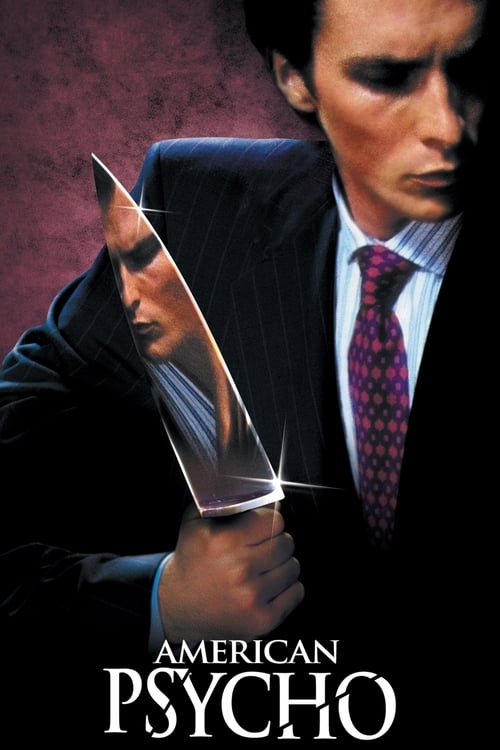
American Psycho
2000 · Mary Harron
For when you want something sharp and wicked — a pitch-black comedy to argue about afterward. Definitely a challenge watch, not a comfort watch.
What it's about
Patrick Bateman is a wealthy Manhattan investment banker in the late 1980s — obsessive about skincare, business cards, and reservations — who may also be a serial killer. The film follows his immaculate surface life and the escalating violent fantasies beneath it, never quite confirming where the performance ends and the reality begins.
The experience
Icy, hilarious, and deeply unsettling, often in the same scene — you laugh at the deadpan absurdity, then catch yourself. It's a horror film wearing a designer suit, and the ambiguity lingers long after it ends.
Performances
Christian Bale gives a physically total, career-making performance — every gesture calibrated, the charm and the vacancy inseparable. His monologues about pop albums delivered mid-menace are unforgettable.
The craft
Mary Harron cracked a famously 'unfilmable' novel by playing it as deadpan satire: cold, precise compositions, gleaming surfaces, and a tone that lets the horror and the comedy share the frame. The restraint is the point — what you don't see does the damage.
Why it matters
It turned a scandalous novel into a canonical satire of Wall Street excess, launched Bale into the top tier, and became one of the most quoted and meme-d films of its era.
Snapshot
A satirical psychological thriller adapted from Bret Easton Ellis's incendiary 1991 novel, American Psycho follows Patrick Bateman — Manhattan investment banker, fastidious consumer, and possibly serial killer — through the Reagan-era late 1980s. Mary Harron's film resolves what many considered an unfilmable source text by leaning into ambiguity, deadpan comedy, and formal precision: the murders may or may not be happening, but the spiritual vacancy is never in doubt. Christian Bale's physically total performance anchors a work that functions simultaneously as horror film, dark comedy, and diagnostic portrait of a culture that mistakes performance for identity. The film's cold aesthetic and pitch-black satirical intelligence have secured it a permanent place in the canon of American cinema at the turn of the millennium.
Industry & production
American Psycho had a notoriously fraught path to production. Ellis's novel had attracted protests upon publication — most prominently from the National Organization for Women, which objected to its graphic violence against women — and Hollywood studios were wary. Producer Edward R. Pressman acquired the rights and the project cycled through multiple directors and casting scenarios across nearly a decade. At one point Leonardo DiCaprio was attached to star, generating significant studio interest and temporarily displacing Harron from the director's chair. DiCaprio ultimately departed, and Harron returned, bringing Christian Bale — who had lobbied aggressively for the role — with her. The film was produced on a modest budget by major-studio standards, distributed in North America by Lionsgate (then Lions Gate Films), a company then positioning itself as a home for challenging, adult-oriented material. The relatively limited financial scale arguably freed Harron to pursue her ironic, controlled approach without the softening pressure of a larger studio investment.
The screenplay was co-written by Harron and actress-writer Guinevere Turner. Their collaboration was crucial: both writers are openly gay women, and their shared perspective shaped a reading of the source material that foregrounded its satire of male identity performance rather than its transgressive violence. Where Ellis's novel situates the reader uncomfortably inside Bateman's consciousness, Harron and Turner's adaptation introduces structural and tonal distance — we observe Bateman from a slight remove that makes the comedy legible and the horror philosophical.
Production was shot primarily in Toronto standing in for Manhattan, a practical and budgetary decision that, paradoxically, lends the film a slightly uncanny quality — the exteriors are plausibly New York without being emphatically of it, reinforcing the sense of a world that is a simulation of itself.
Technology
American Psycho was shot on 35mm film, standard for its period, and makes no conspicuous use of digital tools in production or post-production beyond the emerging norms of the late 1990s. The choice to shoot 35mm is appropriate to the film's aesthetic ambitions: the slightly elevated grain of the photochemical image, combined with cinematographer Andrzej Sekula's meticulous lighting choices, produces a surface that is simultaneously glossy and clinical — the look of a very expensive magazine advertisement that is also somehow sterile.
The film predates the digital-intermediary era in mainstream use, meaning color grading was achieved through traditional photochemical means and optical processes. The resulting palette — cool whites, steel blues, and the warm amber of candlelit restaurant interiors — was arrived at through lighting and stock choice rather than post-production manipulation, giving it a material consistency that purely digitally graded films of a later era sometimes lack.
Technique
Cinematography
Andrzej Sekula, who had shot Quentin Tarantino's Pulp Fiction (1994), brought to American Psycho a very different sensibility from his Miramax work. Where Pulp Fiction's camerawork is kinetic and expressive, Sekula's work here is controlled, static, and compositionally severe. The camera often holds at a slight distance from Bateman, declining to fully enter his subjectivity. Close-ups are used with precision — the famous business card sequence deploys extreme close-ups of card stock and embossed lettering with the reverence normally reserved for sacred objects, generating comedy and horror simultaneously. Mirrors are a recurring compositional element, literalizing the film's preoccupation with surfaces and self-image; Bateman's most intimate moments occur in reflection rather than direct address.
The 2.35:1 anamorphic widescreen frame suits the film's world of vast open-plan offices and cavernous apartments, environments designed to display wealth and intimidate. Harron and Sekula use that width to stage scenes of male competition as geometric arrangements — characters positioned across the frame with the formal tension of opposing forces on a battlefield.
Editing
Editor Andrew Marcus cuts the film with a rhythm that mirrors Bateman's own controlled affect: methodical, deliberate, and occasionally punctuated by abrupt violence. The editing is not flashy; it declines the kinetic montage that characterized much American genre filmmaking of the period. Scenes play out at unusual length, allowing the comedy of Bateman's monologues to accumulate weight and the horror of his actions to register without exploitation. The film's most formally adventurous editing occurs in the murder sequences, which are staged and cut with a choreographic quality that aligns violence with performance — Bateman as auteur of his own atrocities, an alignment that implicates the viewer in questions of spectatorship.
Mise-en-scène / staging
The production design by Gideon Ponte is one of the film's great unsung achievements. Bateman's apartment is a shrine to a particular species of 1980s masculine aspiration: Philippe Starck objects, Helmut Newton photographs, everything white and hard and without warmth. The Wall Street offices carry the same logic — mahogany and marble as the material grammar of dominance. Costume design (by Isis Mussenden) deploys the uniform of the period — Valentino suits, Hermès ties — as armor and performance costume rather than clothing.
Harron's staging frequently positions Bateman in relation to his environment as if he is on display within it, a luxury object among luxury objects. The iconic morning routine sequence, in which Bateman narrates his skincare regimen while his face-masked image stares back from a mirror, establishes early that this is a film about a man performing a role he has mistaken for a self.
Sound
The sound design works in counterpoint to the violence: the film is frequently, deliberately quiet in ways that genre conventions would not predict, letting the absence of sound register unease more effectively than a conventional score might. John Cale composed the film's score, providing sparse, often dissonant underscore that refuses to editorialize — it neither condemns Bateman nor invites identification, maintaining the film's ironic distance.
The most celebrated dimension of the film's sonic world, however, is its use of diegetic music. Bateman's elaborate monologues praising Phil Collins, Huey Lewis and the News, and Whitney Houston are among the film's most famous sequences. The comedy operates on multiple levels: the sincerity of Bateman's enthusiasm, the absurdity of the critical register applied to mass pop, and the use of these performances as preludes to violence, so that "Hip to Be Square" and "In the Air Tonight" became indelibly linked to bloodshed. Harron uses these sequences to literalize the film's central argument — that cultural consumption has replaced interiority, that taste performance has become a substitute for selfhood.
Performance
Christian Bale's performance is one of the most discussed in contemporary American cinema. Physically transformed for the role — conspicuously muscular in a way that reads as another form of construction rather than natural embodiment — Bale plays Bateman as a man assembled from other men's signals, a collection of absorbed masculine tics with no organizing self beneath. The performance is famously keyed to a Tom Cruise interview: Bale has reportedly described studying a talk-show appearance by Cruise and finding in the actor's relentless, slightly pressurized enthusiasm a model for Bateman's hollow affect — all surface warmth with nothing behind it. Whether or not this account is precisely accurate, it describes the performance's quality: Bale mimics the shape of emotion without committing to its content.
The supporting cast — Willem Dafoe as a detective who seems to be permanently on the verge of seeing through Bateman but never quite does, Jared Leto as a rival whose grotesque murder is among the film's darkest comedy, Reese Witherspoon as a fiancée who barely registers Bateman as a person, Chloë Sevigny as his perpetually overlooked secretary — are deployed with economy and precision, each representing a different relationship to Bateman's performance of normality.
Narrative & dramatic mode
American Psycho is structured as an unreliable-narrator thriller in which the central ambiguity — did Bateman commit these murders, or are they elaborate fantasies? — is never resolved, and is ultimately beside the point. Harron is clear in interviews that the film is interested in the question as a formal and satirical device, not as a puzzle to be solved. The murders, real or imagined, are expressions of the same frustrated masculine ego that expresses itself elsewhere in the domination of restaurant reservations and the perfection of a business card.
The dramatic mode is that of dark comedy sustained at an unusually consistent temperature — Harron never lets the film tip fully into horror or fully into farce, maintaining an ironic pressure throughout that keeps both registers available simultaneously. This tonal control is the film's most difficult achievement and its most distinctive quality.
Genre & cycle
The film belongs to a cycle of late-1990s and early-2000s American films preoccupied with the spiritual costs of masculine identity and consumer capitalism — a cycle that includes Fight Club (David Fincher, 1999), Being John Malkovich (Spike Jonze, 1999), and, at a slight remove, Eyes Wide Shut (Stanley Kubrick, 1999). These films share an anxiety about performance, authenticity, and the self as social construct. Within this context, American Psycho is distinctive for its explicitly feminist authorship: unlike Fight Club, which has generated ongoing debate about the extent to which it endorses or critiques the masculinity it depicts, Harron's film maintains an ironic distance from its protagonist that is structural rather than merely rhetorical.
The film also participates in the tradition of satirical horror about American capitalism stretching back through the 1980s and beyond: the body-horror of consumerism in Society (Brian Yuzna, 1989), the Wall Street satire of Oliver Stone's Wall Street (1987), and the tradition of the yuppie-in-peril thriller that ran through much 1980s genre cinema.
Authorship & method
Mary Harron is a Canadian-born director who came to features via journalism and television. Her debut feature I Shot Andy Warhol (1996) established her interest in transgressive historical subcultures and her capacity for combining sympathy and ironic distance. American Psycho deepens both concerns: like I Shot Andy Warhol, it is interested in the relationship between violence, celebrity, and the performance of selfhood in a specifically American register.
Harron's method on set was reportedly precise and well-prepared. Her background in journalism and documentary work informs a directorial disposition that prizes research and structural clarity over improvisational spontaneity — a fitting temperament for a film about a man who scripts every interaction.
Guinevere Turner, co-screenwriter, brought to the adaptation a background in queer independent cinema (she had written and starred in Rose Troche's Go Fish, 1994). Her collaboration with Harron produced a script that is densely faithful to Ellis's satirical intent while significantly restructuring the novel's immersive, repetitive form for cinematic purposes.
Andrzej Sekula (cinematographer) and John Cale (composer) are addressed above.
Movement / national cinema
The film is American in subject, authorship, and production, though it was financed and distributed by a Canadian-American company and shot largely in Canada. Its concerns are specifically with American masculine mythology, American consumer capitalism, and the particular texture of late Reagan-era Manhattan. Within American independent cinema of the period — then experiencing a post-Sundance moment of relative vitality and institutional support — it represents an unusual case: a transgressive literary adaptation made with feminist authorial intent, positioned at the intersection of art cinema and genre.
Era / period
The film depicts a specific historical moment — Wall Street in the late 1980s, the apex of Reagan-era deregulatory capitalism, Gordon Gekko's "greed is good" as ambient ideology — while being made from the vantage point of 2000, with the ironic retrospection that vantage enables. The period setting is rendered with satirical precision: the clothes, the restaurants, the business card fetishism, the musical tastes are all historically specific, functioning as the anthropological evidence of a culture's pathology. The film is not nostalgic; it uses the period the way a case study uses clinical data.
Themes
The film's central preoccupation is the substitution of performance for selfhood: Bateman has no identity beneath his constructed surface, and the horror of the film is that this condition is not aberrant but representative. His colleagues are essentially interchangeable — they confuse each other's names and faces with comic frequency — because they are all performing the same role from the same social script. The murders, real or imagined, are the logical extension of a system in which other people have no interiority that needs to be respected.
Consumer culture and brand consciousness are rendered as forms of psychic colonization: Bateman cannot encounter an object, a garment, or a restaurant without situating it in a hierarchy of taste. This is not connoisseurship but compulsion — the continuous operation of a ranking system that substitutes for genuine engagement with the world.
Masculinity and its performance are the film's specific diagnostic focus. Bateman is a satirical figure of American masculine aspiration — physical fitness, financial dominance, sexual conquest, cultural literacy — who reveals these aspirations as empty by performing them to their logical extreme. The film also foregrounds the violence that underlies normalized masculine power, in ways that place it in conversation with feminist theory about the relationship between patriarchal social order and individual pathology.
Unreliable subjectivity — the question of what we can know about another consciousness, and the extent to which social surfaces conceal or constitute inner life — runs throughout the film as both narrative device and philosophical concern.
Reception, canon & influence
Critical reception at release was divided. Some reviewers were troubled by the film's relationship to its source material's violence, while others recognized the formal intelligence and tonal control Harron brought to intractable material. Roger Ebert's review was notably mixed, finding the film's irony too cool to generate genuine engagement. Over time, critical consensus has moved significantly in the film's favor; it is now regularly cited as one of the essential American films of the 2000s and a model for how transgressive literary material can be adapted without either sanitizing or exploiting it.
Influences on the film are multiple. Ellis's novel is the primary source, and the film is in conversation with its satirical tradition — Don DeLillo's novels of consumerist alienation, the literary brat-pack fiction of the 1980s. Cinematically, the film's cold, controlled aesthetic owes debts to Stanley Kubrick's capacity for ironic formal distance, particularly A Clockwork Orange (1971), whose unreliable violent protagonist and satirical engagement with questions of free will and social construction are antecedents. Brian De Palma's 1980s thrillers — their formal stylization and ironic relationship to genre conventions — are a visible influence. The opening credits, which move across surfaces of food and architecture with advertising-image reverence, echo Paul Schrader's American Gigolo (1980) in ways that seem deliberate.
Legacy and forward influence is substantial. The film anticipated and partly shaped a decade of cultural preoccupation with toxic masculinity, performative identity, and the spiritual vacancy of consumer aspiration that would recur in The Wolf of Wall Street (Martin Scorsese, 2013), in numerous prestige television antihero narratives, and in a broader cultural discourse about masculine identity performance. Specific sequences — the business card scene, the morning routine, the Huey Lewis murder — have become cultural touchstones reproduced, parodied, and referenced extensively across film, television, and internet culture.
Bale's performance established him as a major film actor capable of extreme physical and psychological transformation, directly anticipating his later work in The Machinist (Brad Anderson, 2004) and The Dark Knight (Christopher Nolan, 2008). The film's model of feminist authorship applied to transgressive genre material — making a film about male violence from a position of ironic critical distance rather than either condemnation or complicity — has been influential on subsequent filmmakers working in adjacent territory. Mary Harron's achievement is to have made a film that is genuinely disturbing, genuinely funny, and structurally honest about the system it anatomizes without resolving any of those tensions prematurely.
A Deleuzian reading
Watch the business cards again.
The full Deleuzian reading of American Psycho →
Reception
Divisive on release in 2000 — it premiered at Sundance to mixed, uneasy reviews and controversy inherited from the novel — but it's since been reappraised as one of the sharpest satires of its era and the film that made Christian Bale a star.
How American Psycho was received, from release to now →
Influences: the films it descends from and the films it influenced
- A Clockwork Orange (1971) — Kubrick's technique of staging choreographed violence in precise rhythmic alignment with diegetic popular and classical music — generating simultaneous horror and dark comedy through aesthetic incongruity — is the direct structural template for Bateman's Phil Collins commentary and the formally balletic murder sequences.
- Psycho (1960) — Hitchcock's deployment of extreme close-ups to endow mundane objects with fetishistic menace — the drain, the eye — and his structural technique of holding an audience inside the charming surface of an unreliable male killer are both explicitly inherited and transformed by Harron.
- Blue Velvet (1986) — Lynch's method of deploying diegetic pop songs as dissonant counterpoint to horrific action — Roy Orbison, Bobby Vinton — and extreme close-ups of consumer surfaces as apertures into violence beneath are structural principles American Psycho inherits wholesale.
- Taxi Driver (1976) — Bernard Herrmann's dissonant sparse scoring of an unreliable first-person male voiceover narrator, combined with Scorsese's static compositions rendering the urban consumer landscape as a projection of a violent male psyche, establishes the formal template Harron adapts.
- Pulp Fiction (1994) — Cinematographer Andrzej Sekula shot both films; his technique of static-controlled anamorphic compositions with extreme close-ups that fetishize mundane objects — the briefcase, the watch — carries directly into American Psycho's business card sequences and their object-worship aesthetic.
- Funny Games (1997) — Haneke's rigorously static wide-angle compositions that observe violence with formal coldness — refusing the subjective camera, withholding cathartic spectacle — and his structural indictment of the viewer's appetite for exactly what the film denies are the formal logic American Psycho inherits for its ambiguous murder sequences.
- Heathers (1988) — Lehmann's dark-comedy horror template — a hollow-affect protagonist performing deadpan satire of consumer American culture through violence — is the structural and tonal model Harron reframes through a feminist-adaptation lens, sharpening the class critique while defusing the source material's misogyny.
- Frenzy (1972) — Harron inherits Frenzy's predatory-normalcy performance register (the killer as socially exemplary figure) and its ironic-score strategy—pop music counterpointing murder to produce horror-farce tonal calibration—applying Hitchcock's black-comedy architecture to a satirical register Frenzy itself approached in the potato-truck sequence.
- Wall Street (1987) — Harron carries Stone's semiotics of costume to satirical endpoint: the business card scene is a direct formal parody of the power-suit iconography Stone established, and Patrick Bateman is Gordon Gekko stripped of charm — the yuppie-cycle's surface aesthetics turned into evidence of psychic vacancy.
- American Gigolo (1980) — Pushes Gigolo's commodification and designer-branding-as-self to satire — Armani, business cards, and skincare ritual standing in for identity in the objectified consuming male.
- The Criminal Life of Archibaldo de la Cruz (1955) — Deploys an urbane, murderously respectable narrator whose confessed killings may be fantasy, extending the unreliable-confession and ironic-reversal structure of Archibaldo's account.
- Monsieur Verdoux (1947) — Literalizes Verdoux's 'business is murder' thesis into the figure of the immaculate businessman-killer, sustaining the satire that capitalist self-presentation and homicide share the same fastidious grammar.
- There Will Be Blood (2007) — Day-Lewis's total physical and vocal transformation to inhabit a hollow-affect capitalist predator employs the same method as Bale's Bateman — treating the body as an instrument in service of a character whose interior life is vacancy performing historical ambition.
- The Wolf of Wall Street (2013) — Scorsese deploys diegetic period pop music as satirical counterpoint to Reagan-era financial excess — inheriting American Psycho's structural technique of using pop song commentary to render moral horror as dark comedy — while the unreliable narrating Wall Street protagonist reprises the same consumer-masculine satirical subject.
- Nightcrawler (2014) — Gyllenhaal's hollow-affect performance — deliberate physical transformation, the unblinking wide-eye register — directly descends from Bale's method; Gilroy's static-controlled night-city compositions parallel Sekula's clinical aesthetic in depicting a psychopathic male protagonist navigating predatory consumer capitalism.
- Cosmopolis (2012) — Cronenberg adapts Don DeLillo's novel — in the same literary tradition of American surplus-masculine vacancy as Bret Easton Ellis — through static-controlled compositions and deliberate pacing, using the sealed luxury limousine as the environment for a Manhattan billionaire whose interiority is pure consumer performance.
- The Machinist (2004) — Bale's 63-pound weight loss directly extends the physical-transformation method he established as Bateman — the actor using radical corporeal alteration in service of a male protagonist whose unreliable grip on reality makes his own body the site of both performance and dissolution.
- Batman Begins (2005) — Bale's performance of a hollow public mask layered over a hidden self — the direct precedent for his tripartite Bruce/Batman/playboy identity work.
- Woman of the Hour (2024) — Female-authored serial-killer film that satirizes male predation as a function of social performance and surface respectability — female-directed genre revisionism aimed at the predator's camouflage.
- Obsession (2026) — Uses first-person voiceover from a charming predator whose interior monologue seduces even as it condemns, modeling the complicit 'nice guy' confessional narration.
- Promising Young Woman (2020) — Demonstrates glossy consumerist surface and needle-drop set-pieces deployed satirically to mask predation — kitsch-conceals-rot staging filtered through a female director's ironic remove.
- Fresh (2022) — Models the satirical fusion of glossy consumerist appetite and violence, the immaculate yuppie predator whose lifestyle-porn aesthetics indict a culture that literally consumes bodies.
- Fight Club (1999) — Both films deploy an unreliable male narrator who may be fabricating his own violence as critique of consumer masculinity; where Fincher uses destabilizing kinetic editing to dissolve reality, Harron's deliberate pacing holds the comedy at a stable ironic distance that keeps the satire legible.
- Eyes Wide Shut (1999) — Kubrick's final film uses the same static-controlled anamorphic compositions and recurring mirror staging in luxury interiors — the space as psychological projection — to locate a male protagonist's identity crisis, maintaining formal precision as a register of vacancy while reality dissolves.
- The Talented Mr. Ripley (1999) — Minghella's adaptation uses extreme close-ups of luxury objects and a hollow-affect male protagonist who constructs identity by acquiring and mimicking social roles — asking the same formal question as Harron: whether the precise performance of desire constitutes a self or merely its absence.
- The House That Jack Built (2018) — A parallel affectless killer-aesthete who delivers deadpan connoisseur monologues on design and music as dark comedy — the same self-satirizing 'murder dressed as significance' register as Jack.
Similar films
- The Wolf of Wall Street (2013) — influence & lineage · same viewing thread
- Fight Club (1999) — influence & lineage · same viewing thread
- Psycho (1960) — influence & lineage
- The Machinist (2004) — influence & lineage
- Taxi Driver (1976) — influence & lineage · same viewing thread
- Margin Call (2011) — same viewing thread
- Wall Street (1987) — same viewing thread
- Killing Them Softly (2012) — same viewing thread
All the films related to American Psycho →
Watch it with: curated runs of related films
- The American Male Comes Apart — A run of self-made men — brokers, founders, dealers, drifters — hollowed out by the very thing they chase, each film pressing the same nerve where ambition curdles into alienation and violence.