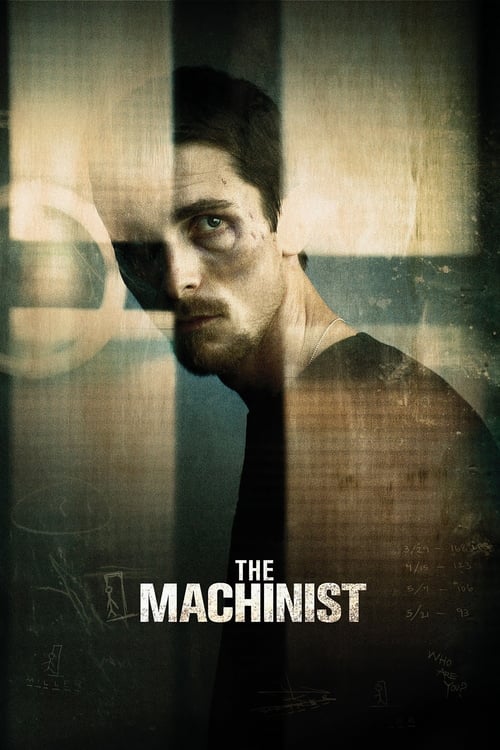
The Machinist
2004 · Brad Anderson
For when you're craving a dark psychological puzzle — a film to watch late at night and then immediately want to discuss. Unsettling rather than terrifying; challenge with a satisfying click at the end.
What it's about
Trevor Reznik operates a lathe in a grim industrial plant and hasn't slept in a year. He's wasting away to nothing, papering his apartment with post-it reminders, and now a hulking coworker no one else seems to see has started turning up everywhere. As accidents mount at the factory, Trevor tries to work out whether he's being tormented or losing his mind.
The experience
Cold, gray, and quietly nerve-shredding — a slow-burn paranoia trip where the dread accumulates like sleep debt. It plays as a riddle you assemble alongside Trevor, and the mounting unease pays off with real emotional weight.
Performances
Christian Bale's transformation is the stuff of legend — he shed a shocking amount of weight until his body became the film's central image — but the performance underneath is just as committed: twitchy, guarded, and heartbreaking.
The craft
Brad Anderson drains the film of color and warmth, building a depopulated industrial purgatory in the style of mid-century suspense cinema, with a score that leans into old-fashioned, theremin-tinged unease. Every frame is engineered to make you feel Trevor's exhaustion.
Why it matters
It became the defining example of extreme actor transformation — the reference point for every conversation about how far a performer should go for a role — and a cult staple of the 2000s psychological-thriller wave.
Snapshot
The Machinist is a psychological thriller built around an act of physical self-erasure: Christian Bale's emaciated lathe operator Trevor Reznik, who has not slept in a year, drifts through a depopulated industrial purgatory haunted by a man no one else can see. Directed by the American independent filmmaker Brad Anderson from a screenplay by Scott Kosar, the film is at once a guilt parable, a noir riddle, and a stylistic homage to mid-century suspense cinema. Its lasting notoriety rests on Bale's transformation — a drastic, widely reported weight loss that turned the actor's body into the film's central image and its primary marketing claim. Beneath that spectacle is a tightly engineered narrative of repression and confession, indebted to Dostoevsky and to the American tradition of the unreliable, conscience-stricken protagonist. A Spanish production shot in and around Barcelona, the film occupies an unusual transnational position: an English-language, American-cast genre piece financed and crewed largely in Spain.
Industry & production
The Machinist was produced through the Spanish company Filmax, with Julio Fernández among its producers, and shot in Spain — principally in and around Barcelona — to control costs while maintaining the appearance of an anonymous American industrial city. This arrangement is central to understanding the film: it is an American-authored, English-language thriller realized by a substantially Spanish crew, including its cinematographer, composer, and editor. The choice of Spain afforded the production studio control over its bleached, controlled environments and let it assemble factory interiors, a carnival, and apartment sets without the overhead of a domestic American shoot.
The film arrived as Brad Anderson's follow-up to Session 9 (2001), an atmospheric horror film shot in a derelict mental hospital that had established his interest in dread, psychological disintegration, and oppressive locations. Scott Kosar's screenplay reached Anderson during a period when Kosar was active in studio horror, having written the 2003 remake of The Texas Chain Saw Massacre; The Machinist, by contrast, is a spare, art-house-inflected original.
The dominant industrial fact of the production is Bale's preparation. The actor undertook an extreme regimen of caloric restriction to embody a man wasting away, and contemporaneous accounts describe a loss commonly reported at around sixty pounds, leaving him at a weight in the neighborhood of 120 pounds. Bale himself has said he wished to go further and that the production intervened on grounds of safety. The exact figures circulate in interviews and press rather than verified medical records, so they should be treated as approximate; what is not in doubt is that the transformation was real, severe, and the engine of the film's publicity. Commercially, the film had a limited theatrical release and was a modest performer rather than a wide hit; I will not assign specific box-office figures, as the reliable record on its precise grosses is thin.
Technology
Technologically, The Machinist is a conventional early-2000s photochemical production: it was shot on 35mm film, not digitally, and its distinctive look is achieved primarily through art direction, lighting, and color manipulation rather than novel capture technology. The film's most significant technical signature is its color grading. Its palette has been pushed toward a cold, desaturated blue-green — a sickly, metallic register that drains warmth from skin and surfaces alike. Sources and the filmmakers have described this as a deliberate near-monochrome treatment; whether achieved through chemical processing, filtration, or a digital intermediate, the effect is a world leached of vitality, consistent with Trevor's deathly physiology. The body itself functions as a kind of production technology here: Bale's actual emaciation removes the need for prosthetic or digital effects, grounding the film's horror in an undeniable physical fact rather than a manufactured one.
Technique
Cinematography
The cinematography is by Xavi Giménez (Xavier Giménez), and it is the film's most consistently praised craft element. Giménez renders Trevor's world in the cold, drained palette described above, lending every interior a clinical, fluorescent chill and every exterior a washed-out flatness. The camera favors controlled, often static or slowly creeping compositions that trap Bale's skeletal figure in industrial geometry — the lathe, the locker room, the stairwells of his apartment building. The imagery deliberately recalls a tradition of expressionist and noir lighting, with hard shadows and a sense of architectural menace. Crucially, the photography is complicit in the film's deception: it presents the impossible — the figure of Ivan, the apartment of a man who may not exist — with the same objective solidity as everything else, so the audience, like Trevor, cannot trust what the lens reports.
Editing
Edited by Luis de la Madrid, the film is constructed as a puzzle that withholds its own logic until the final movement. The cutting establishes a fugue-like continuity in which dream, hallucination, and waking life are deliberately not demarcated; transitions are smooth where they should be jarring, so that the viewer absorbs Trevor's disorientation as a structural condition rather than a marked subjective state. Recurring motifs — the Post-it hangman game, the photograph in the refrigerator, the fairground ride — are seeded and reprised so that the climactic revelation reorganizes the preceding material retroactively. The editing's restraint is part of its effect: it does not signpost the twist with conspicuous flourishes, which is why the disclosure reads as confession rather than gimmick.
Mise-en-scène / staging
The film's design world is one of depopulation and decay. The machine shop, with its oily light and exposed mechanisms, becomes a stage for guilt and accident; Trevor's apartment, with its bleach, its hidden notes, and its toe-tagged refrigerator, is a confessional in miniature. The production design repeatedly stages spaces as too empty — diners and amusement parks attended by almost no one — reinforcing the sense that much of what we see is interior, projected, unpeopled because it is unreal. The hangman puzzle, slowly spelling its accusation, is the clearest example of mise-en-scène as narrative mechanism: the set itself is the clue.
Sound
The sound design supports the film's insomniac unease through industrial drone, mechanical clamor, and stretches of unsettling quiet, but the dominant aural element is the score (discussed below). The film uses sound to fuse the mechanical and the psychological — the rhythm of machinery standing in for a mind that cannot stop and cannot rest.
Performance
Performance in The Machinist is inseparable from Bale's physical condition. His emaciation is not a stunt grafted onto an unrelated performance but the foundation of the characterization: the hollowed cheeks, the visible ribs and spine, the trembling deliberateness of his movements all read as the somatic expression of a year without sleep and a year of unmetabolized guilt. Bale plays Trevor with a haunted, courteous fragility that makes his unraveling sympathetic rather than merely clinical. Jennifer Jason Leigh, as the prostitute Stevie, supplies the film's only sustained warmth and its principal anchor to a recognizable emotional reality; Aitana Sánchez-Gijón plays Marie, the airport-café waitress whose role is bound up with the film's deception; and John Sharian plays Ivan, the bald, grinning antagonist whose status the film keeps suspended. The supporting performances are calibrated to ambiguity — never quite confirming whether they address a real man or a projection.
Narrative & dramatic mode
The film operates in the mode of the unreliable subjective thriller: a story told so thoroughly from inside a disordered consciousness that the audience inherits the protagonist's epistemic crisis. Its dramatic engine is the slow return of the repressed. Trevor's sleeplessness, his hallucinated double Ivan, and the accusatory notes are symptoms of a buried act — a hit-and-run that killed a child — that his mind has walled off and that the narrative is structured to excavate. The resolution is not a victory but a confession and a surrender; the dramatic arc bends toward the relief of being finally able to sleep, achieved only through acknowledgment of guilt. This is the structure of conscience-drama as much as of thriller: the mystery's solution is moral self-recognition.
Genre & cycle
The Machinist sits at the intersection of several genres and cycles. It is a psychological thriller in the lineage of films about unreliable narrators and hidden traumas, and it belongs to the early-2000s cycle of twist-driven, puzzle-box cinema that folled the success of films like The Sixth Sense (1999), Fight Club (1999), and Memento (2000) — works whose endings recontextualize everything prior. It also draws on the iconography of horror and the doppelgänger tradition, and on the visual grammar of film noir, with its guilt-ridden protagonist and shadowed, fatalistic world. Within Anderson's own output it pairs naturally with Session 9 as a study of a mind coming apart inside a forbidding industrial space.
Authorship & method
Brad Anderson directs as a stylist of atmosphere and psychological dread, extending the concerns of Session 9 into a more formally classical register. His method here is one of restraint and misdirection: he stages the unreal as real and trusts the design and performance to carry dread without overt shock. The screenplay by Scott Kosar provides the film's rigorous architecture of clues and its moral spine. The key collaborators are distinctly authorial presences: cinematographer Xavi Giménez, whose drained palette is the film's visual identity; composer Roque Baños, whose score is the film's loudest statement of allegiance to classical suspense cinema; and editor Luis de la Madrid, whose patient, fugue-like cutting sustains the deception. The collaboration is notable for being genuinely transnational — an American director and writer working with a Spanish craft team to produce a film that feels placeless by design.
The score deserves particular emphasis as a method of authorship. Roque Baños composed lush, ominous orchestral music explicitly in the idiom of Bernard Herrmann, the composer most associated with Alfred Hitchcock. The result openly invokes the Hitchcockian thriller — the swelling strings, the sense of psychological vertigo — situating The Machinist within a self-conscious dialogue with the suspense tradition. This is homage used structurally: the music tells the audience what kind of moral-psychological story they are watching.
Movement / national cinema
The film's national identity is genuinely hybrid. By production and crew it is a Spanish film — financed through Filmax and realized by Spanish technicians in Catalonia — yet by language, cast, authorship, and setting it presents as an American independent thriller. It can be read against the early-2000s wave of Spanish genre filmmaking that increasingly produced internationally facing, English-language work, while also belonging to the broader American independent tradition of the psychological character study. It is not the product of a coherent national movement so much as an example of the transnational genre production that became common in the period.
Era / period
The Machinist is very much of its early-2000s moment. It rides the post-Fight Club, post-Memento appetite for narratives that conceal a structural twist and reward retrospective reassembly, and it shares that cycle's interest in fractured masculine subjectivity, dissociation, and the unreliability of the protagonist's perceived reality. It is also a late example of fully photochemical, pre-digital-dominant genre filmmaking, achieving its effects through film stock, color processing, and an actor's literal body rather than computer-generated imagery. The film's industrial, recession-gray aesthetic and its preoccupation with guilt and accountability give it a sober, almost anachronistic seriousness relative to the slicker thrillers around it.
Themes
The film's governing theme is guilt and its somatic consequences: the idea that an unconfessed act will exact a physical toll, manifesting here as the literal wasting of the body and the impossibility of sleep. Closely related are repression and the return of the repressed — the mind's effort to wall off an unbearable memory, and that memory's insistence on surfacing through doubles, notes, and hallucinations. The doppelgänger Ivan dramatizes the split self, the externalized conscience or guilty alter ego. Insomnia operates as both literal condition and metaphor for a conscience that cannot rest. The film is finally about confession and atonement: the only release from the year-long sleeplessness is the acknowledgment of responsibility for a death, framing the entire narrative as a moral reckoning staged as a thriller.
Reception, canon & influence
Critically, The Machinist was received with respect rather than rapture, and the overwhelming focus of its reception — both in reviews and in popular memory — was Bale's physical transformation, which became one of the most cited instances of extreme actorly commitment in modern cinema and a frequent reference point in discussions of method preparation. Critics generally praised the film's craft, its cold atmosphere, and Herrmann-esque score, while some found its central twist and Dostoevskian moral schema more schematic than profound. It did not become a wide commercial hit and reached much of its audience through limited theatrical release and home video.
The influences on the film are clearly legible. Its narrative of a guilt-driven man pursued by his own conscience is frequently and rightly linked to Dostoevsky's Crime and Punishment, and it draws on the broader literary tradition of guilt-haunted confession (the Poe-like logic of the buried deed that will not stay buried). Cinematically it descends from film noir, from the doppelgänger tradition, and — most explicitly through Baños's score — from the Hitchcock/Herrmann suspense film. Its puzzle-box structure places it in conversation with Fight Club, Memento, and The Sixth Sense.
Its legacy forward is most concentrated in the cultural conversation around physical transformation in acting: The Machinist is routinely invoked as a benchmark when actors dramatically alter their bodies for roles, and it materially shaped Bale's reputation for total physical commitment, a reputation he extended across his subsequent career. As a piece of filmmaking it consolidated Brad Anderson's standing as a director of intelligent psychological dread. Its direct stylistic influence on later cinema is more diffuse than that of its puzzle-box contemporaries, and the honest assessment is that its enduring place in the canon rests less on a school of imitators than on the singular, unforgettable image of its star's vanishing body in service of a story about the weight of guilt.
A Deleuzian reading
The yellow Post-it on the refrigerator door: a little gallows in ballpoint, a row of blank dashes, a letter or two filled in.
The full Deleuzian reading of The Machinist →
Reception
In 2004 it landed as a modest Sundance curio that reviewers treated mostly as a delivery system for Christian Bale's shocking transformation; two decades on it's a fixture of the 2000s cult-thriller canon, rewatched and re-ranked alongside the era's other mind-benders.
How The Machinist was received, from release to now →
Influences: the films it descends from and the films it influenced
- Psycho (1960) — Baños's score is a deliberate pastiche of Bernard Herrmann's stabbing, all-strings Hitchcock idiom, importing the suspense-film's musical grammar to flag the moral-psychological register.
- Vertigo (1958) — Herrmann's spiraling, vertiginous string writing models the swelling psychological vertigo Baños emulates, paired with the guilt-and-doppelganger obsession driving an unraveling man.
- Taxi Driver (1976) — Herrmann's final score over an insomniac, emaciated urban loner consumed by guilt is the direct template for the Machinist's sleepless-conscience pairing of music and wasting body.
- Repulsion (1965) — Establishes the subjective-apartment psychosis where the environment visibly distorts to externalize a protagonist's mental collapse, the staging logic of mise-en-scène-as-symptom.
- The Tenant (1976) — Depopulated, paranoid interiors and a doppelganger persecution that originates inside the protagonist supply the 'staging the unreal as real' deception Anderson uses.
- Jacob's Ladder (1990) — Builds the return-of-the-repressed architecture in which the entire narrative is a guilt-fugue resolved by a retroactive twist revealing a death the protagonist cannot accept.
- Angel Heart (1987) — The investigator who discovers he is his own quarry — a doppelganger guilt revealed by a retroactive reveal that rereads the whole film — is the structural blueprint for Trevor's pursuit.
- Raging Bull (1980) — De Niro's drastic on-screen weight gain set the benchmark of extreme method body transformation that Bale's vanishing physique consciously extends and surpasses.
- Eraserhead (1977) — Originates the continuous industrial-drone soundscape as a sustained register of dread in a depopulated, dehumanized environment.
- American Psycho (2000) — Bale's 63-pound weight loss directly extends the physical-transformation method he established as Bateman — the actor using radical corporeal alteration in service of a male protagonist whose unreliable grip on reality makes his own body the site of both performance and dissolution.
- Shutter Island (2010) — A guilt-driven protagonist's perceived reality is revealed as a self-protective delusion via a retroactive twist that re-reads the film — the Machinist's exact structure scaled up.
- Black Swan (2010) — Fuses extreme physical transformation with a doppelganger psychological thriller built on unreliable subjectivity, extending the body-as-instrument-of-dread approach.
- Dallas Buyers Club (2013) — Its drastic actorly weight-loss transformations were marketed and discussed against the Machinist/Bale benchmark that the film helped canonize as the measure of physical commitment.
- Marrowbone (2017) — Xavi Giménez's own precedent — desaturated, hard-sourced interiors built around a hallucinated antagonist who is the protagonist's guilt made flesh; Marrowbone's palette and its embodied denial are the same DP working the same conceit.
- Fight Club (1999) — Shares the unreliable narrator whose tormentor is a projection of himself, a retroactive reframe of prior scenes, and a desaturated industrial palette.
- Memento (2000) — Co-defines the puzzle-box thriller as a rigorous architecture of planted clues whose guilt is disclosed by a withheld, retroactively detonated twist.
- The Sixth Sense (1999) — Pioneers the mise-en-scène-as-clue twist that forces a wholesale rereading of every prior scene once the protagonist's misperception is exposed.
- Pi (1998) — High-contrast, drained cinematography and abrasive industrial sound design over an insomniac paranoiac prefigure the Machinist's cold sensory world.
- Session 9 (2001) — Anderson's own prior film fixes his signature method of depopulated-space dread and low ambient industrial drone, carried directly into the Machinist's atmosphere.
- Spider (2002) — Uses a drained palette and patient, unreliable subjective reconstruction of a repressed guilty memory, the same fugue-like deception sustained by editing.
- Monster (2003) — Foregrounds extreme bodily metamorphosis (Bale's emaciation) as the film's defining gesture, a near-contemporary instance of the transformation-as-subject performance Monster crystallized.
Similar films
- Memento (2000) — influence & lineage
- Batman Begins (2005) — shared sensibility
- American Psycho (2000) — shared sensibility
- The Matrix (1999) — shared sensibility
- The Prestige (2006) — shared sensibility
- Relay (2025) — shared sensibility
- A History of Violence (2005) — shared sensibility
- The Cabinet of Dr. Caligari (1920) — shared sensibility