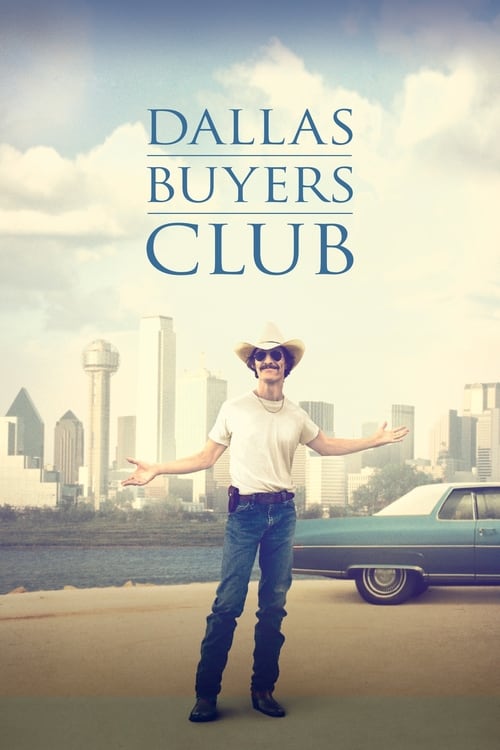
Dallas Buyers Club
2013 · Jean-Marc Vallée
For when you want a gripping, true-story drama about a fighter — something substantial that earns its emotion. Challenging subject matter, but driven by momentum rather than misery.
What it's about
Texas, 1985. Ron Woodroof — electrician, rodeo hand, hard partier, and casual homophobe — is diagnosed with HIV and given thirty days to live. Refusing both the prognosis and the limits of approved treatment, he starts smuggling unapproved medications across borders and selling memberships to fellow patients, building an underground 'buyers club' that puts him at war with the FDA and in uneasy alliance with the gay community he'd always scorned. Loosely based on a true story.
The experience
Lean, scrappy, and propulsive — it plays less like a solemn issue drama than a hustler's survival story with real anger in it. The transformation at its center, physical and moral, keeps you locked in even when the film is at its bleakest.
Performances
Matthew McConaughey, gaunt and wired, gives the performance that redefined his career and won him the Best Actor Oscar; Jared Leto won Best Supporting Actor as Rayon, the fragile, funny business partner who becomes the film's heart. The two-hander between them is the movie.
The craft
Jean-Marc Vallée shot it stripped-down and fast in available light, giving it a handheld immediacy that keeps the story on skin-level rather than soapbox-level. The script, decades in development, resists cleaning up its prickly protagonist, and the film is all the stronger for it.
Why it matters
A defining film of the mid-2010s awards era, it capped the 'McConaissance,' brought the AIDS-era buyers-club history to a mass audience, and raised Vallée's Hollywood profile. It remains a reference point for debates about patients' rights and drug regulation.
Snapshot
Dallas Buyers Club is a lean, sharply performed drama built around one of the more unlikely protagonists of the American AIDS narrative: Ron Woodroof, a hard-living Texas electrician and rodeo hand who, after a 1985 HIV diagnosis and a thirty-day prognosis, began smuggling and distributing non-FDA-approved medications to fellow patients. Directed by the Québécois filmmaker Jean-Marc Vallée and released by Focus Features, the film is best understood as a convergence of three things: a script that spent roughly two decades in development, a director committed to stripped-down, available-light realism, and two lead performances built on drastic physical transformation. It premiered at the Toronto International Film Festival in September 2013 and went on to win Academy Awards for Matthew McConaughey (Best Actor), Jared Leto (Best Supporting Actor), and its makeup and hairstyling team. It stands both as a landmark in the mid-2010s AIDS-cinema revival and as the keystone of what critics dubbed the "McConaissance."
Industry & production
The project's defining industrial fact is its long, precarious gestation. Screenwriter Craig Borten interviewed the real Ron Woodroof in 1992, shortly before Woodroof's death, and he and later co-writer Melisa Wallack developed the screenplay over roughly twenty years, during which the film reportedly attached and lost directors and financing repeatedly. That protracted development is itself part of the film's meaning: it reached screens long after the acute crisis it depicts, arriving as a period piece rather than a bulletin.
When it finally coalesced under Vallée, it did so as a modestly budgeted independent production—widely reported at roughly $5 million—shot on a compressed schedule (commonly cited as around 25 days) on location in and around New Orleans, standing in for 1980s Dallas. The economics shaped the aesthetic at every level: small crew, few setups, natural light, and a reliance on actors delivering in limited takes. The most-repeated anecdote of the shoot concerns its makeup budget, said to have been only a few hundred dollars—an emblem of the production's scarcity that became, improbably, an Oscar-winning story when Adruitha Lee and Robin Mathews took the makeup and hairstyling prize. McConaughey and Leto also each reportedly worked for reduced fees, and McConaughey has been credited as a driving force in getting the film made after his own commitment. The financing and casting history is well documented in outline; some specific deal terms remain thinly sourced, and I flag them as such rather than assert precise figures.
Technology
Dallas Buyers Club is a case study in how low-cost, lightweight production technology enabled a particular realism. Vallée and cinematographer Yves Bélanger worked predominantly with available light and handheld camera operation, minimizing the lighting rigs, dollies, and grip infrastructure that consume time and money. This approach—portable cameras, fast lenses, practical and natural sources—let the production move quickly through many locations on a short schedule. The exact capture format is not something I can state with confidence from the established record, so I will not specify a camera or stock; what is well attested is the methodology of natural light and mobile, minimally supported cameras rather than the specific hardware. On the sound side, the film's most notable technological choice is a negative one: it largely forgoes an original orchestral score in favor of curated period source music, a strategy that both suited the budget and reflected Vallée's authorial preferences.
Technique
Cinematography
Yves Bélanger, a regular Vallée collaborator, shoots the film with a documentary-adjacent immediacy: handheld framing, shallow available-light exposures, and a willingness to let faces fall into shadow or blow toward windows. The palette leans toward the sun-bleached and desaturated—Texas heat, motel interiors, hospital corridors—rather than the burnished nostalgia typical of period drama. The camera tends to stay close to Woodroof, following rather than composing, which reinforces the sense that we are riding alongside a man improvising his own survival. The look is deliberately unglamorous, and it is inseparable from the film's ethical stance: this is bodily, unadorned suffering and hustle, not tragedy prettified.
Editing
Vallée is credited as co-editor of the film, working under the pseudonym "John Mac McMurphy" alongside editor Martin Pensa—an arrangement consistent with the hands-on, self-editing practice Vallée maintained across his features. The cutting favors elision and momentum: time compresses across Woodroof's declining health and expanding operation through brisk montage, and emotionally, the film often cuts away before scenes can curdle into sentiment. The editing carries a good deal of the film's information load, tracking the passage of months, the accumulation of clients, and the legal and medical pressures closing in, without recourse to heavy expository scaffolding.
Mise-en-scène / staging
The staging privileges cramped, lived-in spaces—the motel room that becomes the club's headquarters, trailer interiors, clinics, cars. Production design keeps period signposting restrained and functional rather than showcased. Vallée blocks scenes loosely, giving actors room to move and improvise within the frame, so that confrontations feel found rather than choreographed. The recurring visual environment of the "buyers club" itself—a makeshift dispensary run out of borrowed rooms—materializes the film's central idea: a black-market health system improvised in the vacuum left by official medicine.
Sound
The film's soundtrack is built largely from diegetic and period source music rather than a composed score, a hallmark of Vallée's cinema (he used a similar needle-drop-forward strategy across his work). The absence of an emotive orchestral bed keeps the register dry and prevents the film from cueing easy pathos; music tends to characterize Woodroof's honky-tonk, hard-rock milieu rather than underline sentiment. Ambient sound—rooms, traffic, bodies—carries much of the atmosphere, consistent with the available-light, on-location ethos.
Performance
Performance is the film's center of gravity, and both leads built their work on radical physical transformation. Matthew McConaughey and Jared Leto each underwent substantial, widely reported weight loss to portray men wasting from AIDS (McConaughey by roughly forty-plus pounds, Leto by a comparable proportion—figures I cite as reported rather than verified to the ounce). McConaughey's Woodroof is all wiry aggression and Texan swagger curdling into something more searching; the performance charts a homophobic bigot's slow, incomplete, self-interested education without ever fully sanding down his edges. Leto plays Rayon, a transgender woman who becomes Woodroof's business partner and emotional counterweight—a fictional, composite character invented for the film. Jennifer Garner plays Dr. Eve Saks, the sympathetic physician who functions as the film's institutional conscience. The two male performances won Oscars; both remain admired and, in Leto's case, later contested (see Reception).
Narrative & dramatic mode
Structurally the film is a redemption-arc biopic crossed with an underdog-versus-the-system procedural. Its dramatic engine is transformation: a man given thirty days to live who not only survives for years but reinvents himself as an outlaw entrepreneur and, incidentally, an agent of solidarity across the very lines of sexuality and gender he once policed. The mode is largely realist and character-driven, eschewing voiceover and expository framing in favor of accretion—scene by scene, we watch Woodroof learn the science, work the loopholes, and soften. The antagonist is diffuse but clear: the FDA, the pharmaceutical apparatus, and the medical establishment's regulatory rigidity, personified in figures who enforce the AZT trials Woodroof comes to distrust. The film's dramaturgy is unabashedly individualist, funneling a collective catastrophe through a single charismatic protagonist—a choice that is both its narrative strength and, for some critics, its ideological limitation.
Genre & cycle
Dallas Buyers Club sits at the intersection of the historical biopic, the disease/illness drama, and the AIDS film. Within American cinema's engagement with the epidemic, it belongs to a lineage running from Longtime Companion (1989) and And the Band Played On through the mainstream breakthrough of Philadelphia (1993). It also arrived within a distinct early-2010s cluster of AIDS-crisis reappraisals—alongside the documentary How to Survive a Plague (2012) and, shortly after, Ryan Murphy's television film of The Normal Heart (2014)—that revisited the 1980s activist and treatment struggles from a historical remove. Against that cycle, Dallas Buyers Club is distinguished by its protagonist: a straight, homophobic outsider rather than a gay activist, which reframes the epidemic through an unlikely and deliberately abrasive point of entry.
Authorship & method
Jean-Marc Vallée (1963–2021) brought to the project a consistent authorial signature developed across C.R.A.Z.Y. (2005), The Young Victoria (2009), and Café de Flore (2011): emotional intimacy achieved through handheld naturalism, available light, curated source-music soundtracks in place of score, and a hands-on editing practice (here under the "John Mac McMurphy" pseudonym). His method favored actor freedom and lightweight, fast shooting, and Dallas Buyers Club is arguably its purest expression under budgetary constraint. His key collaborators include cinematographer Yves Bélanger, with whom he would continue on Wild (2014) and the acclaimed HBO series Big Little Lies and Sharp Objects; co-editor Martin Pensa; and screenwriters Craig Borten and Melisa Wallack, whose two-decade labor supplied the film's spine. The absence of a traditional composer is itself an authorial statement. Vallée's death in December 2021 has since framed the film as an early peak in a distinctive, prematurely curtailed body of work.
Movement / national cinema
The film is a hybrid of national cinemas: an American story, set in Texas and financed and distributed through the U.S. independent system, directed by a filmmaker formed in Quebec's cinema. Vallée emerged from the vibrant Québécois film culture that produced his breakthrough C.R.A.Z.Y., and he carried its intimate, music-saturated, family-and-body-centered sensibility into English-language production. Dallas Buyers Club thus exemplifies a common contemporary pattern—an international auteur applying a personal, non-Hollywood method to American subject matter within the indie ecosystem—rather than belonging to any formal movement. It is best placed within American independent cinema of the early 2010s, inflected by its director's Canadian art-film lineage.
Era / period
The film depicts the mid-to-late 1980s, beginning with Woodroof's 1985 diagnosis, at the height of the AIDS crisis and amid the fraught early history of AZT and the FDA's drug-approval regime. Its period texture—the trials, the stigma, the desperation for any treatment, the emergence of gray-market "buyers clubs" nationwide—is historically grounded, though dramatized around a single figure. As a production it belongs to the 2013 independent landscape and to a moment when the epidemic could be treated as history and reckoning rather than emergency. That temporal doubling—1980s content, 2010s vantage—defines the film's stance: it looks back on a catastrophe with the knowledge of what came after, including the eventual combination therapies that transformed HIV from a death sentence into a manageable condition.
Themes
The film's dominant themes are bodily autonomy and the individual against institutional authority: Woodroof's crusade dramatizes a patient's right to choose his own treatment against a regulatory system portrayed as slow, captured, and indifferent to the dying. Intertwined is a theme of unlikely solidarity and moral education—the bigot who, through shared mortality and partnership with Rayon, comes to recognize the humanity he had denied. Mortality and reinvention run throughout: given a deadline, Woodroof converts terror into enterprise and, ultimately, into a form of purpose. The film also engages, more obliquely, questions of capitalism and care—Woodroof is simultaneously a profiteer and a lifeline—refusing to fully sanctify its hero. Underpinning all of it is the broader theme of a public-health catastrophe met by improvisation from below when official institutions failed.
Reception, canon & influence
Critically, the film was strongly received on release, with near-universal praise for McConaughey's and Leto's transformations and broad admiration for its unsentimental craft; it converted that reception into major awards recognition, most prominently the Best Actor, Best Supporting Actor, and Best Makeup and Hairstyling Oscars, alongside a Best Picture nomination. It became the definitive marker of Matthew McConaughey's critical reinvention—the "McConaissance"—and a signal entry in Vallée's ascent toward prestige television.
The influences on the film are twofold: the documentary-realist tradition of handheld, available-light filmmaking that Vallée had absorbed and refined across his career, and the earlier canon of AIDS cinema (notably Philadelphia) against which it defined its rougher, more ambivalent protagonist. Its two-decade screenwriting genesis also means it drew directly on Borten's early-1990s interviews with the real Woodroof.
Its legacy is more complicated and instructive. Forward-looking, it helped consolidate the early-2010s revival of AIDS-crisis storytelling and reinforced the awards-season currency of extreme physical transformation as a marker of "serious" acting. But it has also become a touchstone in critical debates that intensified after its release. Leto's Oscar-winning turn as Rayon—a transgender woman written as a fictional composite and played by a cisgender man—drew significant criticism from LGBTQ commentators as emblematic of cisgender actors being celebrated for trans roles, a discourse the film is now frequently cited within. Separately, historians and critics have questioned the film's sharply negative portrayal of AZT and its decision to center a straight white man in an epidemic that devastated gay communities, reading it as a narrative that made the crisis palatable to mainstream audiences by routing it through an unlikely everyman. That the film is now discussed as much for these debates as for its performances is itself a measure of its influence: it remains a fixture in conversations about representation, biopic ethics, and how popular cinema metabolizes the history of AIDS.
Reception
In 2013 it was an awards juggernaut — the emotional peak of the McConaissance, with two acting Oscars to show for it. A decade on, it's discussed far more warily: Jared Leto's Rayon has become a case-study in why Hollywood stopped casting cis actors in trans roles, and the film now reads to many as a time capsule of a certain kind of Oscar-bait.
How Dallas Buyers Club was received, from release to now →
How to watch Dallas Buyers Club: what to notice on a first viewing
- Notice how the handheld camera stays close, following Woodroof. Bélanger rarely composes formal shots; the frame trails Woodroof through rooms, letting faces fall into shadow or blow out near windows. The camera behaves like it is improvising survival alongside him, not observing from a safe distance.
- Notice the sun-bleached, washed-out color in every interior. Texas heat, motel rooms, and hospital corridors all share a desaturated look rather than warm period nostalgia. The unglamorous palette keeps the suffering bodily and unadorned instead of prettified into tragedy.
- Listen for the absence of any orchestral score cueing emotion. Music comes from period source tracks tied to Woodroof's honky-tonk world, never a swelling underscore telling you how to feel. The dry soundtrack keeps the film from manufacturing easy pathos out of a dying man's story.
- Watch how cramped the club's headquarters and clinic rooms are. Motel rooms, trailers, cars, and clinics stay tight and lived-in throughout, never opening into grand spaces. The confined staging materializes a black-market health system improvised in rooms officialdom never intended for medicine.
The whole guide to watching Dallas Buyers Club, with the keys for a rewatch →
Influences: the films it descends from and the films it influenced
- Philadelphia (1993) — Established the mainstream AIDS-drama template of an individual litigating institutional cruelty; Dallas Buyers Club inherits its individual-vs-institution legal-battle spine (Woodroof vs. the FDA) but strips out Demme's operatic score and sympathetic saint for abrasive available-light naturalism and an unlikeable everyman.
- Longtime Companion (1989) — The pre-Philadelphia foundation of the 1980s-set AIDS-crisis chronicle structured around bodily decline and a mounting death toll, the historical-canvas mode DBC compresses into one man's clinic.
- C.R.A.Z.Y. (2005) — Vallée's own prototype for wall-to-wall licensed needle-drops in place of a composed score and music-cued elliptical memory montage — the exact method DBC distills under budget.
- GoodFellas (1990) — Canonized source-music-as-scaffolding, letting a curated soundtrack carry chronology and mood in place of an original score — the no-composer needle-drop logic Vallée builds on.
- Faces (1968) — The American-independent grammar of handheld camera, available light, and actor-freedom improvisation from which Vallée's fast, lightweight, performance-first shooting directly descends.
- Raging Bull (1980) — De Niro's 60-pound gain codified extreme physical transformation as the ultimate proof of 'serious' acting — the awards currency McConaughey's 47-pound loss and Leto's emaciation trade on.
- The Machinist (2004) — Christian Bale's skeletal, self-starved body is the immediate modern precedent for McConaughey's dangerous real-weight reduction as a marker of committed transformation.
- Monster (2003) — Theron's deglamorizing bodily overhaul turning a star unrecognizable into an Oscar-winning role — the same star-erasure-as-prestige mechanism that fueled the McConaissance.
- Milk (2008) — A prestige biopic of one figure battling institutions over gay-rights history, blending period source music and a transformative lead turn — the same individual-vs-institution biopic mold DBC works in.
- Wild (2014) — Reunites DP Yves Bélanger for the identical fractured, sensory memory-montage and licensed-music scoring, applied to another physical-endurance redemption arc immediately after DBC.
- Sharp Objects (2018) — Extends the Vallée–Bélanger method into long-form television: subliminal associative cutting, available-light interiors, and a diegetic-music soundscape replacing conventional score.
- BPM (120 battements par minute) (2017) — Advances the early-2010s AIDS-crisis revival DBC helped consolidate, but pointedly corrects it by centering collective ACT UP activism and gay experience over a lone straight everyman.
- The Theory of Everything (2014) — Rode the reinforced awards-season equation of extreme physical/bodily transformation with 'serious' acting that DBC cemented, Redmayne's degenerative-body performance winning Best Actor the very next cycle.
- Café de Flore (2011) — Refined Vallée's associative cross-cutting and hands-on cutting-room practice (credited under his 'John Mac McMurphy' pseudonym) that structures DBC's rhythm.
- The Wrestler (2008) — Its closest tonal cousin: handheld follow-the-back vérité, available light, and a needle-drop soundtrack wrapped around a battered everyman's physical decline and shot on the run.
- The Normal Heart (2014) — Part of the same 2013–14 wave of AIDS-crisis storytelling, pairing an angry outsider protagonist against institutional inaction and deploying visible weight-loss transformation as dramatic proof of illness.
- The Smashing Machine (2025) — The physical-transformation biopic performance — a star reshaping his body and image into deglamorized fragility — the same transformation-as-authorship gambit Johnson and Safjson co-author.
- Pride (2014) — Shares the mismatched-alliance engine — a bigot and the queer community forced into pragmatic coalition — dramatizing AIDS-era activism from a based-on-true-story foundation.
- Holding the Man (2015) — Part of the 2010s AIDS-era remembrance wave, foregrounding the actor's physical transformation across the disease's progression as the film's central craft feat.
Similar films
- The Wrestler (2008) — influence & lineage
- Milk (2008) — influence & lineage
- GoodFellas (1990) — influence & lineage · often watched together
- Raging Bull (1980) — influence & lineage · often watched together
- 12 Years a Slave (2013) — often watched together
- The Revenant (2015) — often watched together
- Leaving Las Vegas (1995) — often watched together
- The Intouchables (2011) — often watched together