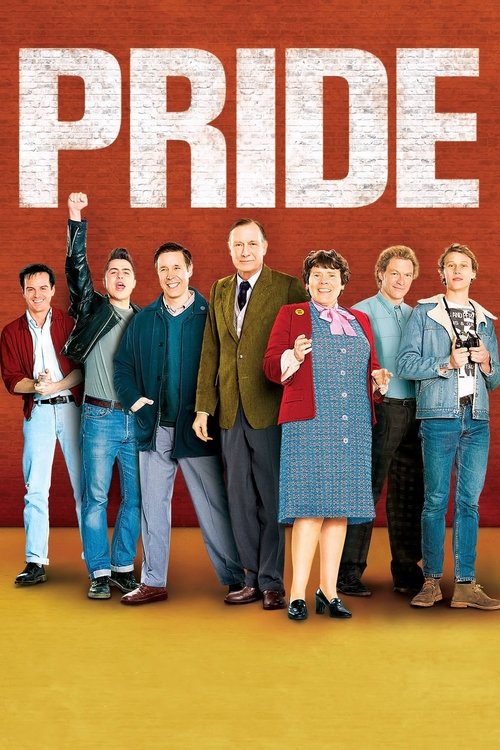
Pride
2014 · Matthew Warchus
For when you need your faith in people restored — a film to watch with friends when the news has worn you down and you want to end the night grinning through tears. Pure comfort, but comfort with a backbone.
What it's about
London, 1984: a small band of lesbian and gay activists decides that the striking miners — vilified by the same government and the same tabloids hounding them — are natural allies, and starts collecting money in buckets under the banner Lesbians and Gays Support the Miners. The catch is that the union doesn't want their help, so they take their donations directly to a small mining village in South Wales. What follows, drawn from a true story, is the awkward, funny, gradually warming collision of two communities that have been taught to distrust each other.
The experience
A proper crowd-pleaser with real political teeth — it makes you laugh out loud, then blindsides you with moments of solidarity that hit like a wave. Warm, brisk, and generous to every character, it's the rare feel-good film that actually earns the feeling.
Performances
Bill Nighy and Imelda Staunton are quietly wonderful as villagers on opposite ends of the welcome, Nighy doing career-best work in miniature. Ben Schnetzer burns as activist Mark Ashton, Dominic West gets a show-stopping dance floor moment, and Andrew Scott brings unexpected ache to a man returning to a Wales he'd fled.
The craft
Stephen Beresford's script juggles a dozen characters without dropping one, balancing broad comedy against genuine grief and political anger. Theater director Matthew Warchus paces it like a great ensemble play, and the 80s soundtrack — pop anthems and Welsh choral singing — does heavy emotional lifting, especially in the film's communal set pieces.
Why it matters
It won the Queer Palm at Cannes and rescued the real LGSM story from obscurity, becoming a beloved staple of both British working-class cinema and queer film history — proof the two traditions were always intertwined.
Snapshot
Pride dramatizes one of the strangest and most moving alliances of the Thatcher years: the real-life campaign by a small group of London lesbians and gay men who, during the 1984–85 miners' strike, raised money for a mining community in the Dulais Valley of South Wales. The group called itself Lesbians and Gays Support the Miners (LGSM), and the film tracks the awkwardness, suspicion, and eventual solidarity that grew between two constituencies Britain's establishment had taught to distrust one another. It was the feature debut of playwright Stephen Beresford as screenwriter and of theater director Matthew Warchus as a fully-fledged cinema director. Premiering in the Directors' Fortnight at Cannes in May 2014, where it won the Queer Palm, the film arrived as a crowd-pleasing but politically pointed entry in Britain's long tradition of working-class comedy-drama. Its reputation rests on a rare tonal balance — broad ensemble comedy braided with the encroaching shadow of AIDS and the defeat of the strike — and on a warmth that never fully sands away the period's cruelties.
Industry & production
Pride was produced within the well-established ecosystem of publicly-supported British filmmaking. It was made by Calamity Films (David Livingstone) with backing from the BBC (BBC Films) and Pathé, with additional support from the BFI, and released internationally by Pathé and CBS Films in the United States. This is the characteristic funding architecture of the mid-budget British "quality" picture: a broadcaster, a European distributor, and public money combining to underwrite a film too specific and too domestic in subject for pure commercial financing. Beresford spent years researching and developing the script, tracking down surviving LGSM members and figures from the Onllwyn community; the participation of real participants (notably Mike Jackson, an LGSM co-founder) lent the production both authenticity and a degree of ethical accountability to living people. The film was shot substantially on location in South Wales, using real valley communities and halls, which grounds the ensemble in a tangible geography rather than a studio approximation. As a debut feature for its writer and a first major cinema outing for its stage-trained director, Pride is very much a picture assembled around a strong screenplay and a deep bench of British character actors rather than around spectacle or a marquee lead.
Technology
Pride is a contemporary digital-era production in its post and delivery, and it makes no technological display: there are no significant visual-effects set pieces, no elaborate camera rigs, and no stylistic reliance on the affordances of new capture technology. The technical ambition is period reconstruction — 1984 London and the Welsh coalfields — achieved through production design, costume, locations, and music rather than through digital augmentation. I do not have reliable confirmation of whether cinematographer Tat Radcliffe captured the film on 35mm or digitally, and I will not guess; what is clear is that the finished image cultivates a warm, slightly desaturated period naturalism consistent with mainstream mid-2010s British drama regardless of the acquisition format. The film's "technology," in the fullest sense, is dramaturgical and musical: the deployment of an era-specific soundtrack and the machinery of ensemble staging inherited from the theater.
Technique
Cinematography
Tat Radcliffe's photography is unshowy and character-serving. The film alternates between two visual registers keyed to its two worlds: the London of the gay activists — bookshops, marches, the crowded flat that becomes LGSM's headquarters, the neon and dark of clubs — and the wide, gray-green Welsh valley with its terraced streets and communal miners' welfare hall. Radcliffe favors clean, legible framing that keeps the large ensemble readable, with the camera hanging back far enough to let group dynamics play in the same shot. Interiors of the Welsh hall are lit to feel lived-in and warm, a visual argument for community that pays off emotionally in the film's musical set pieces. The palette leans toward period-appropriate muted tones and earth colors, with brighter accents reserved for the activists' banners and the queer London milieu, so that the meeting of the two worlds registers chromatically as well as narratively.
Editing
Melanie Oliver's cutting manages the film's central technical problem: a very large ensemble and two parallel communities that must be introduced, individuated, and then interwoven. The editing keeps pace brisk in the comic passages — reaction shots, the timing of Imelda Staunton's and Bill Nighy's deadpan — while opening up and slowing for the dramatic beats, particularly the AIDS subplot and the strike's collapse. The film is structured as a series of visits and returns between London and Wales, and the editing uses this back-and-forth rhythm to build the sense of a relationship deepening over months. The montage of fundraising and of the "Pits and Perverts" benefit concert is assembled for uplift, and the closing sequence — the arrival of the miners' contingent — is cut for maximum communal catharsis.
Mise-en-scène / staging
This is where Warchus's theatrical training is most visible. Pride is fundamentally a film of ensembles in rooms: the LGSM flat, the welfare hall, the pub, the community meeting. Warchus stages crowded group scenes with a director's instinct for where the eye should go, allowing multiple simultaneous reactions and letting the comedy and tension emerge from bodies arranged in a space. The recurring motif of the hall — a neutral community space that is gradually transformed by the alliance — functions almost like a stage set whose meaning changes as the drama develops. Production and costume design do heavy narrative work: the activists' badges, leathers, and slogans against the knitwear and respectability of valley domestic interiors, a visual grammar of difference that the film slowly reconciles.
Sound
The soundtrack is one of Pride's defining elements and among its most effective tools. The film draws on period pop and protest music to locate the audience firmly in 1984 and to carry emotional meaning — the queer-anthem lineage of Bronski Beat sits alongside the labor tradition of union and folk songs. Diegetic communal singing is a load-bearing device: the film's celebrated moment in which a Welsh woman rises in the hall to sing "Bread and Roses," joined gradually by the others, uses collective voice to dramatize solidarity more persuasively than any dialogue could. Christopher Nightingale's original score underpins the drama without overwhelming the source cues, supporting the swings between comedy and pathos.
Performance
Pride is an actor's film built on a deep ensemble. Ben Schnetzer plays Mark Ashton, LGSM's charismatic young co-founder, with a driven intensity that anchors the movement; George MacKay plays the closeted newcomer Joe ("Bromley"), the audience's point of entry into the activist world. The film is stacked with senior British talent: Bill Nighy as the reticent valley committee man Cliff, Imelda Staunton as the redoubtable Hefina, and Paddy Considine as Dai Donovan, the union man who first accepts the London group's help. Dominic West brings flamboyant comic energy as Jonathan (whose partner Gethin is played by Andrew Scott, in a quieter, wounded register), Joseph Gilgun and Faye Marsay round out the activists, and Jessica Gunning's Sian is given one of the film's most satisfying arcs from housewife to nascent political figure. The performances are calibrated to the film's tonal tightrope — large enough for comedy, restrained enough for the grief and fear underneath.
Narrative & dramatic mode
The film operates in the mode of the ensemble feelgood social comedy-drama, structured around a "based on a true story" chronicle that runs roughly across the year of the strike. Its dramatic engine is the classic mismatched-alliance premise — two groups who should be enemies, or at least strangers, forced into contact and gradually humanized to one another — and it wrings both comedy and emotion from mutual misunderstanding curdling into loyalty. Beneath the comic surface runs a more sober double tragedy the film refuses to hide: the miners lose their strike, and the shadow of AIDS falls over the gay characters, historically underscored by the fate of the real Mark Ashton, who died of an AIDS-related illness in 1987 at the age of 26 (the film notes this in its closing text). The narrative thus follows a bittersweet rather than triumphalist shape, ending on an act of reciprocal solidarity — the miners' unions supporting gay-rights motions — that reframes political defeat as a durable human victory.
Genre & cycle
Pride belongs unmistakably to the cycle of British working-class comedy-dramas that flourished from the mid-1990s onward — films that find warmth, humor, and dignity in communities battered by deindustrialization and Thatcherite economics. Its clearest kin are Brassed Off (1996), The Full Monty (1997), and Billy Elliot (2000), all of which sit against the backdrop of the collieries and their closure, and Made in Dagenham (2010), with which it shares an activist-solidarity plot and a period-jukebox strategy. Like those films, Pride pairs a crowd-pleasing surface with genuine political grievance, and uses collective performance (a brass band, a strip act, singing) as a metaphor for community resilience. It also participates in the tradition of British LGBTQ cinema, joining a lineage of films that place queer experience within, rather than apart from, broader social and class history.
Authorship & method
The film is the product of a distinctive pairing of debut and stage authorship. Stephen Beresford, a playwright, wrote the screenplay as his first produced film script, and its craft — dense ensemble, sharp comic dialogue, careful management of multiple arcs — reflects a theatrical writer's discipline. Matthew Warchus is one of Britain's most successful stage directors (later artistic director of the Old Vic), known for work ranging from Yasmina Reza's Art to the musical Matilda; Pride is his first major cinema feature, and his direction is defined by ensemble staging, tonal control, and a showman's instinct for the uplifting set piece. Among his key collaborators, cinematographer Tat Radcliffe supplies the naturalistic period image; editor Melanie Oliver shapes the two-community structure and its tonal swings; and composer Christopher Nightingale — a frequent Warchus collaborator, including on Matilda the Musical — provides the score that supports the period-song soundtrack. The method throughout privileges performance, script, and music over directorial flourish, an approach consonant with both the British social-realist inheritance and Warchus's theatrical formation.
Movement / national cinema
Pride is a quintessential product of British national cinema in its publicly-supported, socially-engaged mode. It descends from the tradition running through the British New Wave and the socially-committed realism of Ken Loach into the more commercial "feelgood" strain of the 1990s and 2000s. It is a BBC Films / Pathé picture in both funding and sensibility: rooted in specific national history (the miners' strike is one of the defining traumas of modern British political memory), attentive to region and class, and produced for a domestic audience that shares the historical reference points, while packaged accessibly enough to travel internationally on the festival and arthouse circuit.
Era / period
Set in 1984–85, Pride is steeped in the specific texture of mid-Thatcher Britain: the year-long miners' strike led by the NUM, the confrontation with the Conservative government, tabloid homophobia at the dawn of the AIDS crisis, and Section 28 looming on the political horizon (it would be enacted in 1988). The film's period reconstruction is precise about these pressures — police harassment, hostile press, and the everyday risks of being out — and it treats 1984 not as nostalgic backdrop but as a moment of genuine political stakes. As a 2014 film, it was released into a very different landscape (the year after the Marriage (Same Sex Couples) Act in England and Wales), and part of its emotional force derives from the distance between its two moments: an audience watching from the far side of gains that the film's characters could barely imagine.
Themes
The film's central theme is solidarity across difference — the discovery that oppressed groups have more in common with one another than with the power structures that marginalize them, dramatized through the meeting of gay Londoners and Welsh mining families. Radiating from this are themes of coming out and visibility (Joe's arc, and the movement's insistence on being named as "Lesbians and Gays"), the dignity of collective action, and community as a form of resistance to economic and social devastation. The film is also, quietly, about grief and mortality — the coming AIDS catastrophe shadows its comedy — and about women's political awakening, particularly through Sian's transformation. Running beneath all of it is a thesis about coalition politics: that the alliances forged in this episode helped, historically, to shift the labor movement toward supporting gay rights.
Reception, canon & influence
Pride was warmly received critically, praised for its ensemble, its tonal balance, and its emotional generosity, and it drew comparisons to Brassed Off and The Full Monty as an heir to the British feelgood tradition. Its Cannes debut in the Directors' Fortnight and its Queer Palm signaled festival endorsement of its queer politics; in the awards season it earned recognition including a BAFTA in the Outstanding Debut category for its debut writer and producers, and a Golden Globe nomination in the comedy/musical category. I do not have reliable box-office figures to cite and will not invent them; the film is generally understood to have been a modest commercial performer that found a substantial and durable afterlife through streaming, television, and word of mouth.
Influences on the film (backward): it draws directly on the British social-comedy cycle — Brassed Off, The Full Monty, Billy Elliot, Made in Dagenham — for its structure, tone, and use of period music, and on the broader realist tradition of British cinema for its attention to class and region. Above all it is shaped by its documentary source: the real history of LGSM, the surviving participants who informed the script, and the archival memory of the 1984–85 strike.
Legacy (forward): the film's most tangible cultural effect has been to revive public memory of LGSM and the miners'-strike alliance, restoring a nearly-forgotten episode to prominence in histories of both the labor movement and LGBTQ activism, and reinvigorating the legacy of Mark Ashton. It was successfully adapted for the stage as the musical The Last Ship's contemporary — more precisely, it inspired stage and educational treatments and is frequently cited in discussions of solidarity politics and intersectional coalition-building. Within film culture it stands as a touchstone for how to fold queer history into the mainstream feelgood form without sacrificing political specificity, and it is regularly invoked as one of the defining British LGBTQ films of the 2010s.
Reception
A word-of-mouth hit out of Cannes 2014 (where it won the Queer Palm), it's only grown since — from well-liked British crowd-pleaser to an annual Pride-month ritual watch and one of Letterboxd's most beloved feel-good films.
How Pride was received, from release to now →
How to watch Pride: what to notice on a first viewing
- Notice how many people react at once in group scenes. Warchus stages crowded rooms so multiple simultaneous reactions play in the same shot, letting comedy and tension emerge from where bodies stand. You can watch an entire room's opinion shift without a single line of dialogue.
- Notice the color shift between London and the Welsh valley. Radcliffe shoots neon and dark for the queer London milieu and gray-green, muted earth tones for the mining valley, two visual worlds that slowly meet. You can feel the alliance forming just from the palette closing the gap between the two places.
- Notice the activists' badges and leathers against valley knitwear. Costume marks the two communities as opposites at first glance, London's queer signifiers against the respectability of the mining town's domestic dress. The clothes carry the culture clash before either side says a word.
- Listen for the hall breaking into song together. A woman rises to sing 'Bread and Roses' and others join in one by one, the film using collective voice instead of dialogue to show solidarity forming. You hear the alliance arrive before anyone announces it.
- Watch how the same welfare hall looks different each visit. The neutral community hall recurs across the film, gradually transformed by each visit from the London activists into something new. One room becomes a way to measure how far the two communities have moved toward each other.
The whole guide to watching Pride, with the keys for a rewatch →
Influences: the films it descends from and the films it influenced
- The Full Monty (1997) — Supplies the template Pride reuses wholesale: a humiliated working-class collective rehearsing toward one uplifting public set-piece, comedy mined from economic desperation, and an ensemble whose dignity is restored through a shared performance.
- Brassed Off (1996) — Directly models Pride's fusion of feelgood tone with miners'-strike political anger, and its use of diegetic communal music (colliery brass band) as the literal sound of solidarity under pit closures.
- Billy Elliot (2000) — Establishes the 1984–85 strike as a stage for crossing gender/sexuality lines inside a mining community, and demonstrates the stage-director-to-cinema translation of working-class material into an emotionally engineered crowd-pleaser.
- Made in Dagenham (2010) — Provides the immediate model for dramatizing a real labor-activist campaign as ensemble comedy-drama with a period-song soundtrack, staging picket-line collective action as feelgood uplift.
- My Beautiful Laundrette (1985) — Pioneers folding a gay romance directly into Thatcher-era class and coalition politics, refusing to bracket queer life off from the era's economic struggle — the intersection Pride builds its whole structure on.
- Beautiful Thing (1996) — Locates a tender coming-out narrative on a working-class British estate scored to communal pop (Mama Cass), setting the precedent for treating queer visibility warmly within an ordinary working-class milieu.
- Milk (2008) — Model for dramatizing real gay-activist movement history through a charismatic organizer figure (Harvey Milk / Mark Ashton), grounding the drama in archival memory and coalition-building tactics.
- Kes (1969) — Founding text of the British social-realist tradition Pride inherits — naturalistic Northern working-class observation, regional voice, and non-glamorized community that underpins Tat Radcliffe's period image.
- Matilda the Musical (2022) — Warchus's own later feature extends his method — theatrical ensemble staging and the showman's uplifting set piece — and reunites him with composer Christopher Nightingale, whose scoring supports song-driven emotional swells exactly as in Pride.
- Blinded by the Light (2019) — Reworks the Thatcher-era working-class feelgood formula with a period-jukebox soundtrack (Springsteen) as the emotional and political spine, exactly the music-as-uplift strategy Pride deploys.
- BPM (Beats Per Minute) (2017) — Extends the same craft of dramatizing queer collective action through the texture of the activist meeting itself — debate, faction, and consensus staged as ensemble drama drawn from real movement history (ACT UP).
- Dallas Buyers Club (2013) — Shares the mismatched-alliance engine — a bigot and the queer community forced into pragmatic coalition — dramatizing AIDS-era activism from a based-on-true-story foundation.
- God's Own Country (2017) — Carries forward British queer cinema rooted in Northern working-class landscape and labor, though trading Pride's ensemble feelgood register for intimate two-hander realism.
- Kinky Boots (2005) — Runs the same mismatched-alliance premise — a struggling working-class factory town saved by an alliance with queer (drag) performance — resolving class-vs-queer difference through a communal uplifting finale.
- The History Boys (2006) — Parallel example of a leading British stage director translating a dense ensemble play to screen with theatrical blocking and sharp comic dialogue, integrating queer characters into a warm ensemble.
- Sunshine on Leith (2013) — Shares Pride's device of diegetic communal singing as the expression of working-class community feeling, building set pieces where a group breaking into shared song carries the emotional climax.
- I Swear (2025) — British crowd-pleaser that converts a stigmatized group's struggle into communal solidarity and collectively earned uplift.
Similar films
- Billy Elliot (2000) — influence & lineage
- The Full Monty (1997) — influence & lineage
- God's Own Country (2017) — influence & lineage
- My Beautiful Laundrette (1985) — influence & lineage
- Milk (2008) — influence & lineage
- Pillion (2025) — often watched together
- Short Term 12 (2013) — shared sensibility
- All of Us Strangers (2023) — shared sensibility