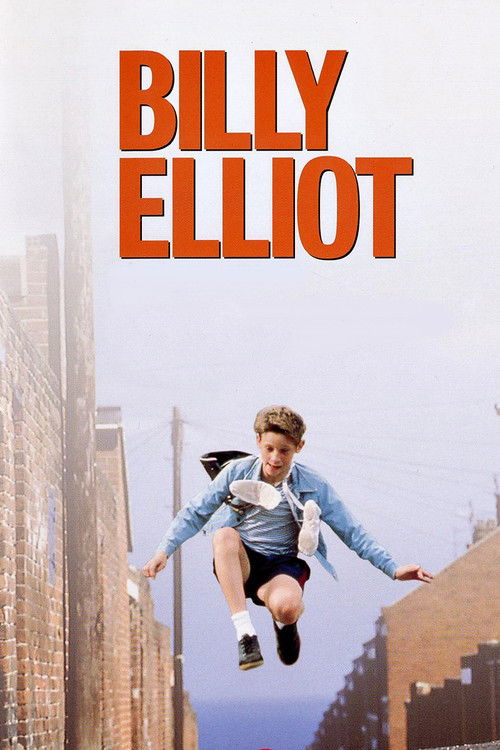
Billy Elliot
2000 · Stephen Daldry
For when you need a guaranteed lift that doesn't feel cheap — a feel-good film with real grit under it. Pure comfort, best shared.
What it's about
County Durham, 1984, with the miners' strike tearing the town apart. Eleven-year-old Billy, son of a striking miner, drifts out of his boxing lesson and into the ballet class sharing the hall — and turns out to be good. Keeping the dancing secret from a father and brother on the picket line becomes its own small war, fought in a house that has no money and no patience for it.
The experience
Scrappy and funny before it's moving, with dance sequences that burst out of the grim streets like a pressure valve. It builds honestly to a finish that earns the lump in your throat — you'll laugh, you'll well up, and you'll leave lighter than you arrived.
Performances
Jamie Bell, in his debut, is astonishing — all coiled frustration that only comes out through his feet — and Julie Walters gives the chain-smoking dance teacher a wit and weariness that keeps the film from ever going soft.
The craft
Stephen Daldry's first feature runs on Lee Hall's script, written from inside the world it depicts, so the strike is texture, not backdrop. The dancing is cut to pop songs with real punch — Billy hammering down a cobbled street says what no dialogue could — and the film plays even better loud.
Why it matters
One of the defining British crossover hits of its moment: Oscar nominations, a BAFTA for its young star, and an afterlife as a long-running stage musical that made the story a cultural fixture.
Snapshot
Billy Elliot is a coming-of-age drama in which an eleven-year-old boy in a County Durham mining town discovers a gift for ballet against the backdrop of the 1984–85 miners' strike. Directed by Stephen Daldry as his feature debut from a screenplay by Lee Hall — himself a product of the Tyneside region the film depicts — it fuses the grain of British social realism with the emotional architecture of the crowd-pleasing uplift narrative. Premiering at Cannes in May 2000 (where it had been retitled from its working title Dancer), it became one of the signal British crossover successes of its moment, propelling the young Jamie Bell to a BAFTA for Best Actor and earning Academy Award nominations for Daldry, Hall, and Julie Walters. Its afterlife — most consequentially the Elton John–scored stage musical of 2005 — has arguably eclipsed the film in cultural reach, but the original remains a precise, politically grounded work whose sentimentality is anchored by genuine grief, class anger, and bodily struggle.
Industry & production
The film was produced by Working Title Films — the British company then at the height of its transatlantic crossover model under Tim Bevan and Eric Fellner — through its lower-budget Working Title 2 arm, with Greg Brenman and Jon Finn as producers and BBC Films involvement. This placed Billy Elliot squarely within a late-1990s/early-2000s British industrial strategy that had already yielded regional working-class crowd-pleasers such as Brassed Off (1996) and The Full Monty (1997): modestly budgeted stories of post-industrial communities recovering dignity through performance, designed to travel internationally on emotional rather than star appeal.
Daldry came to the project not from cinema but from the theater, where he had been an acclaimed artistic director of the Royal Court — a background that shaped both his work with actors and his attention to the script as the spine of the film. Lee Hall's screenplay carried personal regional authority; Hall is from the North East and had written extensively for radio and stage about the area. The casting of the lead was the production's central gamble: Jamie Bell, then a teenager from Billingham in the North East, was selected from a wide search, and his real dance training and authentic regional voice underwrite the film's claim to rootedness. Veterans Julie Walters (as the chain-smoking dance teacher Mrs. Wilkinson) and Gary Lewis (as Billy's bereaved, striking father) supplied the seasoned ballast around him.
I should flag that precise budget and box-office figures circulate widely but I won't cite specific numbers here without certainty; what is securely established is that the film was a substantial commercial success relative to its modest scale and became one of the more profitable British films of its year.
Technology
Billy Elliot is, technologically, a conventional turn-of-the-millennium film shot on 35mm photochemical stock and finished in the traditional manner; it makes no claim to formal innovation in its capture or post-production technology, and the record reflects a craft production rather than a technical showcase. Its interest lies elsewhere — in choreography, performance, and editing. The one domain where the era's apparatus matters is sound: the film's heavy reliance on pre-existing pop recordings (above all the glam-rock catalog of T. Rex) reflects the increasingly central role of licensed music and the soundtrack album in the commercial calculus of British films of this period, where a curated needle-drop score functioned as both emotional engine and marketing asset.
Technique
Cinematography
The cinematography is by Brian Tufano, a senior figure in British cinema whose credits include Quadrophenia, Shallow Grave, and Trainspotting — a lineage that connects Billy Elliot both to British realist tradition and to the more kinetic, stylized energy of the 1990s Danny Boyle films. Tufano renders the mining town in muted, wintry tones appropriate to a community under siege, with the terraced streets, the colliery, and the picket lines shot in a register continuous with social-realist precedent. Against this, the dance sequences open up: the camera moves with Billy, and the framing grants his body room to express what he cannot articulate verbally. The contrast between the constricted domestic and industrial spaces and the liberating geometry of movement is the film's central visual argument, executed largely through Tufano's modulation of light, palette, and camera mobility rather than through overt stylization.
Editing
Edited by John Wilson, the film's cutting is most conspicuous in its dance set-pieces, where movement, music, and image are synchronized into the film's emotional climaxes. The celebrated "Angry Dance" sequence — Billy hammering out his frustration in tap and stamp through the streets and against a brick wall, scored to T. Rex's "A Town Called Malice" by The Jam in some accounts of the sequence's energy — depends on editing that matches percussive footwork to cut rhythm, turning choreography into a release of class and familial rage. Elsewhere the editing serves the realist mode, holding on performance, but the film's structural pulse is the alternation between the strike narrative and Billy's secret pursuit of dance, a parallel montage that lets the two stories comment on each other.
Mise-en-scène / staging
The production design fixes the film firmly in 1984–85: the strike's iconography (placards, braziers, police lines, "Coal Not Dole" sentiment) saturates the backgrounds, and the cramped Elliot household — motherless, three generations under one roof — is the emotional crucible. Daldry's theatrical instincts show in his staging of confrontation and reconciliation as charged spatial events: the father's discovery of Billy dancing in the gym, the Christmas-hall scene, the climactic decision to cross the picket line so his son might have a future. The recurring motif of the absent mother (glimpsed in memory and through a letter) is staged with restraint, giving the uplift narrative its undertow of loss.
Sound
Sound is where the film most boldly asserts itself. The needle-drop deployment of T. Rex — "Cosmic Dancer," "I Love to Boogie," "Get It On," "Children of the Revolution" — fuses Billy's interior life to the glam-rock exuberance of an earlier British working-class moment, while Stephen Warbeck's original score (Warbeck having recently won an Oscar for Shakespeare in Love) supplies the more lyrical, orchestral connective tissue. The friction between pop irreverence and the political gravity of the strike is a deliberate sonic strategy. The North East accents — thick, unsoftened — are themselves a sound-design choice asserting regional authenticity over legibility for international audiences.
Performance
Performance is the film's foundation. Jamie Bell's Billy is physically expressive in a way that carries the film's thesis that the body speaks what the boy cannot; his dancing is his own, lending the sequences a non-doubled authenticity. Julie Walters plays Mrs. Wilkinson with weary, sardonic tenderness, refusing easy mentor sentimentality. Gary Lewis's father and Jamie Draven's older brother Tony embody the strike's masculine desperation, and the screenplay's care in letting the father evolve — from horror at his son's "unmanly" pursuit to sacrifice on his behalf — gives Lewis the film's most affecting arc. Stuart Wells, as Billy's friend Michael, introduces a tender, matter-of-fact subplot about emerging queerness that the film treats with notable gentleness for a mainstream 2000 release.
Narrative & dramatic mode
The film operates in the classic mode of the talent-against-the-odds bildungsroman, but it earns its catharsis by binding the individual's escape to a collective defeat. Billy's ascent is structurally counterpointed against the strike's slow collapse: as he moves toward the Royal Ballet School audition and the wider world, the community that produced him is being broken. The dramatic engine is the conflict between self-realization and class loyalty, with the father as the hinge — the man who must betray the strike (crossing the picket) to fund his son's departure from the very class culture the strike defends. This gives the uplift ending its bittersweet charge: the famous coda, leaping forward years to the adult Billy performing the lead in Matthew Bourne's all-male Swan Lake (danced by Adam Cooper), is a triumph watched from the stalls by a father and brother who remain in the world Billy left behind.
Genre & cycle
Billy Elliot belongs to the British "feel-good realism" cycle of the late 1990s — the post-industrial uplift film exemplified by Brassed Off and The Full Monty, in which working-class communities devastated by Thatcher-era deindustrialization recover agency through artistic or bodily performance. It also sits within the long tradition of the dance film and the gifted-child narrative. What distinguishes it within these cycles is the seriousness of its political framing: where some of its cousins use the industrial backdrop largely as color, Billy Elliot makes the strike structurally and thematically central, refusing to let the personal triumph erase the collective loss.
Authorship & method
The film is best understood as a collaboration between a first-time film director with deep theatrical command of actors and a screenwriter with authentic regional and class authority. Stephen Daldry, arriving from the Royal Court, treated the screenplay as paramount and the actors as the film's primary instrument; Billy Elliot launched a film career marked by literary adaptation and prestige drama (The Hours, The Reader) and, later, the television series The Crown. Lee Hall's screenplay supplies the political and emotional specificity; his subsequent work (the stage play The Pitmen Painters) confirms a sustained engagement with North East working-class art and labor. Brian Tufano brought the authority of British realist and stylized cinematography; Stephen Warbeck supplied the score; John Wilson edited. The film's method might be summarized as theatrical actor-direction grounded in regional authenticity, lifted at key moments into stylized, music-driven physical expression.
Movement / national cinema
The film is a touchstone of British national cinema at the millennium, drawing on the kitchen-sink and social-realist traditions associated with Ken Loach and the British New Wave while deliberately departing from their characteristic refusal of consolation. It belongs to the moment when Working Title and BBC Films had perfected a model for exporting British regional stories to global audiences. Its Englishness is regionally specific — North East, mining, post-industrial — and its politics are legibly tied to the Thatcher period's defining domestic conflict, making it a national-cinema artifact in both subject and sensibility.
Era / period
Billy Elliot is doubly period-bound: produced in 2000, set in 1984–85. The setting is not incidental nostalgia but the film's political subject — the miners' strike was the decisive confrontation between organized labor and the Thatcher government, and its defeat marked the effective end of the industrial working-class culture the film mourns. Made fifteen years after the events, from the vantage of a New Labour Britain, the film looks back on that defeat with elegiac knowledge of how the story ended, which is precisely what lends Billy's escape its melancholy: he gets out, but there is no longer much to get out of.
Themes
The film's central theme is the tension between individual self-expression and class and gender expectation — the idea that artistic gift, and the male body dancing, can be both a betrayal of and a redemption for a community. Masculinity is interrogated throughout: boxing versus ballet, the father's initial shame, the gentle handling of Michael's queerness, and the final image of a man dancing the swan all work to expand what working-class masculinity might contain. Grief (the absent mother) and inheritance run beneath the uplift. And the strike supplies the overarching theme of collective defeat as the price and frame of individual escape — solidarity, sacrifice, and the painful arithmetic by which a parent funds a child's departure from the parent's own world.
Reception, canon & influence
Critically, Billy Elliot was warmly received as an emotionally potent crowd-pleaser with more political and performative substance than the genre usually allows; the consensus singled out Jamie Bell's revelatory lead and Julie Walters's supporting turn. Its awards profile was strong: Jamie Bell won the BAFTA for Best Actor in a Leading Role, and the film drew three Academy Award nominations — Daldry for Director, Hall for Original Screenplay, and Walters for Supporting Actress. (The film was widely honored at the BAFTAs; I'll avoid listing specific wins beyond Bell's where my recollection is not fully secure.)
Looking backward, the film's influences are the British social-realist tradition (Loach, the New Wave's working-class miserabilism) crossed with the uplift template of Brassed Off and The Full Monty; the all-male Swan Lake coda explicitly invokes Matthew Bourne's celebrated 1995 production, embedding a real contemporary landmark of British dance into the fiction. Looking forward, its most significant legacy is Billy Elliot the Musical (West End, 2005), with music by Elton John and book and lyrics by Lee Hall, which became a long-running international stage hit and arguably the more globally recognized form of the property. The film also confirmed a viable model for British regional crossover drama and launched the screen careers of Jamie Bell and Stephen Daldry. Within the broader canon, Billy Elliot endures as a defining example of how a national cinema can fold a real political defeat into a personally triumphant narrative — a film whose sentimentality is licensed by the genuine historical grief it never quite lets the audience forget.
A Deleuzian reading
Billy hits a wall.
The full Deleuzian reading of Billy Elliot →
Reception
A word-of-mouth crowd-pleaser in 2000 (three Oscar nominations, huge UK box office for its size), it's since settled into beloved comfort-classic status — though it's now also read more seriously as one of the defining films about the 1984-85 miners' strike.
How Billy Elliot was received, from release to now →
Influences: the films it descends from and the films it influenced
- Kes (1969) — Establishes the template Daldry inherits — a working-class Yorkshire boy's private passion (falconry) as the lone escape route from a colliery future, shot with non-professional regional authenticity and unsentimental observational realism.
- Saturday Night and Sunday Morning (1960) — British New Wave kitchen-sink realism — location shooting in Northern industrial towns with regional accents foregrounded — supplies the working-class-masculinity idiom and authentic class texture Billy Elliot rests on.
- The Loneliness of the Long Distance Runner (1962) — Pairs working-class physical talent (running) with class entrapment, using lyrical slow-motion and freedom-through-the-body montage that prefigures Billy's dance-as-escape sequences.
- Brassed Off (1996) — Direct template for folding the 1984–85 miners' strike and pit-closure grief into an uplift narrative where collective political defeat is redeemed by a performing-arts triumph (the colliery band).
- The Full Monty (1997) — Establishes the feel-good-realism crossover formula of redundant Northern working-class men reclaiming dignity through unlikely performance/dance, with comedy licensed by deindustrial despair.
- Flashdance (1983) — Blueprint for the working-class-protagonist-auditions-for-elite-dance-academy climax, with needle-drop-scored dance montages cut percussively to pop tracks — the structural spine of Billy's Royal Ballet audition arc.
- Saturday Night Fever (1977) — Originates the dance-floor-as-escape-from-dead-end-class-life motif scored to chart hits, where solo physical virtuosity becomes the protagonist's only currency of self-transcendence.
- October Sky (1999) — A mining-town boy defies his collier father to pursue a forbidden vocation amid a colliery strike — the company-town father-son aspiration structure transposed to dance.
- Shall We Dance? (1996) — Builds a whole film on Suō's central device: dance as a secret self kept hidden from a repressive social milieu that codes male dancing as shameful, released only through clandestine rehearsal.
- Muriel's Wedding (1994) — Uses pop needle-drops (T. Rex) to externalize a working-class dreamer's fantasy life through dance, the fantasy-versus-reality music strategy Muriel pioneered with ABBA.
- The Hours (2002) — Daldry extends his theatrical actor-direction and parallel-montage method — intercutting separate timelines into emotional rhyme — refining the cross-cut structure he used between Billy's dancing and the strike.
- Bend It Like Beckham (2002) — Directly inherits Billy Elliot's model — a youth defying family/gender expectation to pursue a physically gifted vocation (football) against working-class/immigrant constraint — with the same needle-drop-driven crowd-pleasing uplift.
- Whale Rider (2002) — Extends the gifted-child-versus-traditional-community-gender-roles bildungsroman, climaxing in a performance/ritual that converts the elder's grief into acceptance, mirroring Billy's father-arc resolution.
- Pride (2014) — Theater-director-turned-filmmaker (like Daldry) revisits the 1984–85 miners' strike with the same fold of solidarity and political defeat into a feel-good ensemble uplift, scored to period needle-drops.
- Rocketman (2019) — Lee Hall's screenplay returns to the working-class-boy-saved-by-art arc as full jukebox biopic, deploying the percussive dance-to-music-cutting and fantasy-staged numbers that Billy Elliot's musical legacy normalized.
- Billy Elliot the Musical Live (2014) — Daldry and Hall's own stage adaptation makes explicit the theatrical-confrontation staging and music-driven physical expression latent in the film, with Elton John scoring the dance-as-defiance set pieces.
- Sing Street (2016) — Carries forward the working-class-adolescent-escapes-through-performance bildungsroman scored to era-specific needle-drops, with art as the individual exit from a depressed regional economy.
- And Then We Danced (2019) — Stages dance as revolt against a coded-masculine, working-class tradition, the male body claiming a forbidden discipline against its milieu's expectations.
- I Swear (2025) — Coming-of-age in a hard northern town where uncontrollable bodily expression becomes the vehicle for overcoming communal shame and social prejudice.
- CODA (2021) — Working-class family melodrama built on the individual-artistic-aspiration-versus-familial-duty engine and resolved by a conservatory-audition climax that CODA reproduces almost beat for beat.
- Swing Kids (2018) — The socially-engaged dance film in which dance becomes personal transcendence staged directly against a backdrop of bitter political conflict — art transcending ideology through the moving body.
- A Matter of Loaf and Death-era T. Rex needle drops in Velvet Goldmine (1998) — Shares the strategy of mining Marc Bolan/T. Rex glam-rock as a sonic signifier of working-class English self-invention and queer-coded liberation through performance.
- East Is East (1999) — Contemporary regional working-class crossover dramedy mining 1970s–80s Northern English family life for authenticity, balancing patriarchal-masculinity conflict with warmth in the same feel-good-realism register.
- Beautiful Thing (1996) — Descendant that fuses gritty social-realist milieu with feel-good uplift over a working-class boy's self-realisation — the same reconciliation of Loachian texture and crowd-pleasing structure.
- C.R.A.Z.Y. (2005) — Stages a working-class father-son rupture over a son's nonconformity and releases it through glam-rock (T. Rex) music-and-movement set pieces, the same fusion of pop cue and emotional catharsis.
Similar films
- The Full Monty (1997) — influence & lineage · often watched together
- Pride (2014) — influence & lineage
- Sing Street (2016) — influence & lineage
- Rocketman (2019) — influence & lineage
- Mary Poppins (1964) — often watched together
- Slumdog Millionaire (2008) — shared sensibility
- Trainspotting (1996) — shared sensibility
- Kes (1970) — shared sensibility
All the films related to Billy Elliot →
Watch it with: curated runs of related films
- The Working-Class Long Shot — A run of men whose bodies and grit are their only capital, each grinding toward a single shot at dignity — watch them together and the American bootstrap dream and its bleaker European labor-film shadow start to rhyme.