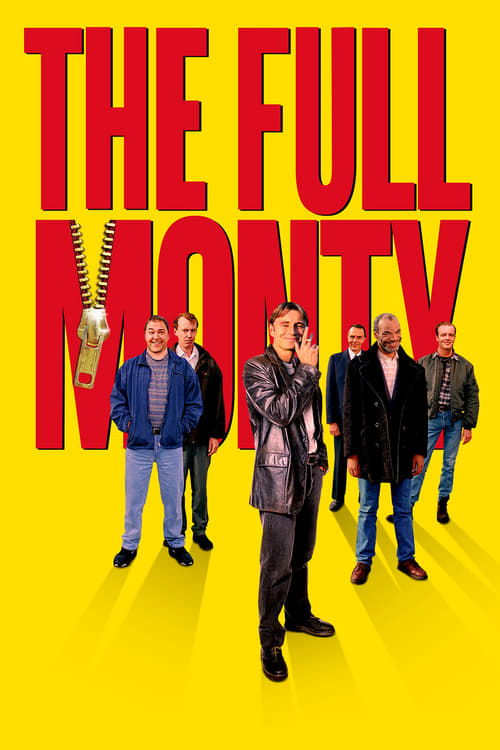
The Full Monty
1997 · Peter Cattaneo
For when you need cheering up but don't want anything fake about it — a feel-good film with real hardship in its bones. One of the all-time crowd-pleasers for a group night in.
What it's about
In a Sheffield hollowed out by the collapse of the steel industry, Gaz — jobless, broke, and about to lose the right to see his son — hatches a scheme: recruit a crew of fellow laid-off men and put on a one-night-only strip show, promising to go further than the Chippendales ever did. The catch is that these are ordinary blokes with ordinary bodies, and every one of them has more to lose than his clothes.
The experience
Genuinely funny and sneakily moving — it earns its laughs from character rather than gags, and the sadness of men stripped of work and purpose sits right under the comedy without sinking it. By the finale you're grinning and a little choked up at once.
Performances
Robert Carlyle carries it with scrappy, wounded charm as Gaz, and the ensemble around him — Tom Wilkinson as the proud ex-foreman, Mark Addy as the self-conscious best mate — makes every man in the troupe specific and touching.
The craft
Simon Beaufoy's screenplay is a small miracle of construction, welding British social-realist grit to a perfect crowd-pleaser arc, and the film mines comedy from choreography — the dole-queue scene where the men unconsciously start dancing to 'Hot Stuff' is an instant classic. The disco soundtrack does heavy lifting and does it joyfully.
Why it matters
A low-budget British comedy that became a global phenomenon and a Best Picture nominee, it defined the late-90s wave of working-class British crowd-pleasers and put post-industrial Sheffield on the world's screens.
Snapshot
The Full Monty is a low-budget British comedy that became one of the defining commercial and cultural phenomena of late-1990s cinema. Set in a Sheffield gutted by the collapse of the steel industry, it follows Gaz (Robert Carlyle), an unemployed and broke former steelworker who, desperate for cash and the right to keep seeing his son, recruits a mismatched band of fellow redundant men to mount a one-night strip act — promising, unlike the Chippendales, to go "the full monty," that is, all the way to full nudity. From this brazenly comic premise the film draws a surprisingly tender meditation on unemployment, masculinity, fatherhood, and self-worth. Directed by first-time feature filmmaker Peter Cattaneo from a screenplay by Simon Beaufoy, it married the social-realist concerns of British cinema to the structure of a crowd-pleasing underdog comedy, and the combination proved extraordinarily potent: a modestly budgeted regional film became a worldwide hit, an awards contender, and the template for a whole cycle of "feel-good" British comedies about ordinary people staging unlikely performances.
Industry & production
The film was produced by Uberto Pasolini through Redwave Films and financed and distributed by Fox Searchlight Pictures, the specialty arm of Twentieth Century Fox. It was made cheaply — reported budgets cluster around £3–3.5 million — using a largely British cast of working actors rather than stars, and shooting on location in and around Sheffield. The Full Monty would become one of Fox Searchlight's earliest and most important commercial successes, helping establish the credibility of the studio's specialty-division model in which small films could yield outsized returns.
Its commercial performance was the headline of its release. Against its tiny budget it grossed in the region of a quarter of a billion dollars worldwide, an almost unheard-of multiple for a film of its scale. In the United Kingdom it became, for a time, the highest-grossing film in the domestic box-office record before being overtaken by Titanic. The disproportion between cost and return made the film a case study, frequently cited thereafter, in how a specific, regional, unglamorous story could achieve broad international reach. Pasolini, the producer, came from an aristocratic Italian background and would later move into directing himself; the film's success raised the commercial profile of everyone involved.
Technology
The Full Monty is not a technically ambitious film in the sense of effects or apparatus, and the historical record offers little to suggest elaborate technological innovation. It was shot photochemically on 35mm in the standard manner of mid-1990s British production, prioritizing location authenticity and natural light over spectacle. Its "technology," in any meaningful sense, is sociological rather than cinematic: the film is about the obsolescence of an industrial technology — the steel mills whose closure has stranded its characters — and the opening mock-promotional film about Sheffield as "a city on the move" sets that theme in ironic relief against the rusting plant where the men now scavenge and loiter. The contrast between the heavy machinery that once defined these men's labor and identities and the bodies they are now reduced to selling is the film's central technological irony.
Technique
Cinematography
The cinematography, by John de Borman, favors an unforced naturalism appropriate to the post-industrial setting: muted northern light, drab interiors, the grays and browns of derelict works and council estates. De Borman keeps the camera close to the actors and resists prettifying the locations, which grounds the comedy in a recognizably real, economically depressed Sheffield. The restraint is deliberate; the film earns its emotional and comic payoffs by establishing a plain, observational visual world first, so that the eventual eruption of the strip routine — lit, staged, and joyous — registers as a genuine release from that grayness.
Editing
Cut by Nick Moore and David Freeman, the film moves with the brisk efficiency of comedy while leaving room for its quieter beats. The editing is most celebrated in its set-piece comic sequences — above all the dole-queue scene in which the men, waiting in line, involuntarily fall into the choreography of Donna Summer's "Hot Stuff," cutting between deadpan faces and the dawning recognition that they have all secretly been rehearsing. The film's rhythmic management of music, gesture, and reaction is its editorial signature, and the construction of the climax — building anticipation toward the final reveal and then cutting to black on the moment of full exposure — is a textbook example of comic timing and withheld payoff.
Mise-en-scène / staging
The staging works by contrast: cramped domestic spaces, the labor club, the abandoned steelworks repurposed as a rehearsal hall. The men's bodies — ordinary, aging, overweight, anxious — are foregrounded against these backdrops in ways that refuse the gloss of the conventional showbiz musical. The recurring gag of clumsy, earnest rehearsal in unglamorous rooms is central to the film's tone, dignifying the characters precisely by showing how far they are from the polished ideal they aspire to imitate. The final performance, staged before a packed, predominantly female working-class audience, transforms this awkward physicality into collective triumph.
Sound
Sound, and specifically the use of popular music, is arguably the film's most important technical dimension. The soundtrack leans on a canon of recognizable pop and soul — Hot Chocolate's "You Sexy Thing," Tom Jones, Donna Summer, Gary Glitter-era glam staples of the strip-act idiom — deployed both diegetically (the men's chosen routine music) and as ironic counterpoint. The needle-drops carry enormous narrative and emotional weight, signaling the men's reluctant, then exuberant, embrace of performance. Anne Dudley's original score threads between these tracks, providing connective tissue and emotional underscoring.
Performance
Performance is the heart of the film, and its ensemble is its glory. Robert Carlyle's Gaz is wiry, fast-talking, and driven by a desperation that never quite curdles into self-pity; the role consolidated Carlyle's standing as one of the most compelling British actors of his generation. Mark Addy's Dave embodies the film's anxieties about body image and male self-worth with great pathos. Tom Wilkinson, as the laid-off middle-manager Gerald hiding his unemployment from his wife and obsessively tending his garden gnomes, supplies a more buttoned-up register of shame. Steve Huison's Lomper (whose suicide attempt opens one of the film's tonal pivots), Paul Barber's Horse, and Hugo Speer's Guy round out a troupe whose individuated vulnerabilities give the comedy its emotional ballast. The performances are pitched so that the laughter is never at the men's expense but in solidarity with them.
Narrative & dramatic mode
The film's dramatic mode is the underdog ensemble comedy, organized around the classic "let's put on a show" structure familiar from the backstage musical, here transplanted into the idiom of British social realism. The narrative engine is double: the external goal (stage the act, make the money) is braided with an internal, emotional stake (Gaz's need to retain access to and the respect of his son Nathan, and more broadly each man's struggle to recover a sense of usefulness and dignity). The comedy of rehearsal and humiliation runs alongside genuine social pain — unemployment, depression, marital strain, fear of one's own body — and the film's achievement is to hold these registers in balance, so that the climactic strip is both a great comic payoff and a real act of collective courage. The withheld final image, ending on the moment of full nudity rather than dwelling on it, is the structural keystone of this design.
Genre & cycle
The Full Monty belongs to a distinctly British genre formation that fuses comedy with the social-realist tradition: stories of working-class communities responding to economic devastation through unlikely communal performance. Its closest sibling is Mark Herman's Brassed Off (1996), which dramatized a Yorkshire colliery brass band facing pit closure in much the same emotional and political key. Together these films are often discussed as the leading edge of a 1990s–2000s cycle of "feel-good" British social comedies — later including the likes of Billy Elliot, Calendar Girls, and Kinky Boots — in which ordinary people from declining industrial communities find dignity through public, often body-centered, performance. The Full Monty did as much as any single film to define and popularize that cycle internationally.
Authorship & method
Peter Cattaneo directed The Full Monty as his feature debut, and his contribution lies above all in tonal control — the ability to keep the film funny without trivializing its subject and moving without lapsing into sentimentality. The screenplay is by Simon Beaufoy, whose carefully observed, regionally specific writing grounds the comedy in the lived texture of post-industrial Sheffield; Beaufoy would go on to a major career, later writing the Oscar-winning screenplay for Slumdog Millionaire and 127 Hours. The cinematography is by John de Borman; editing by Nick Moore and David Freeman; and the original score by Anne Dudley, a composer with deep roots in pop production (notably the Art of Noise). Producer Uberto Pasolini was a driving creative force behind the project. The film is best understood not as the expression of a single auteur but as a finely calibrated collaboration in which writing, performance, music, and tonal direction reinforce one another.
Movement / national cinema
The film is a landmark of 1990s British cinema and a key document of British national identity in the post-Thatcher, deindustrializing moment. It draws on the long tradition of British social realism — the kitchen-sink lineage running back through Ken Loach and the British New Wave — but redirects its concern with class and work into a commercially expansive comic form. It also sits within a remarkable mid-1990s flowering of British films that traveled internationally (alongside titles such as Trainspotting, which shared Robert Carlyle, and Four Weddings and a Funeral), demonstrating that specifically British, regionally rooted stories could command global audiences. Its Sheffield setting is not incidental decoration but the film's subject: the human cost of the collapse of British heavy industry.
Era / period
Made and set in the mid-1990s, the film is steeped in the aftermath of the industrial decline that reshaped northern England across the 1980s and into the 1990s — the closures, redundancies, and mass male unemployment that followed the contraction of steel and mining. Its release in 1997 coincided with a moment of political transition in Britain, and the film's portrait of communities abandoned by economic change resonated widely. The soundtrack's reliance on 1970s and 1980s pop and soul further locates the characters generationally: these are men whose formative cultural reference points predate their present obsolescence, lending the music both nostalgia and poignancy.
Themes
The film's central theme is the crisis of working-class masculinity in the wake of deindustrialization: men whose identities were built on industrial labor must reconstruct a sense of worth when that labor disappears. Around this core cluster several interlocking concerns — unemployment and economic precarity; the reversal of gendered roles (the recurring observation that women now hold the jobs and the economic power); body image and shame, voiced most directly through Dave's anxieties; fatherhood and the fear of losing one's children's respect, in Gaz's storyline with Nathan; depression and despair, marked by Lomper's suicide attempt; and the tentative, generous treatment of sexuality, including the gentle gay relationship that develops between two of the men. Underlying all of these is a theme of solidarity: the recovery of dignity not individually but collectively, through mutual exposure — literal and emotional — and communal performance.
Reception, canon & influence
Critically and popularly, The Full Monty was embraced as one of the defining British films of its decade. It won the BAFTA Award for Best Film and earned four Academy Award nominations — for Best Picture, Best Director, Best Original Screenplay, and Best Original Musical or Comedy Score — of which Anne Dudley won for her score, in a short-lived category that distinguished comedy/musical scoring from drama. Reviewers praised its tonal balance, its ensemble performances, and its capacity to extract genuine feeling and social observation from a high-concept comic premise; the film's reputation as a "feel-good" hit has at times obscured the seriousness of its social subject, a tension that later criticism has been keen to recover.
Looking backward, the film's influences lie in the British social-realist tradition and in the contemporaneous Brassed Off, with which it shares its regional setting and its theme of communal response to industrial collapse; its narrative architecture descends from the long lineage of backstage and "put-on-a-show" musicals. Looking forward, its legacy is substantial. Commercially, it helped validate Fox Searchlight's specialty model and proved the international viability of small British films. Generically, it became the template for the cycle of British feel-good social comedies that followed. And the property itself proved unusually durable across media: it was adapted into a Broadway stage musical (with songs by David Yazbek), later reworked into a stage play and a West End musical adaptation drawing on Beaufoy's own writing, and revived decades on as a streaming-era television sequel revisiting the original characters. Few films of its size have exerted so wide and lasting an influence — on an industry's economics, on a national genre, and on the broader cultural conversation about masculinity, work, and dignity.
A Deleuzian reading
Start with the dole queue.
The full Deleuzian reading of The Full Monty →
Reception
A word-of-mouth sleeper that became one of the biggest sleeper hits of the '90s — even landing a Best Picture Oscar nomination — before being filed away as fluffy feel-good fare; it's since been reappraised as a genuinely sharp, melancholy film about male unemployment and post-industrial Britain that's darker than people remember.
How The Full Monty was received, from release to now →
Influences: the films it descends from and the films it influenced
- Kes (1969) — Loach's observational naturalism and use of regionally-specific Yorkshire texture and non-professional inflection is the social-realist grammar John de Borman's unglamorous, available-light cinematography inherits.
- Saturday Night and Sunday Morning (1960) — The British New Wave's kitchen-sink portrait of the disaffected factory-floor male established the industrial working-class masculinity that Beaufoy's Sheffield men are the post-Thatcher, post-employment heirs to.
- This Sporting Life (1963) — Anderson centers wounded working-class masculinity on the physical male body as a site of labor and display — the same conflation of body, work and exposure the strip premise literalizes.
- 42nd Street (1933) — The backstage 'put-on-a-show' architecture — rehearsal montages whipping rank amateurs toward one climactic performance — is the narrative skeleton the film transplants from Broadway to a Job Club.
- The Commitments (1991) — Parker assembles unemployed working-class amateurs into a performing act, fusing the rehearsal-comedy of ordinary bodies with a needle-drop soul soundtrack exactly as Cattaneo later does with the strip routine.
- Raining Stones (1993) — Loach extracts deadpan comedy from working-class economic desperation without softening the hardship — the precise tonal register Cattaneo cites as keeping the film funny without trivializing unemployment.
- Billy Elliot (2000) — Reworks the formula directly: a miners'-strike North where embattled working-class masculinity is renegotiated through bodily performance, governed by the same gear-shifting between comedy and feeling.
- Calendar Girls (2003) — Transposes the engine wholesale: ordinary, non-ideal bodies disrobing as a collective fundraising 'show,' staged as a feel-good ensemble comedy mined from a real Northern community.
- Kinky Boots (2005) — Recycles the deindustrialization-plus-spectacle premise — a dying Northampton shoe factory rescued by performance and drag — the failing-industry-saved-by-a-show template the film standardized.
- Made in Dagenham (2010) — Stages a working-class ensemble's labor struggle as warm, accessible social comedy, extending the British feel-good-realist genre cycle The Full Monty's box office validated.
- Pride (2014) — Runs the male-solidarity-amid-collapse engine through the miners' strike, treating strike-era politics with the same comic warmth and ensemble staging the template established.
- Magic Mike (2012) — Reframes male stripping as precarious post-industrial labor, choreographing its set-pieces against economic anxiety and tracing the same ordinary-man-to-performer arc, stripped of the British comedy's reassurance.
- Slumdog Millionaire (2008) — Direct authorship debt: Beaufoy's screenplay again structures acute social hardship inside an uplifting popular-genre frame, the writerly method he first calibrated on Sheffield.
- Swing Girls (2004) — The ragtag-underdog-troupe engine: clumsy rehearsal rendered as comic montage that resolves into one nerve-wracking public performance where the amateurs finally cohere onstage.
- I Swear (2025) — Supplies the core British crowd-pleaser structure I Swear inherits: a marginalized working-class figure earns dignity by exposing his most shameful vulnerability in a public performance climax.
- Brassed Off (1996) — Its near-contemporaneous twin: the same pit-closure Yorkshire setting and the same device of collective performance (a colliery brass band) as communal answer to deindustrialization, with identical comic-to-elegiac tonal balancing.
- Trainspotting (1996) — Boyle's ironic needle-drop scoring — chart and dance-pop cut hard against grim post-industrial life — models the same sound strategy that lets Hot Chocolate's 'You Sexy Thing' carry a Job Centre queue.
- Little Miss Sunshine (2006) — Builds the underdog-ensemble toward a deliberately unglamorous amateur performance whose comic awkwardness becomes collective redemption — the same payoff structure as the closing strip.
- Shall We Dance? (1996) — Independently arrives at the same feel-good engine — repressed, socially constrained men redeemed through amateur public performance — proving the international portability of the ordinary-person-through-performance formula Suō perfected.
- The Castle (1997) — Transnational sibling released the same year: a working-class ensemble underdog comedy that wrings dignity and heart from economic precarity in the identical affectionate-realist register, made fast and cheap around love of its characters.
- Basic Sanitation, the Movie (2007) — Same engine of an economically desperate community mounting an improbable amateur production as the literal solution to its material shortfall.
- Muriel's Wedding (1994) — Carries forward the tragicomedy of ordinary working-class misfits, mining real pathos and dignity from staged humiliation and unglamorous bodies.
Similar films
- Billy Elliot (2000) — influence & lineage · often watched together
- Trainspotting (1996) — influence & lineage
- Pride (2014) — influence & lineage
- Slumdog Millionaire (2008) — influence & lineage
- Once (2007) — often watched together
- Naked (1993) — shared sensibility
- Boiling Point (2021) — shared sensibility
- Get Carter (1971) — shared sensibility