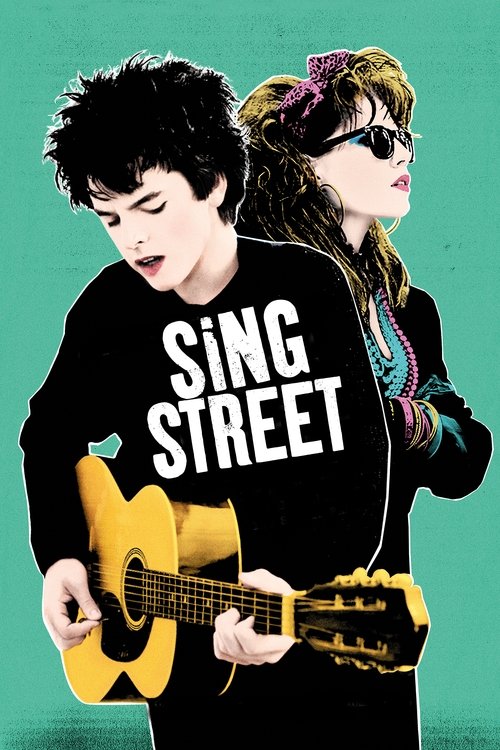
Sing Street
2016 · John Carney
For when you want to feel young and possible again — a feel-good film with a real heart under the synths, perfect for a night when you need music to save somebody, including maybe you.
What it's about
Dublin, 1985: a fourteen-year-old boy is yanked out of his private school and dropped into a rough Christian Brothers institution while his parents' marriage falls apart at home. To impress an older girl who dreams of modeling in London, he claims to have a band — then has to actually form one, and the group starts writing songs and reinventing its look with every new record that lands from across the water.
The experience
Joyful and bittersweet at once — it moves with the giddy energy of kids discovering they can make something, while the recession-gray Dublin around them keeps the stakes real. The original songs are good enough that you'll be humming them for days, and the whole thing carries a lump-in-the-throat sweetness about brothers, first love, and escape.
Performances
Ferdia Walsh-Peelo is winning as Conor, believably transforming from shy kid to frontman, and Lucy Boynton gives Raphina a guarded sadness that keeps the romance from being simple. Jack Reynor quietly steals the film as the older brother whose record collection and hard-won wisdom fuel everything.
The craft
John Carney writes original songs that convincingly evolve as the band absorbs each new influence — Duran Duran one week, The Cure the next — so the soundtrack doubles as the story of a kid finding his voice. The period pastiche of mid-'80s pop and homemade music videos is affectionate and exact. Watch it with the volume up.
Why it matters
It cemented Carney's run of beloved films about music-making as a lifeline and became a word-of-mouth favorite whose songs and 'happy-sad' spirit have earned it a devoted following well beyond its modest release.
Snapshot
Sing Street is John Carney's third and warmest feature about music-making as an act of survival, a coming-of-age musical set in recession-battered Dublin in 1985. A fourteen-year-old, Conor (Ferdia Walsh-Peelo), pulled out of a fee-paying school and dropped into the grim Christian Brothers institution on Synge Street, forms a band chiefly to impress an older girl, Raphina (Lucy Boynton), who says she is a model bound for London. What begins as a boy's romantic pretext becomes, over the film's runtime, a genuine artistic education: the band writes original songs, remakes itself weekly in the image of whatever record Conor has just absorbed, and its leader discovers a self worth escaping toward rather than merely escaping into. The film pairs pastiche of a very specific pop moment — Duran Duran, The Cure, Spandau Ballet, Hall & Oates, Joe Jackson — with an emotional register the film itself names "happy-sad." It is at once Carney's most crowd-pleasing work and his most personal, drawing openly on his own Dublin adolescence, and it stands as a defining example of the low-budget, song-driven musical he has made his signature.
Industry & production
Sing Street is a modestly budgeted Irish/UK/US co-production, financed through a coalition of small companies — Carney's own circle plus PalmStar Media, FilmWave, Distressed Films and others — with support from Bord Scannán na hÉireann (the Irish Film Board), the kind of public-plus-private stack typical of Irish feature production in the period. It premiered at the Sundance Film Festival in January 2016 and was picked up for North American distribution by The Weinstein Company, with Lionsgate handling the UK and Ireland; it opened commercially in the spring of 2016. Precise budget and gross figures I won't assert with confidence, but the film belongs unambiguously to the specialty/independent tier: shot in Dublin locations on a scale where a school corridor, a handful of streets, and a music-video shoot on a suburban stairwell constitute the principal sets.
The production's defining constraint was also its method. Carney cast musically capable unknowns for the band — Walsh-Peelo and Mark McKenna (as Eamon, the multi-instrumentalist collaborator) among them — so the young performers could actually play and sing, a decision that shapes everything from the staging of rehearsals to the credibility of the concert scenes. Around these newcomers Carney assembled seasoned Irish talent: Jack Reynor as the older brother Brendan, and Aidan Gillen and Maria Doyle Kennedy as the fracturing parents. The Weinstein association, in hindsight, complicates the film's commercial afterlife — the distributor's later collapse muddied the catalog rights of everything it released in this window — but had no bearing on the work itself.
Technology
Technically the film is unshowy by design. It was shot digitally in the mid-2010s house style, favoring a soft, slightly nostalgic palette rather than any conspicuous format gambit; there is no celluloid-grain fetish here, and the period is evoked through production design and music rather than through camera technology. The one place technology becomes a subject rather than a tool is diegetic: the film is partly about 1980s media infrastructure. Conor's education arrives through vinyl records and, crucially, through Top of the Pops on television — the band literally studies music videos to learn how to look, and stages its own home-made videos in imitation. The gap between the glossy image the boys aspire to and the camcorder-grade reality of a Dublin backyard is one of the film's richest sources of comedy and tenderness, so the "technology" of the story is the emergent 1985 pop-video apparatus that taught a generation to imagine itself.
Technique
Cinematography
Yaron Orbach's photography works in a warm, unfussy naturalism that lets the songs and faces carry the film. The visual grammar is largely classical — coverage that keeps the young actors legible, handheld looseness in the rehearsal and street scenes to preserve spontaneity — but it opens up decisively for the musical numbers. The film's signature visual set-piece is the "Drive It Like You Stole It" sequence, in which a modest video shoot in a school hall dissolves into Conor's fantasy of a glossy American-styled 1950s prom, complete with an imagined reconciled family and a Raphina who actually shows up; the camera and lighting shift register from documentary drabness to saturated dream and back, and the deflation when reality reasserts itself is staged as a visual let-down as much as a narrative one. Throughout, Dublin is shot gray and constrained, so that color and movement read as aspiration.
Editing
The editing (credited principally to Andrew Marcus) alternates two rhythms. In the dramatic scenes it is patient and observational, letting exchanges between Conor and Brendan, or Conor and his parents, play at length. In the music it becomes propulsive and associative, and the film's central structural idea is legible in the cutting: each time the band absorbs a new influence, the film jump-cuts them into a new look and sound, compressing weeks of adolescent reinvention into montage. The prom fantasy is the editing's bravura moment, cross-cutting wish and actuality; more quietly effective is the way the film builds its songs across scenes, so that a lyric written in a bedroom pays off in performance later.
Mise-en-scène / staging
Costume and production design (period design by Alan MacDonald's department; costuming that tracks the band's serial makeovers) do enormous narrative work. The boys' evolving wardrobe — New Romantic ruffles, then Cure-ish goth eyeliner and backcombed hair, then sharp mod tailoring — is not decoration but plot: their clothes chart Conor's discovery of successive record collections and, underneath, his search for a self. Against this, the two fixed poles of the mise-en-scène are the drab brown institutional world of the Synge Street school (embodied in the sadistic Brother Baxter) and the cluttered, smoke-hazed sanctuary of Brendan's bedroom. Raphina, in her thrift-store glamour, is staged as a splash of London color trapped in the same gray city.
Sound
Sound is the film's true medium. The soundtrack yokes carefully chosen period tracks — used both as Conor's curriculum and as emotional scoring — to a suite of original songs written to sound like 1985 without being any specific real record. These originals ("The Riddle of the Model," "Up," "Drive It Like You Stole It," "A Beautiful Sea," and the closing "Go Now") are diegetically the band's own compositions, which lets the film dramatize songwriting as it happens: we hear a tune in embryo and then hear it realized. That the young cast perform much of the music themselves gives the sound an unpolished authenticity that a lip-synced production could not buy.
Performance
Walsh-Peelo carries the film with an unforced, slightly guarded sweetness, growing in confidence as Conor does. Boynton gives Raphina more melancholy and self-invention than the manic-pixie template would allow — she is performing a version of herself, too, and the film knows it. But the performance most often singled out is Jack Reynor's Brendan: the stalled older brother who has surrendered his own ambitions and channels them into mentoring Conor. His late monologue about having "cleared the path" for his younger siblings is the film's emotional keystone, and it reframes the coming-of-age comedy as, partly, an elegy for a sibling who won't get out.
Narrative & dramatic mode
The film runs on the classic backstage-musical engine — form a band, chase a dream, put on the show — but braids it with a domestic drama of family collapse and a romance of adolescent self-fashioning. Its dramatic mode is comedy shading repeatedly into something sadder, the "happy-sad" that Brendan and Conor discuss explicitly as an artistic goal. Structurally it is episodic, organized by songs and by the band's serial reinventions rather than by tight plotting, and it culminates not in a triumphant concert but in a leap of faith: Conor and Raphina motoring a small boat out of Dublin harbor toward Britain through rough seas, an ending poised deliberately between exhilaration and foolhardiness. Carney refuses to resolve whether they make it, letting the image stand as a metaphor for youth's necessary recklessness.
Genre & cycle
Sing Street sits at the intersection of the jukebox/original-song musical, the coming-of-age film, and the rock-and-roll-fantasy tradition. Within Carney's own output it completes an informal trilogy of music films — Once (2007), Begin Again (2013), Sing Street — that treat songwriting as the medium through which characters say what they cannot otherwise say. In the broader cycle it belongs with a run of affectionate 1980s-set music movies and with the enduring lineage of British and Irish social-realist coming-of-age stories leavened by pop. It is often, and rightly, read as a spiritual cousin to The Commitments (1991) — another Dublin story of working-class kids forming a band as a route out — though Sing Street trades soul covers for New Wave originals and a more fantastical, wish-fulfilling tone.
Authorship & method
The film is emphatically an auteur project. Carney wrote and directed it, and its method reflects his established practice: cast for musical ability, keep the budget low and the schedule intimate, and build the drama around songs generated for the film. The songwriting was a genuine collaboration — Carney worked with Gary Clark, a key musical partner, and the original numbers drew contributions from figures including Adam Levine, whose voice closes the film on "Go Now," and Glen Hansard, Carney's collaborator from Once. Yaron Orbach's naturalistic cinematography, Andrew Marcus's editing, and the period-design and costume teams all serve Carney's core conceit rather than asserting independent style. Carney has been open that the film is heavily autobiographical: he attended the real Synge Street CBS, the title puns on that street name, and the older brother is drawn from his own family memory — a fact that lends the Brendan material its ache of specificity.
Movement / national cinema
Sing Street is a landmark of contemporary Irish cinema and of the state-supported Irish production system that has sustained films from The Commitments through Once to the present. Its Dublin is not a tourist backdrop but a specific mid-1980s place shaped by unemployment, emigration, church-run schooling and economic despair — the same conditions that pushed a generation onto the ferries to London. In that sense the film participates in a durable Irish tradition of the emigration narrative, but inflects it optimistically: leaving is framed as opportunity rather than only loss. It also extends the modern Irish music-film, a small but distinct national sub-genre in which Carney is the central figure.
Era / period
Set precisely in 1985, the film is a period piece about a moment when British and American pop was mutating weekly and when television — Top of the Pops above all — served as the primary conduit of style to the provinces. The recession, the boat to England, the corporal-punishment-era Catholic school, the aspirational glossiness of New Romantic pop against gray material reality: these are the period's structuring tensions, and the film mines the gap between MTV-age fantasy and Irish austerity for both comedy and pathos. Made and released in 2016, it also participates in that decade's broad wave of affectionate 1980s nostalgia, though Carney's version is sharpened by lived memory rather than pure retro pastiche.
Themes
The film's governing theme is art as self-invention — the idea that by imitating what you admire you can, in the phrase Conor adopts, become a "futurist" and remake yourself into someone capable of escape. Around this cluster love as motive and catalyst; the family as both wound and inheritance (the parents' marriage disintegrates in the background as the children improvise their own futures); emigration and the dream of "over there"; and the passing of ambition between brothers. Brendan's arc supplies the film's melancholy underside: the older sibling who "went first," absorbed the parents' disappointment, and stalled, so that the younger one might get out. The recurring "happy-sad" motif names the film's whole thesis — that the best pop, and the best of adolescence, holds joy and grief in the same chord.
Reception, canon & influence
Sing Street was warmly received on its festival debut and in general release, widely praised as Carney's most fully realized film and as one of the most likable music movies of its decade; critics singled out the original songs, Reynor's supporting performance, and the emotional honesty beneath the crowd-pleasing surface. It earned a Golden Globe nomination in the musical-or-comedy category, and the conspicuous absence of any of its songs from the year's Academy Award nominations became a minor point of critical grievance — a sign of how highly the music was regarded. (Exact award tallies and box-office receipts I won't specify from memory, but its reputation as a critical success is secure.)
Its influences, backward, are legible on the surface: the specific 1985 pop pantheon the boys work through, the Dublin-band lineage of The Commitments, the backstage-musical tradition, and Carney's own Once, whose DIY songwriting ethos this film scales up. Forward, its legacy has taken an unusual shape. The film cultivated a devoted, durable fanbase and its songs took on a life beyond the movie; more strikingly, it has migrated toward the stage, developed as a musical theater property, testifying to the strength of its original score. Within Carney's career it consolidated his identity as the pre-eminent modern maker of the small music film, and it remains a touchstone reference whenever critics discuss the contemporary movie musical built around original, character-generated songs rather than a pre-existing catalog.
Reception
A Sundance charmer that made barely a ripple at the 2016 box office, it found its real audience on streaming and word-of-mouth, quietly climbing into the feel-good comfort-movie canon.
How Sing Street was received, from release to now →
Influences: the films it descends from and the films it influenced
- Once (2007) — Establishes Carney's core method — songs written to be composed and performed live and diegetically by cast musicians, with the drama built around the act of writing a song rather than lip-synced production numbers.
- The Commitments (1991) — The template of a Dublin band assembled from working-class unknowns cast for genuine musical ability and shot performing live, transplanting the backstage-musical form into gritty Irish social realism.
- Fame (1980) — Naturalistic school-kid milieu punctuated by original character-generated numbers that erupt into choreographed fantasy set-pieces, the same tonal switch Carney uses for the gym dream sequence.
- A Hard Day's Night (1964) — The model for filming a young pop band with jump-cut kinetic energy and cheeky charm, integrating chart-pop performance directly into narrative comedy rather than staging it as spectacle.
- Purple Rain (1984) — Autobiographical musician's-rise told through original, character-generated songs performed by the star on screen, with the performance staged as emotional catharsis and self-authorship.
- Quadrophenia (1979) — British youth-subculture rendered through costume-as-identity — the precise styling that lets a teenager reinvent himself — with pop allegiance as the engine of adolescent self-definition, echoed in Conor's shifting looks.
- Almost Famous (2000) — Autobiographical coming-of-age filtered through one specific pop-music moment, structured around an older sibling who bequeaths a record collection as the gateway to self-invention — Carney's Brendan is the same figure.
- Gregory's Girl (1980) — The gentle naturalist register of awkward teen romance in a working-class school, prizing deadpan charm and observed behavior over plot mechanics.
- Back to the Future (1985) — Its 1955 'Enchantment Under the Sea' prom is directly pastiched by the 'Drive It Like You Stole It' gym fantasy — the wish-fulfilment production number that breaks cleanly from the film's surrounding naturalism.
- Billy Elliot (2000) — Carries forward the working-class-adolescent-escapes-through-performance bildungsroman scored to era-specific needle-drops, with art as the individual exit from a depressed regional economy.
- Swing Girls (2004) — Forms a band from scratch with the cast genuinely performing the songs, driving an underdog-to-competence arc powered by diegetic live music.
- Blinded by the Light (2019) — An '80s working-class teenager who reinvents himself through pop fandom, with lyrics literally erupting on screen as the language of self-invention — art-as-escape in Carney's exact key.
- Wild Rose (2018) — Character-generated original songs performed live by the lead as the vehicle for class escape and self-authorship, the music built to reveal character rather than reference a catalog.
- CODA (2021) — Working-class coming-of-age in a social-realist register where performing music becomes the route out, driven by the tension between family obligation and an individual artistic dream.
- Flora and Son (2023) — Carney's own continuation of the formula — songs composed on screen and performed by the cast, with songwriting dramatized as the act that reinvents and connects broken people.
- School of Rock (2003) — The kids-forming-a-band-as-liberation narrative in which amateur musical performance becomes the concrete vehicle for characters' self-actualization against an oppressive institution.
- We Are the Best! (2013) — Outsider teens forming a band in a sharply specific period, celebrating DIY amateurism and reinvention shot in warm, roaming handheld naturalism close to Orbach's.
- God Help the Girl (2014) — Original indie-pop songs written expressly for the film and performed by a young non-star cast, with the coming-of-age arc structured entirely around forming a band.
- La La Land (2016) — A contemporary original-song musical that stages fantasy production numbers and resolves on the identical happy-sad mode — the couple parts but the art survives.
- Begin Again (2013) — Carney reworking his own method at a larger scale — original songs as the medium of human connection and music-making as personal reinvention, built around the studio/recording process.
- Girls Like Girls (2026) — Extends the same fusion of original pop songwriting and period coming-of-age, letting music-making itself drive the narrative and the visual set-pieces.
- Dinner in America (2020) — Sibling in the diegetic-songwriting arc — original songs composed and performed within the story track the couple's growing intimacy, pairing scrappy DIY music-making with a deliberately warming tonal trajectory.
- Beautiful Thing (1996) — Sibling in music-supervision-as-authorship — a working-class coming-of-age where curated pop, not original score, is the narrative and emotional engine, exactly the role Cass Elliot plays here.
- C.R.A.Z.Y. (2005) — Coming-of-age in which period pop/new-wave becomes the literal engine of identity formation and family escape, treating song as the primary narrative device the way C.R.A.Z.Y. does.
- Kneecap (2024) — An Irish band-formation origin film where music becomes escape and identity within a precisely observed local milieu, a contemporary sibling in the Irish music-origin mode.
- Sunny (2011) — Parallel solution to the same problem: a band formed from a period record collection, with the era's chart pop diegetically sourced and a climactic performance shot as a collision between the imagined ideal version and the shabby real one.
Similar films
- Once (2007) — influence & lineage
- CODA (2021) — influence & lineage · same viewing thread
- Lady Bird (2017) — same viewing thread
- Ghostlight (2024) — same viewing thread
- All of Us Strangers (2023) — same viewing thread
- Girls Like Girls (2026) — shared sensibility
- Kneecap (2024) — shared sensibility
- Dìdi (弟弟) (2024) — shared sensibility
All the films related to Sing Street →
Watch it with: curated runs of related films
- Funny Because It Aches — A run of tender, deadpan dramedies where love, grief, and the panic of becoming yourself all get metabolized through jokes — watch these when you want to laugh and cry in the same scene.