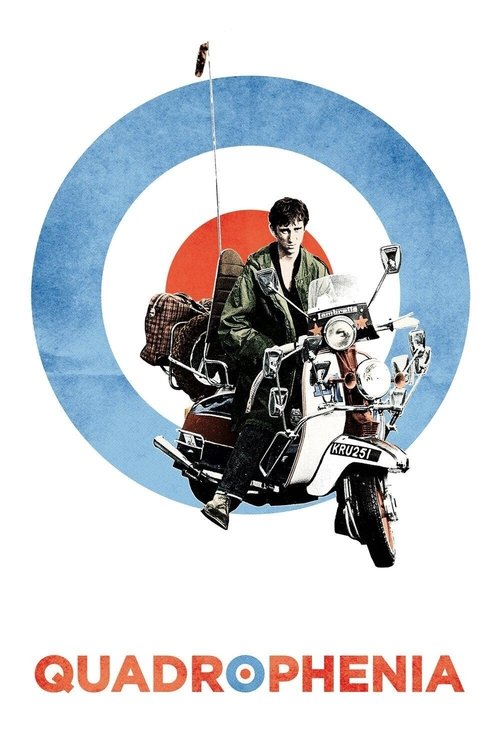
Quadrophenia
1979 · Franc Roddam
When you want to feel seventeen again — the anger, the clothes, the music, the desperate need to belong — or when you're in the mood for a coming-of-age story with no comforting lies in it. Best played loud.
What it's about
London, 1964. Jimmy is a teenage Mod: dead-end mail-room job by day, tailored suits, pills, and a chrome-mirrored scooter by night. His parents don't understand him, his job is beneath him, and the only thing that makes him feel real is the scene — which is about to converge on Brighton beach for a bank holiday showdown with the rival Rockers that promises to mean everything.
The experience
Raw, propulsive, and unsentimental — less a rock musical than a hard-edged slice of social realism with The Who thundering underneath. It captures the electric high of belonging to a tribe and the vertigo of watching that tribe fail you, and it builds to a finish that hits like a punch.
Performances
Phil Daniels is ferocious as Jimmy, all wired energy and wounded pride — one of the great screen teenagers. A young Sting has a striking early turn as Ace Face, the Mod the whole scene idolizes.
The craft
Roddam adapts The Who's 1973 rock opera by throwing away its operatic form and keeping its soul, reconstructing 1964 London and the Brighton seafront riots with documentary grit. The Who's music surges through the film as inner weather rather than performance numbers — this one genuinely rewards good speakers.
Why it matters
The definitive film about Mod culture and a cornerstone of British youth cinema, it sparked a real-world Mod revival on release and has been a rite of passage for generations of British teenagers since.
Snapshot
Quadrophenia is the rare rock-album adaptation that throws away the album's form. Pete Townshend's 1973 double LP was a quadraphonic concept record about a London Mod named Jimmy whose personality splits four ways, each facet mapped onto a member of The Who. Franc Roddam's film keeps the boy, the year, the parka and the scooter, and discards nearly everything else — the doubled selves, the sung interiority, the operatic scale. What remains is a hard, unsentimental social realist picture about a seventeen-year-old with a dead-end post-room job, a bedroom he has been thrown out of, a subculture that will not hold his weight, and a bank holiday in Brighton that promises to mean everything and means nothing.
Made in 1978 and released in 1979, it arrived at a strange double angle to its own moment: a period reconstruction of 1964 shot at the exact instant a Mod revival was surging through British youth culture, so that the film functioned simultaneously as history, as nostalgia, and as contemporary fashion plate. It is Roddam's first feature, Phil Daniels' defining performance, and — through its cinematographer, its writers, its cast and its template — one of the most consequential British films of its decade for what came after it.
Industry & production
The film was produced under the banner of The Who's own film operation, with the band's manager Bill Curbishley and Roy Baird producing and Townshend, Roger Daltrey and John Entwistle attached as executive producers. This matters because it explains both the film's existence and its independence. The Who had already been through the album-to-film pipeline once, with Ken Russell's Tommy (1975) — a maximalist, star-stuffed, deliriously vulgar spectacle. Quadrophenia is in almost every respect the corrective: no celebrity cameos in the leading roles, no fantasia, no singing protagonist, a cast of largely unknown young British actors, and a production that lived on London streets and the Brighton seafront rather than on sets.
Roddam was an unusual choice for a rock property, and a revealing one. He came out of British television documentary and docudrama: he worked on the BBC's fly-on-the-wall series The Family (1974), the landmark experiment in filming an ordinary Reading household as continuing series, and he directed Dummy (1977), a controversial television film about a deaf young woman drawn into prostitution. He was hired, in effect, for his vérité instincts rather than his flair. The band wanted the world of the record made literal and credible; Roddam wanted a youth picture that could stand next to the British New Wave.
Casting followed the same logic. Phil Daniels and Mark Wingett came out of the Anna Scher Theatre in Islington, the north London children's theater that produced a generation of working-class London screen actors; Philip Davis, Leslie Ash, Toyah Willcox, Ray Winstone, Trevor Laird, Gary Shail and a very young Timothy Spall fill out the ensemble. The single piece of stunt casting is Gordon Sumner — Sting, then fronting the not-yet-famous Police — as Ace Face, and it works precisely because he is used as an icon rather than an actor: a face, a posture, a silhouette in a long leather coat.
Shooting took place in autumn 1978, principally in Shepherd's Bush and around west London and on location in Brighton, with the climactic cliff sequence at Beachy Head. Keith Moon died in September 1978, immediately before production; the film that resulted is the last project mounted with the original Who nominally intact behind it.
Budget figures reported for the film vary and are not reliably documented; what is unambiguous is that it was made cheaply relative to its scale of crowd work, and that its financial life was long and unusual — a solid domestic performer that then became a perennial revival title, repeatedly reissued, restored and re-released on anniversaries.
Technology
The film sits at an interesting technical junction. Its source album was itself a technology artifact: quadrophenia is a pun welding quadraphonic — the four-channel surround format Townshend was chasing in 1973 — to schizophrenia. The record's four-way sound was meant to be its four-way psychology. The film cannot use that conceit at all. Quadraphonic domestic audio had collapsed commercially by the mid-1970s, and cinema in 1979 was in the middle of a different transition, the spread of Dolby Stereo optical release prints through first-run exhibition. So the album's organizing technical metaphor simply evaporates, and the film has to find its subject elsewhere — in behavior, faces and streets.
Photographically, Quadrophenia belongs to the late-1970s moment when fast color negative and lightweight 35mm camera bodies made it genuinely practical to shoot dense, low-light, handheld location work in color rather than retreating to the black-and-white documentary look of the previous generation. Interiors are dim, smoky and underlit by design; the Brighton night scenes and the pill-fuelled party sequence exploit stock latitude rather than fighting it. The film is framed for standard widescreen rather than anamorphic scope, which suits its preference for pressing bodies together inside cramped rooms and alleys.
The other technological substrate is the pop record itself. Quadrophenia uses the Who album's tracks — remixed and adapted for the film under John Entwistle's supervision — alongside a wide bed of period singles: Booker T. & the M.G.'s, The Kingsmen, James Brown, girl-group sides, and The Who's own pre-fame Mod incarnation as The High Numbers. The pre-existing catalog functions as score, source and period marker at once. This is now the default grammar of the youth film; in 1979 it was still being invented, and Quadrophenia is one of the places where it was worked out.
Technique
Cinematography
Brian Tufano's photography is the film's spine, and its influence runs further than the film itself. Tufano came from British television and brought a documentarian's willingness to shoot in whatever light exists. The camera is frequently handheld and inside the group, jostled by it — the Brighton riot is covered as though by someone caught in it rather than someone staging it. Compositions favour bodies packed into frame: the post room, the record-shop crowd, the dance floor, the police van.
Against this, Tufano reserves a small number of wide, still, distancing images — Jimmy alone on the seafront, the final cliff-edge landscape — so that isolation registers formally, not just dramatically. Color is muted, drab greens and browns and wet grays, with the Mods' clothes and scooter chrome as the only saturated things in the frame; the subculture is literally the only color in Jimmy's life. Tufano would carry this location-realist eye forward into Shallow Grave (1994), Trainspotting (1996), East Is East (1999) and Billy Elliot (2000), which makes him a direct technical conduit between British realism of the 1970s and the British youth cinema of the 1990s.
Editing
The cutting, credited to Sean Barton, does two distinct jobs. In the crowd sequences it is fast, fragmentary and deliberately disorienting — the Brighton clashes are assembled from shards, with no master geography and no clean sense of who is winning, which is both accurate to riot and useful for disguising a modest production's limits. In the domestic and workplace scenes it slows drastically, holding on Jimmy's face in silence.
The film's most important structural decision is a framing device: it opens with Jimmy walking away from a cliff at dusk, then flashes back. Everything that follows is retrospective, and the ending returns us to the cliff. That structure quietly changes the meaning of the final images — the scooter going over the edge is not necessarily Jimmy going over the edge, and the film has already shown us him walking away. The ambiguity is a formal effect, produced by editing rather than by dialogue.
Mise-en-scène / staging
The art direction is archaeological rather than decorative. Scooters, suits, hair, shopfronts and interiors are reconstructed with fetishistic care, because the subculture is the film's material — Mod was a movement organized around consumption, precision and surface, and the film respects that by treating clothes as plot. Jimmy's status rises and falls with what he is wearing and what he is riding.
Staging repeatedly contrasts two spatial registers: the collective and the solitary. Jimmy is nearly always in a mass — a crowd of parkas, a wall of scooters, a scrum — and the film's cruelty is in the moments where the mass dissolves and leaves him standing alone in the same frame that was crowded a minute earlier. The most famous instance is the reveal of Ace Face, the untouchable Mod god of Brighton, in a hotel bellboy's uniform, carrying luggage and being tipped. The staging is flat, unemphatic, almost banal; the deflation is total. It is the album's "Bell Boy" translated from song into blocking.
Sound
The mix layers three strata: the Who material, period singles, and a very present naturalistic track of traffic, sea, scooter engines and overlapping shouted dialogue. Accents are thick and unaccommodating; the film makes no concessions to comprehensibility, which was reportedly a point of friction for overseas distribution. Music is used diegetically far more often than as underscore — records on turntables, radios, dance halls — so that the songs belong to the characters' world rather than commenting on it from outside. When Who tracks do rise up non-diegetically, particularly at the cliff, the shift is felt as a rupture.
Performance
Phil Daniels gives one of the great British screen performances of the decade: wired, needy, funny, contemptuous, and increasingly unbearable to be around. Crucially, the film does not protect him. Jimmy is not a misunderstood sensitive; he is loud, cruel to his family, self-deceiving, and largely responsible for his own abandonment. The ensemble around him — Davis, Wingett, Shail, Winstone as the childhood friend who has gone Rocker, Michael Elphick and Kate Williams as the parents — plays in a loose, overlapping, improvisational register consistent with Roddam's documentary background. Sting, by contrast, barely acts at all, and is used as pure image, which is exactly right.
Narrative & dramatic mode
The mode is episodic realism organized around a single downward slope. There is no plot engine in the conventional sense — no heist, no quest, no antagonist. Instead the film accumulates: work, home, clothes, pills, a party, a dance, the trip to Brighton, the riot, the arrest, the return, and then a rapid sequence of subtractions in which Jimmy loses his job, his home, his friends, his girl, his scooter and finally his belief in the one figure he idolized.
This is the structure of the British social-problem film crossed with the rock-album narrative's episodic freedom. What replaces plot is a rhythm of highs and comedowns, which is both a formal choice and a thematic one: the film is about amphetamine time, in which everything is either ecstatic or empty and nothing is durable. The flashback frame supplies the only architecture, and the ending refuses catharsis: the climax is not death but disillusionment, and the film ends on an object rather than a person.
Genre & cycle
Quadrophenia belongs to at least three cycles at once. It is a youth-subculture film in the line running from The Wild One (1953) and Rebel Without a Cause (1955) through the British teenage pictures of the early 1960s. It is a rock-album adaptation, the second by The Who after Tommy, and a decisive argument for the realist rather than psychedelic version of that form. And it is a late instance of British social realism, arriving between the kitchen-sink cycle of 1959–63 and the Thatcher-era realism of the 1980s.
It also inaugurated something: the period-reconstructed British subculture film, in which a specific youth scene is recreated with documentary precision and used as a lens on class. That cycle runs forward through Absolute Beginners (1986, which attempts the same 1958–59 world in the opposite, musical-fantasia key), 24 Hour Party People (2002), This Is England (2006) and beyond.
Authorship & method
Roddam's authorship here is essentially methodological: cast unknowns from working-class theater backgrounds, rehearse loosely, shoot on real streets with available light, let dialogue overlap, refuse to editorialize. The film's point of view is close to Jimmy without endorsing him — a documentarian's discipline applied to fiction.
The screenplay is credited to Dave Humphries, Martin Stellman and Roddam, developed from Townshend's album. Stellman's subsequent work — notably Babylon (1980), on the London sound-system scene, and later politically charged British pictures — confirms that the writing sensibility here is sociological rather than mythic. Townshend's role is as source author and executive producer; the film's authorship is genuinely divided between the band's material and Roddam's method, and the tension between them is productive.
The two most important craft collaborators are Tufano, discussed above, and Entwistle, whose adaptation of the album's music for the screen quietly restructures the record into something that can serve narrative. Roddam himself went on to The Lords of Discipline (1983), The Bride (1985) and a segment of Aria (1987) — and, in a genuine curiosity of British cultural history, later created the television format MasterChef.
Movement / national cinema
The film is British social realism's inheritance claimed by a new generation. Its lineage runs from Free Cinema and the British New Wave — Saturday Night and Sunday Morning (1960), A Taste of Honey (1961), The Loneliness of the Long Distance Runner (1962) — through the youth pictures of the mid-sixties such as The Leather Boys (1964), and through the tougher, more marginal vérité of Bronco Bullfrog (1969). Its class politics are New Wave politics: work is degrading, home is a trap, escape is available only in leisure and consumption, and leisure is sold back to you.
Where it departs from the New Wave is in refusing the earlier films' occasional lyricism about landscape and their belief in individual escape. Jimmy has no talent, no exit, and no elsewhere. That refusal marks Quadrophenia as a film of 1979 rather than 1962.
Era / period
The film exists in two eras simultaneously and knows it. Its diegetic present is 1964 — the Whitsun bank holiday clashes between Mods and Rockers on the south coast, amplified into national moral panic by the press. Its production present is 1978–79: mass youth unemployment, the last months before a decisive political turn in Britain, punk exhausted, and a Mod revival in full swing through The Jam and the bands and scooter clubs around them.
That doubling is the film's peculiar power. It reconstructs a subculture as history while functioning as a style manual for a live one — an act of nostalgia and an act of fashion journalism in the same gesture. It is also, coolly, a film about how youth movements end, released to an audience in the middle of one.
Themes
Belonging and its price is the central theme: Jimmy joins a movement whose entire promise is that he will not be like everyone else, and the movement turns out to be a uniform. The film is unusually clear-eyed that Mod is a consumer identity, purchasable and therefore losable.
Beneath that sits class immobility. The post room, the advertising agency, the parents' flat and the police court are all machines for keeping Jimmy where he is; the scooter and the suit are the only forms of self-authorship available, and both can be taken away.
Third is the collapse of idols. Ace Face's revelation as a bellboy is the film's thesis in a single cut: the aristocracy of the scene is itself in service. The album's split-personality conceit survives only as residue — the four mirrors, the mirrored self-regard, the sense of a boy who has no continuous self at all — but the film substitutes something arguably sharper: not a psyche divided four ways, but a psyche with nothing in it that wasn't bought.
Finally, ambiguity about survival. The framing device makes the ending unresolvable by design, and the film's refusal to confirm Jimmy's death is a refusal of the martyrdom that the rock-tragedy form would otherwise supply.
Reception, canon & influence
Contemporary reception was mixed but substantially respectful, with critics noting the film's documentary conviction and the strength of Daniels' performance, and some resisting its bleakness and its density of regional and period slang. It performed well in Britain and had a narrower life abroad, where the accents and the specificity of the Mod/Rocker conflict were genuine barriers. Its critical standing has risen steadily and considerably since; it is now routinely placed among the significant British films of its decade, and has been restored and theatrically reissued for anniversary runs.
Backward, the film draws on the British New Wave's class realism, on Roddam's own documentary practice, on the 1960s youth-picture cycle, and — negatively but decisively — on Tommy, whose excesses it was built to refute. It also draws on the historical record of 1964 itself, filtered through Townshend's memory and through the press mythology of the seafront riots.
Forward, its influence is unusually traceable. It supplied the visual grammar of Mod to British pop culture for the next four decades — parka, scooter, target, Brighton — imagery that became foundational to the 1979 revival and then again to the Britpop iconography of the 1990s, a circuit closed almost literally when Phil Daniels turned up as the narrating voice on Blur's "Parklife." Its cast dispersed into the center of British screen acting: Winstone, Spall, Davis, Daniels, Ash, and Sting into a different kind of fame. Tufano carried its photographic method directly into Trainspotting, the film that most obviously inherits Quadrophenia's structure of subcultural euphoria followed by systematic subtraction. And its basic proposition — that a youth scene can be filmed as a class document, with period exactitude and a pop back-catalog as score — became a durable British form, visible in Babylon, This Is England, 24 Hour Party People and their descendants.
The film's final image endures for the same reason its structure does: it declines to tell you whether the boy died, and insists instead that the scooter did.
A Deleuzian reading
A man in a bellboy's uniform carries a stranger's suitcase up the steps of a Brighton hotel and takes the tip.
The full Deleuzian reading of Quadrophenia →
Reception
A modest hit in Britain in 1979 that landed square in the middle of the mod revival it helped ignite; decades on it's canonized as one of the great British youth films, a rite-of-passage watch passed down like the parka itself.
How Quadrophenia was received, from release to now →
How to watch Quadrophenia: what to notice on a first viewing
- Watch how packed the frame is whenever Jimmy is with the Mods. The post room, the record shop, the dance floor are all shot as bodies crammed edge to edge, Jimmy folded into a single moving crowd rather than photographed as an individual. The crowd reads as one creature on screen, not as a group of separate people.
- Watch for the only bright colors: parkas, suits, and scooter chrome. Everything around Jimmy runs to drab greens, browns, and wet gray, while the Mod uniform and the machines stay the only saturated things in frame. The subculture is shown as the one splash of color in an otherwise gray life.
- Watch what happens to the frame when the crowd walks off. More than once a shot that was crammed with parkas and scooters empties out, and Jimmy is left standing alone in the exact same space. The emptying frame does the emotional work no line of dialogue has to.
- Listen for the music always coming from a record or radio. Songs play from turntables, dance halls, and car radios throughout, tying the music to the characters' actual world rather than commenting on it from outside. You are hearing what Jimmy hears, not a soundtrack telling you how to feel.
- Watch how little Ace Face actually does or says. Sting barely acts at all, playing the Mod idol as a coat, a posture, a silhouette the crowd opens up for, rather than as a speaking character. The film treats him as an image to be worshipped, which tells you exactly how Jimmy sees him.
The whole guide to watching Quadrophenia, with the keys for a rewatch →
Influences: the films it descends from and the films it influenced
- Saturday Night and Sunday Morning (1960) — Establishes the structural engine Quadrophenia reuses wholesale — weekend euphoria financed by a deadening weekday job, shot on real streets in available light, with the hero's defiance systematically subtracted rather than punished by plot.
- The Loneliness of the Long Distance Runner (1962) — Supplies the flashback-frame architecture — a boy's present-tense crisis intercut with the compressed run-up that produced it — and the refusal-gesture ending that withholds narrative resolution in favour of a single legible act.
- A Hard Day's Night (1964) — Invents the grammar of filming a pop subculture as newsreel: handheld long lenses in crowds, hard cutting on rhythm rather than continuity, and songs that function as diegetic events instead of underscore.
- The Leather Boys (1964) — Films actual ton-up Rocker haunts (the Ace Café, the A-roads, the machines themselves) with semi-documentary attention, fixing the leather-and-motorbike iconography that Quadrophenia stages its parkas and scooters against.
- Bronco Bullfrog (1969) — The direct precedent for Roddam's casting method — untrained East End teenagers from a workshop theater, delivering overlapping unsubtitled local speech that the film pointedly declines to soften for outside audiences.
- Kes (1969) — Chris Menges' available-light location photography and Loach's loose-rehearsal, let-them-talk-over-each-other direction establish the documentarian's discipline applied to fiction that Roddam and Tufano adopt intact.
- Mean Streets (1973) — Models the pre-existing pop record as score with diegetic alibi — jukeboxes and bar speakers motivating the needle-drops — inside a handheld camera that stays inside a peer group rather than observing it.
- American Graffiti (1973) — Proves a back-catalog can replace composed score wall-to-wall, and pairs it with archaeological period reconstruction of a single youth night, down to the vehicles and the radio transmission itself.
- Tommy (1975) — The negative ancestor: same Townshend source, opposite method — Quadrophenia is built as a corrective to Russell's expressionist maximalism, replacing operatic performance-as-spectacle with Entwistle's narrative re-arrangement of the album for realist scenes.
- Dummy (1977) — Roddam's own drama-documentary rehearsal for the method — real locations, improvised overlapping dialogue, camera close to the subject without editorial comment — carried directly into fiction two years later.
- Brighton Rock (1948) — Re-enters Brighton as a screen site with the same geography of pier, seafront and cliff — the finale converting the film's vertiginous drop into the scooter going over the edge — and shoots the mob action with location-documentary crowd coverage rather than staged choreography.
- Babylon (1980) — Co-written by Martin Stellman with the identical sociological brief — a music subculture filmed as a class document, Chris Menges shooting available-light night streets, non-professionals speaking patois that the film never translates.
- The Firm (1989) — Inherits the reading of subcultural uniform as class text — the fetishized clothing, the badge, the tribal insignia cataloged with period exactitude — and the deflation of a charismatic 'face' whose status collapses on contact with ordinary life.
- Trainspotting (1996) — Brian Tufano transplants his Quadrophenia photographic method — handheld proximity, saturated subcultural color against a muted civic palette — onto the same shape of collective euphoria followed by systematic subtraction, scored by a curated pop catalog and spoken in accents left untamed.
- 24 Hour Party People (2002) — Adopts the British form Quadrophenia codified — a regional music scene reconstructed with archaeological period detail and scored entirely from its own back catalog — while restaging the crowd-versus-solitude staging of the gig and the club.
- This Is England (2006) — Reproduces the whole package: untrained young performers cast for region and rehearsed loosely, a subculture's uniform reconstructed to the stitch, a pre-existing catalog as score, and a closing gesture of discarded insignia that answers the scooter on the cliff.
- Sing Street (2016) — British youth-subculture rendered through costume-as-identity — the precise styling that lets a teenager reinvent himself — with pop allegiance as the engine of adolescent self-definition, echoed in Conor's shifting looks.
- Scum (1979) — Drawn from the same Anna Scher/working-class-theater casting pool (Winstone crossing between them) and committed to the same flat, unrhetorical framing of institutional violence with no music cueing the viewer how to feel.
- Rude Boy (1980) — Extends the fiction-inside-documentary contract further, cutting staged scenes of a drifting roadie against actual Clash gigs and actual street disorder so the crowd footage carries the same evidentiary weight as Quadrophenia's riot montage.
- Made in Britain (1982) — Takes the unaccommodating regional voice and the refusal to editorialize to their limit — a Steadicam that follows an unlikeable youth without judgment, letting the institutions rather than the script make the argument.
- Pink Floyd: The Wall (1982) — Contemporary British attempt to translate a Who concept album into narrative cinema, sharing the album-as-blueprint method and the same postwar-Britain generational-alienation material.
Similar films
- Trainspotting (1996) — influence & lineage
- 24 Hour Party People (2002) — influence & lineage
- Bohemian Rhapsody (2018) — shared sensibility
- Pink Floyd: The Wall (1982) — shared sensibility
- Performance (1970) — shared sensibility
- The Story of Lovers Rock (2011) — shared sensibility
- This Is England (2007) — shared sensibility
- Last Night in Soho (2021) — shared sensibility