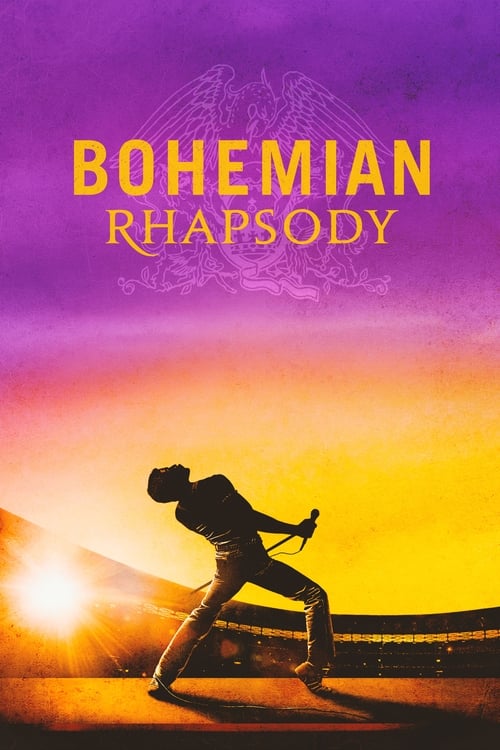
Bohemian Rhapsody
2018 · Bryan Singer
For a feel-good night when you want anthems, spectacle and a lump in your throat — ideal with friends or family who'll sing along. Pure comfort viewing, tears included.
What it's about
The story of Queen, from a London art student named Freddie Mercury joining a struggling band in 1970 to the group becoming one of the biggest acts on earth. It follows the making of their most audacious songs, the friction of four strong personalities, Mercury's search for love and identity as fame isolates him, and the road back to the stage for the 1985 Live Aid concert.
The experience
A big, warm, crowd-pleasing ride — funny in the studio scenes, bittersweet in the private ones, and flat-out euphoric whenever the music kicks in. By the finale you'll want to stand up and sing.
Performances
Rami Malek's Oscar-winning turn as Freddie Mercury is the whole show — he nails the strut, the wit and the loneliness behind them, and his recreation of the Live Aid set is electrifying.
The craft
The production design lovingly rebuilds the 1970s and 80s rock world, and the sound mix — built around Queen's actual recordings — is the reason to see it loud: the Live Aid recreation at Wembley is a genuine sensory event. Crank the speakers or don't bother.
Why it matters
One of the highest-grossing music biopics ever made, it sent Queen's catalog roaring back up the charts for a new generation and kicked off a fresh boom in rock-star biopics — while also stirring lasting debate about how much truth these films owe their subjects.
Snapshot
A large-scale rock biopic charting the rise and internal fractures of the British band Queen from their formation in the early 1970s through the triumphant Live Aid concert at Wembley Stadium in July 1985. Anchored by Rami Malek's Academy Award–winning portrayal of Freddie Mercury, the film is simultaneously an industrial phenomenon — one of the highest-grossing music biopics in cinema history — and a flashpoint for debates about the form's obligations to historical truth. Its troubled production, involving the mid-shoot dismissal of its credited director and the uncredited completion work of a replacement, complicates any straightforward auteurist reading. What survives is a crowd-pleasing, formally conservative entertainment that nonetheless achieved enormous cultural reach, reinvigorating Queen's catalog for a new generation while drawing sustained critical scrutiny for its selective and sometimes distorting relationship to the biographical record.
Industry & production
The project spent well over a decade in development. Queen's surviving members Brian May and Roger Taylor, along with longtime band manager Jim Beach, held tight creative control throughout, a constraint that shaped the film's eventual softening of certain biographical tensions. Sacha Baron Cohen was attached for a period in the early 2010s and has spoken publicly about his departure, attributing it in part to creative disagreements over how Mercury's death and personal life would be handled — though the specifics of those negotiations remain contested. By the time Rami Malek was cast and production began in earnest under Bryan Singer's direction, the project was a major studio venture for Twentieth Century Fox and New Regency Pictures, with producer Graham King shepherding the film.
Singer was dismissed from the production in December 2017, with reporting from the Hollywood Reporter and other outlets citing extended unauthorized absences from set and deteriorating relations with cast and crew — particularly with Malek. Dexter Fletcher was brought in to complete the remaining filming schedule, which included reshoots and finishing sequences. Under Directors Guild of America rules, Fletcher did not receive a directing credit; Singer retains the sole credit despite not having completed the film. This division of labor left visible seams in the finished work that critics noted, though attributing specific sequences definitively to one director or the other is not straightforwardly possible from the outside.
The film was released in October 2018 in the United Kingdom and November 2018 in the United States. Its commercial performance was extraordinary, ultimately accumulating well over $900 million in worldwide theatrical grosses — a figure that placed it at the top of the music biopic box-office hierarchy and surprised analysts who had expected a more modest run. The film benefited from an older audience demographic whose theatrical attendance habits had been in decline, demonstrating that the right property could still mobilize those viewers at scale.
Technology
The centerpiece technical achievement is the recreation of Queen's Live Aid performance, originally given at Wembley Stadium on 13 July 1985. The production team constructed a full-scale replica of the Wembley stage at a site in England — sources indicate this was carried out at an aerodrome location in the English countryside — and populated it with thousands of extras as well as visual effects augmentation to replicate the stadium's full capacity. Extensive archival research into photographs, broadcast footage, and contemporaneous documentation informed the staging choices, with the goal of near-exact spatial and costume fidelity to the original twenty-minute set.
Rami Malek's performance involved sophisticated vocal work. Mercury's original recordings were used throughout, but the production also employed Marc Martel, a Canadian singer known for his close resemblance to Mercury's voice, to contribute to the vocal blend. The exact compositional balance of Malek's own voice, Mercury's recordings, and Martel's contributions in different sequences has been described in interviews but not mapped with exhaustive precision by the production. Malek wore custom prosthetic teeth designed to replicate Mercury's prominent incisors — a feature Mercury famously chose not to correct because he believed it enhanced his vocal range.
Period recreation extended to analog studio environments. Sequences depicting the recording of "Bohemian Rhapsody" and other albums were built around production design research into Rockfield Studio and Sarm West Studios, where Queen recorded. The recreation of the multi-track layering process that characterizes Mercury's vocals on the song gave the film some of its most technically engaged passages.
Technique
Cinematography
Newton Thomas Sigel served as director of photography. The visual strategy is largely in service of legibility and the performance: medium and close framings dominate biographical conversation scenes, with Sigel deploying a warmer palette for period interiors and cooler, harder light for moments of estrangement or illness. Anamorphic lenses contribute to the concert sequences' widescreen grandeur, and the Live Aid recreation uses a deliberately documentary-inflected grammar — long focal lengths cutting between crowd reactions and band members — that nods to the grammar of concert films while remaining firmly within narrative feature conventions. The cinematography has not attracted significant independent scholarly or critical attention as a distinctive authorial contribution; it is competent and professional without advancing any particular visual argument.
Editing
John Ottman, who has collaborated with Singer repeatedly across his career, cut the film and won the Academy Award for Film Editing at the 91st Academy Awards — a result that was itself contested by commentators who found the editing sometimes erratic, citing unconventional cut rhythms in dialogue scenes and what several critics described as a disorienting use of close-up inserts. Whether these anomalies reflect Singer's original cut, Fletcher's contributions, post-production assembly decisions, or the pressure of the disrupted shoot is not publicly known. The editing controversy became a minor discourse of its own, with the Oscar win generating pushback from critics who felt other nominees had stronger claims. Ottman's work on the concert sequences, by contrast, was widely praised for its kinetic energy and fidelity to the music's structure.
Mise-en-scène / staging
The staging of band dynamics leans on established rock biopic grammar: rehearsal rooms as crucibles of tension, recording studios as sites of inspiration, and stage performances as catharsis or revelation. The film is most visually inventive in the studio sequences, where the spatial relationship between the band members communicates creative communion or its absence. The Live Aid sequence benefits from its scale — the sheer physical fact of the reconstructed Wembley creates an involuntary grandeur that the more intimate dramatic scenes do not quite match. May and Taylor's direct involvement in approving staging choices imparted an insider legitimacy to the band's performance aesthetics while also, critics argued, ensuring the film would not probe too uncomfortably at interpersonal faultlines.
Sound
The film won Academy Awards for both Best Sound Editing and Best Sound Mixing. The sound design operates primarily through the management of Queen's catalog: the songs must function simultaneously as diegetic performances, as biographical evidence, and as emotional triggers for audiences who know them. The Live Aid reproduction achieves this most fully — the mix uses the original broadcast recording's tonal quality at moments to invoke memory, shifting toward fuller contemporary production for emotional peaks. The acoustic recreation of the band's studio work attempts to balance period fidelity with contemporary listening expectations.
Performance
Malek's performance is the film's dominant fact. His work is founded on extraordinarily detailed physical study — Mercury's characteristic microphone handling, his fist-pump choreography, his manner of scanning an audience — combined with a sustained inward quality that attempts to locate Mercury's famous extroversion as a performance that conceals as much as it displays. The prosthetic teeth required Malek to recalibrate his relationship to his own mouth and jaw, a technical challenge he has discussed at length in promotional contexts. The Live Aid sequence, essentially a twenty-minute sustained impersonation in real time, is genuinely remarkable as a feat of physical acting. Whether the screenplay gives him the material to build a fully rounded interior life is a separate question on which critical opinion divided sharply. The supporting performances — Ben Hardy as Roger Taylor, Gwilym Lee as Brian May, Joe Mazzello as John Deacon — are competent character work in relatively constrained roles, the script consistently privileging Mercury's perspective. Lucy Boynton as Mary Austin provides the film's primary heterosexual emotional anchor.
Narrative & dramatic mode
The narrative follows an essentially teleological structure: the band's formation, the recording of "Bohemian Rhapsody," Mercury's growing divergence from the band's domestic stability, his HIV diagnosis, and the redemptive reunion at Live Aid. The film compresses and reorders the biographical record to service this arc. Most significantly and controversially, it depicts Mercury learning of his HIV-positive status before the Live Aid concert of 1985, when the biographical evidence strongly suggests he received this diagnosis later — by some accounts not until 1987. The reordering transforms Live Aid into a conscious valediction rather than a performance made in ignorance of what was coming, a dramaturgical decision that gives the finale greater tragic weight at the cost of factual accuracy.
The mode is classical three-act melodrama with a strong redemption structure. Mercury's solo career diversion is cast as a temptation narrative leading to productive isolation; the band's reunion rehearsal functions as a reconciliation scene; Live Aid closes the circle. The film declines to dwell on the final years of Mercury's illness or death, ending instead on the high of the concert — a decision that prioritizes uplift over biographical completeness.
Genre & cycle
Bohemian Rhapsody arrives at a moment when the prestige music biopic had re-established itself as a commercially reliable genre after a period of relative dormancy. Walk the Line (2005) and Ray (2004) had demonstrated earlier in the century that the form could attract major stars and awards attention, but the intervening years produced fewer standout examples. The film aligns itself with what might be called the "jukebox biopic" variant — one in which the primary text is the catalog of familiar songs, which carry most of the emotional labor, while the biographical narrative provides connective tissue and character motivation. This variant courts fans of the featured artist as a core audience and relies on the affective charge of recognition: hearing a known song placed at the moment of its narrative origin, or performed in a recreated concert, produces pleasures distinct from those of conventional dramatic storytelling.
The cycle it belongs to — and arguably accelerated — includes Rocketman (2019), which adapts Elton John's story with a more formally adventurous approach, and Elvis (2022), Baz Luhrmann's maximalist treatment of Presley. Both can be read partly in dialogue with Bohemian Rhapsody's commercial success; the genre remained active and commercially significant through the early 2020s. The gender and sexuality politics of the biopic form are foregrounded in all three films, with Bohemian Rhapsody facing the most criticism for its relative caution around Mercury's queerness relative to the freedoms it claimed.
Authorship & method
The credited director Bryan Singer had, by 2018, built a career defined by genre entertainments of considerable scale — the original X-Men films, The Usual Suspects, Superman Returns — and an intermittent commitment to outsider or marginalized male protagonists, a thread that would logically connect to Mercury. Whether any of this constitutes a coherent auteurist signature is complicated by the mid-production transition to Dexter Fletcher, whose own sensibility, shaped by his work as an actor and later director of Eddie the Eagle and then Rocketman, is markedly different — warmer, more fabulist, less interested in genre architecture.
Newton Thomas Sigel's long collaboration with Singer would ordinarily weight the cinematography toward the credited director's vision. Anthony McCarten, the screenwriter, had previously written The Theory of Everything (2014) and Darkest Hour (2017), establishing a recognizable practice of prestige biographical drama with a strong central performance as its pivot. His screenplay was criticized for its historical compressions but functioned effectively as a structure for Malek's performance. John Ottman's dual role as editor and composer is unusual even within Hollywood practice and has been a consistent feature of his work with Singer; his score draws heavily from Queen's existing recordings while providing underscore that supports the biographical narrative between musical sequences.
Movement / national cinema
The film is a British-set production with American financing and a mixed international cast. It participates in a long tradition of British rock mythology — the narrative of provincial or working-class energy transformed into global pop phenomenon — while its subject, Freddie Mercury (born Farrokh Bulsara in Zanzibar, raised partly in India, schooled in England), complicates straightforward national readings. The film touches on Mercury's Parsi background and immigrant experience but does not deeply explore how these shaped his artistry or his relationship to British identity; this reticence was noted critically as a missed dimension.
Era / period
The film's diegetic span runs from approximately 1970 to 1985, covering fifteen years of British rock history, shifting cultural attitudes toward sexuality, the AIDS crisis's emergence, and the music industry's transformation through the rise of stadium rock and global satellite broadcast. The era's costume and design are rendered with considerable production investment. The film's own moment of production — 2018 — was one of heightened public attention to gender and sexuality in entertainment, which shaped both its ambitions and the critical scrutiny of what it chose to include or omit about Mercury's life. The tensions around how explicitly and with what framing the film depicted Mercury's queerness and his relationships with men were central to reception discourse.
Themes
The film's primary thematic armature is belonging — Mercury's search for a family structure that can accommodate both his artistic ambition and his private self. The band is positioned as his authentic family; his solo career divergence becomes a form of self-exile; reconciliation with May, Taylor, and Deacon is the prerequisite for the final cathartic communion of Live Aid. Within this frame, the film raises questions about the performance of identity — Mercury's onstage persona as armor, release, and authentic expression simultaneously — without resolving them with particular complexity.
Authenticity and artifice run through the film as related themes, most directly in the extended sequence depicting the composition and recording of "Bohemian Rhapsody" itself: a song that deliberately defied commercial logic and genre convention becomes the emblem of the band's willingness to follow creative instinct over industry formula. The HIV diagnosis introduces mortality as a clarifying force. Isolation and community are repeatedly counterposed; Mercury's most destructive period is associated with a clique of sycophants, and his recovery with restored honesty.
Reception, canon & influence
Critical reception was sharply bifurcated. Malek's performance attracted near-universal praise and secured the Academy Award for Best Actor at the 91st ceremony, the film's other Oscars going to Editing, Sound Editing, and Sound Mixing, with a Golden Globe for Best Motion Picture — Drama preceding the Oscar season. Against this, reviewers at most major publications found the film formulaic, hagiographic, and historically dishonest. The HIV timeline manipulation was singled out as the most egregious distortion. A. O. Scott in the New York Times, among others, characterized the film as a missed opportunity to explore Mercury's complexity with the candor his life merited. The divergence between commercial success and critical reception was unusually wide even by biopic standards.
Influences on the film (backward): The genre lineage runs through Walk the Line, Ray, and La Bamba (1987) back to the prestige biographical musical of the classical Hollywood era. The formal convention of building to a climactic "real" performance — in this case, one that exists in historical footage and can be compared to the recreation — is a device the jukebox biopic form makes available in a way unavailable to non-musical biography. The involvement of surviving band members as producers places the film in a tradition of estate- or subject-approved biopics, with all the protective tendencies that implies.
Legacy and influence (forward): The film's commercial performance became a data point cited by studios and producers in greenlight decisions for subsequent music biopics through the early 2020s. Rocketman (2019), released only months later, was frequently positioned in relation to it — both as a corrective (more formally adventurous, more frank about its subject's sexuality) and as a direct commercial competitor. The discourse around Bohemian Rhapsody's selective treatment of Mercury's queerness contributed to an ongoing critical conversation about the obligations of LGBTQ biographical cinema, shaping how subsequent films in the cycle were discussed and evaluated. Whether it will retain lasting canonical status as a film, rather than as a commercial benchmark and Malek vehicle, is a question that remains open; as of this writing, its critical reputation has not materially recovered, while its audience reach continues to be cited as evidence that the music biopic remains capable of extraordinary popular mobilization.
A Deleuzian reading
Start with the teeth.
The full Deleuzian reading of Bohemian Rhapsody →
Reception
Critics shrugged, audiences turned it into a near-billion-dollar phenomenon, and it swept four Oscars — the most of any film that year. Since then the arc has run in reverse: it's now cinephile shorthand for the Oscars rewarding the crowd-pleaser over the craft, its Best Editing win in particular treated as a punchline.
How Bohemian Rhapsody was received, from release to now →
Influences: the films it descends from and the films it influenced
- Walk the Line (2005) — Established the modern jukebox-biopic grammar of broken chronology resolved by a single climactic live-concert vindication; Joaquin Phoenix performing Cash's catalog on screen created the actor-performs-the-catalog precedent that Malek's lip-sync mimicry inherits.
- Ray (2004) — Codified prosthetic-aided physical transformation as the primary instrument of a music biopic performance, with the performer's Best Actor Oscar as the structural goal-object; the 'childhood trauma explains the artist' compression formula runs directly into McCarten's screenplay.
- La Bamba (1987) — Established the jukebox-biopic architecture in which the artist's catalog functions as narrative chapter-markers and the film's emotional climax is a live-performance recreation — the precise device Bohemian Rhapsody scales up with the Live Aid sequence.
- Coal Miner's Daughter (1980) — Sissy Spacek performing Loretta Lynn's recordings live on screen is the foundational precedent for the actor-as-vocalist tradition; the physical aging-across-decades transformation and 'authentic roots vs. corrupting fame' arc both feed the genre Bohemian Rhapsody inhabits.
- What's Love Got to Do with It (1993) — Angela Bassett's physicalized transformation in an R&B biopic with a suppressed-sexuality subtext and survival-as-redemption arc is a direct template; the film's selective disclosure of the subject's private life prefigures Bohemian Rhapsody's deferred queerness.
- The Last Waltz (1978) — Scorsese's multi-camera documentary grammar for widescreen concert cinematography — direct-address performance, isolating close-ups cut against wide stage tableaux — is the formal ancestor of the biopic concert sequence that Bohemian Rhapsody's Live Aid recreation emulates.
- Amadeus (1984) — Full-scale period set replicas of historically documented performance spaces, used to stage recreations of events that exist in cultural memory; the prestige-biopic 'misunderstood genius vindicated posthumously' arc that Bohemian Rhapsody compresses into a living-subject format.
- The Doors (1991) — Kinetic concert editing — rapid intercutting between performance and crowd, handheld intrusion into staged spectacle — combined with anamorphic widescreen for rock-spectacle sequences; Stone's rock-star-as-doomed-outsider biographical arc is the template McCarten domesticates.
- The Theory of Everything (2014) — McCarten's screenplay establishes his prestige-biopic formula here: biographical compression around a single charismatic performance as structural pivot, with personal suffering as the lens through which public achievement is dramatized — the same architecture he applies to Mercury.
- Darkest Hour (2017) — McCarten's second biopic screenplay before Bohemian Rhapsody; prosthetic-aided physical impersonation of a historical figure (Oldman's Churchill makeup) plus the 'darkest hour before the triumphant public moment' narrative arc that the Live Aid climax directly replicates.
- Straight Outta Compton (2015) — Ensemble music biopic with period recording-studio recreation as a central set piece and diegetic catalog integration structuring the narrative — the band's internal fractures drive the plot in the same way Queen's dynamics nominally do, operating inside the same genre conventions.
- The Imitation Game (2014) — The film inherits The Imitation Game's three-strand temporal crosscutting applied to LGBTQ-historical drama, with a retrospective framing device anchoring the narrative that functions analogously to the interrogation frame, and a lead role structured entirely around a public/private concealment-identity paradox.
- Judy (2019) — Renée Zellweger's prosthetic-aided physical transformation wins Best Actress in a musical biopic structured around a climactic stage-performance recreation; Bohemian Rhapsody's Oscar success for Malek directly shaped the prestige calculus for which Judy was greenlit and marketed.
- Elvis (2022) — Extends Bohemian Rhapsody's kinetic concert-cutting into maximalist editing; deploys full-scale period venue replicas (Sun Studio, International Hotel) at comparable production scale; Austin Butler's physical impersonation in anamorphic widescreen concert sequences is the genre logic Bohemian Rhapsody made commercially viable again.
- Whitney Houston: I Wanna Dance with Somebody (2022) — Estate-approved jukebox biopic modeled directly on Bohemian Rhapsody's commercial template: diegetic catalog integration, Naomi Ackie's physical impersonation, and strategic deferral of the subject's queer relationship (Whitney-Robyn) — the same selective disclosure pattern, greenlit explicitly because Bohemian Rhapsody proved the audience existed.
- Michael (2026) — Shares producer Graham King and his template: an estate-sanctioned biopic engineered to climax on a note-perfect restaged live set while sanding the subject's transgressions out of the frame.
- Latin Blood – The Ballad of Ney Matogrosso (2025) — Anchors the named 'Bohemian Rhapsody cycle' by reconstructing concert-film set pieces with meticulous lip-sync fidelity and reframing the arena performance as emotional drama — the commercial template the film consciously joins.
- Rocketman (2019) — Fletcher, who completed Bohemian Rhapsody after Singer's removal, directed this near-simultaneous Elton John jukebox biopic using fantasy-production-number staging instead of literal recreation — a formal fork that became the critical measure of what Bohemian Rhapsody refused to attempt, including frank LGBTQ content.
- A Star Is Born (2018) — Part of the same 2018–19 music-film cycle, reconstructing a live set (Live Aid) through meticulous shot-for-shot staging of an audience-facing performance.
- Better Man (2024) — Contemporary jukebox music-biopic sibling built on the same commercial arc—hit-song montage, self-destruction, comeback-concert climax—that Better Man both uses and interrogates.
- Green Book (2018) — Same-season demonstration of the total-transformation performance built from prosthetics plus lip-and-hand sync to an archival master track, with the concert/recital sequence cut as the emotional climax that certifies the impersonation.
Similar films
- The Doors (1991) — influence & lineage · same viewing thread
- Elvis (2022) — influence & lineage · same viewing thread
- Rocketman (2019) — influence & lineage
- Walk the Line (2005) — influence & lineage · same viewing thread
- What's Love Got to Do with It (1993) — influence & lineage · same viewing thread
- Michael (2026) — same viewing thread
- Better Man (2024) — same viewing thread
- Latin Blood – The Ballad of Ney Matogrosso (2025) — same viewing thread
All the films related to Bohemian Rhapsody →
Watch it with: curated runs of related films
- The Making of a Legend — A run of biopics that watch private people get forged into public icons — the ambition, the pressure, and the loneliness of becoming somebody the world can't stop looking at.