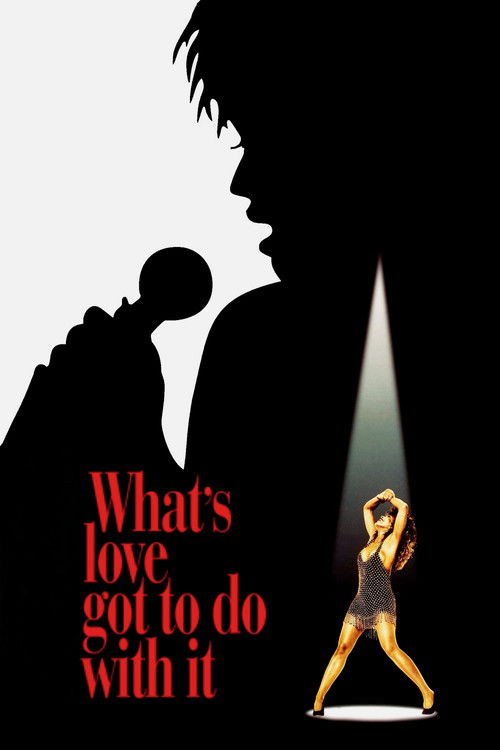
What's Love Got to Do with It
1993 · Brian Gibson
For when you want a true story of survival and triumph with great music — inspiring, but be ready for scenes of domestic violence that hit hard. Cathartic rather than cozy.
What it's about
The life of Tina Turner, from a Tennessee childhood through her rise with the Ike & Tina Turner Revue to the top of the charts — and the long, harrowing marriage to Ike Turner that shadowed it. Adapted from Turner's own autobiography, it follows her from discovery to stardom to the hard-won courage to walk away and rebuild.
The experience
Electric on stage and brutal off it — the musical numbers are joyous and full-throttle, which makes the domestic scenes land harder. It's a rousing survival story that doesn't flinch from the abuse at its center.
Performances
Angela Bassett is ferocious as Tina — she performs the stage numbers with startling physical conviction — and Laurence Fishburne makes Ike charming and terrifying in the same breath; both earned Academy Award nominations.
The craft
The film is built as a two-hander, and the staging of the Ike & Tina Revue numbers has real concert-film energy — the songs are recreated with full-body commitment rather than lip-synced gloss. It rewards good speakers.
Why it matters
It pushed the music biopic toward franker territory, treating domestic abuse as the story rather than a footnote, and made Bassett's performance a benchmark for the genre.
Snapshot
What's Love Got to Do with It is a Hollywood music biopic that dramatizes the life of Tina Turner from her Nutbush, Tennessee childhood through her rise with the Ike & Tina Turner Revue, the long ordeal of her marriage to Ike Turner, and her escape and reinvention as a solo star. Directed by the British filmmaker Brian Gibson and adapted from Turner's autobiography I, Tina (written with Rolling Stone editor Kurt Loder), the film is built as a two-hander: Angela Bassett's Tina and Laurence Fishburne's Ike, whose paired performances earned both actors Academy Award nominations and gave the picture its lasting reputation. Released through Disney's Touchstone Pictures label in 1993, it belongs to the tradition of the American star-singer biography while pushing that form toward a franker reckoning with domestic violence than the genre had typically allowed. Its cultural afterlife rests less on formal innovation than on two towering lead turns and on a template — talent, abuse, flight, triumph — that later music films would follow.
Industry & production
The film was produced and distributed by Touchstone Pictures, the Walt Disney Company's adult-oriented imprint, positioning a story of addiction and spousal abuse within a mainstream studio release rather than an independent or specialty context. The screenplay by Kate Lanier drew on I, Tina, the 1986 memoir Turner co-authored with Kurt Loder, which gave the production its authorized spine and much of its incident. Tina Turner's involvement was central to the project's viability: she cooperated with the adaptation and, crucially, re-recorded her vocals for the soundtrack, so that the film could present her music as performed rather than merely referenced. The precise deal terms and Turner's degree of creative control are documented mainly through press accounts and her own later statements; where those accounts diverge on detail, the safest claim is simply that the film was made with her authorization and participation.
Casting was the production's defining gamble. Angela Bassett, then known chiefly for supporting roles (including in Boyz n the Hood and Malcolm X), was cast in the lead and undertook an extensive physical-training regimen to approximate Turner's stage athleticism. Laurence Fishburne — billed here as Laurence rather than the earlier "Larry" — has recounted in interviews that he was reluctant to take the role of Ike Turner, wary of playing an abuser, and agreed only when the part was developed into a fuller, more dimensional character rather than a flat villain. Both leads worked without lip-sync doubling of the acting while performing to Turner's re-recorded tracks. Concert and revue sequences required period-accurate restaging of stage shows across roughly two decades of changing style, one of the production's larger logistical demands.
I cannot responsibly cite budget or box-office figures here from memory; the reliable public record is that the film was a mid-budget studio release that performed respectably and drew strong reviews, with its commercial and awards profile amplified by the soundtrack's success.
Technology
What's Love Got to Do with It was a conventionally produced 35mm studio film of its era, and it is not remembered for technological novelty. Its most consequential "technology" is musical rather than cinematic: the decision to have Tina Turner re-record her catalog so the film could deploy authentic, contemporary-quality vocals over Bassett's physical performance. This let the movie stage its numbers as full performances rather than archival pastiche, and it produced a commercially released soundtrack — including a newly written song, "I Don't Wanna Fight," which became a hit single for Turner. The synchronization of a lead actor's live-feeling stage performance to pre-recorded vocals is a standard biopic craft problem, and the film's handling of it is one of its genuine technical achievements, even if it involves no new tool or process.
Technique
Cinematography
The cinematography, by Jamie Anderson, serves the film's two registers: the intimate, often claustrophobic domestic scenes of the marriage, and the expansive, kinetic concert sequences. The performance footage aims to convey the heat and motion of a live revue, tracking Bassett's movement and cutting to a rhythm keyed to the music, while the home and hotel-room scenes tighten the frame around the couple. The film also carries the period-picture burden of evolving looks across the late 1950s through the 1980s, signaled through changing color, wardrobe, and staging rather than through overt stylistic rupture. Detailed technical accounts of specific lenses, lighting setups, or camera systems are not well documented in the general record, and I won't invent them; what can be said with confidence is that the visual strategy is subordinate to performance and period, not foregrounded as authorial style.
Editing
The editing (credited to Stuart Pappé) does the biopic's essential structural work: compressing decades into a coherent arc and modulating between musical set-pieces and dramatic scenes. The performance numbers are cut for momentum and to showcase Bassett's physicality, while the abuse and domestic sequences are paced to build dread and, at the climactic breaking point, release. As with the cinematography, granular editorial analysis of this film is thin in the scholarly record; the defensible general claim is that the cutting privileges emotional legibility and star performance over formal experiment.
Mise-en-scène / staging
Staging is where the film invests most visibly. The recreation of the Ike & Tina Turner Revue — costumes, choreography, band configurations, venues — anchors the film's authenticity and evolves across eras to mark the passage of time and the couple's changing fortunes. The domestic spaces are staged for entrapment: the home and, above all, the hotel room where Tina finally resists Ike become theaters of confinement. The film's most discussed staged sequence is that decisive confrontation and escape, blocked as a physical and moral turning point. Period detail in dress and décor carries much of the temporal storytelling.
Sound
Sound is arguably the film's signature dimension, given Tina Turner's re-recorded vocals and the prominence of the musical numbers. The soundtrack functions both diegetically (staged performances) and as emotional score, and the newly recorded material allowed the film to present Turner's voice at full contemporary strength. Stanley Clarke, the celebrated bassist and composer, contributed the score, integrating dramatic underscoring with the song-driven performance sequences. The mix must constantly negotiate between the roar of the concert stage and the intimacy of dialogue and domestic violence, and the film's dramatic power depends heavily on that tonal control.
Performance
Performance is the film's reason for being remembered. Angela Bassett's Tina is a feat of physical transformation and emotional endurance — she reproduces Turner's stage presence while carrying the interior arc from timid young singer to a woman who reclaims her life. Laurence Fishburne's Ike is a study in charisma curdling into control and cruelty, a performance calibrated to be neither excused nor cartoonish. The two performances are built to interlock, and their friction supplies the film's dramatic engine. Both were recognized with Academy Award nominations for the lead acting categories, and Bassett won the Golden Globe for Best Actress in a Motion Picture — Musical or Comedy; these remain the film's most concrete critical laurels.
Narrative & dramatic mode
The film uses the classic rise-fall-rise structure of the star biography, but it reweights the form so that the "fall" is not artistic or commercial decline but private, sustained abuse. The dramatic mode is realist melodrama: high emotion grounded in a factual life, organized around a clear moral trajectory toward liberation. It is a redemption-and-survival narrative rather than a tragedy — the arc bends toward escape and self-reclamation. The through-line is Tina's agency: the film consistently frames her as the subject of her own story rather than as an object of Ike's, and the escape sequence functions as the narrative's cathartic climax, with her later solo success serving as denouement and vindication.
Genre & cycle
What's Love Got to Do with It is a music biopic, part of the long Hollywood lineage of star-singer biographies — a tradition that includes The Buddy Holly Story (1978), Coal Miner's Daughter (1980), Sweet Dreams (1985), and La Bamba (1987). Within that cycle it is notable for foregrounding domestic violence as its central conflict, effectively hybridizing the musical biopic with the social-problem or domestic-abuse drama. It also arrives during the early-1990s surge of studio-backed films centered on African American lives and talent, though as an authorized star biography produced under a Disney label it sits somewhat apart from the more explicitly authored "New Black Cinema" of the same moment. Its particular contribution to the genre is demonstrating that a music biopic could be, at its core, a survival narrative.
Authorship & method
Brian Gibson brought to the film a background that mixed music-driven and biographical material — he had directed the music-scene drama Breaking Glass (1980) and the television film The Josephine Baker Story (1991), the latter directly relevant experience in dramatizing the life of a Black woman performer. Gibson's method here is that of the craftsman-director in service of a strong true story and two star performances rather than that of an overt stylist; the film's authorship is arguably distributed among its collaborators and its subject as much as concentrated in the director.
The key collaborators shape the film in specific ways. Screenwriter Kate Lanier, adapting I, Tina, gave the project its structure and its emphasis on Tina's agency, and the film became an early, defining credit in her career. Cinematographer Jamie Anderson managed the double demand of intimate drama and concert spectacle. Editor Stuart Pappé shaped the compression of a decades-long life and the rhythm of its musical numbers. Composer Stanley Clarke provided the dramatic score around Tina Turner's re-recorded songs. And Turner herself, through her memoir and her vocal recordings, is a form of co-author — the film's authenticity and much of its power derive from her direct participation.
Movement / national cinema
The film is a mainstream American studio production and does not belong to a formal film movement. It is best situated within Hollywood's biographical tradition and within the early-1990s expansion of studio storytelling about Black American lives, alongside the broader wave of African American filmmaking then reaching wide audiences. Its director's British origin adds a transatlantic dimension typical of Hollywood's international hiring practices, but the film itself is thoroughly American in subject, setting, and idiom.
Era / period
Produced and released in 1993, the film reflects a period in which Hollywood was increasingly willing to greenlight Black-centered stories with awards ambitions, and in which public conversation about domestic violence was becoming more open. The film's own diegetic period spans roughly the late 1950s through the 1980s, tracing changes in American popular music — from R&B and rock-and-roll revue culture through to the arena-scale pop of Turner's solo comeback. Its treatment of abuse landed in a cultural moment shortly before domestic violence became an even more prominent national topic, and the film is sometimes read retrospectively as part of that widening awareness.
Themes
The film's central theme is survival and self-reclamation: a woman recovering her name, her voice, and her autonomy from a controlling and violent partner. Adjacent to this run themes of artistic identity versus ownership — Ike's control extends to Tina's stage persona and career, so that her professional liberation and her personal escape are inseparable. Turner's turn to Buddhist practice in the film frames spiritual resource and inner resolve as instruments of survival. The picture also engages fame's double edge, the gendered power dynamics of the music industry, and the making of a public self ("Tina Turner" as a persona partly imposed and later repossessed). Underlying all of it is the theme of naming and self-definition — who gets to decide who a woman is.
Reception, canon & influence
Critically, the film was received above all as a showcase for its two leads, and that reception was ratified by major awards recognition: Academy Award nominations for both Angela Bassett and Laurence Fishburne in the lead categories, and a Golden Globe win for Bassett. Bassett's performance in particular entered the canon of celebrated screen transformations and became a career-defining role. The soundtrack, driven by Tina Turner's re-recordings and the hit "I Don't Wanna Fight," extended the film's cultural reach beyond cinemas.
The influences on the film (backward) are twofold: the documentary source of Turner's own life as set down in I, Tina, and the established grammar of the Hollywood music biopic, from Coal Miner's Daughter to La Bamba, whose rise-and-struggle structure the film inherits and adapts. Its influence forward lies in helping to normalize a franker, more psychologically serious music biopic — one in which private abuse, not just artistic struggle, could be the dramatic core — a mode later visible in films such as Ray (2004) and Walk the Line (2005) and in subsequent musician biographies. Just as significantly, the film's success (and the later frustration many expressed at Bassett's not winning the Oscar) became part of a longer conversation about the recognition of Black performers in Hollywood. Tina Turner's story would return to the screen in other forms in later years — including a stage musical and documentary treatments — but the 1993 film remains the definitive dramatic account, remembered primarily for two performances that outgrew the genre that framed them.
Reception
A hit in '93 with Oscar nods for both leads, it's since become Exhibit A in the Great Oscar Snub discourse — Angela Bassett losing Best Actress that year reads even more egregious now that the performance is treated as an all-timer.
How What's Love Got to Do with It was received, from release to now →
How to watch What's Love Got to Do with It: what to notice on a first viewing
- Notice how tight and closed-in the home scenes feel. Gibson frames the marriage's private spaces, homes, hotel rooms, tighter and more confined than the wide, kinetic concert sequences that surround them. The film shows you which rooms are dangerous just by how much space it gives you in them.
- Watch the camera move with Bassett during a performance number. Jamie Anderson tracks her body through the choreography and Pappe cuts to the beat of the music, so the concert scenes move at a completely different speed than the domestic ones. Onstage she gets to move freely through the frame in a way the rest of the film never allows her.
- Listen for how the film swings between roar and quiet. The soundtrack moves from the full volume of a live revue straight into close, quiet domestic dialogue, the mix constantly resetting the scale of what you are hearing. The silence after a show ends is where the film actually wants your attention.
- Notice the costumes and hairstyles changing across the decades. Wardrobe, choreography, and venue design evolve era by era, so you can place a scene in time by its clothes before any date is given. The costume department is doing the work of a calendar throughout this entire film.
- Watch how charming Ike is in his very first scenes. Fishburne plays the early Ike with real magnetism, letting the control and cruelty surface gradually rather than announcing themselves from his first entrance. You can see exactly why she fell for him before you see what that costs her.
The whole guide to watching What's Love Got to Do with It, with the keys for a rewatch →
Influences: the films it descends from and the films it influenced
- Lady Sings the Blues (1972) — Established the template of the Black-woman-performer biopic as a two-hander in which the abusive/controlling romantic partner (Billy Dee Williams) is the second lead, and drug/domestic torment—not just artistic struggle—drives the drama Bassett/Fishburne inherit.
- Coal Miner's Daughter (1980) — Supplied the rise-and-struggle grammar of the female music biopic built on a working-class woman's marriage-versus-career conflict and decade-spanning compression that Kate Lanier's script adapts.
- La Bamba (1987) — Precedent for the re-recorded-vocals technique—a contemporary act cutting new masters of the subject's catalog while the actor performs to playback—exactly the method by which Tina Turner re-recorded her songs for Bassett to embody.
- The Rose (1979) — Model for the handheld, sweat-and-spotlight concert kineticism and the rise-to-collapse arc of a female rock singer shot as immersive live spectacle rather than staged mime.
- Raging Bull (1980) — Fused an actor's total physical transformation with a domestic-abuse two-hander staged in claustrophobic entrapment interiors, the performance-and-brutality template the Ike/Tina scenes visibly draw on.
- Bird (1988) — Pushed the music biopic toward psychological seriousness and private self-destruction as legitimate dramatic core, licensing the franker register the film brings to abuse.
- The Color Purple (1985) — Precedent for the Black woman's survival-of-abuse-into-self-reclamation arc, with entrapment domestic spaces and eventual escape as the narrative's redemptive engine.
- The Josephine Baker Story (1991) — Gibson's own immediately prior dramatization of a Black woman performer's life gave him the craftsman-director method—period recreation plus star-showcase performance—carried directly into this film.
- Ray (2004) — Extends the frank music biopic in which private addiction and personal damage share equal weight with the catalog, built around a lead's immersive physical/vocal embodiment performed to reworked master recordings.
- Walk the Line (2005) — Recasts the genre as a redemptive romantic two-hander with abuse and addiction at its center, its dual lead-performance showcase and awards profile the direct heir to the Bassett/Fishburne model.
- Cadillac Records (2008) — Carries forward the Black-music-biopic mode with re-recorded vocals and a period-recreated R&B milieu, foregrounding a woman singer's (Etta James) struggle inside an exploitative professional-romantic bind.
- The United States vs. Billie Holiday (2021) — Descends directly from the Black-woman-singer-and-abuser two-hander, staging a controlling partner and addiction in intimate interiors while a singer-actor delivers re-performed standards.
- Respect (2021) — The closest structural heir—Aretha Franklin's rise threaded through a controlling, abusive husband-manager, decade compression, and a star vocal transformation—reprising this film's abuse-as-dramatic-core template almost beat for beat.
- Bohemian Rhapsody (2018) — Inherits the concert-kineticism-plus-decade-compression formula, recreating iconic live performances as climactic set pieces built over re-recorded/remixed masters lip-synced by the lead.
- Judy (2019) — Continues the performer-biopic-as-transformation-showcase, where a single Oscar-courting lead physically and vocally inhabits an abused, exploited woman singer in claustrophobic backstage entrapment spaces.
- Malcolm X (1992) — Contemporary early-1990s Black-cinema adaptation of a first-person memoir that compresses a decades-long life and makes renaming (self-chosen identity) the spine of self-reclamation, paralleling Anna Mae becoming Tina.
- Sleeping with the Enemy (1991) — Contemporary domestic-abuse drama built on the same architecture of entrapment interiors, escalating terror, and escape through a reinvented identity that structures Tina's flight from Ike.
- Once Were Warriors (1994) — Independently arrives at the abusive-marriage two-hander staged in confined domestic space, where the wife's exit is framed as reclamation of self rather than melodramatic rescue.
- Michael (2026) — Built on meticulous restaging of a Black artist's stage act (Bassett to Turner masters) powered by an abusive-family engine — the same performance-plus-domestic-trauma machine.
Similar films
- The Color Purple (1985) — influence & lineage
- Walk the Line (2005) — influence & lineage · same viewing thread
- Bohemian Rhapsody (2018) — influence & lineage · same viewing thread
- Michael (2026) — same viewing thread
- Elvis (2022) — same viewing thread
- She's Gotta Have It (1986) — shared sensibility
- Basic Instinct (1992) — shared sensibility
- The Story of Lovers Rock (2011) — shared sensibility
All the films related to What's Love Got to Do with It →
Watch it with: curated runs of related films
- The Making of a Legend — A run of biopics that watch private people get forged into public icons — the ambition, the pressure, and the loneliness of becoming somebody the world can't stop looking at.