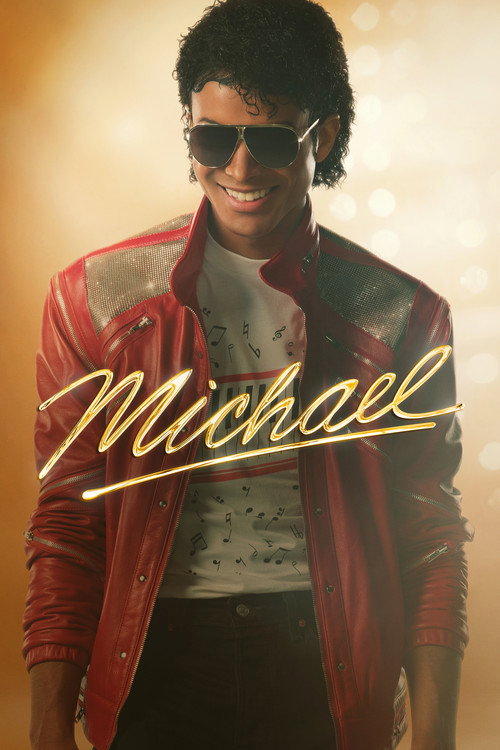
Michael
2026 · Antoine Fuqua
For when you want a big musical biopic night — the songs, the spectacle, the rise — while being ready for the darker chapters about abuse and the price of ambition. Crowd-pleasing surface, heavy undertow.
What it's about
The life of Michael Jackson, from a gifted child fronting the Jackson Five under a father's brutal discipline to the self-made spectacle who set out to become the biggest entertainer on earth. It moves through the 1970s rise and beyond, tracking the family pressures, the ambition, and the cost of a childhood spent on stage. As much a story about the machinery of fame as about the music that made it run.
The experience
A sweeping, music-drenched ride with a bruise underneath — euphoric when the performances ignite, sobering when the film returns to what fame was doing to the person inside them. It's built to move you in both directions.
The craft
Antoine Fuqua brings muscular, kinetic direction to the concert and studio sequences, recreating some of the most famous stagecraft in pop history with a big-budget polish. The draw is audiovisual: era-jumping production design and wall-to-wall music that beg for good speakers.
Why it matters
One of the most anticipated and most debated music biopics of its era — a studio-scale attempt to tell the story of pop's most influential and most contested icon.
Snapshot
Michael is a large-scale studio biopic of Michael Jackson, made under the supervision of the Jackson estate. Its central casting decision is also its biggest gamble: Jaafar Jackson, Michael's nephew, plays the title role. Juliano Valdi plays Michael as a child. The film runs from the Jackson 5 in the 1960s to the Bad World Tour of the late 1980s and stops before the 1993 allegations. Over 127 minutes it moves through the Gary childhood, the Motown machine and the turn from group act to solo superstar, with the recreation of famous performances at its center. Directed by Antoine Fuqua from a screenplay by John Logan, it premiered in Berlin on April 10, 2026, opened in the UK on April 22 and in the US on April 24, and played in IMAX. Commercially it became the largest film of the post-Bohemian Rhapsody music-biopic cycle, with a reported worldwide gross above $1 billion. Critics were mixed. Most praised Jaafar Jackson's restrained performance and the scale of the musical set pieces. Most also judged the film a safe, conventional rise-to-stardom story that leaves out the darker parts of Jackson's life.
Industry & production
Michael follows the model of the estate-authorized prestige biopic, the template that made Bohemian Rhapsody a global hit. The estate's involvement shaped both what the film could show and how critics read it. Access to Jackson's catalog, his family home and his story came with oversight, and critics consistently called the result estate-supervised.
The production was large and long. The reported budget falls somewhere between $155 million and $200 million. Principal photography ran from January to May 2024 in the Santa Barbara area, with work in Los Angeles. Fuqua has said he shot at real locations wherever possible, including Hayvenhurst, the Jackson family home, and original Los Angeles recording studios. Reshoots followed in June 2025. The final film's timeline closes before the 1993 allegations, which leaves the most contested part of Jackson's life outside the story altogether. The size of the release, and the reported plans for a sequel, suggest the closing date was chosen to set up a second installment as well as to stay clear of difficult material.
Casting a family member as Michael was the other key industrial choice. It settled questions of likeness and authenticity at once and gave the marketing a ready-made discovery-of-a-new-star story. The film's commercial results suggest the bet paid off at the box office, whatever critics made of it.
Technology
Michael was shot mainly on digital. The principal camera was the Sony VENICE 2, paired with an Angénieux Optimo Ultra 12:1 zoom (36–435 mm), in a multi-camera setup that leaned toward handheld work. A Canon Scoopic 16, a 16mm film camera, served as a second format, adding period texture against the clean digital image. Fuqua has described choosing formats to suit the different eras the film covers. The film was also released in IMAX.
The real technical challenge is recreating period performance: two decades of American pop culture, from Motown-era television to stadium tours. The production met it mostly through physical recreation rather than effects-driven spectacle. Performances were restaged at original or matching locations with large crowds of extras and filmed with several cameras at once, so the camera could follow the action live instead of building it shot by shot.
Technique
Cinematography
Dion Beebe shot the film. His approach, as the camera package shows, is reactive: long zooms on several handheld bodies let the operators find the performance as it happens, reframing and pushing in without breaking the take. Grainy 16mm sits alongside the polished VENICE 2 image, so different textures distinguish the eras and different kinds of memory. Some reviewers praised how the photography captured the colors of the 1960s and 1970s.
Others were less impressed. One Substack critic found the photography bland and the lighting flat. Harris Dang of Impulse Gamer thought the concert scenes felt oddly confined despite their scale, which suggests the reactive, close-in coverage sometimes works against the sense of a stadium event. The tension is built into this kind of biopic. Jackson's art depended on the whole body moving in space, and a camera tuned for intimacy and immediacy will not always give the dancing the full-figure view it needs.
Editing
Four editors share the credit: John Ottman, Harry Yoon, Conrad Buff IV and Tom Cross. Ottman's presence links the film directly to Bohemian Rhapsody, which he cut, and the team's pedigree drew comment from critics. The verdicts were muted, though. One reviewer called the cutting merely functional, and the critic who found the concert scenes cramped pointed out that a team of this caliber had not opened them up. The underlying problem is the familiar one of the career biopic: compressing more than twenty years into a little over two hours. Michael handles it by jumping from milestone to milestone, which explains the RogerEbert.com review's complaint that it plays like a sequence of songs in search of a story.
Mise-en-scène / staging
Staging is where Michael invests most heavily, and where its makers put their own emphasis. Fuqua has called authenticity the film's foundation. Barbara Ling's production design and the shoot itself favored real places: Hayvenhurst, the original Los Angeles studios, and for "Thriller" the original location, filmed, Fuqua has said, under a full moon. The "Beat It" sequence was recreated with members of the local community, a method Fuqua compared to his work on Training Day, where real neighborhoods and real residents gave the drama its texture. The Bad tour material was shot on the first day of production in front of several hundred extras.
The audience's detailed memory of Jackson sets the bar for this kind of staging. The frame has to call up the familiar image without turning into a waxwork, and Looper's Dominic Griffin judged that Fuqua's recreations of iconic moments clear it. Dramatic scenes get less attention than the performance pieces, which is consistent with the general verdict that the film is strongest when it is staging Jackson's history and weakest when it is interpreting it.
Sound
The music is mostly Jackson's own catalog, and that defines the film's sound. Lior Rosner wrote the underscore, so the original score's job is mainly to link the songs and support the dramatic scenes, not to develop competing themes. The technical work lies in placing the recordings convincingly inside physically restaged performances, so that a concert number reads as an event in a particular room or stadium in front of a particular crowd rather than as a song laid over the picture. The live crowds of extras Fuqua used for the big set pieces were part of that effort.
Performance
The film rests on one central performance, and Jaafar Jackson's work was the most consistently praised thing in it. He spent more than a year studying his uncle's mannerisms and started with an acting coach. Reviewers credited him with capturing the physicality and gestures precisely. Griffin admired the restraint of the performance. Even Dang, who disliked the film overall, found Jackson decent and singled out quiet moments in which his eyes convey the weight of his father's pressure. Because the resemblance is partly inherited, the usual biopic question of impersonation shifts. The interest lies in the stillness between the impressions, where critics found the performance's inner life.
Colman Domingo plays Joseph Jackson, the disciplinarian father, and the role gives the film its most reliable source of friction. Dang thought Domingo created a palpable sense of menace. A Substack critic thought the film drew Joe as a flatly villainous tyrant, a sign that the screenplay's moral bookkeeping is simpler than the performance. Nia Long plays Katherine Jackson, and Miles Teller plays John Branca, the attorney who later became a co-executor of Jackson's estate, which gives his presence in an estate-supervised film an added edge. Laura Harrier, Jessica Sula, Mike Myers and KeiLyn Durrel Jones complete the ensemble. Experienced supporting players surround a newcomer in the lead, so Jackson rarely carries a scene alone.
Narrative & dramatic mode
Michael works in the classic rise-of-the-artist mode: a prodigious child, a demanding father, the Motown factory, and the break from group act to solo star. Critics broadly agreed it is a conventional musical biopic of a rise to fame. Its structure moves through landmark performances, the recreations it does best, and links them with family drama and career milestones. Ending before the 1993 allegations makes the story essentially one of triumph. Ambition and creation carry the arc, and the later controversies stay off screen.
That choice drives most of the criticism. Griffin judged the film safe and reductive, and the RogerEbert.com review found more playlist than story. The father-son conflict with Joe Jackson remains the film's real dramatic engine. It supplies the pressure that turns the early chapters into drama rather than a résumé.
Genre & cycle
The film belongs to the 2020s music-biopic revival, the commercially proven, estate-friendly template of Bohemian Rhapsody (2018) and Rocketman (2019), carried on through Elvis (2022) and the recent Bob Dylan and Bruce Springsteen films. Its links to Bohemian Rhapsody include an editor in common, and with a reported gross above $1 billion Michael is now the cycle's commercial peak. It is the cycle's maximal case: arguably the most recognized pop performer of the twentieth century, deep estate involvement, and a reportedly planned continuation that would turn the single-film biopic into a franchise.
It also sharpens the cycle's basic tension between celebration and reckoning. Critics have long questioned how candid estate-backed biopics can be, but here the gap between the story told and the story left out is unusually large, and reviewers made it the main point of argument.
Authorship & method
Antoine Fuqua was an unexpected but coherent choice. His usual register, in Training Day (2001), the Equalizer films and Southpaw (2015), is physical, tactile genre filmmaking built around charismatic men under pressure. Southpaw in particular showed a director drawn to bodies pushed to their limits and to struggles with father figures. Michael channels those interests into the punishing discipline of performance and the Joe–Michael relationship. Fuqua's comments on method confirm the continuity. He compared the community-cast "Beat It" recreation to Training Day, and his emphasis on real locations, real crowds and physical recreation comes from the same street-level realism.
John Logan wrote the screenplay. He is a dramatist of real standing (Gladiator, The Aviator, Hugo, Skyfall) with a long interest in driven, self-mythologizing artists and public figures. Critics' complaints about the script's conventionality suggest the authorized framework limited what that interest could do with this subject.
Below the line, Dion Beebe's reactive multi-camera photography, Barbara Ling's location-based design and an editing team of high pedigree point to a production built for scale and fidelity. Lior Rosner's underscore works around a soundtrack its subject already wrote.
Movement / national cinema
Michael is mainstream American studio filmmaking: a Hollywood, English-language, globally distributed release whose tradition is commercial U.S. biography. It belongs to a distinctly American mythmaking line, the show-business rise story, with the Motown-to-superstardom arc as a chapter of national pop history. The film takes part in the entertainment industry's ongoing canonization of its own icons. Its insistence on Los Angeles studios, the family home in Encino and original performance sites makes it a film about American places as well as an American star.
Era / period
The film is a product of the mid-2020s biopic economy, in which legacy music catalogs and estate-controlled likenesses have become dependable theatrical draws in a cautious studio landscape. Its billion-dollar run confirms that economy at its height. Its long path to release, with filming in 2024, reshoots in 2025 and a 2026 opening, reflects the period's friction between the commercial pull of a beloved figure and the reputational risks of dramatizing a contested life. Michael looks back at the 1960s through the 1980s from a present acutely aware of how that era's stars are now licensed, litigated and resold. Its chosen endpoint is itself a statement about what such a film can afford to show.
Themes
The foregrounded themes are ambition and the cost of genius: a gifted child's transformation into the biggest entertainer in the world, and the toll that pursuit takes. Closely tied to them is the family theme. The Jacksons appear as both incubator and pressure cooker, with Joe Jackson's discipline as the crucible, and critics identified father-son pressure as the film's emotional core. A quieter theme is the gap between public spectacle and private life, which Jaafar Jackson's performance carries in its silent moments more than the script articulates it.
The critical consensus treats the film's handling of its subject as a theme in its own right. Looper, Impulse Gamer and a Substack critic all read Michael as sanitized, estate-supervised hagiography that puts creation and family in the foreground and leaves the later controversies out entirely.
Reception, canon & influence
Reception split sharply between commerce and criticism. With a reported worldwide gross above $1 billion, Michael became a major global hit and the top earner of the modern music-biopic cycle. Reviews were mixed to negative. Griffin at Looper gave it 6.5/10, praising Jaafar Jackson's measured performance and Fuqua's handling of the musical set pieces while calling the film safe and reductive. Dang at Impulse Gamer gave it 2/10, granting the lead's decency and Domingo's menace but finding the concert scenes cramped despite the craft talent involved. The RogerEbert.com review found a playlist in search of a story. A Substack critic found the cinematography bland, the editing functional and Joe Jackson reduced to a tyrant, though another review admired the period color. The fault line ran exactly along the authenticity-versus-hagiography axis that defines the estate-biopic cycle. Critics praised the fidelity of the performance and the recreations and doubted whether an estate-supervised account could be honest about its subject.
Influences on the film (backward): Michael descends most directly from Bohemian Rhapsody, sharing its template and an editor in John Ottman. It also draws on the broader line of Ray (2004), Walk the Line (2005), Elvis (2022) and the recent Dylan and Springsteen films, the modern grammar of the star-catalog biopic. Its authorial sources are Fuqua's own filmography, especially the physical, father-haunted Southpaw and the community-rooted realism he links to Training Day, and John Logan's portraits of driven artists.
Legacy (forward): The film's commercial scale already makes it a reference point in two ways. First, it validates the family-member-as-lead strategy at the box office. Jaafar Jackson's widely praised performance gives future estates a precedent for casting their icons from within. Second, it marks a landmark in the negotiation between estates and filmmakers over how much of a contested life a licensed biopic may tell. By ending before the 1993 allegations and reportedly planning a sequel, Michael turns that question into a franchise-structure problem: what a second installment chooses to depict, or avoid, will determine how the project as a whole is judged.
A Deleuzian reading
On the first day of shooting, before any of the family story was on film, Antoine Fuqua staged the Bad tour.
The full Deleuzian reading of Michael →
Reception
Written off during years of delays, reshoot drama, and estate lawyering, it opened in April 2026 to the biggest biopic debut ever ($97M domestic) and crossed $1 billion worldwide — the first billion-dollar biopic — while critics shredded it at 38% on Rotten Tomatoes.
How Michael was received, from release to now →
How to watch Michael: what to notice on a first viewing
- Watch Jaafar Jackson's eyes when Domingo's Joe is in the room. Jaafar Jackson plays his own uncle, and the dances are impressions you can check against memory. In the quiet scenes with his father he goes still, and the pressure shows in his eyes rather than his body. The stillness between the impressions is where the performance has an inner life of its own.
- Notice when the image turns grainy, like old 16mm film. Beebe cuts grainy 16mm alongside a polished digital image. The rough texture belongs to the Gary years and the home-movie past. The clean surface belongs to the stage and the studio. The texture tells you which kind of past you are in: the one a family remembers or the one the public watched.
- Watch how the handheld camera pushes in during performances. Several handheld cameras with long zooms follow the numbers as they happen. They reframe and close in without cutting, so the concerts feel near and immediate more often than wide. Jackson's art used his whole body in space. Notice when the closeness gives you his face and when it costs you his feet.
- Look at the crowds in the big numbers. They are real people. Fuqua staged the performances with crowds of extras and shot the "Beat It" sequence with members of the local community, the way he used real neighborhoods in Training Day. The songs land as events in a room in front of people, not as records played over pictures.
- Notice which shots you already know from music videos. The film rebuilds famous images at real locations, including the original "Thriller" site. You recognize them before the scene has done anything, and the film counts on that. Half of each recreated image is on screen and half is in your memory.
The whole guide to watching Michael, with the keys for a rewatch →
Influences: the films it descends from and the films it influenced
- Bohemian Rhapsody (2018) — Shares producer Graham King and his template: an estate-sanctioned biopic engineered to climax on a note-perfect restaged live set while sanding the subject's transgressions out of the frame.
- Ray (2004) — Codified the modern catalog-biopic grammar of a lead lip-syncing to the artist's own master recordings while reproducing his physical tics, letting the archival tracks function as the score.
- Walk the Line (2005) — Set the addiction-and-redemption structure hung on performance beats, with the lead trained to deliver the numbers rather than mime to a double.
- Elvis (2022) — Model for kinetic, montage-driven concert spectacle that treats the icon's onstage body as pure cinematic event — plus the controlling-manager dynamic that maps directly onto Joe Jackson.
- Southpaw (2015) — Fuqua's own template of a male body driven to punishing physical extremity under a fraught father-mentor, here rerouted into the disciplined labor of rehearsal and choreography.
- The Aviator (2004) — John Logan's screenwriting method for the driven, self-mythologizing genius whose public grandeur curdles into private compulsion — his authorial through-line into Michael.
- Lady Sings the Blues (1972) — The original Motown/label-produced star biopic — the founding template of a music company shaping its own icon's screen story, the lineage the Jackson estate now inherits.
- Moonwalker (1988) — Jackson's own catalog-driven performance filmmaking, the self-authored screen mythology and choreographic iconography that the new film must faithfully re-stage.
- Get On Up (2014) — Performer-first recreation of James Brown's footwork and stagecraft — the very showmanship Jackson studied — demanding an actor who can physically reproduce the act rather than suggest it.
- What's Love Got to Do with It (1993) — Built on meticulous restaging of a Black artist's stage act (Bassett to Turner masters) powered by an abusive-family engine — the same performance-plus-domestic-trauma machine.
- Straight Outta Compton (2015) — The authorized, principals-as-producers narrative that openly negotiates which allegations survive the final cut — the same conflict-of-interest architecture as estate-controlled Michael.
- Rocketman (2019) — Extends the catalog biopic by staging songs as diegetic fantasy production numbers rather than straight concert recreations, pushing the form toward musical.
- Bob Marley: One Love (2024) — The family-produced icon biopic (the Marley children as producers) that foregrounds the same conflict-of-interest question of relatives controlling a contested legacy's screen version.
- A Complete Unknown (2024) — The current wave's insistence on the lead performing the catalog live on camera, the same authenticity bet Michael places on Jaafar Jackson's vocal and dance recreations.
- Selena (1997) — The family-approved biopic dependent on a casting near-double and on negotiated access, the precedent for the proximity-casting strategy Michael runs with a real Jackson relative.
Similar films
- Elvis (2022) — influence & lineage · same viewing thread
- Bohemian Rhapsody (2018) — influence & lineage · same viewing thread
- What's Love Got to Do with It (1993) — influence & lineage · same viewing thread
- Walk the Line (2005) — influence & lineage · same viewing thread
- Rocketman (2019) — influence & lineage
- Straight Outta Compton (2015) — influence & lineage
- Southpaw (2015) — influence & lineage
- A Complete Unknown (2024) — influence & lineage · same viewing thread
All the films related to Michael →
Watch it with: curated runs of related films
- The Making of a Legend — A run of biopics that watch private people get forged into public icons — the ambition, the pressure, and the loneliness of becoming somebody the world can't stop looking at.