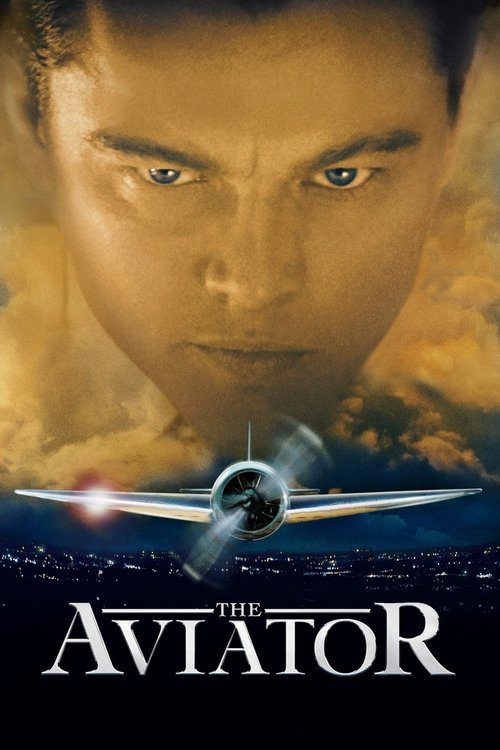
The Aviator
2004 · Martin Scorsese
For when you want a sweeping true-story epic — a long, lush evening of ambition, glamour, and crack-up. Comfort food in scale, with a genuinely uneasy center.
What it's about
Howard Hughes — movie producer, record-setting pilot, aviation tycoon — burns through two decades of American ambition, from bankrolling the most expensive film of its era in the late 1920s to facing down a Senate hearing in 1947. As his empire grows, so does the obsessive-compulsive disorder pulling him apart from the inside. It's the story of a man who could master machines and spectacle but not his own mind.
The experience
Big, glamorous, and propulsive — old-Hollywood dazzle, romances, and white-knuckle flight sequences — that gradually tightens into something claustrophobic and sad as Hughes's compulsions close in. You get the sweep of an epic and the discomfort of a character study in one sitting.
Performances
Leonardo DiCaprio carries the film, equally convincing as the swaggering young mogul and the man unraveling behind locked doors, and Cate Blanchett's Katharine Hepburn is a marvel — an impersonation that becomes a full person.
The craft
Scorsese's boldest move is chromatic: the film's palette imitates the early color film processes of each era it depicts, so the image itself ages alongside Hughes. The flight sequences and period recreations are lavish, and it's built for a big screen and loud speakers.
Why it matters
A high point of the Scorsese–DiCaprio partnership and a major awards-season success, it set a template for the modern prestige biopic that treats its subject's psychology as seriously as his achievements.
Snapshot
The Aviator is Martin Scorsese's lavish, two-decade-spanning biographical portrait of Howard Hughes, tracing the aviator-industrialist-filmmaker from the runaway production of his aviation epic Hell's Angels in the late 1920s through his triumphant flight of the H-4 Hercules ("Spruce Goose") and the 1947 Senate war-profiteering hearings. Working from a screenplay by John Logan and built around Leonardo DiCaprio's central performance, the film fuses the prestige Hollywood biopic with Scorsese's lifelong obsessions: the seductions and corrosions of American ambition, the cinema as a machine for spectacle, and the solitary man undone from within. Its most distinctive gambit is formal: the film restages the look of early color processes, so that its palette ages alongside the period it depicts. Released at the height of the early-2000s prestige-picture economy, it earned eleven Academy Award nominations and won five, and it consolidated the Scorsese–DiCaprio partnership that would define the director's later career. It remains a study of obsession told by a filmmaker temperamentally fluent in obsession.
Industry & production
The Aviator emerged from a tangle of ambitions and rights. Several filmmakers had circled a Hughes project for years; Michael Mann developed this version and ultimately took a producing role, handing the director's chair to Scorsese while DiCaprio — who had championed the material — anchored it as star and producer. The financing structure was characteristic of the era's prestige cinema: Warner Bros. and Miramax distributed, with Initial Entertainment Group's Graham King among the principal financiers, an arrangement that spread the risk on a costly period film. The reported budget of roughly $110 million made it one of Scorsese's most expensive productions to that point, continuing the scale he had embraced on Gangs of New York (2002), his first film with DiCaprio.
Production drew on a deep bench of longtime Scorsese collaborators alongside specialists in period craft. Shooting took place largely in and around Montreal and Los Angeles, with extensive use of soundstages and visual effects to recreate vanished aviation milestones — the test flights, the catastrophic 1946 XF-11 crash into Beverly Hills, and the lumbering ascent of the Hercules over Long Beach harbor. The film's commercial performance was solid for an adult-oriented prestige release, and its awards campaign — a Miramax specialty — positioned it as a frontrunner through the 2004–05 season, though it ultimately lost the Best Picture Oscar to Million Dollar Baby. Its industrial significance is partly historical irony: a film about a mogul who bankrupted himself chasing perfection, produced within a high-stakes prestige economy that rewarded exactly that kind of grand swing.
Technology
The production's signature technological choice was its color. Scorsese and cinematographer Robert Richardson set out to make the film's palette evolve in step with the film stocks of Hughes's lifetime. The earliest sequences are graded to evoke two-strip (two-color) Technicolor, which registered the world in reds and cyan-greens but could not render true blue — so skies and fabrics tilt toward teal and, most famously, peas on a dinner plate read as blue-green. As the chronology advances past the mid-1930s, the imagery shifts to approximate the richer, fuller three-strip Technicolor of Hollywood's classical heyday. This was achieved not through period cameras but through a digital intermediate — the then-emerging practice of scanning film to a digital master for color manipulation before printing back to film. The Aviator was among the higher-profile demonstrations of the DI as an expressive tool rather than a corrective one, using it to make color a narrative clock.
Beyond color, the film leaned on early-2000s computer-generated imagery to resurrect aircraft and disasters that could not be staged practically. The flying sequences, the test-flight crashes, and the Hercules flight blend miniatures, full-scale set pieces, and CGI. The technology is in service of verisimilitude rather than display: the aim is to place the viewer inside Hughes's relationship to his machines.
Technique
Cinematography
Richardson's photography — which won the Academy Award — is the film's most celebrated technical achievement, and not only for its period color logic. His signature top-light, a hard overhead source that blows out highlights and halos his subjects, recurs throughout, lending the imagery a heightened, almost hallucinatory polish suited to a film about a man who confuses control with perfection. The camera is restless in the Scorsese idiom — gliding crane moves through the Cocoanut Grove, sweeping coverage of film sets and hangars — but it also tightens claustrophobically as Hughes's illness narrows his world, trapping him in mirrored bathrooms and the screening-room bunker where he eventually seals himself away. The aerial material is shot for kinetic immersion, putting the lens in the cockpit and the slipstream.
Editing
Thelma Schoonmaker, Scorsese's editor since Raging Bull and his most essential collaborator, won her Oscar here for cutting a film of considerable structural difficulty: a two-decade biography that must move briskly across business, romance, aviation, and psychological deterioration without losing momentum or coherence. Her solution is rhythmic contrast — propulsive, montage-driven passages for Hughes's productive mania (the editing of Hell's Angels, the breaking of speed records) set against held, airless takes for his compulsive episodes, where the cut itself seems to stick. The 1946 crash sequence is a showcase of her control of tempo, escalating to violence and then dropping into stunned stillness.
Mise-en-scène / staging
Dante Ferretti's production design and Sandy Powell's costumes — both Oscar-winning — make the film a sustained act of period reconstruction, from the art-deco glamour of 1930s nightclubs to the institutional spaces of postwar Washington. Scorsese stages Hughes's world as a series of stages: film sets, restaurants, hearing rooms, all arenas of performance. The recurring motif of doors, thresholds, and enclosures externalizes the protagonist's drift from expansive showman to barricaded recluse. The Senate hearing is blocked as theater, Hughes turning a tribunal into a counter-spectacle.
Sound
The sound design foregrounds the roar and whine of aero-engines as both thrill and threat, and it renders Hughes's auditory world subjectively — the muffling, the looping of phrases, the way his compulsions colonize the soundtrack. His verbal repetitions ("show me all the blueprints," "the way of the future") function as sonic symptoms, words that snag and replay. The aural environment of crowds and flashbulbs becomes, in his decline, a source of dread.
Performance
DiCaprio's Hughes is the film's engine: a portrait of charisma and command progressively invaded by terror. He calibrates the obsessive-compulsive disorder not as tic-collection but as a man fighting a losing war against his own mind in public, which gives the late screening-room sequences their pathos. Cate Blanchett's Katharine Hepburn — which won the Best Supporting Actress Oscar — is a bravura act of interpretation rather than imitation, capturing Hepburn's clipped patrician cadence and athletic self-possession while finding the warmth beneath the mannerism. The supporting ensemble is deep: Kate Beckinsale as Ava Gardner, Alec Baldwin as Pan Am's Juan Trippe, Alan Alda as the antagonistic Senator Ralph Owen Brewster, John C. Reilly as Hughes's beleaguered money man Noah Dietrich, and Ian Holm, Jude Law (as Errol Flynn), and others in sharp cameos.
Narrative & dramatic mode
John Logan's screenplay adopts the classical Hollywood biopic's selective architecture — choosing a defined span (roughly 1927 to 1947) rather than the cradle-to-grave sweep — and organizes it around the dramatic engine of a great man's rise shadowed by inward collapse. The mode is fundamentally tragic: Hughes's gifts and his disorder spring from the same compulsive root, so that triumph and breakdown are not opposed but entwined. The film frames its action with a childhood prologue — Hughes's mother bathing him and intoning a warning about disease ("quarantine") — that plants the etiological seed for his germ phobia, a slightly schematic device but an effective one. The Senate hearing supplies a conventional courtroom-style climax in which the hero, at his lowest, rallies to vindicate himself publicly, while the final image — Hughes trapped in compulsive repetition before a mirror — withholds easy uplift, insisting the victory is provisional and the illness permanent.
Genre & cycle
The film sits squarely in the prestige biographical drama, a perennial Oscar-season genre, but it is inflected by Scorsese's recurring concerns and by the aviation-spectacle and Hollywood-history subgenres. It belongs to a lineage of films about American moguls and self-made men consumed by their own appetites — Citizen Kane is the inescapable reference point, and The Aviator knowingly courts the comparison, both films chronicling a fabulously wealthy visionary's retreat into isolation. Within Scorsese's own filmography it extends his cycle of obsessive, self-destructive protagonists. As a film about filmmaking — Hughes the producer of Hell's Angels and The Outlaw — it also functions as Scorsese's love letter to early Hollywood, a register he returns to across his career as critic, preservationist, and historian.
Authorship & method
The Aviator is unmistakably a Scorsese film even as it operates in a more classical, less overtly autobiographical register than his New York pictures. His authorial signatures are present: the propulsive camera, the immersion in a milieu rendered with documentary specificity, the protagonist whose ambition and pathology are inseparable, and the cinephile's reverence for the medium's history. But the film is equally a triumph of collaboration. Richardson's expressionist lighting and period-color conceit, Schoonmaker's architecture of rhythm, Ferretti's and Powell's reconstruction of an era, and Howard Shore's score — which marries period source music with a brooding, motif-driven orchestral underscore that tracks Hughes's interior weather — together constitute the film's authorship as much as the director's hand. Logan's screenplay supplies the dramatic skeleton, and DiCaprio's stardom and producorial investment shaped the project from its origins. This was the second of an ongoing Scorsese–DiCaprio collaboration that would continue across The Departed, Shutter Island, The Wolf of Wall Street, and beyond, repositioning DiCaprio as the director's central screen surrogate in the way Robert De Niro had been in earlier decades.
Movement / national cinema
The film belongs to no movement in the avant-garde sense; it is mainstream American studio cinema operating at its most resourced and ambitious. It is best understood within the tradition of the post-classical Hollywood auteur — the generation of "New Hollywood" directors who absorbed both the studio craft and the European art cinema of the 1960s and who, by the 2000s, were elder statesmen working at large scale within the studio system. The Aviator is also an act of cinematic historiography about American national cinema itself, dramatizing the Hollywood of the 1930s and the rise of the aviation industry as twin engines of a specifically American mythology of self-invention.
Era / period
Produced in 2004, the film is a period piece reconstructing the 1927–1947 span, and it is doubly historical: a 2000s artifact looking back at the 1930s and 40s, and consciously so, through its evolving color palette. The early-2000s context matters. It arrived in a prestige-cinema economy still organized around the specialty divisions of major studios and the awards-season machinery perfected by Miramax, and it exploited a transitional moment in production technology — the digital intermediate's arrival — to do something that would not have been possible a decade earlier. The film thus straddles two eras of filmmaking technology, using the new to resurrect the old.
Themes
The film's governing theme is the inseparability of genius and pathology: the same obsessive drive that lets Hughes break aviation records and stage cinematic spectacle also drives his disintegration, so that there is no version of his greatness without his illness. Around this core cluster several others — the American myth of the limitless individual and its private costs; control as both mastery and madness (Hughes's mania for blueprints, measurements, and germ-free environments); the lure of spectacle and image, with cinema and aviation presented as parallel machines for transcending earthbound limits; and contamination and purity, the germ phobia operating as both literal symptom and metaphor for a man who cannot bear the messiness of the world or himself. The recurring phrase "the way of the future" reads as both Hughes's visionary confidence and the prison of a mind locked in compulsive repetition.
Reception, canon & influence
Critically, The Aviator was warmly received as a return to grand-scale form for Scorsese, with particular praise for DiCaprio's and Blanchett's performances and for the film's craft achievements. Its eleven Oscar nominations — including Best Picture, Best Director, and Best Actor — and five wins (Supporting Actress, Cinematography, Editing, Art Direction, Costume Design) marked it as one of the most decorated films of its year, even as it lost the top prize. Some critics found the biopic structure conventional or the running time taxing, and a recurring critical observation was the film's debt to Citizen Kane — both an homage and a measure against which it was found, by some, to fall short.
Its influences run backward to the mogul-tragedy tradition of Kane, to the classical Hollywood biopic, and to Scorsese's own catalog of obsessive American strivers; the film also draws on the historical record of Hughes's life, including published biographies, while compressing and dramatizing for narrative effect. Forward, its most consequential legacy is twofold. Industrially and aesthetically, it helped legitimize the digital intermediate as a tool for expressive, period-evocative color design, influencing how subsequent period films thought about palette. And within Scorsese's career it cemented the DiCaprio partnership and contributed to the late-career momentum that delivered the director his long-denied Best Director and Best Picture Oscars for The Departed two years later. As a portrait of obsession by a filmmaker who understands it from the inside, The Aviator endures as one of the major American biographical films of its decade.
A Deleuzian reading
The peas arrive blue.
The full Deleuzian reading of The Aviator →
Reception
A prestige hit in 2004 — 11 Oscar nominations, five wins — but its Best Picture loss to Million Dollar Baby folded it into the 'Scorsese is overdue' narrative that only resolved with The Departed. Now it sits in the odd 'mid-tier Scorsese' zone: a film that would be a career peak for almost anyone else, routinely rediscovered and called underrated.
How The Aviator was received, from release to now →
Influences: the films it descends from and the films it influenced
- Citizen Kane (1941) — Supplies the mogul-tragedy template Scorsese consciously cites — the deep-focus newsreel-and-banquet construction of an empire-builder studied through the wreckage of his obsession, including the selective-span biographical scaffold.
- Raging Bull (1980) — Scorsese's own prior portrait of a self-destructing American striver, establishing the Schoonmaker rhythmic-contrast editing and subjective-sound immersion in a protagonist whose pathology is staged as physical sensation.
- The Red Shoes (1948) — The Technicolor saturation and expressive period-color conceit Scorsese (a Powell devotee, married to Schoonmaker, Powell's widow) emulates via digital intermediate to recreate two-strip/three-strip palettes as emotional weather.
- Lawrence of Arabia (1962) — The grand-scale prestige biopic built on selective-span structure, crane and wide-vista staging, and a divided genius whose ambition is rendered as landscape — the scale Scorsese reaches for in the aviation sequences.
- Hell's Angels (1930) — Hughes's own aerial-combat spectacle is restaged as diegesis — Scorsese reconstructs its multi-camera dogfight cinematography and the obsessive production process as the film's central set-piece.
- The Magnificent Ambersons (1942) — Welles's enclosed-interiors-and-thresholds staging of decline, with deep-focus rooms framing a family's contamination, feeding the film's staging/thresholds-enclosures motif of Hughes's retreat into sealed spaces.
- Jean-Luc Godard's color sense via Contempt (1963) — Bold primary-color blocking as psychological signposting, a Richardson-Scorsese touchstone for the deliberately artificial period palettes designed in the digital intermediate.
- A Beautiful Mind (2001) — Extends the genius biopic by dramatizing mental illness as escalating embodied subjective episodes (Hughes's OCD compulsions) rather than describing it clinically.
- Bugsy (1991) — The charismatic-narcissist self-mythologizing-dreamer biopic with period-Hollywood glamour and a dual arc of grand vision and personal self-destruction — Bugsy's character architecture writ large.
- The Departed (2006) — The next Scorsese–DiCaprio film, cementing DiCaprio as the director's De Niro-style screen surrogate and extending the propulsive Schoonmaker cutting that The Aviator re-honed.
- Shutter Island (2010) — Pushes The Aviator's subjective-sound and unstable-interior staging into full psychological subjectivity, with DiCaprio again playing a man whose perception cannot be trusted.
- The Wolf of Wall Street (2013) — Extends the Scorsese–DiCaprio study of American appetite and pathology, reusing the immersive-milieu documentary specificity and the genius-and-excess arc tracked across a selective span.
- There Will Be Blood (2007) — Robert Elswit's deep-period palette and the lone-American-tycoon-consumed-by-obsession portrait extend the prestige-biopic-of-pathology mode The Aviator revived for the 2000s.
- The Social Network (2010) — The contemporary genius-and-pathology biopic of a contamination-averse, control-obsessed mogul, built on the selective-span dramatization and color-graded period reconstruction The Aviator legitimized via DI.
- Blanchett-as-Hepburn / classical star impersonation via My Week with Marilyn (2011) — Extends the performance device Blanchett pioneered here — playing a documented Golden-Age star as interpretive impersonation rather than mimicry, foregrounding the actor-playing-an-actor seam.
- J. Edgar (2011) — DiCaprio developed his performance grammar for Hoover — obsessive control masking fragility, physicalized through compulsive ritual and period-correct comportment — in direct dialogue with his Howard Hughes, including the amber-desaturated mid-century cinematography.
- Michael (2026) — John Logan's screenwriting method for the driven, self-mythologizing genius whose public grandeur curdles into private compulsion — his authorial through-line into Michael.
- Soorarai Pottru (2020) — The obsessive aviation-founder biopic: period airline recreation and a protagonist whose fixation collides head-on with an entrenched industry cartel.
- JFK (1991) — Robert Richardson's signature top-light (hot overhead key isolating faces in pooled brightness) developed here is carried directly into The Aviator's expressionist lighting grammar.
- Bringing Out the Dead (1999) — The immediately prior Scorsese–Richardson collaboration where subjective-sound and hallucinatory light first fuse a protagonist's deteriorating mind to the image, the method The Aviator inherits.
- Pearl Harbor (2001) — A near-contemporary attempt at digitally-augmented aviation spectacle and period reconstruction, against which The Aviator's restrained, motif-driven flight sequences define the more authored approach.
- Ed Wood (1994) — A fellow obsessive-Hollywood-outsider biopic using expressive monochrome/period stylization rather than naturalism, sharing the strategy of letting visual texture embody the subject's era and mania.
- The Hudsucker Proxy (1994) — Period-corporate American mythos rendered through stylized large-scale design and the rise-and-fall trajectory of an industrialist visionary, sharing Hudsucker's Deco-era spectacle and tycoon-fable architecture.
Similar films
- The Wolf of Wall Street (2013) — influence & lineage
- The Departed (2006) — influence & lineage
- Shutter Island (2010) — influence & lineage
- Raging Bull (1980) — influence & lineage
- Lawrence of Arabia (1962) — influence & lineage · often watched together
- Casino (1995) — often watched together
- The Godfather (1972) — often watched together
- Heat (1995) — often watched together
All the films related to The Aviator →