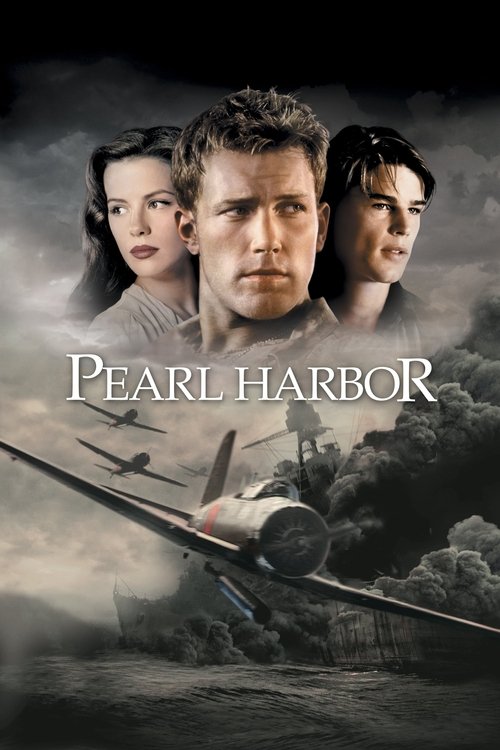
Pearl Harbor
2001 · Michael Bay
For when you want a big, unapologetically corny Hollywood epic — a long Sunday-afternoon watch where you surrender to sweeping romance and enormous explosions. Comfort food at blockbuster scale.
What it's about
Rafe and Danny, childhood best friends turned ace fighter pilots, both fall for Evelyn, a Navy nurse, as America drifts toward World War II. Their love triangle collides with history on December 7, 1941, when the Japanese attack on Pearl Harbor engulfs everyone they know — and the film follows them from the wreckage into the war's first counterstrike.
The experience
Old-fashioned melodrama at maximum volume for a full three hours, built around a forty-minute centerpiece attack sequence of staggering scale. The romance is syrupy and the dialogue creaks, but when the bombs fall the spectacle is genuinely overwhelming.
The craft
Michael Bay's attack sequence remains a benchmark of practical-scale action filmmaking — real ships, real planes, massed stunt work and pyrotechnics blended with then-cutting-edge effects, all cut at his signature velocity. Hans Zimmer's swelling score and the golden-hour cinematography push everything toward myth; it demands the biggest screen and loudest speakers you have.
Why it matters
A famous case study in event-movie ambition: critically savaged for its melodrama and historical liberties, yet a solid global earner whose centerpiece sequence is still cited as a high-water mark of pre-digital-era destruction spectacle.
Snapshot
Pearl Harbor is a big-budget wartime romance released by Touchstone Pictures/Walt Disney Pictures in May 2001, produced by Jerry Bruckheimer and directed by Michael Bay from a screenplay by Randall Wallace. Conceived as a prestige event picture that would fuse the sweep of a David Lean epic with the disaster-spectacle machinery of the Bruckheimer–Bay partnership (fresh off The Rock and Armageddon), it wraps a love triangle between two Army Air Corps pilots and a Navy nurse around the December 7, 1941 Japanese attack on the U.S. Pacific Fleet. The film is remembered less as an artistic success than as a cultural event and a case study: an enormously expensive, technically ambitious spectacle that drew heavy critical derision for its melodrama and historical liberties while performing solidly at the global box office. It arrived four months before the September 11 attacks, a coincidence that would color its afterlife. In Sightlines terms, it sits at a busy crossroads — downstream of Titanic, Tora! Tora! Tora!, and From Here to Eternity; upstream of a wave of skepticism about the CGI-driven historical blockbuster.
Industry & production
The picture is a defining artifact of the turn-of-the-millennium tentpole model. It was developed at Disney with Bruckheimer as producer, and its budget — widely reported in the general vicinity of $140 million — made it one of the most expensive films of its moment; I won't assign a precise figure, as the trade reporting varied. A well-documented production anecdote is the studio's push to secure a PG-13 rating for maximum audience reach, which shaped how the attack's violence was rendered — intense but not graphically bloody — a commercial constraint that materially affected the film's depiction of mass death.
Production leaned heavily on cooperation with the U.S. military. The Department of Defense and the Navy provided access to real vessels, locations, and materiel, and much of the film was shot in and around Pearl Harbor and Hawaii, with additional work involving period aircraft and decommissioned ships. This military cooperation is part of a long Hollywood tradition and typically comes with script consultation; the film's largely reverential treatment of American servicemen is consistent with that relationship. The release itself was staged as an event, including a premiere held aboard a carrier at Pearl Harbor — the kind of marketing spectacle that blurred the line between film and commemoration and that critics singled out as emblematic of the production's ambitions.
Technology
Pearl Harbor belongs to the early-2000s inflection point when computer-generated imagery had matured enough to build a historical set-piece at scale but was still routinely combined with large-scale practical effects. The attack sequence integrates physical elements — full-scale ship sections, pyrotechnics, real and replica aircraft, water tanks — with digital extension: CG planes, digital multiplication of the harbor's ships and installations, digitally created explosions and the falling bombs' point-of-view descents. The film is often cited for a "bomb's-eye-view" shot tracking a released bomb down toward the deck of a battleship, a showcase of the era's ability to place a virtual camera anywhere. The visual effects work (led by Industrial Light & Magic among other houses) earned the film Academy Award attention in the technical categories. In the Sightlines lineage of spectacle technology, it stands between the fully practical staging of Tora! Tora! Tora! (1970) and the more thoroughly digital battle environments that would follow later in the decade.
Technique
Cinematography
Shot by John Schwartzman, the film pursues a warm, burnished, high-gloss look — golden-hour romance in its love scenes, saturated summer light over Hawaii, and a heightened, almost advertising-grade sheen throughout. This is consistent with Bay's signature visual grammar: sweeping crane and aerial moves, low angles that monumentalize figures and hardware, silhouettes against sunsets, and lens flares. The attack is covered with restless, kinetic camerawork — aerial photography of the diving planes, whip-fast reframings, and immersive low placements amid the chaos. The aesthetic prioritizes beauty and momentum over documentary grit, a choice that many critics found tonally at odds with the historical horror being depicted.
Editing
Cut by a team of editors working in the Bruckheimer house style, Pearl Harbor is defined by rapid, propulsive assembly, especially in the attack, which cross-cuts among pilots scrambling, nurses under fire, sailors trapped below decks, and the aerial assault. The film's much-discussed structural problem is one of proportion and pacing: a long first act devoted to the romance and friendship, a roughly 40-minute attack centerpiece, and then an extended coda dramatizing the Doolittle Raid as a restorative counter-strike. At around three hours, the film's editorial rhythm swings between languorous melodrama and overwhelming spectacle, and its length and tonal management were common targets of criticism.
Mise-en-scène / staging
The production design reconstructs 1941 with careful period surfaces — uniforms, aircraft, the ships and shore facilities of the base, hospital interiors — and stages the attack as a series of large, legible spectacle tableaux. Bay favors compositions that turn people and machines into iconic silhouettes and heroically scaled forms. The staging is impressive in sheer logistics but tends toward the poster-like: individual images engineered for maximum grandeur rather than for the accretive realism of, say, a Spielberg combat sequence.
Sound
Sound design is a major channel of the film's spectacle: the drone of aircraft engines, the concussive layering of explosions, torpedo impacts, and the groan of steel as ships list and flood. The film's sound work was recognized in the Oscar technical categories. Hans Zimmer's score (discussed below) is nearly continuous, functioning as an emotional throughline that binds romance and battle; the mix foregrounds music and impact effects in the Bruckheimer manner, aiming for overwhelming immersion.
Performance
Ben Affleck (Rafe), Josh Hartnett (Danny), and Kate Beckinsale (Evelyn) anchor the love triangle, with a large supporting ensemble including Cuba Gooding Jr. as Doris "Dorie" Miller — the real Navy mess attendant who manned an anti-aircraft gun during the attack — Jon Voight as Franklin Roosevelt, Alec Baldwin as Jimmy Doolittle, and Tom Sizemore, Dan Aykroyd, and others. The performances are pitched to the film's earnest, classical-romance register. Critical consensus held that the material gave the leads thin, archetypal roles — the earnest hero, the loyal friend, the devoted nurse — and that the screenplay's dialogue undercut the actors more than the actors undercut the film. Gooding's subplot, honoring a genuine act of heroism by an African American sailor in a segregated Navy, is generally treated as one of the film's more valuable inclusions even if underdeveloped.
Narrative & dramatic mode
The film operates in the mode of the classical Hollywood war romance: a melodrama of love, friendship, loyalty, and sacrifice into which a historical catastrophe erupts. Its structure deliberately echoes the template of prior epics — private emotional entanglements set against a public cataclysm, with the disaster functioning both as spectacle and as the crucible that tests the characters' bonds. The dramatic engine is the triangle (Rafe presumed dead, Evelyn and Danny drawn together, Rafe's return) resolved through the attack and its aftermath. The third act's pivot to the Doolittle Raid reframes the story as one of national recovery and payback, converting trauma into triumphant resolve — a narrative move that critics read as emotionally reassuring but historically and tonally strained.
Genre & cycle
Pearl Harbor is simultaneously a war epic, a historical disaster film, and a romance — a hybrid that consciously courts the Titanic (1997) formula of fictional lovers amid a famous real catastrophe. It belongs to a late-1990s/early-2000s cycle of large-scale WWII-themed productions reviving public interest in the war generation, a wave associated with Saving Private Ryan (1998), The Thin Red Line (1998), the Band of Brothers miniseries (2001), and the broader "Greatest Generation" cultural moment. Within Bruckheimer–Bay's own filmography it extends the disaster-spectacle logic of Armageddon into a historical register. It is also a clear descendant of the earlier Pearl Harbor film, Tora! Tora! Tora!, against which it is frequently and unfavorably compared for historical fidelity.
Authorship & method
Director — Michael Bay. Pearl Harbor is a pure expression of Bay's authorial signature at the height of his commercial ascendancy: maximalist spectacle, hyperkinetic camera and cutting, sun-drenched heroism, and an unabashed emotional and patriotic directness often labeled "Bayhem." His method privileges the engineered spectacular image and overwhelming sensory scale; the film shows both the power and the limits of that approach when applied to solemn historical subject matter. Bay has spoken over the years about the film's difficult reception; I won't attribute specific quotations here without the exact wording.
Producer — Jerry Bruckheimer. The film is a textbook Bruckheimer production — high concept, high gloss, music-driven, event-marketed — and reflects his role as the defining producer of the era's spectacle cinema.
Writer — Randall Wallace. Wallace, the screenwriter of Braveheart, brought a taste for sweeping, sincere historical romance and heroic sacrifice. The script's earnestness is central to the film's identity and to the criticism it drew.
Cinematographer — John Schwartzman. A frequent Bruckheimer collaborator, Schwartzman delivered the film's polished, golden aesthetic.
Composer — Hans Zimmer. Zimmer's romantic, surging orchestral score is one of the film's most durable elements; the soundtrack also featured a Faith Hill ballad, "There You'll Be," released as a single — a characteristic Bruckheimer cross-promotional move.
Editing. The picture was assembled in the fast, propulsive Bruckheimer-house style by its editorial team, prioritizing momentum and spectacle continuity.
Movement / national cinema
This is quintessential mainstream American studio cinema — the Hollywood blockbuster at its most globally oriented and industrially engineered. It is not affiliated with any art-cinema movement; rather, it embodies the commercial spectacle tradition and the American war film's long entanglement with national mythology and military cooperation. Its self-conscious commemorative framing ties it to the specifically American cultural project of memorializing WWII and the "Greatest Generation." Notably, its portrayal of the Japanese attackers is comparatively restrained relative to older war films — it individualizes Admiral Yamamoto and grants the Japanese command strategic rationality — even as the film remains firmly centered on an American heroic perspective.
Era / period
Released in May 2001, Pearl Harbor is a monument of the pre-9/11 blockbuster economy — the moment when studios bet very large sums on single event films engineered for four-quadrant global appeal. Its release just months before the September 11 attacks gave it an eerie retroactive resonance: a film about a surprise attack on American soil and the resolve it summoned, arriving on the cusp of an event that would reframe exactly those themes. Technologically it sits at the hinge between practical and digital spectacle; commercially it is a specimen of the high-budget, high-risk tentpole era.
Themes
The film's central themes are loyalty and friendship tested by love and death; sacrifice and heroism; and national trauma converted into resolve and retaliation. It advances a redemptive, restorative reading of catastrophe — grief answered by the Doolittle Raid's defiant counterstrike. Secondary threads include duty versus desire, the innocence-to-experience arc of its young pilots, and, through Dorie Miller, a glancing acknowledgment of racial injustice within the wartime military. The film's thematic mode is affirmative and consoling rather than interrogative; it treats history primarily as an arena for personal heroism and emotional catharsis, a stance that critics contrasted unfavorably with the more searching, ambivalent war films of its moment.
Reception, canon & influence
Critically, Pearl Harbor was one of the most derided major releases of its year. Reviewers widely faulted its overlong runtime, clichéd and stilted romance, thin characterization, and the perceived mismatch between glossy spectacle and grave subject matter, alongside objections to its historical liberties. It became shorthand for the excesses of the CGI-era blockbuster and for the Bruckheimer–Bay style's application to serious history. At the awards, it drew technical nominations and won the Academy Award for Sound Editing (the record on its exact nominations and wins should be checked against the official Academy database rather than trusted from memory), while also being singled out at the Razzies — a split that captures its dual identity as a technical achievement and a critical punchline. Commercially it was a substantial global earner, though reported figures and profitability judgments varied given its large budget and marketing spend; I won't cite specific grosses.
Influences on the film (backward). The picture is openly indebted to Titanic (fictional lovers amid a real catastrophe), to From Here to Eternity (romance at 1941 Pearl Harbor) and the classical Hollywood war romance, and to Tora! Tora! Tora! as the prior authoritative dramatization of the attack. The David Lean and prior epic tradition informs its scale and structural ambition, while Saving Private Ryan had recently reset expectations for combat realism — a benchmark against which Pearl Harbor was measured and found wanting.
Legacy (forward). Its most lasting influence is cautionary. It sharpened critical suspicion of the digitally engineered historical spectacle and became a recurring reference point for the limits of "Bayhem" applied to real tragedy. The film's release-day proximity to 9/11 gave it an unplanned place in discussions of how American cinema narrates surprise attack, resolve, and retaliation. It did not spawn a cycle of imitators in the way Titanic did; instead, it stands as an emblematic late example of the very-high-budget WWII romance, after which the industry's appetite for that specific hybrid cooled. Within its makers' careers it marked a peak of ambition for the Bruckheimer–Bay partnership and a lesson in the risks of merging melodrama with historical commemoration. In the Sightlines atlas it functions best as a node that clarifies its neighbors — illuminating, by contrast, what films like Tora! Tora! Tora!, Saving Private Ryan, and Titanic each did differently with overlapping material.
A Deleuzian reading
The bomb falls and the camera goes with it.
The full Deleuzian reading of Pearl Harbor →
Reception
Savaged by critics on its Memorial Day 2001 release despite a big box-office haul, it never got a redemption arc — but time has softened mockery into affection for the sheer scale of the attack sequence, now a grudgingly admired piece of pre-CGI-saturation spectacle.
How Pearl Harbor was received, from release to now →
How to watch Pearl Harbor: what to notice on a first viewing
- Notice how the golden light never changes, courtship or chaos. Schwartzman lights the romance scenes in warm, burnished, golden-hour glow, then lights the attack and the wreckage in the exact same palette. One feeling, glory, absorbs the whole film, which is what the reading calls a colour-image: light choosing the meaning before the story does.
- Look at how each shot could be a poster. Bay composes silhouettes against sunsets, monumentalizing low angles, and iconic figure-and-machine arrangements rather than continuous, documentary-style space. Every image is built for maximum grandeur, which means the film trades accretive realism for spectacle you can freeze-frame.
- Listen for how rarely Zimmer's score actually stops. The music runs almost continuously across love scenes and combat alike, becoming the thread that connects the romance to the war. The score does the emotional work the thin dialogue can't, binding three hours into one sustained feeling.
- Track the cuts between pilots, nurses, and sailors below decks. During the attack, editing rapidly cross-cuts among scrambling pilots, nurses under fire, and trapped sailors, building momentum rather than a clear map of the base. The cutting turns historical chaos into propulsive spectacle, prioritizing rhythm over your sense of where anyone actually is.
The whole guide to watching Pearl Harbor, with the keys for a rewatch →
Influences: the films it descends from and the films it influenced
- Tora! Tora! Tora! (1970) — Supplies the procedural geography of the raid — the low-flying approach over Oahu, torpedo runs on Battleship Row — which Pearl Harbor restages shot-for-shot in spirit while swapping its dual-nation neutrality for single-hero POV.
- From Here to Eternity (1953) — Establishes the exact template of a pre-attack romantic idyll among the Hawaii garrison shattered by December 7 strafing, giving Pearl Harbor its structure of domestic melodrama interrupted by aerial assault.
- Titanic (1997) — The direct formal model: a fictional love triangle threaded through a meticulously CGI-reconstructed real catastrophe, split into a romance act and a disaster act, marketed on a female-skewing ballad.
- Saving Private Ryan (1998) — Reset combat realism with concussive, subjective in-the-blast chaos; Pearl Harbor borrows the immersive shrapnel-and-underwater carnage vocabulary for its raid, though it re-glosses it rather than keeping the grime.
- Braveheart (1995) — Carries screenwriter Randall Wallace's signature DNA — earnest heroic sacrifice, sweeping doomed romance, and unironic historical grandeur — which drives the film's sincerity and the criticism of it.
- Top Gun (1986) — The Simpson–Bruckheimer prototype of sun-flared military glamour and aerial photography cut to pop ballads, whose golden fighter-jock iconography Bay inherits wholesale for his aviators.
- The Rock (1996) — Crystallized Bay's own grammar — 360-degree hero low-angles, orange-teal golden sheen, and hyperkinetic multi-camera coverage — that Pearl Harbor applies at epic scale.
- Armageddon (1998) — Perfected the Bruckheimer catastrophe-melodrama engine: montage-built emotional crescendos, ticking-clock self-sacrifice, and Trevor Horn/Aerosmith ballad scoring that Pearl Harbor reruns as war weepie.
- Lawrence of Arabia (1962) — The roadshow-epic model of vast widescreen vistas, intermission-scale runtime, and one man dwarfed by history that Pearl Harbor consciously reaches for in scope and structural ambition.
- The Longest Day (1962) — The all-star, multi-perspective reconstruction of a single decisive battle, whose cross-cutting between command rooms and frontline soldiers Pearl Harbor imitates around the attack.
- Gone with the Wind (1939) — The founding catastrophe-to-triumph war-romance melodrama, staging intimate love against national conflagration in tableau spectacle — the prestige lineage Pearl Harbor claims for its Reader's-Digest sweep.
- Wings (1927) — The original aerial-combat spectacle built on in-cockpit dogfight staging and a romance-among-flyers frame, ancestor to Pearl Harbor's plane-mounted, follow-the-bullet dogfights.
- Transformers (2007) — Extends Pearl Harbor's CGI-practical hybrid and its plunging 'bomb's-eye' camera — the shot riding a falling ordnance to impact — into fully digital, weightless spectacle.
- Midway (2019) — Re-dramatizes the same 1941 attack almost entirely in digital, inheriting Pearl Harbor's swooping camera that tails CGI planes through flak and down onto the fleet.
- Red Tails (2012) — Continues the videogame-fluid, digitally engineered dogfight — impossibly mobile virtual cameras weaving through aerial combat — that Pearl Harbor's raid sequence pioneered for the CGI era.
- Gladiator (2000) — A contemporaneous showcase of Hans Zimmer's surging, choral-romantic martial idiom — the same swelling string-and-voice grammar Zimmer deploys to sanctify Pearl Harbor's sacrifice.
- The Aviator (2004) — A near-contemporary attempt at digitally-augmented aviation spectacle and period reconstruction, against which The Aviator's restrained, motif-driven flight sequences define the more authored approach.
Similar films
- Tora! Tora! Tora! (1970) — influence & lineage
- From Here to Eternity (1953) — influence & lineage
- Titanic (1997) — influence & lineage
- Transformers (2007) — influence & lineage
- Saving Private Ryan (1998) — influence & lineage
- Braveheart (1995) — influence & lineage
- Midway (1976) — shared sensibility
- Silent Victory Submarine Warfare in WWII (2010) — shared sensibility